
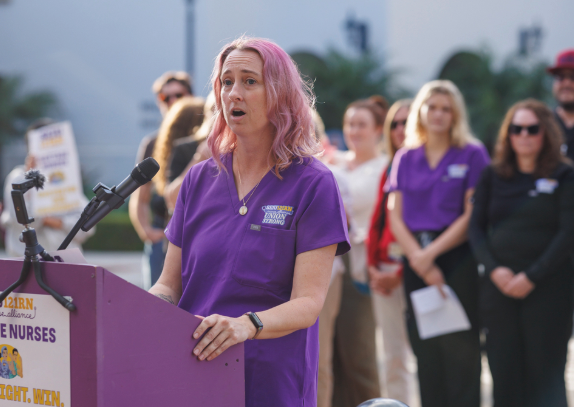
With midterm elections right around the corner, the fight over pay and power at Cottage Health is also headed to the ballot box. On Tuesday, a contingent of registered nurses formally petitioned the National Labor Relations Board (NLRB) for union elections at Cottage’s three hospitals, escalating their campaign for higher wages, stronger staffing, and a greater voice in patient care.
The proposed branch of SEIU Local 121RN would represent roughly 1,300 nurses at Cottage’s Santa Barbara, Goleta, and Rehabilitation hospitals if nurses at all three facilities cast a majority vote in favor. Organizers said they have collected “hundreds” of signed authorization cards from supportive staff (interest from at least 30 percent of employees was needed to petition the NLRB) and expect to hold the secret-ballot elections in the coming weeks.
“We need more staff. We need better compensation. We need some basic transparency,” said Dianna Hosley, an oncology nurse with Cottage since 2014. “And we’ve tried everything we can, but our efforts have fallen on deaf ears, year after year.”
Reyna Estrada Rioux, a surgical nurse, said the time is now to make the changes nurses have long pressed for. “The reality across healthcare is that our patients are aging, with increasingly complicated conditions.… Taking this step helps me feel confident that we’ll be able to fulfill that promise for patients and future nurses.”
Executive compensation has become a particular source of frustration for the nurses, leading the charge to unionize. Cottage’s 2024 tax filing (the most recent available) shows $2.1 million in total compensation for then-president and CEO Ron Werft, including a $550,000 bonus. An $18 million line item in the filing represents “the total value of an insurance plan that was part of [Werft’s] benefits package,” a Cottage spokesperson said.
Hosley and others have questioned why an organization that can compensate its chief executive so generously cannot do more for its bedside staff. Cottage’s mid-level clinical nurses earn an average of $68.62 an hour (which, because they work 36-hour weeks, equates to roughly $125,000 a year before taxes) and receive $100 annual bonuses.
Hosley said a major problem is the lack of clarity around how nurses are paid. When colleagues began comparing hourly wages, she said, “What we found was pretty shocking. There doesn’t seem to be any rhyme or reason to what people make.” Some longtime nurses are paid less than newer hires, she said, and advanced degrees and specialty certifications do not bring higher hourly wages.
Hosley expressed disappointment “that Cottage hasn’t yet decided to respect our wishes to hold an election free from intimidation and misinformation.” She pointed to statements from Cottage that it is “proud” to be one of the few non-union hospital systems in the state. “I’m not sure where that pride comes from,” she said. “It’s a legally protected right. Hospitals and employees always come out ahead when they unionize.”

Cottage leadership, in an interview conducted before the petition announcement, defended its compensation practices and argued that collective bargaining would do more harm than good. They also asserted SEIU’s motivation to represent the nurses was purely financial. “We know that unionization is a business, and their business model is to get dues,” said Chief Human Resources Officer Cara Williams.
Williams said that a board resolution dating back 25 years commits Cottage to competitive wages and benefits. The organization reviews compensation annually and targets the 75th percentile of its Southern California market, including hospitals such as Cedars-Sinai, Hoag, and Huntington. “So, if you compare us to Stanford or UCSF, then yes, we’d be lower because that’s not our market,” she said in reference to data shared by nurses. Executive compensation also targets the 75th percentile, Williams said, using hospitals of similar revenue and complexity.
“It is not lost on us that it is expensive to live in Santa Barbara,” Williams went on, acknowledging that some communities used for wage comparisons may be less expensive. Cottage offers housing assistance and subsidized childcare to help address that difference, she said, with an $11 million childcare expansion expected to break ground early next year.
Chief Nursing Officer Laura Canfield disputed claims of understaffing, citing a 3 percent registered-nurse vacancy rate, compliance with California staffing ratios, and outside labor brought in during spikes in patient load. “I don’t believe it’s accurate that we are understaffed,” she said. “But I don’t want to disparage anyone’s perception that the work is challenging.”
Canfield argued that collective bargaining could reduce Cottage’s flexibility. She pointed to disputed sick leave changes that administrators are revisiting after negative employee feedback. “That’s a nimbleness that we would lose,” she claimed.
Canfield also disputed any impression that all 1,300 nurses support unionization, saying some fear losing their voice and the workplace culture they value. Union representation is “not a panacea for problem solving,” she said, maintaining that Cottage already pays more than some nearby SEIU-represented hospitals.
“I am a supporter of unions,” Denise Sansregret wrote to the Independent. “Of both their legacy and necessity at many institutions. Cottage hospital is not one of those institutions.” Sansregret, a nurse for more than 25 years who has worked in unionized hospitals and spent 11 years at Cottage, said its housing assistance helped her buy a home in Goleta. She supports higher wages, but fears unionization would create an antagonistic relationship with management.
Sarah Gray, a 17-year Cottage employee, urged colleagues to consider the potential trade-offs of collective bargaining. “We currently have valuable benefits at Cottage, along with dedicated employees across many departments, including those who are not licensed clinical staff,” she wrote. “I would hate to see those employees or the benefits we currently enjoy become casualties of negotiations intended to secure higher wages for one group.”
An unsigned letter attributed to emergency department nurses cautioned that a union cannot guarantee particular bargaining outcomes. “We are not suggesting that everything is perfect or that nurses should stop asking for better,” they wrote. “We are asking that we recognize what is working, protect the positive culture we have created, and give collaboration a genuine chance.”
A July report by the consumer advocacy organization Health Access California appears to support the argument from Hosley and others that Cottage has the resources to better compensate its frontline staff. The report shows that in 2024 the Santa Barbara hospital held $1.2 billion in cash and investments and $1.7 billion in net assets. So, when Cottage cries poor, Hosley said, “it feels disingenuous.”

The report also listed approximately 322 days of cash on hand, compared with a statewide average of about 75 days. Commercial insurance payments were equivalent to 305 percent of Medicare rates at Santa Barbara Cottage and 383 percent at Goleta Valley Cottage, compared with a statewide average of 287 percent. Santa Barbara Cottage, it noted, was among seven hospitals designated “high cost” by the state’s Office of Health Care Affordability.
National research also places the nurses’ concerns in a broader context. A 2024 study published in PLOS ONE found that average compensation for nonprofit hospital and health-system CEOs rose about 30 percent between 2012 and 2019 after adjusting for inflation, while registered nurses’ average wages grew just 2.3 percent.
At a Friday press conference, pro-union nurses were joined by Santa Barbara City Council members Oscar Gutierrez and Wendy Santamaria, a former labor organizer, and Kristen Sneddon, a candidate for mayor.
“At some point in everyone’s life, a nurse is the most important person in your life,” Sneddon said. “They are able to lift us up and to carry us through some of our hardest and darkest times. … It’s nurses who are there for us, and it is time for us to be there for nurses.”
Santamaria said wealthy Santa Barbarans should remember they depend on Cottage nurses for their healthcare. “And while somebody else makes that extra dollar, or extra millions of dollars, it’s the nurses that are left with commuting long hours, packing in tighter, and facing rent increase after rent increase that the wages just don’t keep up with,” she said. “We are watching what Cottage Hospital is doing.”
Related Posts








Premier Events
Thu, Oct 29
5:30 PM
Santa Barbara
Silent Movies + Live Organ, Trunk or Treat & More

Wed, Oct 28
5:00 PM
Santa Barbara
Fundraiser for Domestic Violence Solutions

Wed, Oct 28
5:30 PM
Santa Barbara
Coastal Well Woman SB: “Own Your Menopause Journey”

Wed, Oct 28
6:30 PM
Carpinteria
Carpinteria Community Spotlight – El Niño Disaster

Wed, Oct 28
7:00 PM
Santa Barbara
Reel Rock 20 Climbing Film Tour

Wed, Oct 28
7:00 PM
Goleta
IVRPD Presents : Halloween Pumpkin Patch

Thu, Oct 29
12:00 PM
Santa Barbara
Spook Fest at Loubud Wines Halloween Experience
Thu, Oct 29
5:30 PM
Santa Barbara
Silent Movies + Live Organ, Trunk or Treat & More

Thu, Oct 29
6:00 PM
Santa Barbara
Halloween Paint & Sip at Goodland Wine Shop

Fri, Oct 30
12:00 AM
Montecito
Día de los Muertos at The Speakeasy

Fri, Oct 30
11:30 AM
Santa Barbara
🌼💀 Join us for Día de los Muertos! 💀🌼
Thu, Oct 29 5:30 PM
Santa Barbara
Silent Movies + Live Organ, Trunk or Treat & More
Wed, Oct 28 5:00 PM
Santa Barbara
Fundraiser for Domestic Violence Solutions
Wed, Oct 28 5:30 PM
Santa Barbara
Coastal Well Woman SB: “Own Your Menopause Journey”
Wed, Oct 28 6:30 PM
Carpinteria
Carpinteria Community Spotlight – El Niño Disaster
Wed, Oct 28 7:00 PM
Santa Barbara
Reel Rock 20 Climbing Film Tour
Wed, Oct 28 7:00 PM
Goleta
IVRPD Presents : Halloween Pumpkin Patch
Thu, Oct 29 12:00 PM
Santa Barbara
Spook Fest at Loubud Wines Halloween Experience
Thu, Oct 29 5:30 PM
Santa Barbara
Silent Movies + Live Organ, Trunk or Treat & More
Thu, Oct 29 6:00 PM
Santa Barbara
Halloween Paint & Sip at Goodland Wine Shop
Fri, Oct 30 12:00 AM
Montecito
Día de los Muertos at The Speakeasy
Fri, Oct 30 11:30 AM
Santa Barbara


You must be logged in to post a comment.