This article was originally published in UCSB’s ‘The Current‘.
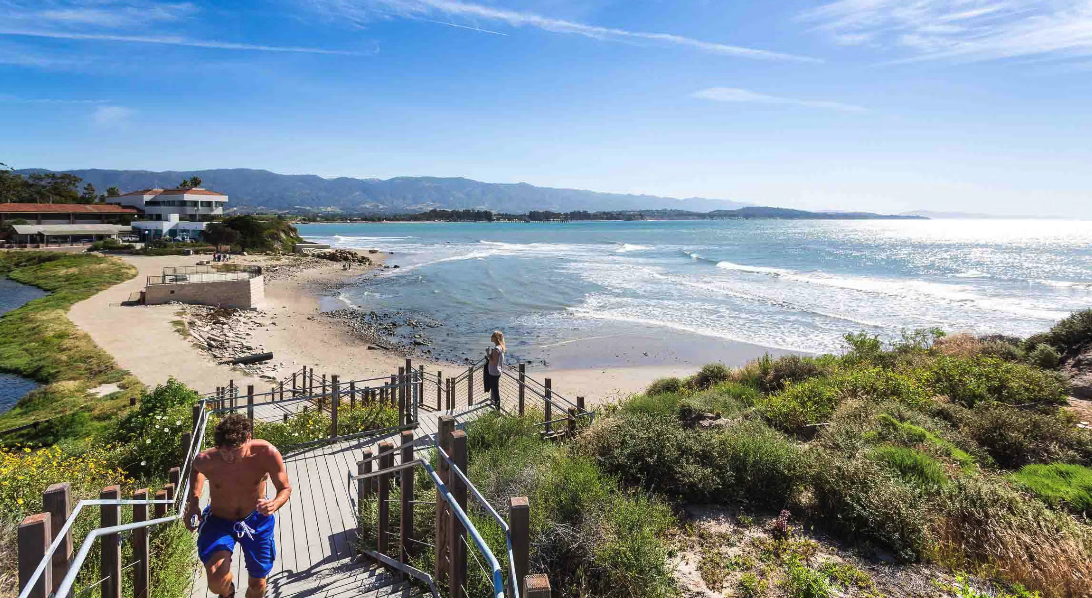
s this season’s El Niño fills forecasts with powerful rain, wind and waves, work crews at UC Santa Barbara are preparing to protect the narrow berm that separates Campus Lagoon from the Pacific Ocean. Depending on wave and tidal conditions, construction of a protective wall of sand-filled barrier bags could begin as early as Monday, November 16.
The university’s concern is that storm-driven erosion of the berm could result in a breach that would cause the lagoon to drain into the ocean. Such a scenario, if significant, could limit public access to a popular beach and Campus Point. More serious, however, would be its threat to a pump system that provides seawater to several buildings and marine laboratories on campus.
“Should the berm breach, the silt that flows out from the lagoon could be sucked into the offshore intake pipes and clog the filtration system, causing seawater outages that would impact education and research,” said Christoph Pierre, director of UCSB’s Marine Operations Facility.
“I echo Christoph’s points on the deleterious impacts of a breach,” added Scott Simon, director of UCSB’s teaching aquarium, The REEF (Research Experience & Education Facility), which relies on the seawater system.
In 2018, UCSB experienced similar impacts to the system from a large plume of silt created by trucked-in soil and debris to nearby Goleta Beach after the Montecito debris flow.
Also, “the berm has been narrowing a lot,” said Josh Rohmer, director of Capital & Physical Planning at UCSB. “In the last 10 years, we’ve lost nearly 10 feet in some spots along the berm.”
Constructed from industrial-sized sand-filled bags, the barrier will be situated seaward of the lagoon berm, where the exposed embankment meets the uppermost section of beach.
With clean sand from a supplier in Grover Beach, the geotextile bags will be filled off site, trucked in and set into place with heavy equipment. Each bag holds one cubic yard of dry sand, weighing approximately 3,000 pounds. The barrier will be approximately 200 feet long and six feet high, located primarily on the south side of the pump station.
Kristi Bascom, the associate director of Campus Planning & Design, noted that the project was in the works for several months and has been vetted through proper channels at the California Coastal Commission.
However, its approval was greenlit in October via an executive order by Governor Gavin Newsom to expedite state of emergency protection measures ahead of potential El Niño events.
Public access to the stairs between the berm and Campus Point will be closed during construction. Access to Campus Point from the west will remain open.
Installed by the military in the 1940s, the berm is composed of compacted concrete slabs, rock, construction debris, sandbags and other fill. The university’s long-term planning for the site is outlined in its Shoreline Adaptation Project, Rohmer said.
“Eventually, we will probably want to transfer to something that’s a bit more natural, but we’re not there yet,” he said. “In the meantime, we just want to make sure it doesn’t breach and have unintended consequences.”