

The Santa Barbara Amateur Radio Club (SBARC) has had a comfortable home at the Vic Trace Reservoir on the Mesa for half a century. But after 72 years, the reservoir is in need of an upgrade, and the club has been asked to leave. An upcoming project will create two five-million-gallon water reservoirs and will use the entire property during construction, including the land that SBARC’s building is on. In January, the Public Works Department informed the radio club that they have until July 30 to vacate.
“We are going to have investigative equipment showing up to do boring, and having to work around [the SBARC facility] adds costs and complications to the projects,” said Joshua Haggmark, the City of Santa Barbara’s Water Resources Manager. “Potentially there is an opportunity to come back, but for the time being, we need them to respect that interest and find a new home,” Haggmark told the council at a City Staff meeting on Tuesday, May 14.
The club was handed an eviction letter January 22 by the Public Works Department. Since the land on Vic Trace is city-owned land, the club was aware that they would need to move if the city needed the property. But with a crunch on time, the club is having difficulty finding a new home.
“If they can’t house us at Vic Trace, we are hopeful they can make accommodations for us and provide some relief in the process of moving that building in the form of permitting and planning,” said Levi Maaia, the radio club’s trustee and member of the board of directors.
One challenge is the specific parameters needed for the station’s central functions. While there have been generous offers from local organizations and individuals, many are at sea level. High elevation, line of sight, and close proximity to Santa Barbara are crucial to the club’s research and emergency response functions, said Maaia.
Maaia, who has been involved in the club since 2008, is hoping for more support from the city during this process. The club feels that it should be included in some part of the plan with the redevelopment.
SBARC is a nonprofit, public-benefit corporation that has provided critical community and emergency services in Santa Barbara for more than 100 years. It was founded in 1920, when a group of technology enthusiasts assembled an antenna on the roof of the YMCA building in Santa Barbara. After over 30 years of operating out of a “garden shed,” as explained by Maaia, the organization raised $100,000 from various organizations and with major funding from the Orfalea Foundation in 2011. The funds were used to create the communication building that now lives on Vic Trace, which is specifically designed and engineered to house communication equipment.
In two of Santa Barbara’s most devastating environmental disasters, the 2017 Thomas Fire and the 2018 debris flow, SBARC provided critical communication for first responders and civilians alike. During the Thomas Fire, SBARC had 150 members, some on the ground and some at the station with line of sight to the fire, who were all prepared to communicate on the status of the fire in real time.
“We know from the feedback we received from first responders on the ground, as well as news media who were monitoring our radio repeater, that we had some of the best information available at the time, as far as live-updated, verified firsthand information from people on the ground,” Maaia said.
Besides emergency response, SBARC participates in a host of community and educational support. Members of SBARC facilitate communications for the Fiesta Parade and road and bike races, as well as offer ship data to Scripps Institute at the University of California, San Diego, to help with whale tracking research. Maaia himself has utilized the club as a high school teacher, creating and launching a high-altitude balloon probe that took photographs and monitored weather data with his students in 2011.
“We’ve been quietly in the background supporting the community,” said Maaia.

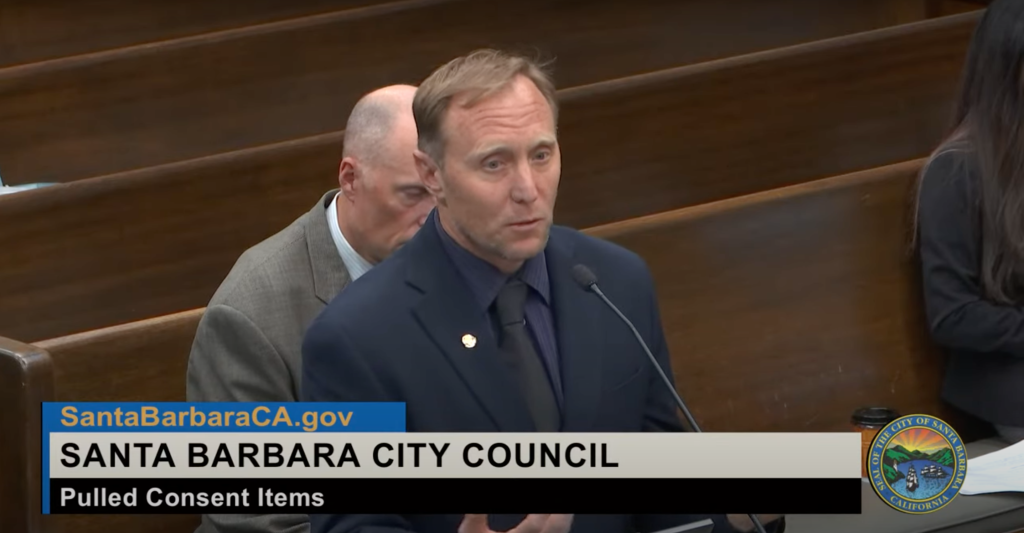
At the City Council meeting on Tuesday, Warren Myers, a technician with SBARC, reiterated that the club would, first, appreciate a way to stay on the property and, second, be granted an extension and assistance in finding a new location.
Councilmember Mike Jordan expressed willingness to help the club brainstorm solutions and stressed the importance of the club to the community. “They’re in line with second responders. When the zombies start coming and regular communications go down,” Jordan joked, “this is one backup system.”
Councilmember Jordan suggested the former Frontier Building on Chapala Street, and the club is in early stages of exploring that option. But it would not be a viable replacement for the Vic Trace site, Maaia said.
At a meeting with city officials on Thursday, May 16, Levi Maaia said that city members and individuals are trying to help, but there simply is not a city-owned location that is viable. Temporary solutions include utilizing alternative stations and locating something on a streetlight like cell providers do, said Maaia.
He still has hope that they can find a way to work with the water department to preserve the property on Vic Trace or at the very least go back when the project is complete.
In the meantime, SBARC asks their community to let their local councilmembers know why it’s important to them that they support their efforts and relocation.
“We’re hobbyists with a purpose,” Maaia said. “We like to use the technology, figure out how things work, and find a way to make it matter when all else fails.”
Related Posts



Premier Events

Tue, Aug 25
5:00 PM
SANTA BARBARA
Library Services Orientation for Teens

Tue, Aug 25
6:00 PM
Santa Barbara
Chaucer’s Book Talk and Signing: Talk Jeffrey Hoelle

Wed, Aug 26
6:00 PM
Santa Barbara
Death over Drafts at the Brass Bear Uptown

Wed, Aug 26
6:30 PM
Goleta
Get Home Safe Seminar/Parking Lots & Garage Safety
Thu, Aug 27
5:00 PM
Santa Barbara
Alzheimer’s Association Town Hall

Fri, Aug 28
3:00 PM
SANTA BARBARA
Family Movie Night at the Eastside Library: “Lilo & Stitch”
Fri, Aug 28
7:00 PM
Buellton
Speaker Series -James Bier, Director of the Chumash

Sat, Aug 29
10:00 AM
Santa Barbara
Wag, Play & Title Day

Sat, Aug 29
11:00 AM
Santa Barbara
🎉 INDY40 Fest 🎉

Sat, Aug 29
2:00 PM
Los Olivos
Reggae In The Vines
Tue, Aug 25 5:00 PM
SANTA BARBARA
Library Services Orientation for Teens
Tue, Aug 25 6:00 PM
Santa Barbara
Chaucer’s Book Talk and Signing: Talk Jeffrey Hoelle
Wed, Aug 26 6:00 PM
Santa Barbara
Death over Drafts at the Brass Bear Uptown
Wed, Aug 26 6:30 PM
Goleta
Get Home Safe Seminar/Parking Lots & Garage Safety
Thu, Aug 27 5:00 PM
Santa Barbara
Alzheimer’s Association Town Hall
Fri, Aug 28 3:00 PM
SANTA BARBARA
Family Movie Night at the Eastside Library: “Lilo & Stitch”
Fri, Aug 28 7:00 PM
Buellton
Speaker Series -James Bier, Director of the Chumash
Sat, Aug 29 10:00 AM
Santa Barbara
Wag, Play & Title Day
Sat, Aug 29 11:00 AM
Santa Barbara
🎉 INDY40 Fest 🎉
Sat, Aug 29 2:00 PM
Los Olivos


You must be logged in to post a comment.