
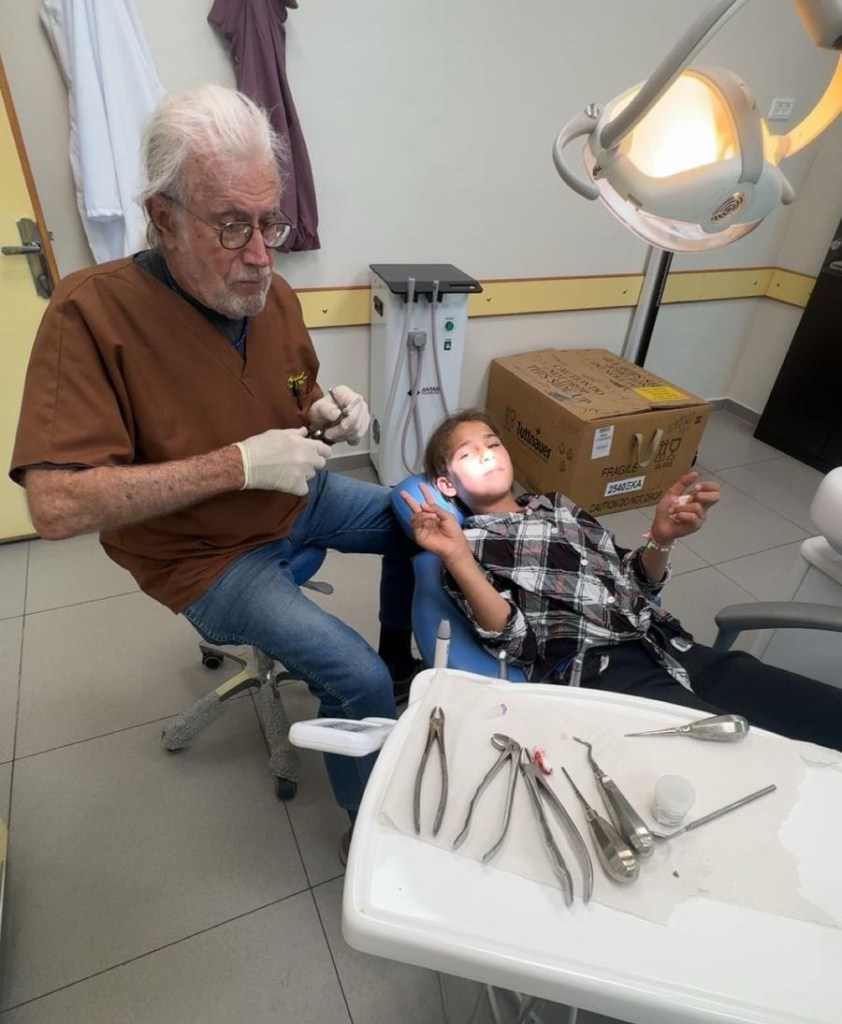
James Rolfe, an 85-year-old dentist, just returned home from Palestine. On the West Bank, he made do with half his usual tools on teeth in much worse condition than he might see at his 24-hour practice in Santa Barbara.
It’s not the first time he’s gone on such a mission — in the past, he’s used his clinic’s profits to treat dental ailments and train new clinicians in war-torn Afghanistan — but this was no less jarring.
Before he left for the Middle East last month, Rolfe said he was curious about the conditions there, having followed the increasingly hostile Israel–Palestine conflict in the news.
“I wanted to go over there because I knew that it was really a big problem,” he said in an interview with the Independent on Wednesday, two weeks after his return. “I just feel like this whole thing is wrong, and the more wrong it felt, the more I had to go there and see what was going on.”
The reality was far worse than he’d imagined.
On the exterior wall of one of the four hospitals Rolfe worked in, a bold-faced message stood out amid the general graffiti and depictions of war: “We can’t live,” it read, “so we are waiting for death.”
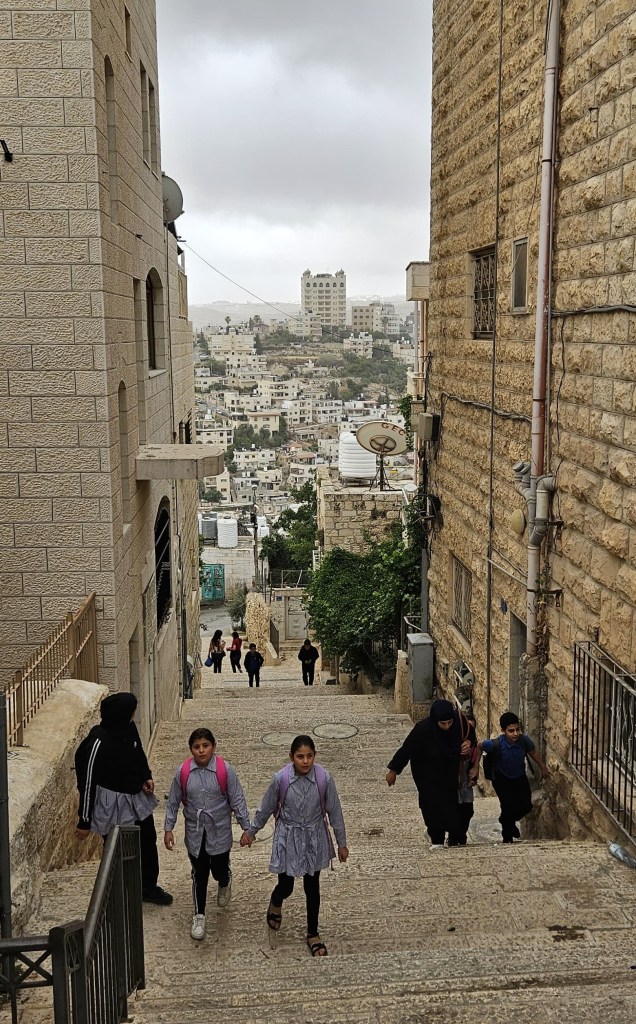
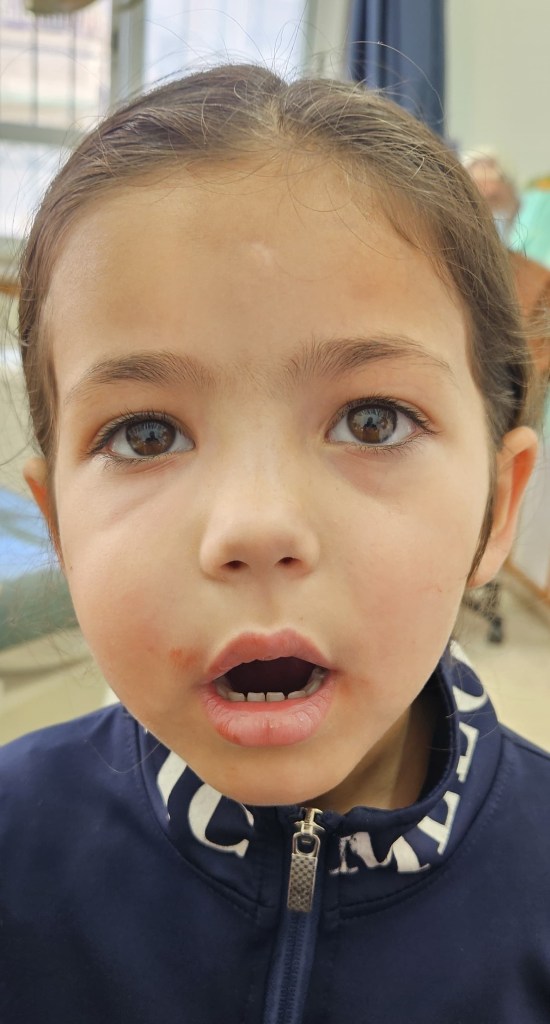
In line with that saying, Rolfe described his patients as depressed and devoid of hope. Their mouths, he said, were “really gross; one after another.” He called each person he saw “a walking disaster,” with multiple serious problems, such as broken teeth, abscesses, and swollen faces. Many had given up on taking care of themselves, he noted. He assigned them no blame, but admitted it made his job difficult.
But what can you expect from a country under an iron grip? To get into the West Bank, Rolfe had to tell the Israel Defense Forces (IDF) he was visiting Jesus’s birthplace. That, of course, was a lie. If he had told the truth, he would not have been allowed in.
He packed four suitcases full of medical supplies to bring into Palestine. But he was told by his partners at the United Nations to leave it at home — it would blow his cover. International efforts to deliver aid to Palestine have been repeatedly blocked. Any supplies Rolfe brought in had to be smuggled.
“You can’t take anything into Palestine that is going to help the people there,” he said.
While in Palestine, he said he worked in hospitals with only one dental chair. He hopped from hospital to hospital to treat patients. Although they have dentists, he said, the prices are high, and their supplies are limited.
“When we were doing a filling on one of the patients, we had to wrap a band around the tooth and hold it with our fingers while we put the filling in,” he explained. “It was just terrible.”

Palestine is in the midst of a humanitarian crisis, with recent reports indicating that more than 5,300 Palestinians have been killed and nearly 18,000 injured since March alone. Israeli airstrikes and ground operations continue to pound Gaza, already reduced to rubble. Survivors are being denied food, basic aid, and medical care. More than 66,0000 children in Gaza are suffering from severe malnutrition, according to the World Food Programme and UNICEF.
Rolfe noted that Israeli Prime Minister Benjamin Netanyahu still has a warrant out for his arrest by the International Criminal Court for numerous alleged war crimes, coupled with accusations of genocide by the International Court of Justice. Since the October 7, 2023, attack by Hamas killed 1,200 Israelis, Israel has, in turn, killed more than 60,000 Palestinians.
“But the United States, of course, is a partner of Israel, and a lot of the weapons that are going to Israel are coming from the United States,” Rolfe said. “So this makes the United States really complicit in all the horror that’s going on there.”
Despite the horror, Rolfe described the people on the West Bank as the “nicest people in the world.” He said he never was in disagreement with anybody.
“I wanted to get one of those scarves that they wear on their heads,” he recalled. “I was trying to find a store to buy one of those. I couldn’t find one. So I walked up to this older Palestinian guy. And I said, ‘Hey, where can I buy one of those?’ And he just took his off and gave it to me.”
The West Bank is different from Gaza, though, he said. Businesses and schools are open, and people have stayed in their homes. But the West Bank also has many Israeli settlements. “They just keep expanding into Palestine and taking the land,” Rolfe said. “And they’re really aggressive.”
Now that he’s back in Santa Barbara, he can’t wait to leave again. For some reason, he explained, he doesn’t get scared. He’s not afraid to go back. He mentioned the recent, dubious talks of a 60-day ceasefire announced by U.S. President Donald Trump on Tuesday.
“I’ve volunteered to go back into Gaza, and I think a ceasefire might be my opportunity. I’ve been talking to the different heads of the hospitals in Gaza and trying to find a way that I could get in through Egypt, into Gaza and build a dental clinic there for people, because all these millions of people there don’t have any access to them here, and it’s like Afghanistan.”
He continued, “I’m ready to work. If I have to lay people on the ground, you know, on a rug or something like that, and kneel over them, I can do the treatment that I need to do. I might just go, stick out my thumb, and hope a truck driver might take me across the border.”

No matter what he’s doing, what Rolfe truly believes in is helping people. He even “scavenges” for food at home or grows his own, which he said “allows me to not be a burden on the Earth and to use what I would normally spend on food to do humanitarian work.” He brought the Independent some of that food on Thursday — a full blueberry pie, a package of cookies, unopened drinks, almonds, and other snacks.
“It feels good to not think about yourself,” he said. “If you’re doing things to help other people, other people will help you.”
Related Posts

Premier Events
Sun, Oct 25
11:00 AM
Santa Barbara
Free Family Day: Día de los Muertos

Sun, Oct 25
12:00 PM
Fields of Funk

Sun, Oct 25
2:00 PM
Santa Barbara
Halloween Pooch Parade
Sun, Oct 25
3:30 PM
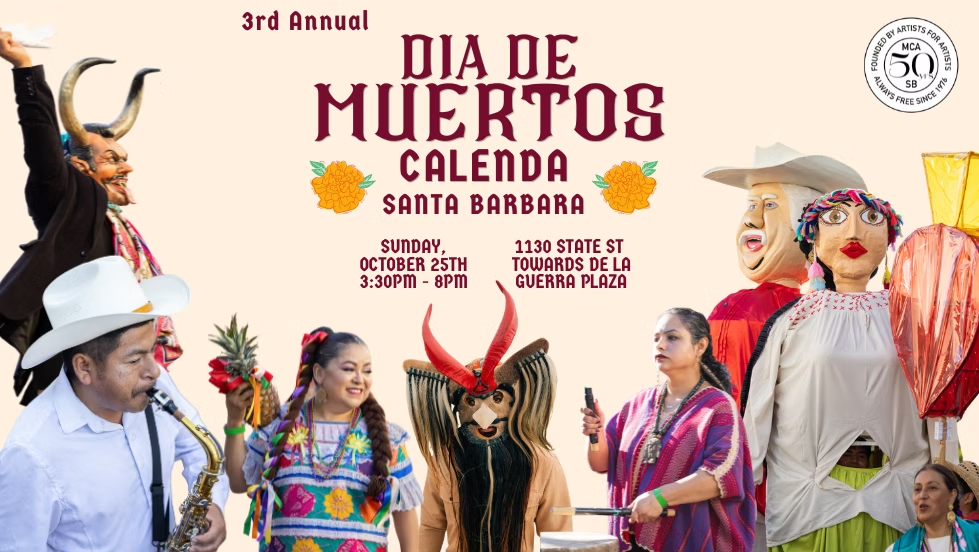
Dia de Muertos Calenda 2026

Sun, Oct 25
4:00 PM
Santa Barbara
S.B Revels Annual S.B Harbor Sing

Sun, Oct 25
7:30 PM
Santa Barbara
Comedy is a Drag Halloween Spooktacular

Mon, Oct 26
5:00 PM
Montecito
Halloween at The Speakeasy at San Ysidro Ranch

Mon, Oct 26
6:00 PM
Santa Barbara
Chaucer’s Book Talk & Signing with Jennifer Chassman Browne “See Us, Know Us: Profiles of Disability”

Wed, Oct 28
5:00 PM
Santa Barbara
Fundraiser for Domestic Violence Solutions

Wed, Oct 28
7:00 PM
Santa Barbara
Reel Rock 20 Climbing Film Tour
Sun, Oct 25 11:00 AM
Santa Barbara
Free Family Day: Día de los Muertos
Sun, Oct 25 12:00 PM
Fields of Funk
Sun, Oct 25 2:00 PM
Santa Barbara
Halloween Pooch Parade
Sun, Oct 25 3:30 PM
Dia de Muertos Calenda 2026
Sun, Oct 25 4:00 PM
Santa Barbara
S.B Revels Annual S.B Harbor Sing
Sun, Oct 25 7:30 PM
Santa Barbara
Comedy is a Drag Halloween Spooktacular
Mon, Oct 26 5:00 PM
Montecito
Halloween at The Speakeasy at San Ysidro Ranch
Mon, Oct 26 6:00 PM
Santa Barbara
Chaucer’s Book Talk & Signing with Jennifer Chassman Browne “See Us, Know Us: Profiles of Disability”
Wed, Oct 28 5:00 PM
Santa Barbara
Fundraiser for Domestic Violence Solutions
Wed, Oct 28 7:00 PM
Santa Barbara


You must be logged in to post a comment.