This article was underwritten in part by the Mickey Flacks Journalism Fund for Social Justice, a proud, innovative supporter of local news. To make a contribution go to sbcan.org/journalism_fund.
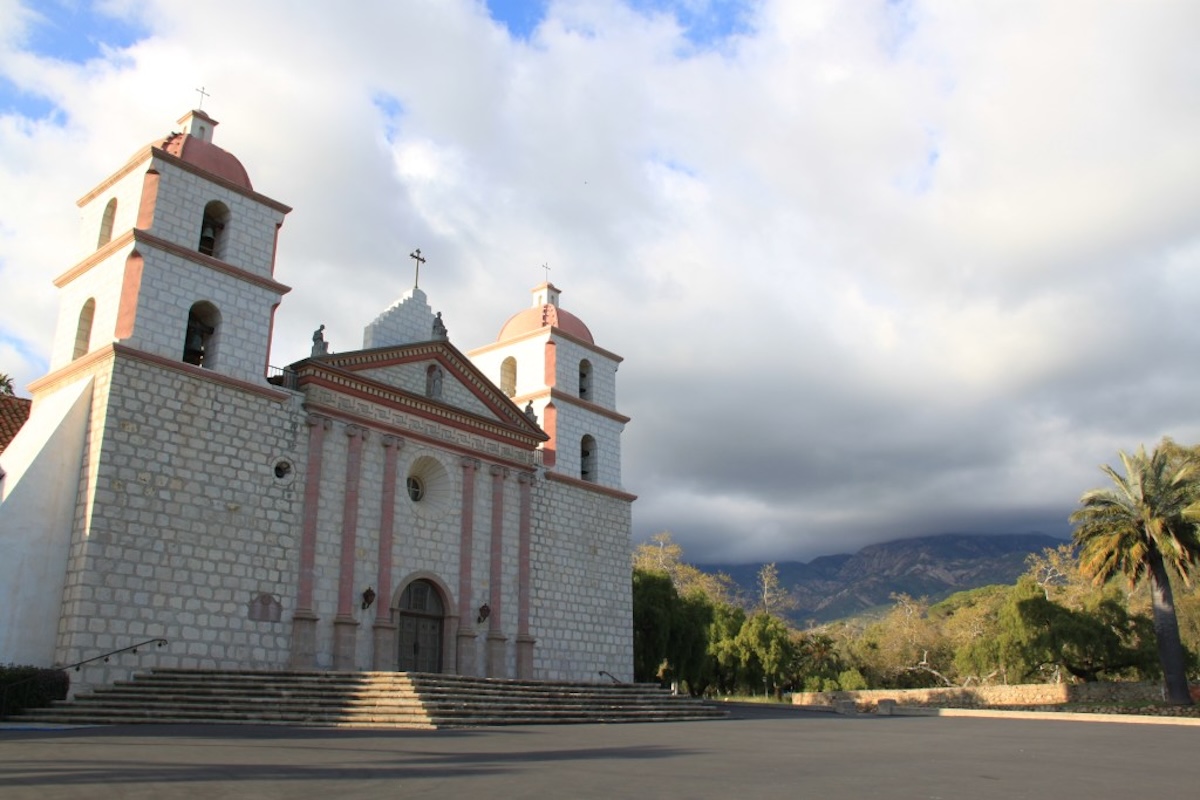
The proposed eight-story building behind the Santa Barbara Mission will undergo environmental review under a new state law that Governor Gavin Newsom signed on Saturday.
Senate Bill 158, a trailer bill, acts as “cleanup” to legislation passed earlier this year, according to Senator Scott Weiner of San Francisco and Representative Jesse Gabriel of the San Fernando Valley, who brought it to the State Senate and House floor, respectively.
In June, lawmakers passed Assembly Bill 130, a separate trailer bill that made sweeping changes to the California Environmental Quality Act, or CEQA. Those changes included expanding CEQA exemptions to cover many projects with affordable housing in urban infill areas, among other exemptions. At the time, the proposed eight-story project at 505 East Los Olivos Street fit some of the parameters for the exemption.
Still, that exemption was not guaranteed. The City of Santa Barbara sent a letter to its developers in July that said because it was inconsistent with the city’s general plan and zoning regulations and because it did not meet all the environmental criteria in state legislation, it was not exempt.
SB 158 narrowed the scope of the CEQA exemptions and set specific parameters that “de-exempt” the project behind the Mission. The parameters, which include specifying projects four acres and larger filed under builder’s remedy in cities of a specific size within counties of a specific size, on land with wetland and floodways and situated near historic landmarks, seemed to only apply to this project. (Builder’s remedy is the provision in California law that allows a developer to bypass building restrictions when a city’s housing element hasn’t been state certified.)
At that time, the project’s development team, which goes by the name The Mission LLC, said in a statement that the bill showed a “few wealthy NIMBYs” (NIMBY stands for “Not in My Backyard”) exerting control on public policy to stop low income housing.
“Thankfully, we are confident that the courts will find it to be illegal as California prohibits legislation attacking a single project,” the statement said, suggesting possible legal action.
The Mission LLC did not respond to a request for comment on the governor’s signing of SB 158 in time for this story. The team has a history of lawsuits. It has sued the City of Santa Barbara twice over alleged violation of builder’s remedy, and the County of Santa Barbara once over property taxes, namely claiming that because they rent to a church, they should not have to pay them. Craig and Stephanie Smith are CEO and CFO of the church in question, the Unitarian Universalist Mission. The Smiths are connected to Los Olivos through the Mission LLC’s project manager, Ben Eilenberg. All told, the Mission LLC owes more than $290,000 in property taxes.
Around that time, Senator Monique Limón, who represents Santa Barbara County along with parts of San Luis Obispo and Ventura counties, said she provided feedback on several aspects of AB 131 — including tribal consultant, habitat definition for protected species, advanced manufacturing, and local impact. Senator Limón did not provide further comment for this story.
SB 158 does more than require environmental analysis for the Mission LLC’s project. It provides funding for the Homeless Housing Assistance and Prevention and assigns $2.1 million to the Office and Land Use and Climate Innovation for mapping urban infill areas as specified under SB 131, among other changes.