

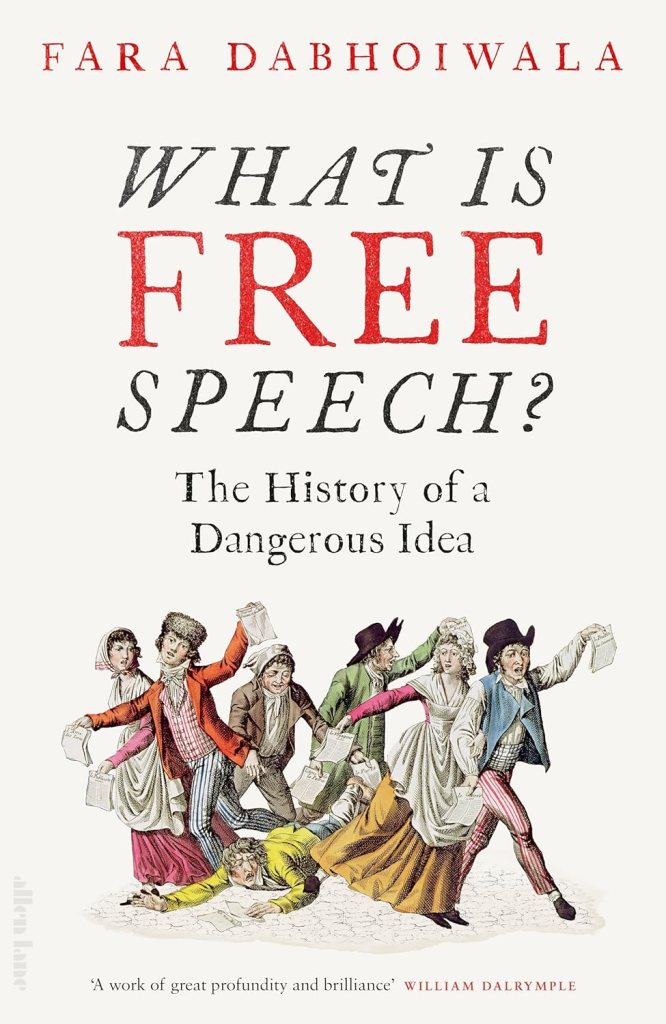
I confess to not having given much thought to the historical origins of free speech before reading Fara Dabhoiwala’s marvelous history, What Is Free Speech? As an American, the right to freedom of speech is something I’ve taken as a given, bestowed by the founders of our constitutional republic. In my heretofore blinkered and naive view, our constitutionally protected right of free speech and expression contributed to what has made America a unique experiment in self-government. Perhaps, but until now, I didn’t fully grasp the implications of the First Amendment or have much to compare or contrast it with. How did our conception of free speech come to be, and what were its intellectual foundations? This is a subject we ought to care about in an age of rampant misinformation and media self-censorship. Are we really free to say what we want, when we want, to whomever we want?
In some respects, we’ve come a long way. An English law of 1275 declared it a crime to tell or publish false tales that might create discord between the King and his subjects. Penalties included imprisonment or worse. All pre-modern governments went to extraordinary lengths to restrict and control political information and opinion. Free speech, as Dabhoiwala observes, is itself a contrived and invented concept, and it flows more easily in certain directions than others; it also tends to aggregate around power. Here’s an observation that lies at the heart of Dabhoiwala’s analysis:
“Who can speak, who gets heard, and who makes the rules about what one can say is always about power and authority, as much as about judgements of harm and danger.”
In the early decades of the 18th century, a pair of London journalists, Thomas Gordon and John Trenchard, published a series of articles that became known as Cato’s Letters. The importance of these Letters, according to Dabhoiwala, is that they advance novel arguments about free speech, casting it as a secular ideal and popular political right. Gordon and Trenchard are somewhat obscure figures in the history of free speech, but Dabhoiwala shows how their association with populist national politics organized around the first-ever enduring political parties made them influential and controversial. Frequently reprinted, the Letters experienced a long afterlife, influencing American debates about press freedom.
Thomas Jefferson was concerned about the absolutist approach adopted by his fellow framers of the American constitution. Jefferson favored a balanced approach that limited speech that might jeopardize national security or injure people. Balancing public interests may have been more to Jefferson’s liking, but his view didn’t prevail. “Among America’s earliest constitution-makers,” writes Dabhoiwala, “Jefferson was essentially alone in favouring a balanced articulation of the liberty of the press.”
As ideas of free speech evolved and print became a reliable and dominant means for broad dissemination of ideas and information, liberty of the press became a catchphrase politicians tossed about when out of power, but sought to trample when in power. High-minded debates about press freedom masked messier realities in the early days of newspapers, such as cutthroat competition for readers, incessant political lying, and the spreading of propaganda and misinformation, ills that remain with us to the present day. It’s worth remembering that in the early years of our republic — and despite First Amendment platitudes — criticism of slavery was considered an unacceptable form of speech, as many abolitionist publishers in the north discovered when their offices were attacked and their printing presses destroyed.
Dabhoiwala devotes two chapters to an examination of notions about free speech that pertained to Europe and its colonies. One question of the time was the shape press liberty would take in colonial contexts, with their racialized gradations of citizenship, freedom, and power. Try as they might, colonial powers couldn’t completely confine free speech to ruling-class voices. “Women, servants, foreigners, the religiously heterodox, the darker skinned and the enslaved — inferior people of all kinds — constantly asserted and appropriated the right to speak, to listen, and to be heard.” In British-ruled India, debates over press freedom raged for decades. How much liberty should colonial subjects be allowed? Was it permissible for them to criticize the government in general and individual ministers in particular?
Where does the truth fit into this story? Does the right to free speech enhance and protect the truth and serve the public good? Dabhoiwala asserts that the incentives of private media ownership are never aligned with the public good. Who gets heard, and who makes the rules governing what can be said, has always been more about power than truth, fairness, or rational civic debate. This seems self-evident in the age of global social media platforms that employ algorithms to promote some forms of speech and stifle others. What makes speech free is a question for which there is no single answer. As this remarkable study points out, fake news, lies, and slander aren’t new. The marketplace of ideas is old and has always been mercenary and partisan. If there’s one truism, it is that people everywhere are always trying to restrict the expression of unwelcome ideas. When it comes to free speech, we must always ask: Whose freedom are we talking about?
This review originally appeared in the California Review of Books.







You must be logged in to post a comment.