
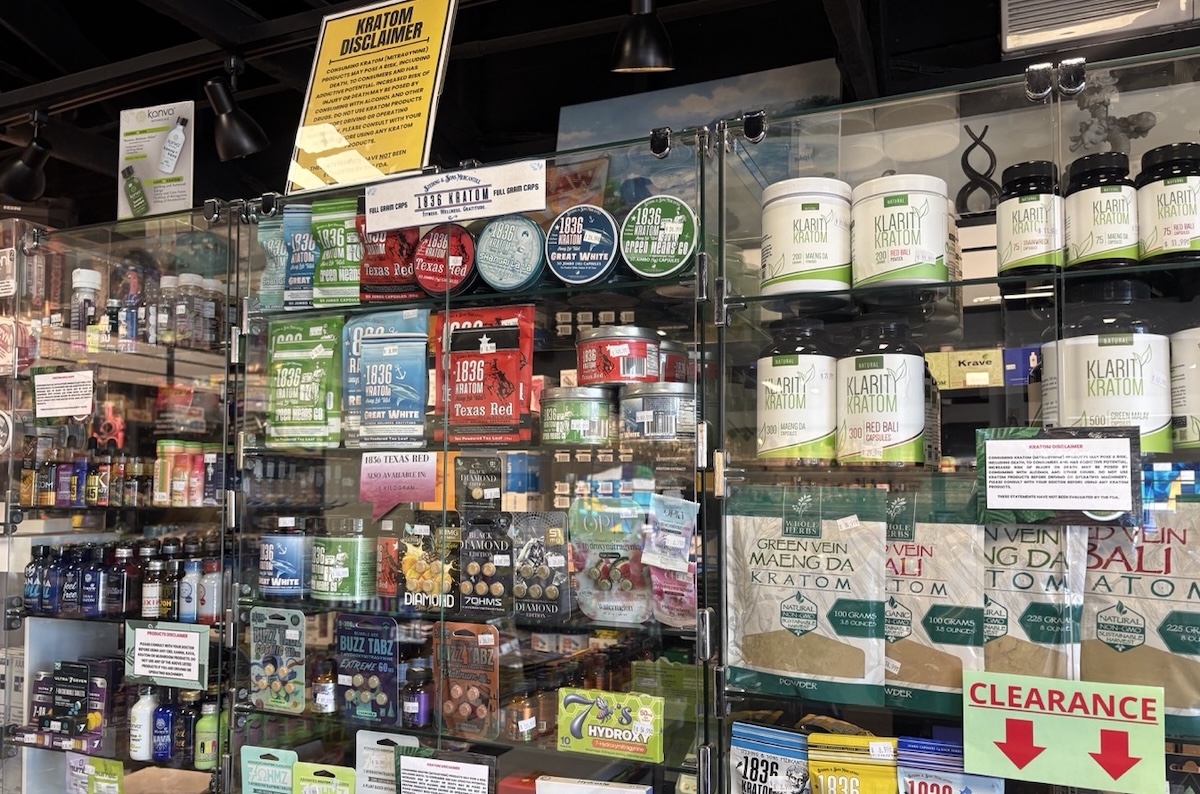
Santa Barbara County health officials have issued a warning to residents to avoid kratom products after confirming two overdose deaths in 2025, and five in the past three years, involving the supplement. Authorities say kratom and a potent compound known as 7-hydroxymitragynine carry serious health risks — including addiction, respiratory depression, and overdose — and are not legally approved for sale as food, dietary supplements, or drugs in California, despite continuing to appear in local retail shops.
“Kratom is packaged and marketed as a harmless natural supplement,” said Santa Barbara County Health Officer Dr. Henning Ansorg, warning that kratom carries a significant risk of dependency and overdose — particularly when consumed in concentrated forms or combined with alcohol or other drugs. He added that dosing in commercially available products is often inconsistent or poorly labeled, making it difficult for consumers to know how much they are ingesting. Toxicity, he said, is dose-dependent.
Health officials also caution that pregnant women who use kratom risk causing severe withdrawal symptoms in newborns. The U.S. Food and Drug Administration does not approve kratom products for consumption.
Origins and Traditional Use
Kratom comes from Mitragyna speciosa, a tropical tree native to countries in Southeast Asia, including Thailand, Malaysia, Indonesia, and Myanmar. For centuries, laborers in those regions traditionally chewed fresh leaves or brewed them into tea to combat fatigue, increase stamina, and relieve minor pain. In some communities, kratom has also been used as a folk remedy for diarrhea or as a substitute for opioids to ease withdrawal symptoms.
Unlike the highly concentrated extracts sold in the United States, traditional use typically involved whole leaves at relatively low doses, producing mild stimulant effects at lower doses and sedative or pain-relieving effects at higher doses.
Natural Kratom vs. Synthetic 7-OH
Kratom is rarely consumed as a raw leaf in the U.S. Instead, it is processed into powders, capsules, gummies, beverages, and concentrated extracts marketed for pain, anxiety, depression, fatigue, or opioid withdrawal. Officials say their branding — often emphasizing natural or herbal qualities — can obscure the risks. “Natural” does not mean safe, they say, particularly when products contain high concentrations of opioid-like compounds.
Public health researchers say kratom use has grown in the United States over the past decade amid the opioid crisis, as some individuals seek alternatives for pain relief or attempt to manage withdrawal symptoms without medical supervision.
Of particular concern to health officials is 7-hydroxymitragynine, often referred to as 7-OH. The compound occurs naturally in small amounts in kratom leaves but is sometimes concentrated or isolated to increase potency. According to the National Institutes of Health, 7-OH is approximately 13 times more potent than morphine and 46 times more potent than mitragynine, which is the chief psychoactive substance in the plant leaf.
Experts say this opioid-like activity increases the risk of tolerance, dependence, respiratory depression, and overdose.
Availability and Pricing
Despite regulatory restrictions, kratom products remain widely available in smoke shops, vape shops, gas stations, and online marketplaces. They are sometimes labeled “not for human consumption” or sold in a regulatory gray area, even when packaging and marketing suggest therapeutic benefits.
Prices vary by form and potency. A single 12-ounce canned kratom drink typically sells for about $8, while a 90-capsule package may cost around $26. Officials say the relatively low price point may increase accessibility for students and young adults.
In an Isla Vista smoke shop, kratom products were displayed alongside vape supplies, including flavored beverages and high-potency formulations. An employee described 7-hydroxymitragynine as a concentrated alkaloid extracted from kratom, calling it “really, really strong,” and acknowledging that it acts on opioid receptors in the brain.
The employee advised inexperienced users to start with lower doses and downplayed overdose risks, suggesting fatalities typically involve other substances such as alcohol. Public health officials, however, warn that concentrated kratom products — especially those containing isolated or enhanced 7-OH — can carry serious risks, particularly when combined with other depressants.
Behavioral health officials say dependency is an increasing concern. Withdrawal symptoms can mirror those associated with opioids and may include nausea, constipation, sweating, nervousness, vomiting, and, in severe cases, respiratory depression.
“Individuals have reported using kratom thinking it was a healthier alternative to alcohol,” said Suzanne Grimmesey, public information officer and chief of strategy and community engagement for the county’s Department of Behavioral Wellness. “Kratom becomes more dangerous — and carries a higher risk for overdose — when mixed with other substances,” she said.
Nationwide toxicology data indicate that more than 2,000 overdose deaths since 2021 have involved kratom, though the majority also involved other substances. Fatalities attributed solely to kratom are considered uncommon but have been documented, particularly in cases involving high-potency products.
In the five deaths involving kratom in Santa Barbara County during the past three years, in most cases, multiple substances such as alcohol, fentanyl, and prescription opioids were found in toxicology results.
Identifying Toxicity in the Emergency Room
Emergency departments regularly treat patients experiencing toxicity linked to kratom and 7-hydroxymitragynine, according to Ansorg. Clinicians often rely on patient history and clinical presentation when assessing suspected toxicity, the National Institute on Drug Abuse reported, as kratom alkaloids are not detected on most routine hospital drug screens and require specialized laboratory testing for confirmation.
A person with a suspected kratom overdose may show symptoms such as slowed breathing, decreased consciousness, nausea, vomiting, or constricted pupils. Because kratom acts on opioid receptors, naloxone, or Narcan, may be administered in cases involving respiratory depression, though response can vary.
Regulation and Enforcement in Southern California
There is no single statewide ban on kratom in California. However, the California Department of Public Health has determined that kratom-containing products cannot legally be sold as food, dietary supplements, or drugs. Enforcement has been uneven.
In November, the Los Angeles County Department of Public Health issued an order prohibiting the sale of kratom and 7-OH products and directed retailers to remove them from store shelves. Businesses that failed to comply faced penalties, including fines and destruction of inventory.
Orange County, as well as the cities of Newport Beach, San Diego, and Oceanside, enacted similar prohibitions on the sale or distribution of kratom products.
In Santa Barbara County, the Sheriff’s Office said it currently has no active investigations into kratom sales and relies primarily on community complaints to initiate enforcement.
Health officials urge residents to avoid consuming kratom or 7-OH products and to carefully review product labels to prevent accidental use. They also recommend carrying naloxone, a medication that can reverse opioid overdoses, and know how to respond in an overdose emergency.
“We encourage anyone who notices kratom products for sale to contact the Sheriff’s Office, either through our dispatch center, the anonymous tip line, or by email,” said Raquel Zick, public information officer for the Santa Barbara County Sheriff’s Office.
As officials emphasize, the growing availability of concentrated kratom products highlights a broader public health message: Products labeled “natural” can still carry significant — and sometimes fatal — risks.
Correction: The number of deaths involving kratom use in Santa Barbara County in the past three years is five, not 10 as originally reported.
Related Posts








Premier Events

Sat, Oct 10
9:00 AM
Santa Barbara
Treble Clef Chorus Fall Treasure Sale

Sun, Oct 11
5:00 PM
Santa Barbara
Trinity Choir: Choral Evensong

Thu, Oct 08
7:00 PM
Santa Barbara
“A Night of Blues” with Morganfield Burnett

Fri, Oct 09
7:00 PM
Santa Barbara
Paseo Nuevo Spooky Movie Nights
Sat, Oct 10
9:00 AM
Santa Barbara
SBNC 1st Annual Health & Wellness Fair

Sat, Oct 10
1:30 PM
Goleta
🌴 Another Day in Paradise at S.B’s Premier Ice Rink

Sun, Oct 11
7:00 AM
Ojai
Flamenco Guitarist Tony Ybarra

Sun, Oct 11
10:00 AM
Santa Barbara
18th Annual Domestic Violence Solutions Brunch
Sun, Oct 11
10:00 AM
Santa Barbara
Free Community Day at S.B. Botanic Garden

Sun, Oct 11
10:00 AM
Santa Barbara
Downtown Classic Car Show Santa Barbara

Sun, Oct 11
11:00 AM
Santa Barbara
Raíces y Sueños: Bilingual Storytime at Santa Barbara Museum of Art

Sun, Oct 11
2:00 PM
Santa Barbara
The Theatre Group at SBCC Presents: “CLUE”
Sat, Oct 10 9:00 AM
Santa Barbara
Treble Clef Chorus Fall Treasure Sale
Sun, Oct 11 5:00 PM
Santa Barbara
Trinity Choir: Choral Evensong
Thu, Oct 08 7:00 PM
Santa Barbara
“A Night of Blues” with Morganfield Burnett
Fri, Oct 09 7:00 PM
Santa Barbara
Paseo Nuevo Spooky Movie Nights
Sat, Oct 10 9:00 AM
Santa Barbara
SBNC 1st Annual Health & Wellness Fair
Sat, Oct 10 1:30 PM
Goleta
🌴 Another Day in Paradise at S.B’s Premier Ice Rink
Sun, Oct 11 7:00 AM
Ojai
Flamenco Guitarist Tony Ybarra
Sun, Oct 11 10:00 AM
Santa Barbara
18th Annual Domestic Violence Solutions Brunch
Sun, Oct 11 10:00 AM
Santa Barbara
Free Community Day at S.B. Botanic Garden
Sun, Oct 11 10:00 AM
Santa Barbara
Downtown Classic Car Show Santa Barbara
Sun, Oct 11 11:00 AM
Santa Barbara
Raíces y Sueños: Bilingual Storytime at Santa Barbara Museum of Art
Sun, Oct 11 2:00 PM
Santa Barbara

