Nearly 20 years ago, Santa Barbara astrophysicist Dr. Andy Howell was part of a team that discovered what’s called “superluminous supernovae,” the hyper-bright explosions of large dying stars. “At first, we didn’t know what they were,” Howell said. Regular supernovae were already among the brightest phenomena in the universe ― releasing as much energy in weeks or months as our sun will in its 10-billion-year lifetime ― but these eruptions were far more dazzling, by many orders of magnitude.
To help explain the mysterious and rare event ― only 100 or so have been observed since ― researchers developed the “magnetar model.” The theory went that a star’s violently collapsing core would sometimes create a magnetar, a rapidly spinning neutron star with a powerful magnetic field. (A neutron star is half a step away from a black hole, incredibly dense objects that cram the mass of the sun into a ball 10 miles wide.) As the magnetar spins, scientists thought, it acts like a battery and pumps energy into the expanding supernovae, increasing their intensity.
While the model could account for the astounding energies needed for superluminosity, Howell said, it could not explain the strange periodic bumps in brightness that researchers also observed. Most supernovae fade in a predictably smooth arc, but these explosions were displaying undulations ― or “chirps” ― of light that pointed to hidden physics taking place within the celestial bombs.
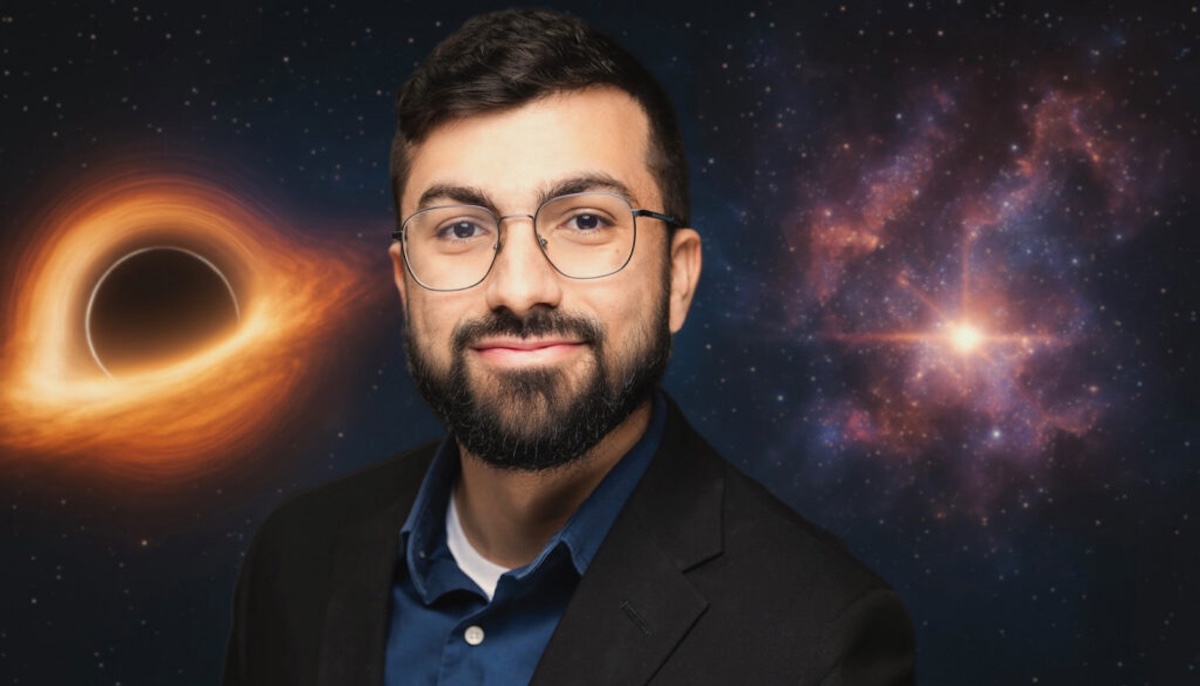
Now, it appears that Howell’s protégé Joseph Farah, a fifth-year graduate student at UC Santa Barbara and Goleta’s Las Cumbres Observatory (LCO), has helped crack the code to not only confirm the magnetar model but also explain the chirps. A paper by Farah and international researchers featured on the March 12 cover of Nature magazine and is being hailed as a breakthrough in the field.
“I think Joseph has found the smoking gun, and he’s tied the bumps into the magnetar model, and explained everything with the best-tested theory in astrophysics ― General Relativity,” said Howell. “It is incredibly elegant.”
For 200 continuous days in 2024 ― made possible by LCO’s global network of 27 telescopes ― Farah and his colleagues tracked a superluminous supernova located roughly a billion light-years away. They determined that some of the matter ejected during the star’s explosion fell back toward the magnetar and formed a platter of material called an “accretion disk.”
Because the magnetar was so dense and spinning so rapidly, it twisted spacetime around itself and caused the disk to wobble like a spinning top. As it wobbled ― or “precessed” ― the disk periodically blocked and reflected light from the magnetar, turning the whole system into a sort of strobing cosmic lighthouse.
LCO Director Dr. Lisa Storrie-Lombardi said the significance of the findings cannot be overstated. “I’ve been doing this for 30 years, and the only thing with an impact close to Farah’s result that I’ve been a part of was the discovery nine years ago of seven earth-sized planets orbiting the star TRAPPIST-1,” she said. “Farah’s result is phenomenal.”
For his part, Farah ― who in 2022 helped capture the first image of a supermassive black hole lurking at the center of our Milky Way galaxy ― called this month’s paper “the most exciting thing that I have ever had the privilege to be a part of.”
“This is the science I dreamed of as a kid,” he said. “It’s the universe telling us out loud and in our face that we don’t fully understand it yet and challenging us to explain it.”
Farah is set to defend his PhD thesis at UCSB this May and after that will continue his research as a Miller Fellow at UC Berkeley. He’ll be working alongside Dan Kasen, the physicist who originally proposed the magnetar model.
But before that, he will deliver a talk at the Santa Barbara Museum of Natural History called General Relativity Beats the Heart of a Dying Star. The event takes place on March 30 at 7 p.m. Visit lco.global for more information.