


The original version of this newsletter was sent out on Tuesday, April 7.
Sign up for All Booked, our bi-monthly newsletter exclusively for book lovers.
Hello, fellow bookworms!
When I went to the Santa Barbara Museum of Natural History a few weeks ago, I had no idea I’d find myself looking at a book that was made about four years after Henry VIII died. I was absolutely spellbound.
I’d been invited to the museum to tour their library and their collections of archives and rare books. As both a book lover and a fan of the museum — it’s been one of my favorite places in town since I was barely tall enough to press the button for the rattlesnake (if you know, you know) — I couldn’t say yes fast enough. Admittedly, though, I hadn’t been aware that the museum had a library, let alone that it’s open to the public. Newly reopened after about a year and a half of renovations, the Library & Archives is an absolutely stunning temple of natural history, and Santa Barbara history in particular.
While the rare books and archives require a special appointment, the library is open to the public Monday through Saturday, 10 a.m. to 4 p.m., and if you’re coming to the museum only to use the library, no admission is required! I eagerly followed librarian Terri Sheridan through the stunning main room, which was originally built in 1929 and feels like a room in an old manor house. Styled after Max Fleischmann’s estate, Edgewood, the library boasts hardwood floors, warm lighting, sturdy tables, and comfortable chairs next to the fireplace. A large portrait of Fleischmann, who was a major benefactor of the museum and funded the library and the Mammal Hall, sits over the fireplace, flanked by the stuffed heads of various antelope species he hunted in Africa in the 1910s.
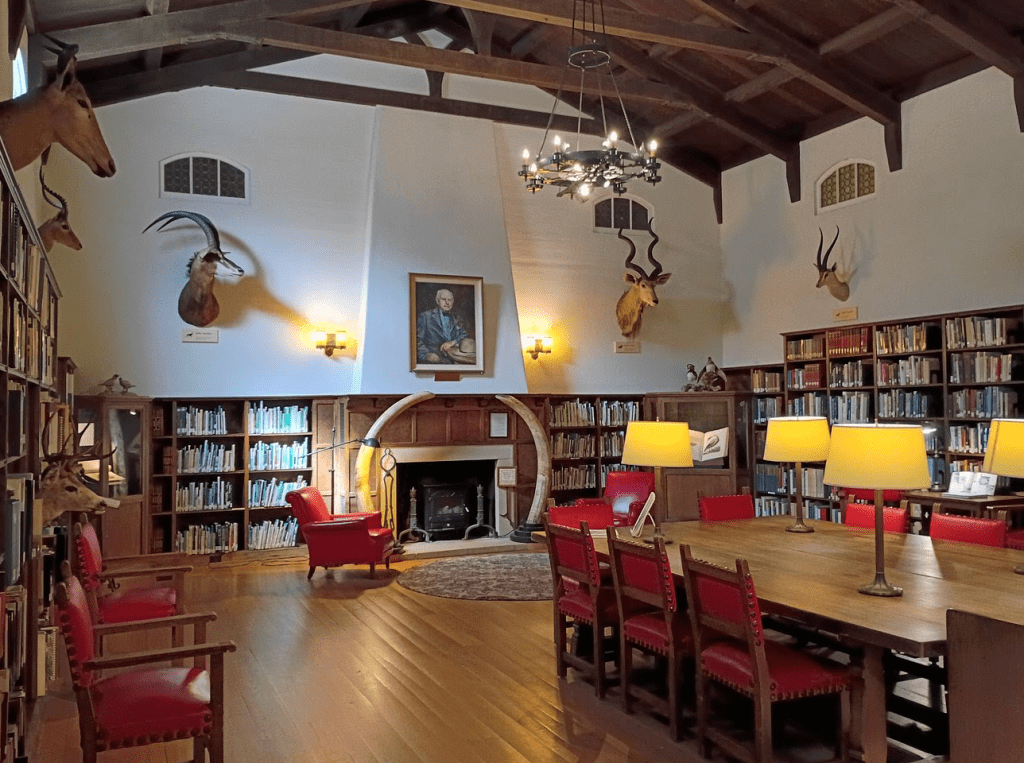
With such a beautiful, cozy atmosphere, I regretted that I couldn’t take some time to curl up with a book, but I had barely scratched the surface! Terri showed me the two archive rooms, carefully temperature- and humidity-controlled, and took me through their collection of documents, maps, and photographs. Original, hand-drawn maps by geologist Thomas Dibblee, who mapped about a third of California, amazed me with their intricacy, and I laughed out loud at what are lovingly referred to as the “Loretta stones” — a sweet collection of small gourds and round rocks sketched with the likeness of Dibblee’s wife, Loretta, that he made when he missed her during his expeditions.
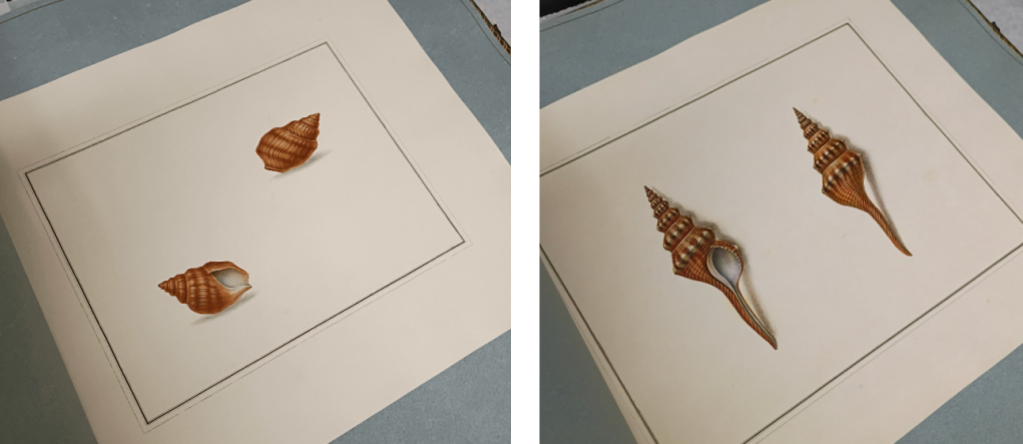
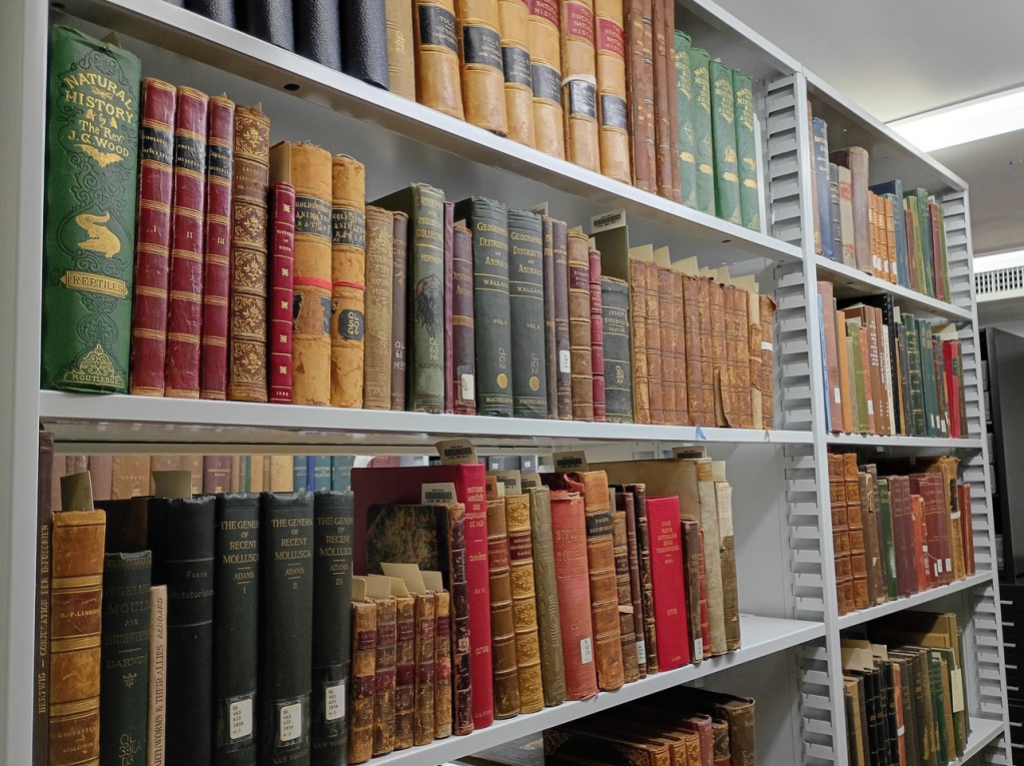
However, the best was yet to come; once Terri took me to the room holding the museum’s collection of rare books, I must have sounded like a broken record — how many times can one use the word “incredible”? Shelves and shelves of beautiful old books, an absolute treasure trove. Most of them are related to exploration, zoology, and other taxonomic subjects, such as one of my favorites: a book on mollusks from 1753 that still has research value today for those who think they may have discovered a new species, and, in a similar vein, a book from 1784 featuring exquisite art by Thomas Martyn, who illustrated seashells.
Another beautiful example of the artistic side of scientific study are the collections of sea moss created by women in the late 1800s. Like making herbariums, which was considered a ladylike pastime, women in seaside places such as Santa Barbara would often make collecting, drying, and preserving various types of algae and sea moss between the pages of a book their hobby. Some of these books even feature illustrations and original poems, which warmed my heart.
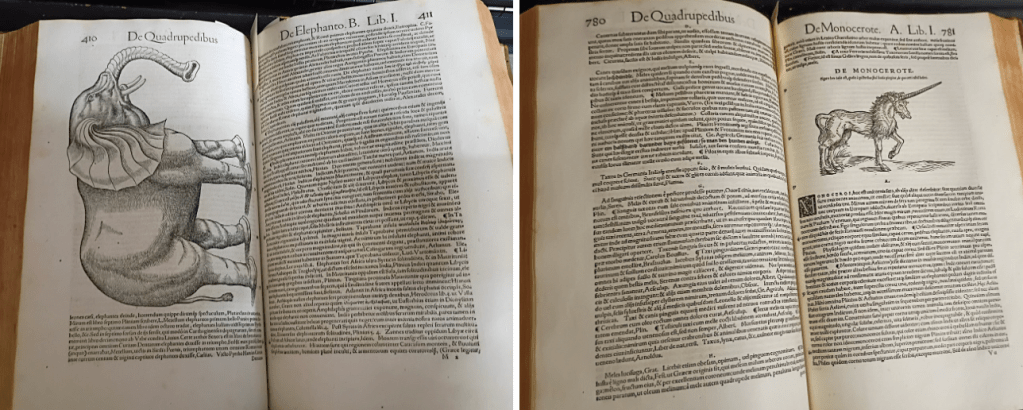
Once I asked Terri about the oldest books in the museum’s collection, she delivered with one that left me speechless: a book on the identification of quadrupeds from 1551. I found myself holding my breath. This book is so old that the pages aren’t made of wood pulp but linen, and it’s beautifully preserved. Written in Latin, it identifies quadrupedal animals, including elephants, many antelope species, and even, to my surprise, unicorns! My high-school Latin is terribly rusty, unfortunately; I would have loved to be able to quickly read about the characteristics of unicorns just in case I run into one in the wild.
Even in just a few short hours, I had an incredible time taking a peek behind the curtain of the Museum of Natural History, and I give extra thanks to museum librarian Terri Sheridan and Marketing & Communications Director Jonah Haas for making it happen. Whether you’re coming to study, research, or spark the love of the natural world in the next generation — the library also boasts a kids’ section! — the museum’s library is an absolute treasure. Click here for more information on making a trip to the library part of your next museum excursion!
In addition to being a wonderful place to spend an afternoon, the Museum of Natural History also hosts events, such as this Science Pub by Irreversible: What Can We Do? coauthor Craig Smith, who will discuss his book and the mission of tackling irreversible climate change at Dargan’s on Monday, April 13, 6:30 p.m. Click here for more information on this event, and read on for a review of Irreversible by our incredible news intern Emily Vesper.
Happy reading! I’ll see you at the museum.
—Tessa, allbooked@independent.com
Irreversible: What Can We Do? by Craig B. Smith and William D Fletcher
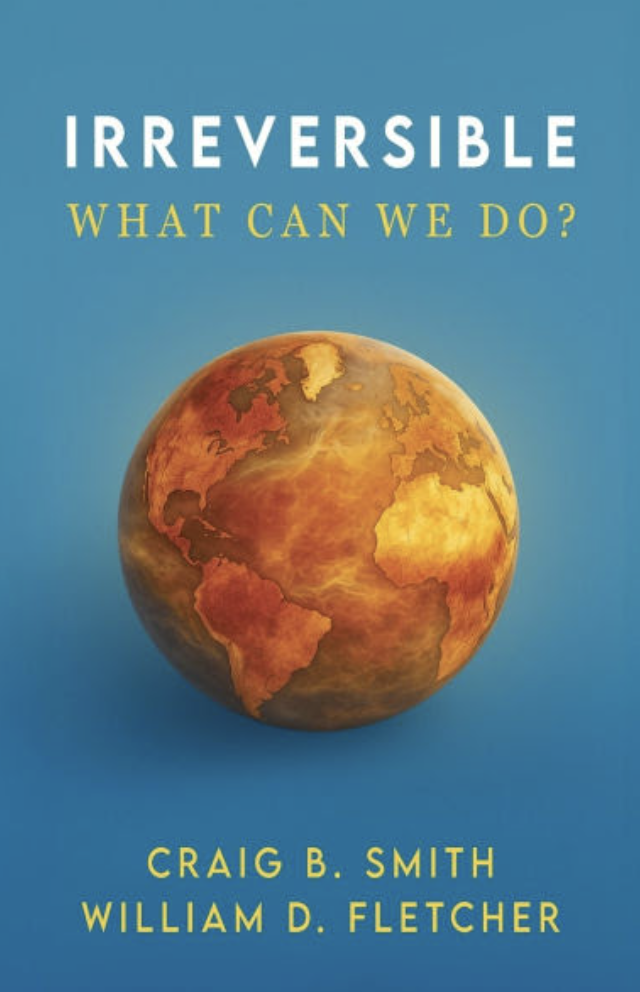
In Irreversible: What Can We Do?, authors Craig B. Smith (of Santa Barbara) and William D. Fletcher lay out a comprehensive review of why climate change is occurring, what it means for humanity, and what we can do to combat it. Both Smith and Fletcher are retired engineers with decades of experience in the energy and power field, and they present their expertise with clarity and sobering realism. Global warming as caused by human-produced greenhouse gas emissions is “irreversible,” hence the book’s title. “But,” Smith and Fletcher write, “continued warming is not inevitable — if we take action promptly.”
Irreversible begins with several chapters explaining the science behind global warming and climate changes. Then, Smith and Fletcher detail the impacts of rising global temperatures. Many of the extreme weather events the authors connect to climate change — droughts, heat waves, severe wildfires — will be intimately familiar to Central Coast readers. After establishing a technical foundation, they look at policy, exploring worldwide efforts to halt global warming and proposing strategies for reducing fossil-fuel dependency and increasing renewable energy use.
“We authors believe that most or all of the technology needed to deal with global warming is currently available,” Smith and Fletcher write. The challenge, then, is in incentivizing governments and corporations to adopt the policies and practices that will make a difference.
Smith and Fletcher write in a straightforward, no-frills style, supplementing their writing with graphs and hard data. “Charlie,” a personified carbon dioxide molecule, jumps in every now and then to simplify complicated scientific topics for the layperson reader. Taken as a whole, the book offers an overview of climate change that is factually grounded, clearly and concisely written, and pragmatic in its call to action. It’s more akin to a primer or textbook than light bedtime reading, but it’s an important read. In an age full of misinformation, Smith and Fletcher provide readers with the facts on climate change and call upon them to create a sustainable future.
—Emily Vesper
FROM OUR PAGES
We’ve had some great author visits and interviews recently, so don’t miss out. Here is some of our book-related coverage from the last two weeks! Read all this and more at Independent.com.
“Santa Barbara Literary Festival Debuts May 2-3” by Leslie Dinaberg
UPCOMING BOOK EVENTS
Below, you will find a few bookish events coming up in Santa Barbara. If you are hosting a bookish event in Santa Barbara, be sure to submit the event to our online events calendar.
Godmothers Gather: Marie Benedict, Daughter of Egypt
Tuesday, April 7, 6 p.m. | Godmothers
UCSB Arts & Lectures Presents Ibram X. Kendi
Tuesday, April 7, 7:30 p.m. | Campbell Hall, UCSB
SBPL Día de los Niños/Día de los Libros: Celebrating the Wonderful Abilities Every Child Brings to the World
Wednesday, April 8, 1 p.m. | Eastside Library
Comic Chaos Club
Wednesday, April 8, 4 p.m. | S.B. Central Library
Romance Book Club
Wednesday, April 8, 5:30 p.m. | S.B. Central Library
Godmothers Gather: Jamilah Lemieux and Gaye Theresa Johnson, Black. Single. Mother.: Real Life Tales of Longing and Belonging
Wednesday, April 8, 6 p.m. | Godmothers
SBMM Book Club
Thursday, April 9, 10 a.m. | S.B. Maritime Museum
Poetry Night: Stephanie Barbé Hammer, Rich Ferguson, Kathleen Florence, and Melinda Palacio
Thursday, April 9, 6 p.m. | Chaucer’s Books
Godmothers Gather: Amy Wallace and Claire Hoffman, Nobody’s Girl: A Memoir of Surviving Abuse and Fighting for Justice
Thursday, April 9, 6 p.m. | Godmothers
Author Talk: Christopher E. Jones, The Invention Of Infinite Growth: How Economists Came To Believe A Dangerous Delusion
Thursday, April 9, 6:30 p.m. | Community Environmental Council Hub
Sensory-Friendly Storytime
Friday, April 10, 4:45 p.m. | S.B. Central Library
Bioblitz: Storytime in the Restoration Plot with Santa Barbara Public Library
Saturday, April 11, 10 a.m. | Elings Park
Storytime at the Sea Center
Saturday, April 11, 10:30 a.m. | S.B. Museum of Natural History Sea Center
Godmothers Storytime: Little G’s: Kitty Caterpillar
Saturday, April 11, 11 a.m. | Godmothers
Art & Soul: Architectural Photography Book Launch: Pentimento
Saturday, April 11, 5 p.m. | Art & Soul
Storytime at the Sea Center
Sunday, April 12, 10:30 a.m. | S.B. Museum of Natural History Sea Center
Carpinteria Festival of Books
Sunday, April 12, noon-4 p.m. | Lynda Fairly Carpinteria Arts Center
Godmothers Gather: Emma Straub and Claudia Ballard, American Fantasy
Sunday, April 12, 6 p.m. | Godmothers
Trivia Night: All About Books!
Monday, April 13, 6:30 p.m. | S.B. Wine Collective
S.B. SPOTLIGHT
We at the Independent get many books sent to us by area authors, sometimes too many! It’s practically impossible for us to read and review them all, but just because we are busy bees does not mean that they aren’t worth the attention. In an attempt to not completely drop the ball, we have compiled a list of books here that are either written by a Santa Barbara author, feature someone in our community, or have another tie to Santa Barbara. I urge you to look through this list. Perhaps you will find your new favorite read!
The following are the most recent titles that have been sent to us.
I’m Not My Story: A Poetic Journey of Healing by Swamini B
If you are a local author and would like us to feature your book in this section, please email allbooked@independent.com with the subject line “S.B. Spotlight.”
Book Reviews Courtesy of CALIFORNIA REVIEW OF BOOKS*
Thanks to the generous contributions of David Starkey, Brian Tanguay and their team of reviewers at California Review of Books, we are able to provide a steady stream of book reviews via our content partnership. Recent reviews at Independent.com include:
The Body Builders by Albertine Clarke; review by Brian Tanguay
*At the present time, all of the Independent’s book reviews are provided in collaboration with California Review of Books (calirb.com).






You must be logged in to post a comment.