The Historic Landmarks Commission gave its blessing to the Music Academy of the West’s revised architectural renderings for the building it recently purchased at 901 State Street — the former site of Forever 21 — which, if all goes as proposed, will soon morph into a major music instruction, rehearsal, and performance hub.
Last week’s meeting was the second bite at the apple for the commissioners. From the start, they were uncharacteristically agog about the transformative potential the project promised for Santa Barbara’s ever-in-search-of-itself downtown. They were also pleased with the changes to the project since they first looked at it last December. In that meeting, the commissioners were less than thrilled by the sharper contemporary vibe of the design; one commissioner termed it “not respectful of the history of what this town is.”
In response, the architectural team of Michael Holliday and Larry Scarpa massaged their original renderings, giving the new plans a more traditional Paseo Viejo treatment. They focused their changes on the elevator tower and reimagined the lengthy oblong frontage windows, which, in the plans’ previous iteration, struck some commissioners as pinched, severe, and random.
With the commissioners’ support, the project next goes to the city’s Planning Commission, though no date has been set. The Planning Commission needs to sign off on the additional bump in height created by the proposed 3,000-square-foot rooftop lounge. With the new lounge space is factored in, the building height will now be 56 feet high; the city’s height limit is 45 feet. Last December the City Council designated the proposal a “Community Benefit” project, which allows the Music Academy more latitude when it comes to building height limits.
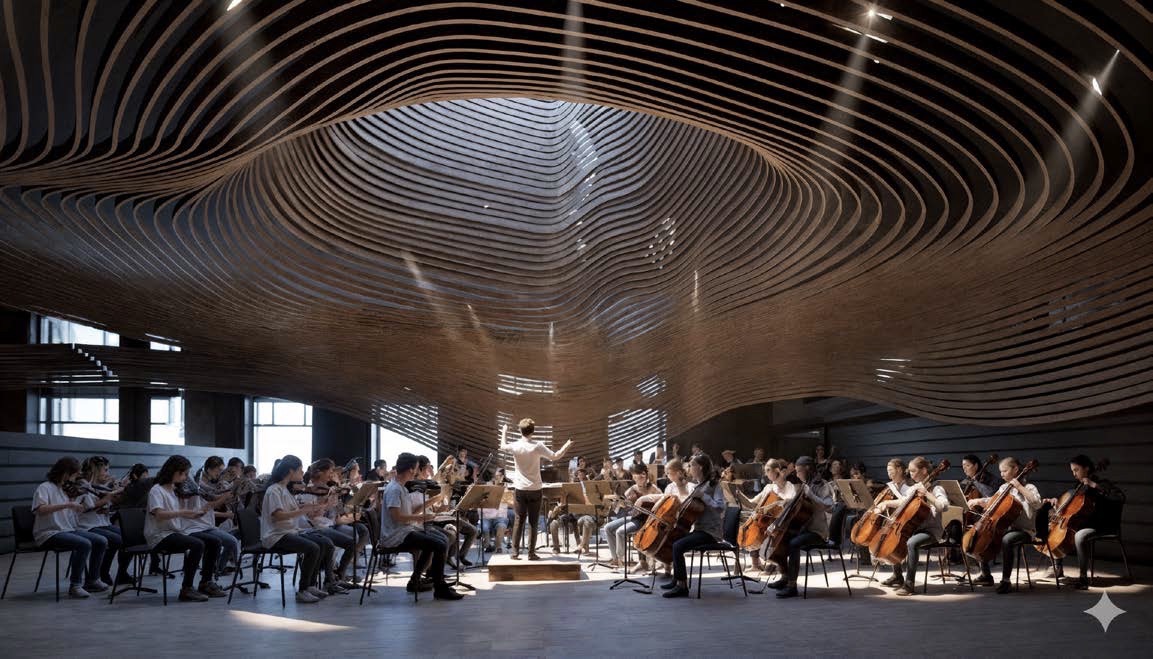
Most of the major changes will take place inside the building to accommodate an acoustically engineered performance space capable of accommodating a 90-piece orchestra, nine teaching studios, four practice rooms, a large ensemble percussion studio, and a recording studio, too.
After the Planning Commission, the proposal goes back to the Historic Landmarks Commission for final sign-off. Unless there’s an appeal along the way, the project won’t go back to the City Council.
Demolition work on the interior is tentatively scheduled for some time this July.