
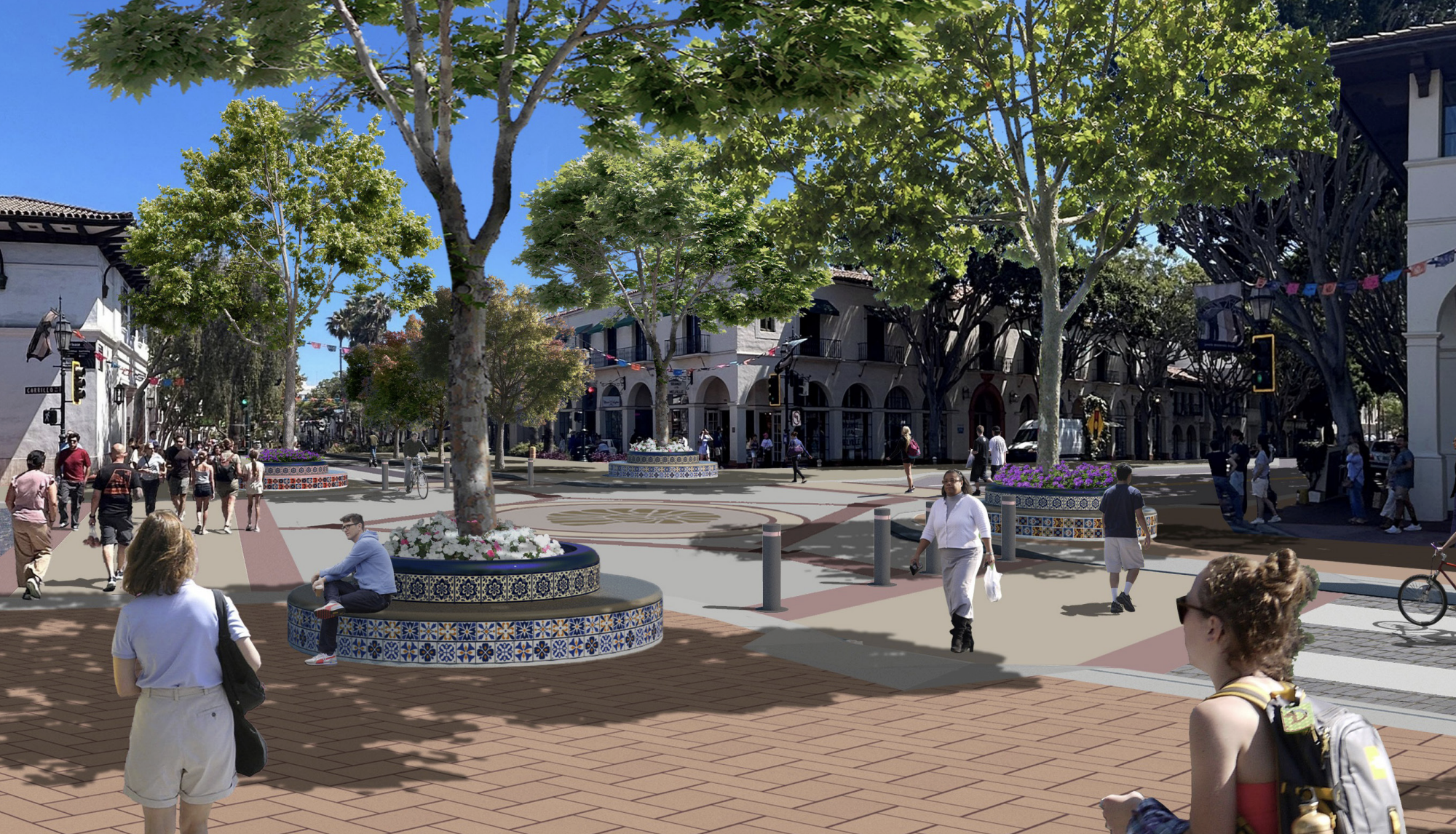
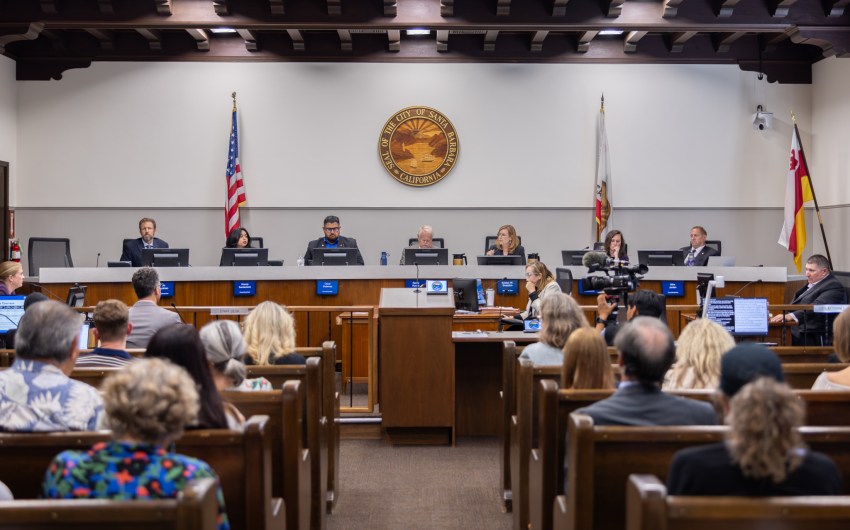
The State Street Master Plan, the guiding document for the future of downtown Santa Barbara, was approved by the City Council in a 6-1 vote — with Mayor Randy Rowse voting in opposition — at the end of another lengthy council hearing on Tuesday night.
The City Council’s approval of the plan marks a major milestone on the path toward a major rehaul of State Street, signaling a shared vision for a flexible pedestrian-centered central district, though questions remain over interim operations and how the city will fund the nearly $100 million price tag.
The new design, completed by renowned architect and urban planner Stefanos Polyzoides, is the result of nearly five years’ worth of city planning efforts, combining the input from dozens of public meetings, recommendations from city review boards, and suggestions from hundreds of letters and public comments from residents, business owners, and members of community organizations.
State Street Master Planner Tess Harris, who has worked closely with Polyzoides to finalize the plan, presented the latest version to the City Council on Tuesday. Harris said the plan for a flexible street with retractable bollards earned support from every city board over the past few months and would allow the city to take a true step forward, despite the continued debate over whether cars would be included in the future plans.
The city received nearly 800 public comments from April through June, and another 250 written comments prior to Tuesday’s meeting. Of these, 368 were in favor of leaving the street closed to cars, while 87 asked to bring vehicles back.

Harris made it clear that the City Council was not expected to decide on interim plans or close the door entirely on the cars-or-no-cars issue at this time. Instead, the City Council just needed to give the green light on the general components of the plan to allow city staff to begin the pre-construction phase and funding plan.
The current estimate for the entire project, which includes major upgrades to the downtown stormwater drainage system, is more than $96 million. This comes to about $9 million per block, with an estimated $10 million for construction management and another $8 million for necessary policy updates, programing, and economic development plans for the first six years of the project.
Total construction costs are estimated to be $68 million, more than half of which would be for underlying infrastructure, with more than $17.5 million for utility relocation and $14.5 million for stormwater construction. These upgrades would be necessary with or without the State Street master plan, Harris said.
The details of this funding plan would still need to be decided during the next budget planning cycle, though city officials are looking to secure grant funding to support much of the early design and engineering efforts. If the city moves on an accelerated timeline, the project could be done in three phases over six years, with construction beginning as soon as 18 months.
“The pace of city action is going to set the pace for everything else,” Harris said. “So how fast we decide to move is going to make this plan move quickly, or not.”
Ideally, the city would begin with lighting improvements, upgraded shuttle service, and pre-construction efforts. Other early actions could include converting one-way streets near State Street into two-ways, and encouraging more housing downtown by streamlining permitting processes or looking into fill-in or adaptive reuse projects on city parcels.
“A firm ‘yes’ today sets us on our forward motion. We can start cleaning up the street; we can start lighting it; we can start programming it,” said Councilmember Kristen Sneddon, who voted in support of the plan. “We can start being forward facing, our compass direction set to where we are heading, and that’s where we can spend our energies, instead of this constant perception that it hasn’t been addressed.”
During public comment, community members shared opposing viewpoints, with some encouraging City Council to begin work on the plan as soon as possible while others urged caution in approving such a major project without a solid funding plan.
“There comes a point in every long process when planning has done its job, and we’re there,” said Sharon Rich, founding board president of Friends of State Street. “There is a risk in reluctance to commit to a future. You have moved this plan forward at every step, and now I’m asking you to take the next step. Waiting will cost us momentum, funding, and people ready to build.”
Business owners and downtown groups expressed that they were feeling left out of the conversation. Some urged city councilmembers to consider reopening portions of the street, and worried about the impact of construction costs on other city priorities.
“Good ideas are pretty, but we don’t have the money,” said business owner and interior designer Lisa Sands.
Councilmember Wendy Santamaria, who also supported the plan, said she understood the concerns about the hefty price, but was hopeful that the city could secure much of the funding from outside sources.
“We very obviously don’t have $96 million in our reserve or general fund,” Santamaria said. “But every single dollar is not going to come from our general fund. It will come from grants. But I do want to be very careful that we are securing those grants, that we are not just shoving the plan forward without the secured financing.”
Councilmember Meagan Harmon has been consistent in her support of the State Street Master Plan, and said she hoped that this shared vision would carry over into discussions about funding and encouraging more housing downtown.
“I’m so glad we’re meeting this milestone,” Harmon said. “But the real commitment — the actual allocations — those moments are still to come, and those are not small things.”
Councilmember Eric Friedman voted in favor of the plan, though he expressed concerns about funding and potentially leaving struggling business owners out of the discussion. Friedman attempted to make a last-minute motion asking council to vote on a shorter four-block closure, though the motion failed for lack of a second.
Mayor Rowse voted against the plan, calling the removal of cars from State Street a failed six-year experiment that was too long to function effectively. He was skeptical about the master plan, saying it was too expensive and could impact other city funding priorities.
“The bottom line for me is: State Street is a street,” Rowse said. “It just needs to be taken care of.”
The city will begin with early phases of the plan, and city council is expected to discuss the interim plans — with options for addressing concerns over cars and e-bikes — in the coming months.
Related Posts



Premier Events
Fri, Sep 11
2:00 PM
Santa Barbara
Music & Meditation SB with Robert DeMaine, cello

Sat, Sep 12
9:00 AM
Santa Barbara
Santa Barbara Sea Glass & Ocean Arts Festival
Sun, Sep 13
9:00 AM
Santa Barbara
Santa Barbara Sea Glass & Ocean Arts Festival

Wed, Sep 09
6:00 PM
Santa Barbara
Chaucer’s Book Talk: Antwone Fisher – “Reflections Beneath the Buckeye Trees: Notes From a Life”

Fri, Sep 11
5:00 PM
Santa Barbara
Romeo & Juliet at Elings Park

Fri, Sep 11
7:30 PM
Santa Barbara
Selah Dance Collective: “Beethoven’s Tango” and “The Stranger”

Fri, Sep 11
7:30 PM
Santa Barbara
Planned Parenthood CCC After-Hours Event!
Sat, Sep 12
9:00 AM
Santa Barbara
Community Walk with ‘Latino Outdoors’

Sat, Sep 12
10:00 AM
Santa Barbara
Planned Parenthood’s 52nd Annual Mary Jane McCord Book Sale

Sun, Sep 13
10:30 AM
Santa Barbara
Meet PBS Kids Character Buddy the Dinosaur
Sun, Sep 13
1:00 PM
Santa Barbara
SB Jazz Society: Jazz du Jour with Sandy Cummings at SOhO

Sun, Sep 13
4:00 PM
Santa Barbara
PPCCC YA (Planned Parenthood Young Advocates) Community Reading

Sun, Sep 13
6:00 PM
Santa Barbara
The Papas and Mamas – A MAMAS & PAPAS Experience
Fri, Sep 11 2:00 PM
Santa Barbara
Music & Meditation SB with Robert DeMaine, cello
Sat, Sep 12 9:00 AM
Santa Barbara
Santa Barbara Sea Glass & Ocean Arts Festival
Sun, Sep 13 9:00 AM
Santa Barbara
Santa Barbara Sea Glass & Ocean Arts Festival
Wed, Sep 09 6:00 PM
Santa Barbara
Chaucer’s Book Talk: Antwone Fisher – “Reflections Beneath the Buckeye Trees: Notes From a Life”
Fri, Sep 11 5:00 PM
Santa Barbara
Romeo & Juliet at Elings Park
Fri, Sep 11 7:30 PM
Santa Barbara
Selah Dance Collective: “Beethoven’s Tango” and “The Stranger”
Fri, Sep 11 7:30 PM
Santa Barbara
Planned Parenthood CCC After-Hours Event!
Sat, Sep 12 9:00 AM
Santa Barbara
Community Walk with ‘Latino Outdoors’
Sat, Sep 12 10:00 AM
Santa Barbara
Planned Parenthood’s 52nd Annual Mary Jane McCord Book Sale
Sun, Sep 13 10:30 AM
Santa Barbara
Meet PBS Kids Character Buddy the Dinosaur
Sun, Sep 13 1:00 PM
Santa Barbara
SB Jazz Society: Jazz du Jour with Sandy Cummings at SOhO
Sun, Sep 13 4:00 PM
Santa Barbara
PPCCC YA (Planned Parenthood Young Advocates) Community Reading
Sun, Sep 13 6:00 PM
Santa Barbara


You must be logged in to post a comment.