This article was originally published in UCSB’s ‘The Current‘.
Celebrations on Veterans Day are etched into national consciousness by military flyovers, honorary parades, and soldiers saluting in full-dress uniform. However, simple gestures — even just a small table and empty chair — can prove equally as powerful.
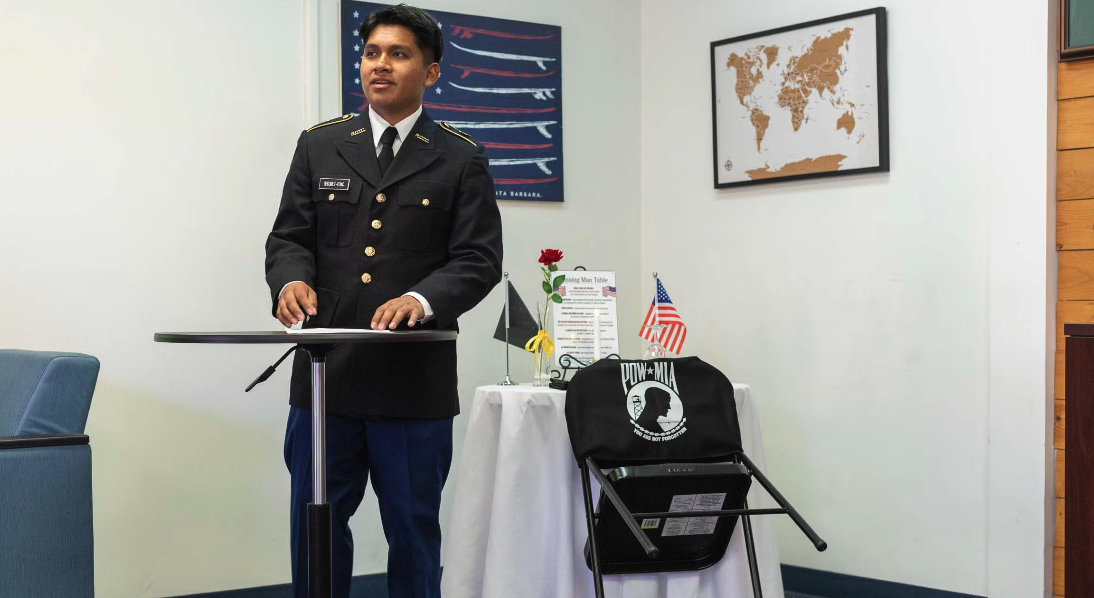
Working with a local nonprofit, UC Santa Barbara has set up a “Missing Man Table” to honor American POWs (prisoner of war) and MIA (missing in action). The installation is a small, round table with a single place setting and an empty chair symbolizing those who have not returned.
“This table serves as a simple but powerful reminder that they have not been forgotten,” said Army veteran Mike Fogelsonger, director of UCSB’s Veterans & Military Services, who worked closely with the Pierre Claeyssens Veterans Foundation, a Santa Barbara–based nonprofit to bring the installation to campus.
“When Mike came to us for support, it was a very easy yes,” said Army and U.S. Coast Guard veteran and former Santa Barbara County undersheriff Barney Melekian, chair of the foundation. “It fits our mission, and it’s the right thing to do.”

Closing the dedication ceremony, UCSB ROTC student leader Kleber Ordóñez-Puac explained the table’s symbols, from the lemon and salt meant to represent bitterness and tears to the yellow ribbon’s hope for return.
The tradition of the “Missing Man Table” — also referred to as the “Fallen Comrade Table” — emerged from the Vietnam War. According to the National League of POW/MIA Families, more than 1,500 American soldiers who served in Vietnam, Laos, and Cambodia remain unaccounted for. During Operation Homecoming in 1973, nearly 600 POWs were released. Across multiple conflicts dating back to World War II, approximately 81,000 Americans are considered missing in action, according to the Defense POW/MIA Accounting Agency.
Fogelsonger said the portable display is intended to be shared across campus during commemorative occasions, such as Veterans Day and Memorial Day, providing opportunities for remembrance and education. He hopes the display will encourage students, faculty and staff to learn about the POW/MIA tradition and the families who continue waiting for answers.