
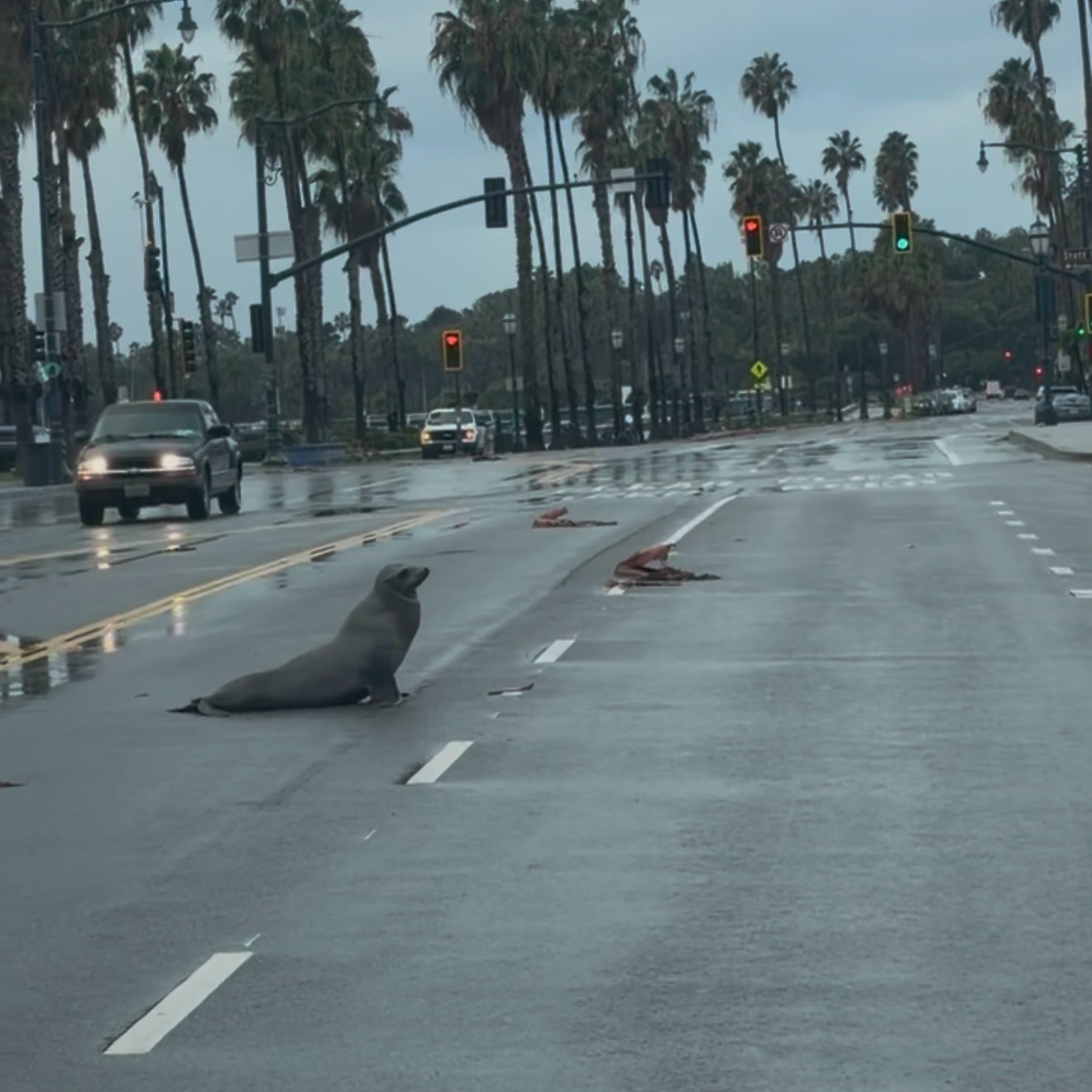
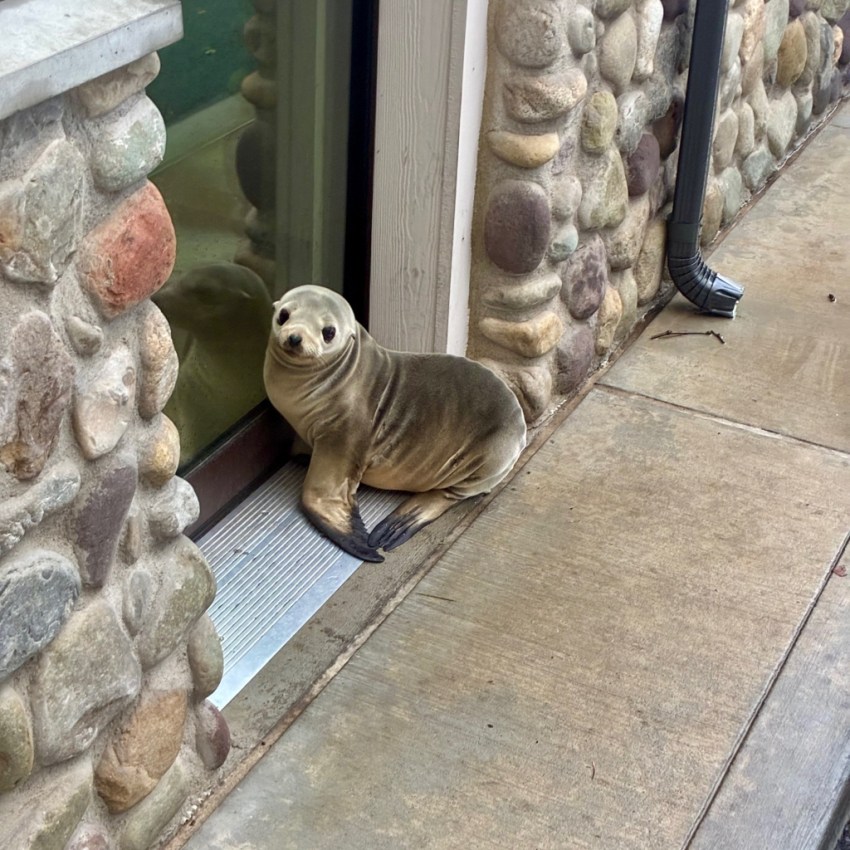
A wayward sea lion crossed four lanes of traffic on Santa Barbara’s Cabrillo Boulevard on Thursday morning, making its way onto the patio of Flor de Maiz restaurant in the Funk Zone.
Drivers stopped in their tracks to let the confused creature cross safely, and several agencies — including Santa Barbara Harbor Patrol, police officers, and Animal Control — kept watch on the animal while they waited for Channel Islands Marine Wildlife Institute (CIMWI) staff to rescue it.
The young adult male was safely captured by 9:15 a.m., said Ruth Dover, managing director of CIMWI.
Specialists at CIMWI did a health assessment on the animal, and found him to be in good condition with no visible injuries. He was a healthy weight, bright, alert, and responsive. In an Instagram post, Dover joked that the sea lion was “impatiently waiting” for Flor de Maiz to open. “He was ready for a signature margarita after weathering the storm!” she wrote in the caption. He was rescued before the restaurant opened. But Flor de Maiz didn’t miss the chance to praise “the cutest guest we’ve had in a while,” on its Instagram.
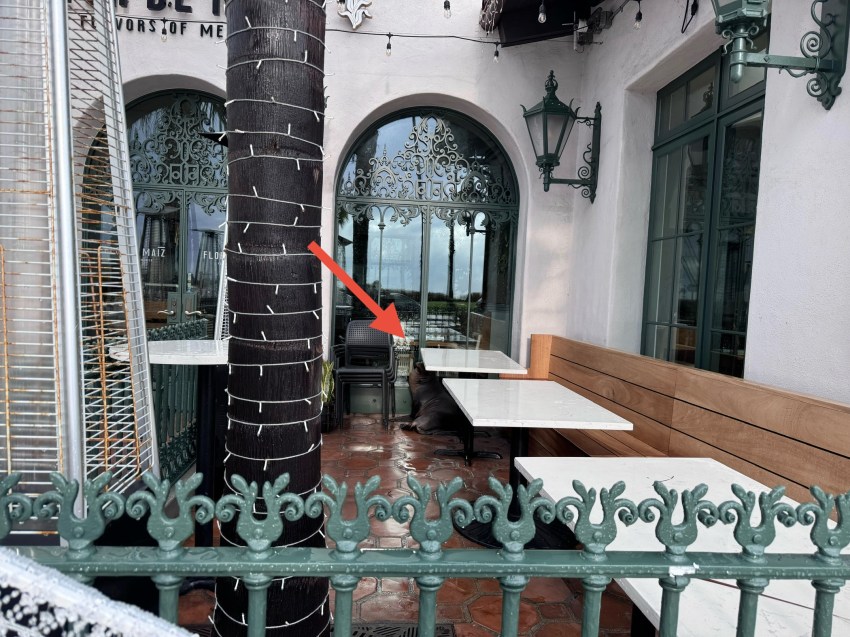
A young adult male sea lion corned himself under a table at Flor De Maiz after crossing Cabrillo Boulevard on Thursday morning. | Credit: CIMWI 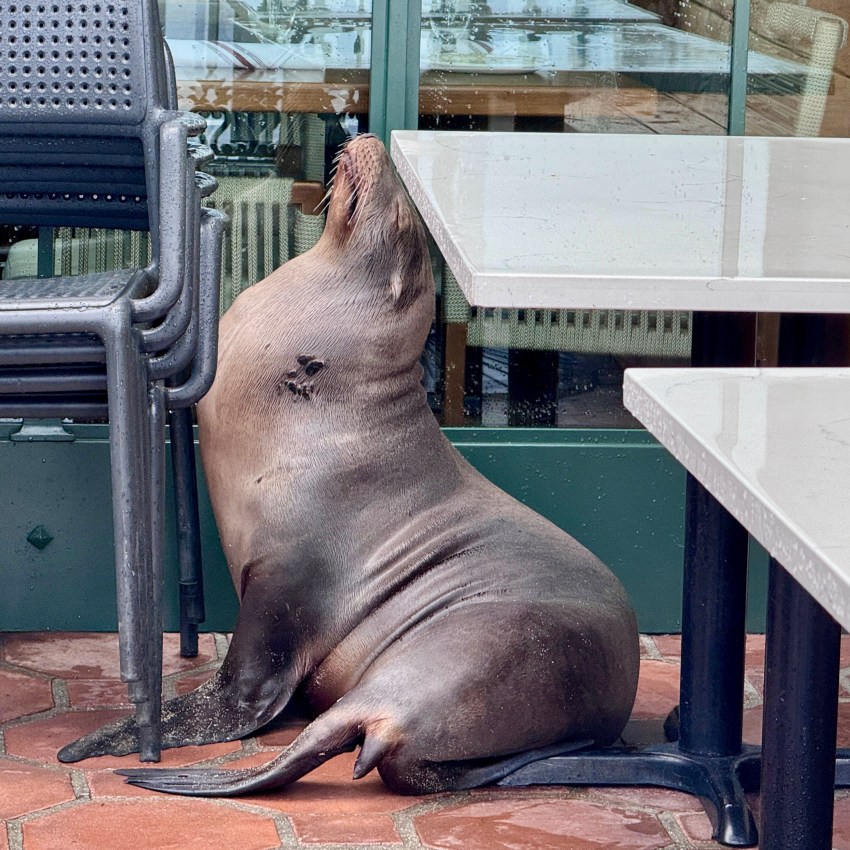
A young male sea lion crossed four lanes of traffic across Cabrillo Boulevard on Thursday, ending up on the patio of Flor de Maiz. | Credit: CIMWI 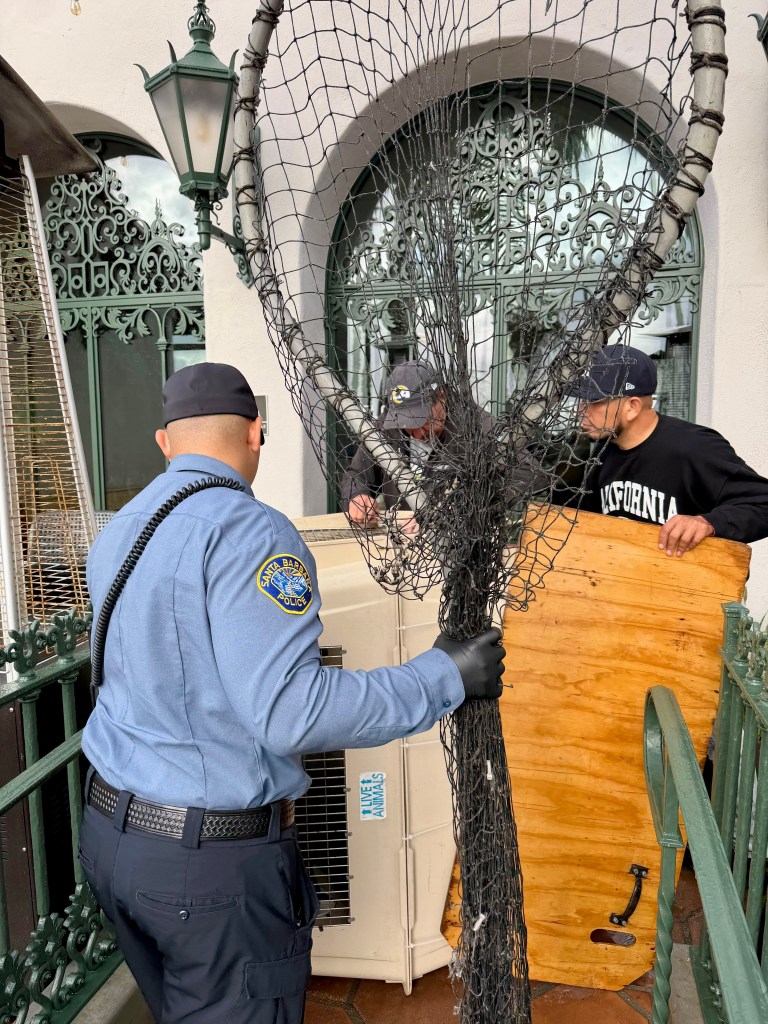
Multiple agencies responded on Thursday to rescue the stranded sea lion at Flor de Maiz. | Credit: CIMWI
Jokes aside, why did the sea lion cross the road?
“It can’t tell us,” Dover quipped. But she theorized that the perplexed pinnaped was likely disoriented, possibly due to turbulent ocean conditions as a result of recent storms and warmer waters. It could have had some level of chronic exposure to domoic acid, a neurotoxin produced by algae, she suggested, but it did not display any significant symptoms.
“It could be that the animal was being chased by a shark,” she continued. “We don’t know.”
Once it was determined that the animal was in good condition, CIMWI staff released it back into the ocean at the Hollister Ranch Shoreline Preserve. He beelined for the water.
“It was great that so many community resources came together for concern over the animal,” Dover said.
Pups in Trouble
While the young male’s field trip was a funny story, younger sea lion pups are getting stranded in an attempt to find food.
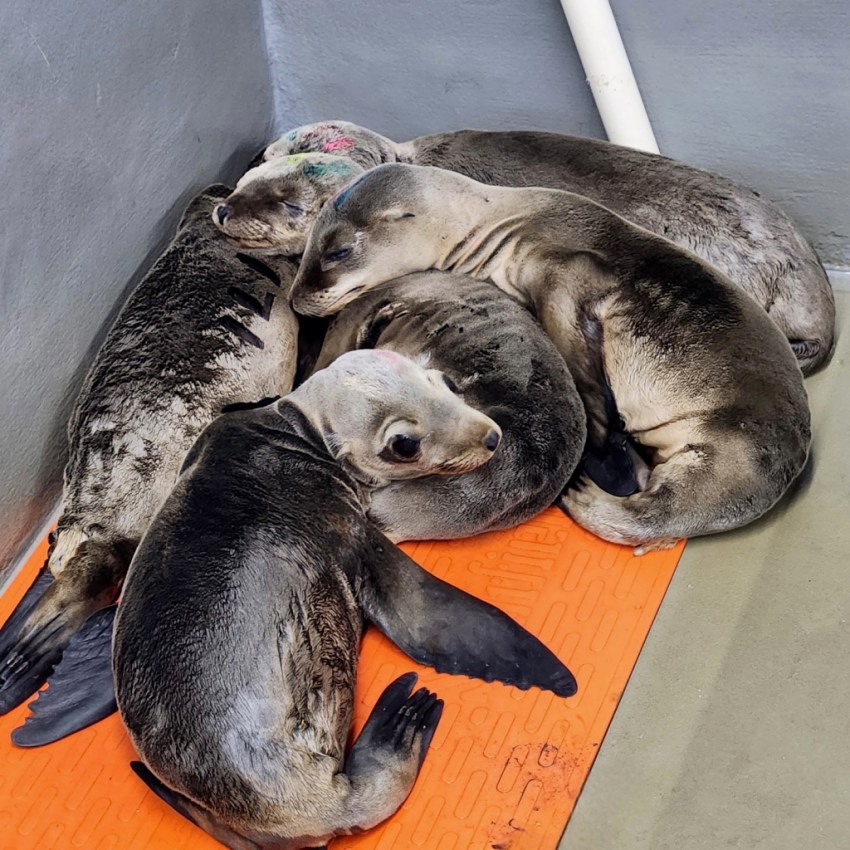
In the past 23 days, CIMWI has rescued 22 malnourished sea lion pups (12 in Santa Barbara and 10 in Ventura). The sea lion in the Funk Zone was just one of three the group responded to on Thursday. One pup was at El Capitan and could not be located once staff were on scene; another was foraging at the Ventura fairgrounds and was successfully rescued.
Dover said the organization was expecting a challenging winter and spring. A marine heatwave and “super” El Nino weather event are underway, bringing warmer waters and intense storms to the coast — a “one-two punch” against marine mammals, she said.
“We knew this was gonna come but we didn’t know when and how bad,” she said.
Pups are starving because their prey is not as prevalent, and pups cannot dive deep enough to find food, lacking the necessary blubber to withstand colder temperatures. But their mothers are forced to go farther to find food as well, as warmer waters displace their usual diet of fish.
“The pups are getting hungry, and they’re swimming to the mainland, and they’re stranding on our beaches,” Dover explained.
Many of the pups rescued are at “birth weight,” despite being around 5 months old. They come in dehydrated, exhausted, and hypothermic, indicating they have been in a state of starvation for quite some time.
Dover said that CIMWI is the canary in the coalmine for other marine mammal rescue networks, who have not yet seen as many pup strandings. (Although, up north, other organizations have reported historically large domoic acid outbreaks, resulting in hundreds of poisoned sea lions.)
The number of pups turning up malnourished along the Central Coast started as an uptick last month and has since turned into a trend.
On November 14 and 16, CIMWI rescued four pups each day.
“We’re right across the street from the ocean,” Dover said. “We’re the closest in proximity to the Channel Islands [a birthing place for sea lions], so it makes sense that they would come our way first, and that often does happen.”
It is likely the tip of the iceberg. Dover worries that they will see another unusual mortality event for sea lions similar to what they experienced between 2013 and 2016, when a “blob,” a body of unusually warm ocean water, led to hundreds of starving sea lions stranding on local beaches.
“Are we going to see something that is just really bad this winter and spring, or is this going to be a prolonged event?” she questioned. “Our environment is changing — but to what degree and how quickly?”
While California sea lions are not considered endangered or threatened as a species, Dover said that they are “sentinels of the sea”: indicators of ocean health, “and we’re all dependent on the ocean.”
To learn more about CIMWI and report animals in distress, visit here.




You must be logged in to post a comment.