
‘Welcome to Isla Vista‘ is a six-part podcast series. Listen to new episodes here or anywhere you get your podcasts.
I’m Christina McDermott, and this is Welcome to Isla Vista, Episode 5: “The Quiet(er) Corner.”
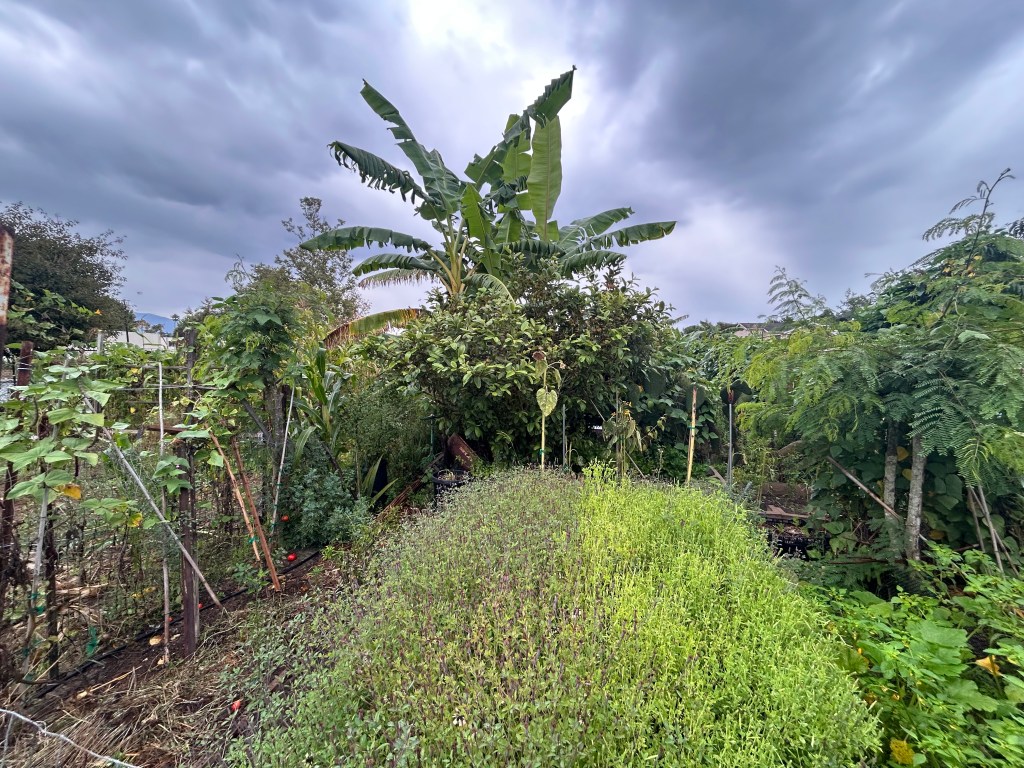
Heavy gray clouds sprinkled light rain one September morning as I approached the gardens at Estero Park. The air smelled fresh, damp, and humid, and as I walked the bike path, I could see the tangle of plants separated by thin fences.
Lush garden plots grow food, everything from corn in towering stalks to dragon fruit. The reds and yellows of flower petals pop from dense green.
Estero Park stretches across the northwest corner of Isla Vista. It includes the gardens (where both students and non-students can rent space), a disc golf course, a basketball court, a playground, and a wide green space. Nearby is a cluster of apartment buildings where many long-term families live.
I met folks from the Isla Vista Recreation and Parks District near the garden’s raised beds. Luis Valerio, the Parks District’s assistant general manager, said the raised-bed project started in 2021. The garden had 30 plots at that time, and 20 people on the waiting list.
“The board identified an abandoned garden plot, which was cleared out and then developed into a raised-bed garden with 10 raised beds and one communal hexagon bed,” he said.
The raised beds, Valerio said, help sustain the garden’s pollinators and grow herbs. They’re ADA-accessible, so folks with disabilities can garden, and their construction was funded through Measure O funding — that’s a bedroom tax in I.V.
“We got some fruit trees along the fence line, some nice native shrubs and plants in the garden,” he said. “Danielle, our community garden coordinator, has installed a beehive on the back end that helps, kind of pollinating everything over there.”
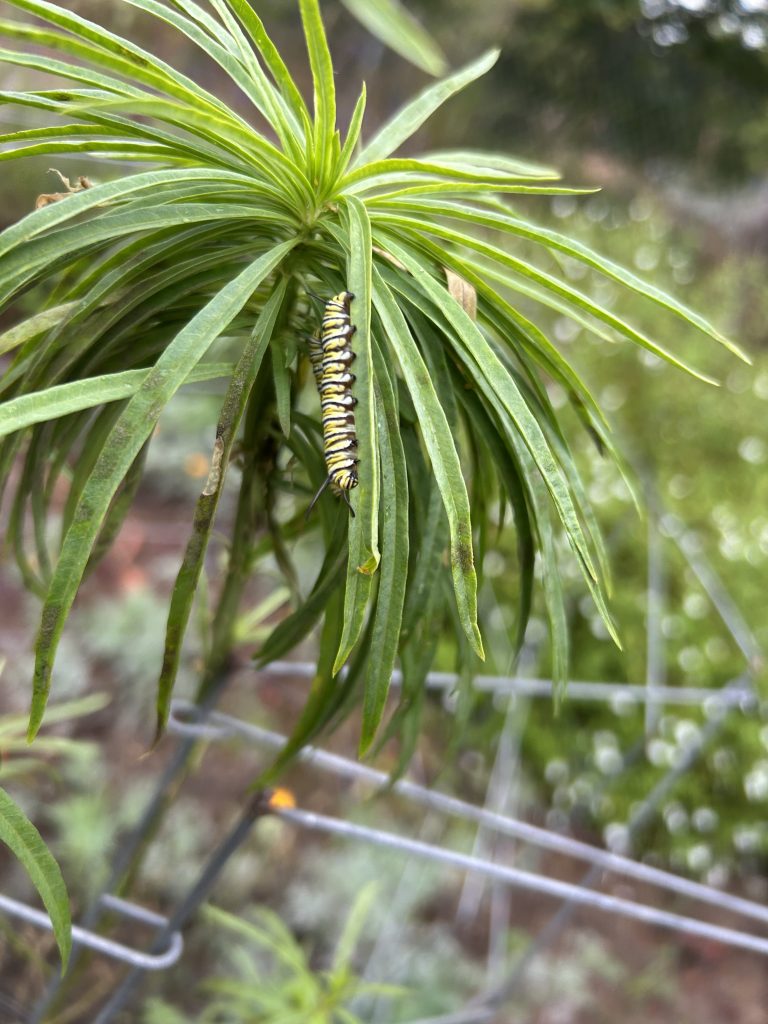
Danielle Bushar is the district’s community garden coordinator. She spends 12 hours each week maintaining Estero Gardens’ communal spaces. The garden is home to native bees, honey bees, and a variety of other pollinators like butterflies, including monarch butterflies, a species that is disappearing from the Central Coast.
“Monarchs have been ubiquitous this week. It’s too bad it’s not sunny, because every time I look over there, they’re just fluttering around, and there’s always two or three,” she said.
This part of I.V. feels a world away from the bustle of Del Playa Drive. Kimberly Kiefer is the general manager for the Isla Vista Recreation and Parks District. The district, she said, is an Independent California Special District. It is kind of its own thing. The garden is multigenerational.
“We’re definitely our own thing. I would say it’s multigenerational. We have some families [who] have been here probably since 1986. They’ve maintained their plot[s],” she said. “They’ve kept their plot. They’ve transferred it to other family members.”
Kieffer said that she and other members of the park district want to break down the stigma that I.V. is dangerous or only known for partying.
“There’s a lot of community-building that’s happening here of all ages and [with] families. And I think it’s a really, really cool place,” she said.
The park hires students, too. Leila Dagan is the garden’s stewardship coordinator and a UCSB student. She said the garden itself has a culture of reciprocity.
“For example, these marigolds came from Tomas,” she said. “He just gave them to me because I’ve been giving him some tomatoes and peppers. Everyone’s really excited about sharing their produce and their knowledge, which has been really inspiring and welcoming.”
While the garden is still popular, with gardeners of different ages, including families, I.V. has fewer families today than it did 25 years ago. Like, a lot fewer. The 2000 census records 717 households in Isla Vista with children under 18. In 2024, the Census Bureau estimated that number at 96.
In 2023, a mass eviction removed hundreds of long-term residents from I.V.
Reporter Ryan P. Cruz works for (you guessed it) the Independent. He covers a range of stories, including housing, city affairs, and immigration.
Cruz, along with reporter Jean Yamamura, covered the renoviction at CBC & The Sweeps in 2023. The Sweeps, a two-story apartment complex in I.V., housed about a thousand tenants — students and long-term families alike. You can see part of what was The Sweeps from El Colegio Road.
“A Chicago-based company called Core Spaces came and bought it, I think, March 16, 2023, and pretty soon after that, they gave an eviction notice,” Cruz said.
Let’s back up and clarify some terminology: renovicton. That means an eviction because a landlord intends to renovate a property.
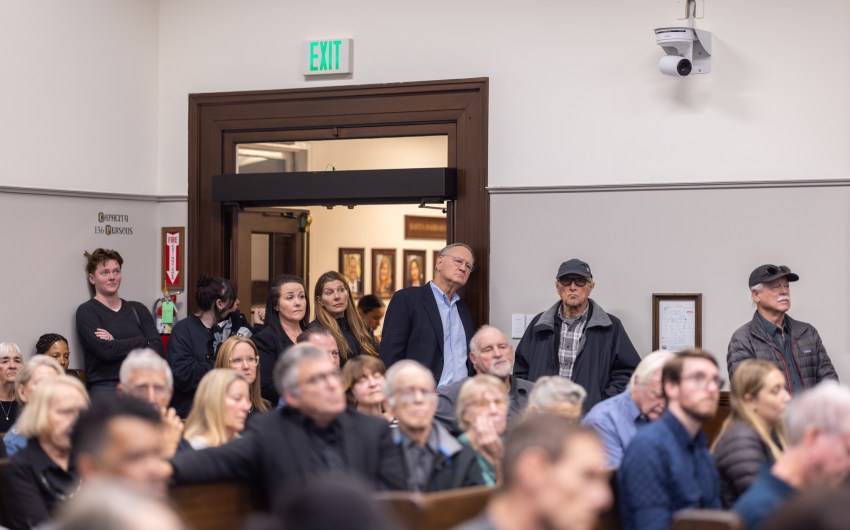
“In California at the time, and in Santa Barbara County and City at the time, the only legal precedent you needed to send was to tell tenants within the letter that you needed to do a quote, unquote, ‘substantial renovation,’” he said.
Cruz said he lived in Isla Vista as a child while his mother attended UCSB.
“When I was probably in elementary school, there were a lot of working-class Latino families that, you know, lived amongst the students,” he said. “We kind of saw a little bit of that in Core Spaces with the community there. It was a mix between not only students but community members that had been there.”
When Core Spaces evicted tenants at The Sweeps, Cruz said, it caught the wider community’s attention.
“It caught the attention not only of the tenants but of the communit,y because the tenants started to ask, ‘What do we do? What can we do in this situation?’”
Tenants organized. Cruz said they formed an association and worked with the Santa Barbara Tenants Union and the Isla Vista Tenants Union.
“It was really creating a community. They held community barbecues, and then they really started to reach out to the media. And that’s how we got involved,” he said.
The eviction event at The Sweeps didn’t have some kind of movie ending; it displaced people. But through people’s willingness to tell their stories, it helped bring the practice of renoviction into public discussion. Cruz said that folks telling their stories, along with a few other renoviction events, prompted the county to make changes to eviction laws to address renoviction.
That included requiring landlords to have building permits before serving notices for tenants to vacate. Landlords now also have to prove the work requires a tenant to vacate for at least 30 days, and the tenant must be offered a first right of refusal (that means they can choose to move back in) with rent no more than 10 percent higher than it was.
Today, The Sweeps is called State Santa Barbara and serves as student housing. Core Spaces rents by the bed, rather than by unit. A double in a two-bedroom, one-bathroom unit goes for a little under $1,400 a month per bed, plus fees.
There are, of course, opportunities to rent to students in I.V. Several Isla Vistans I spoke to — long-timers and students alike — said that if UCSB built more student housing, the situation could improve. There would be more options, after all.
Last fall, I reached out to UCSB and asked what the university was doing to provide more on-campus housing. The university declined multiple requests for an in-person interview but responded via email. Here is some of what they said:
“There has been ample availability of beds for students, both on campus and in the community, for the past couple of years. In fact, there is currently limited availability in both our residence halls and apartment communities,” the university writes.
Rather, the university argued that it was the lack of affordable units that was the problem. UCSB said that in the fall of 2025, it had more than 290 undergraduate beds available in their residence halls and apartments. It’s not clear, exactly, how those beds are distributed.
UCSB’s own numbers suggest their on-campus housing is largely over capacity. In a university planning document, UCSB provided a student housing capacity breakdown — also from fall of 2025. While a few locations were not completely full, especially family student housing, which is for undergrad and grad families, most on-campus housing options exceeded the designed capacity. Undergraduate apartments were at 109 percent occupancy rate. Dorms were even higher — 124 percent [occupancy rate.]
UCSB is currently building more student housing. If you pass by Stadium Road, you’ll see the beginnings of the San Benito Dorm complex. As of February 2026, it’s a concrete skeleton, growing each week.
The San Benito project came on the heels of the failed Munger Hall project. Munger Hall, backed by billionaire Charles Munger, would have been the largest dorm in the country and would have allowed UCSB to house students in one fell swoop. It sparked controversy and backlash. One major sticking point? It didn’t provide windows for most of the dorm rooms.
As the fight around Munger Hall continued, Santa Barbara County and the City of Goleta actually sued UCSB for failing to provide the number of beds they promised as the university increased enrollment. [In 2024, UCSB settled that lawsuit for $6 million dollars.]
With the San Benito project, along with a redo of Santa Rosa Residence Hall, UCSB said that the university will be able to offer housing to more than half of its students at a time. And it will allow UCSB to fulfill its 2010 Long-Range Development Plan commitment.
Let’s head away from El Colegio, and back into the northwest corner of I.V. We’ll pass Friendship Manor, a retirement community for low-income seniors and Isla Vista Elementary School. In this elementary school, students speak more than 25 different languages.
Pegeen Soutar met me outside of her home in I.V. Her friendly retriever, Honeybear, greets me at the front door. Soutar moved to Isla Vista in 1982 for school.
“I was from Los Angeles, and Isla Vista still had that ’70s vibe — that really fun, kind of funky, lots of gardens, ‘do it yourself’ stuff and art and fun music,” she said.
She said she remembers that water towers — at least four of them — still dotted I.V. Remember, before its hookup to Lake Cachuma in the mid-’50s, I.V. didn’t have much potable water.
Soutar majored in art studio. Later she’d go on to get a culinary arts degree from Santa Barbara City College. While she was at UCSB, she learned I.V.’s streets pretty well, in part by delivering pizzas.
“I was needing to work so I worked.I delivered pizzas,” she said.
“For Woodstock’s?” I asked.
“No, the women couldn’t deliver at Woodstock’s,” Pegeen told me.
She said there were perceived safety issues. But Domino’s allowed women to deliver.
Soutar and her husband decided to stay in Isla Vista after graduation and raise their family.
“John and I got pregnant, and we had a child, and then we had another child,” she said. “Then all of a sudden we were looking around, going, ‘Where are the playgrounds? Where are the sidewalks?’”
She said, after her children started school, she realized how few services there were for kids in I.V. She decided to get involved in the park district. Soutar went on to spend a total of 20 years on the district’s board. She helped organize ball checkouts at parks as well as after-school playtime, among other things.
Today, Soutar makes a point to get to know her neighbors. She, alongside other long-time residents, is a stabilizing force.
“I think my role now is to just try to meet the neighbors in the neighborhood,” she said. “And Honeybear helps because everyone wants to come pet Honeybear.”
She said she likes to garden in her front yard, where people will come over to greet Honeybear (her dog). They’ll get to talking, and she said, she lets them know they can stop by if they need anything, whether that’s help on something or a spare egg for cooking.
She hosts a big friendsgiving meal each year, too, and invites her neighbors and other students.
“It’s a potluck,” she said. “And like I said, [it is on the] Saturday before Thanksgiving, and we just run the tables across the front yard. We’ve had up to 60 people here,” she said.
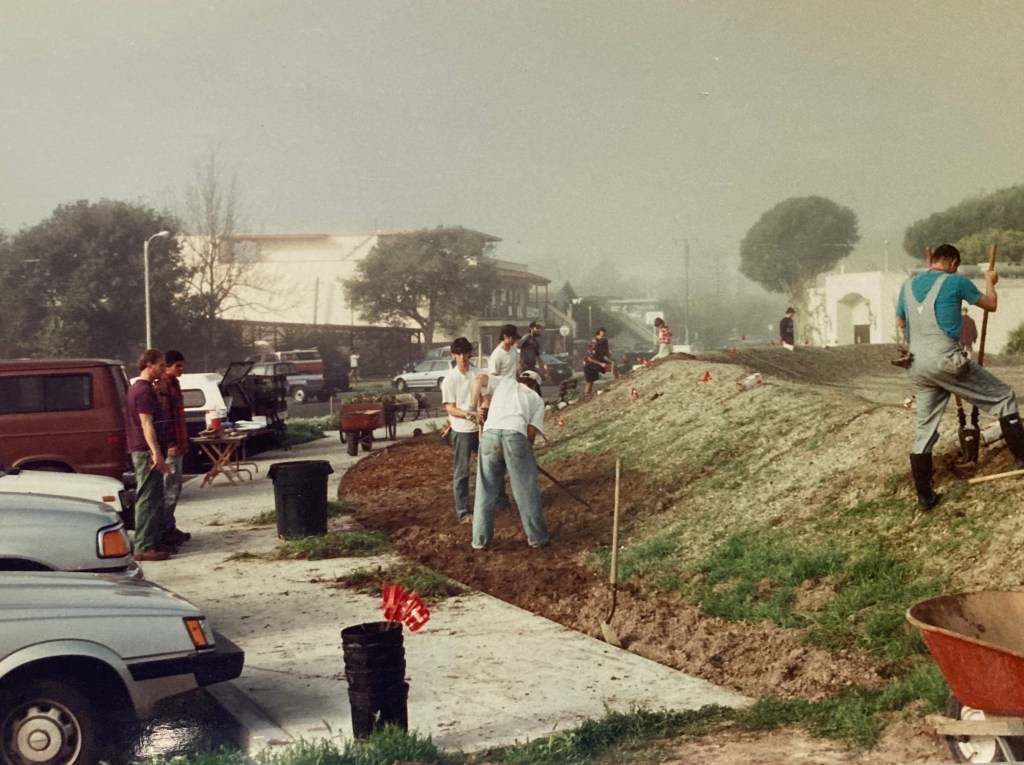
Soutar said she’s seen Isla Vista grow denser over the past 44 years. She sees I.V.’s problems, too: high rent, a lack of parking that can cause dangerous situations, the cliff, and poor living conditions in some places.
“I mean, there’s great property owners here that take really good care of their houses and charge something that is, you know, still affordable. They provide parking, and they keep it up. That’s terrific. There’s places [where] that does not happen,” she said.
I asked Soutar what, generally, motivates her to stay engaged in this highly transient community.
“I think it comes down to safety,” she said. “It comes down to how to make this a safer place, how to build community, so that people who are living here feel like they’re vested.”
Not too far away, Harry Reese and Sandra Liddell Reese live in a house set back on their property. The second time I came to visit them, they gave me a bunch of apples from a tree in their yard.
In one of their studios (located in a former barn on the property), they keep two printing presses.
The Reeses have been in I.V. for decades — since 1977 for Sandra and for Harry, who did an undergraduate and master’s degree at UCSB, more than that. He said he’s left I.V. four times and returned five.
“I’m Harry Reese, co-proprietor of Turkey Press,” he said when I asked him to introduce himself.
The Reeses are artists and independent publishers. Harry Reese founded Turkey Press in 1974 while in the creative writing program at Brown. He soon moved to Berkeley and met Sandra.
At the time, the Reeses said, land in I.V. was more affordable. It was only a few years after the bank had burned, and investors were still wary.
As independent publishers, the Reeses do, to my ears, pretty much everything: editing, design, typography, printing, binding, and distribution. It’s a small press, Harry Reese told me, that’s actually gotten smaller. They select the projects they want to work on.
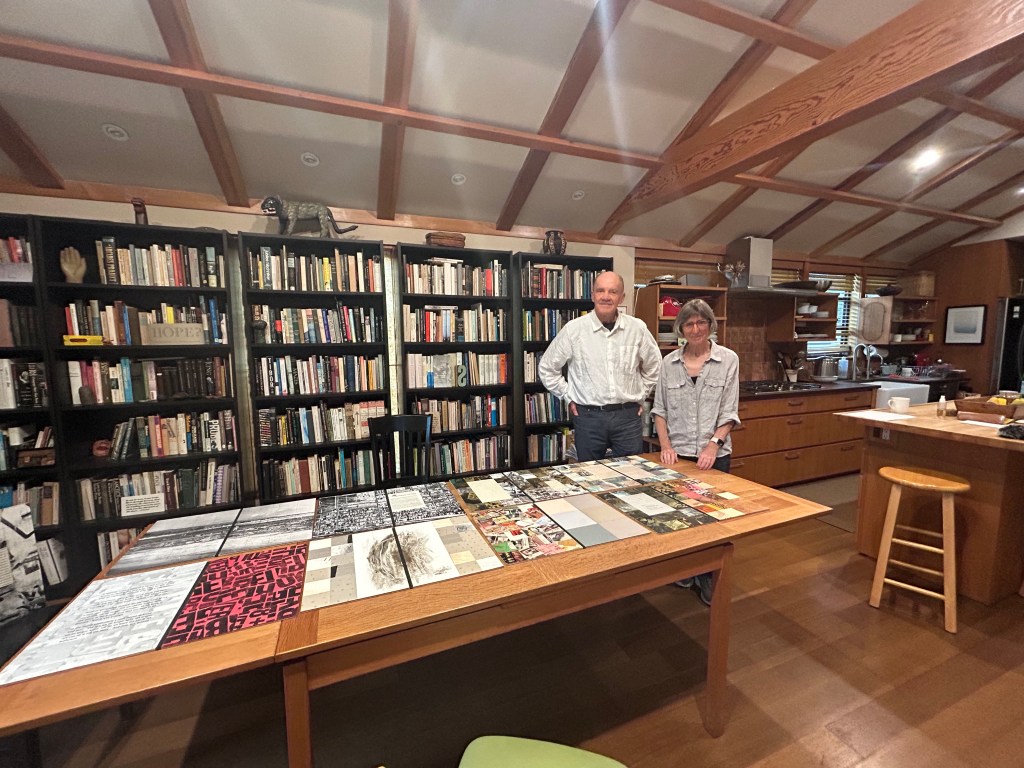
Harry Reese taught a range of classes at UCSB: print, papermaking, visual literacy, and more. He started as a lecturer and moved up the ranks, ending with a permanent professorship posting. Sandra Liddell Reese worked as a teacher before meeting Harry and finding she was suited to the technically driven work involved in the press.
Like the Soutars, the Reeses watch students come in and out of Isla Vista each year. Harry Reese described I.V. as “tidal.”
“This fluctuation of populations here, the notion that this is one of the only places that I know of — beach towns — where the population goes down in the summer,” he said.
Hearing this metaphor made me think I could apply another to I.V. I started thinking about Isla Vista as an ecosystem. I could envision I.V. not just as the land or the people or its housing but all together. Impact to one will impact the others.
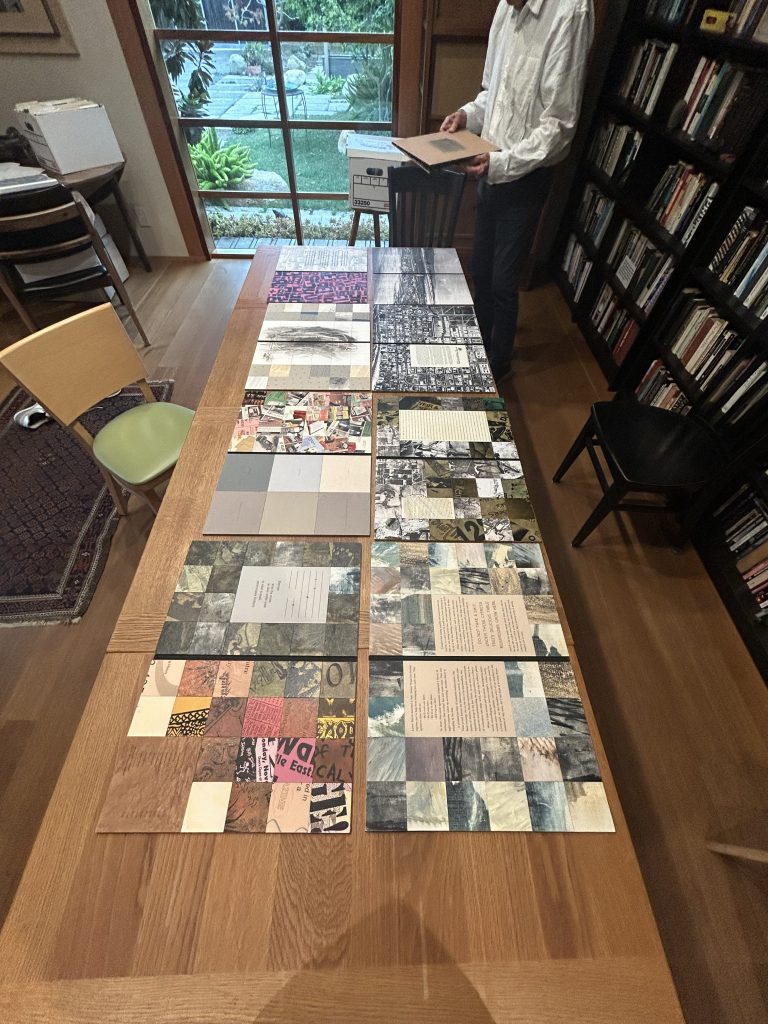
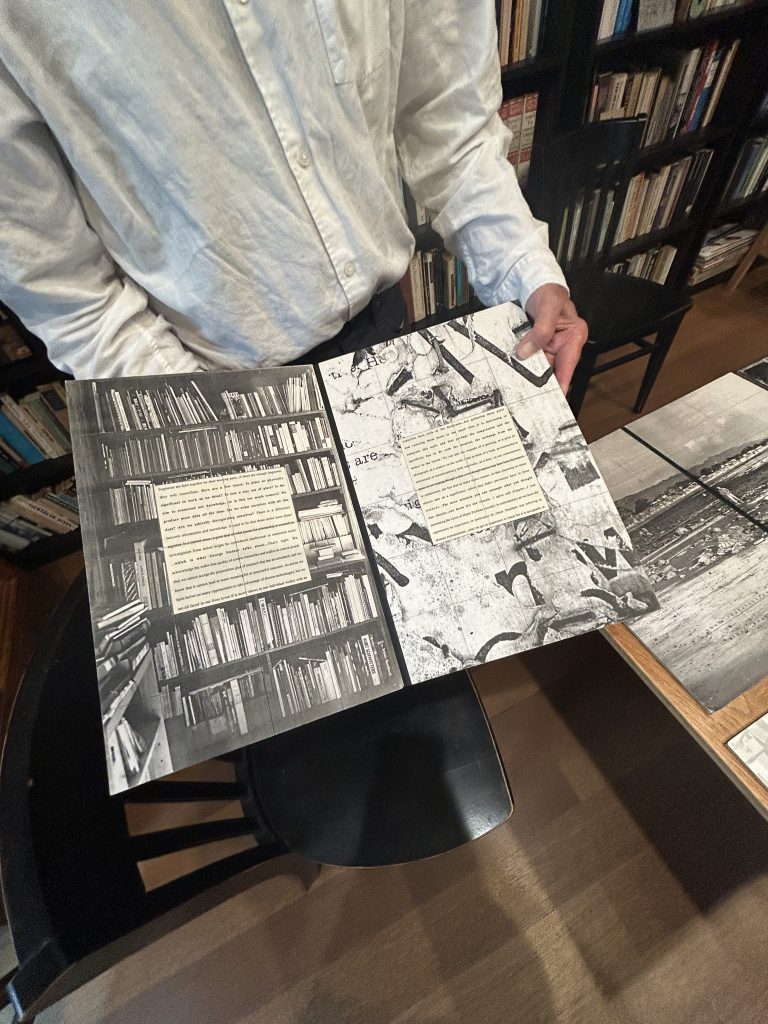
About 35 years ago, the Reeses completed a book installation about Isla Vista, called Near Goleta but Closer.
It was a line that Harry and Sandra heard from the child of a friend, about a made-up land the child had created. Harry Reese took the sentence structure and adapted it.
“I borrowed that line when I did this because I think of Isla Vista: Well, where is it? Well, it’s near Goleta, but it’s not quite in Goleta,” he said.
The Contemporary Arts Forum, now the Museum of Contemporary Art Santa Barbara, displayed the installation in open wood cases stuffed with eucalyptus and tar in a compartment underneath the books. That way, you could smell part of I.V. as you examined the work. There were nine books that opened to panels made of image and text — old fliers found on telephone poles and at kiosks that Sandra Reese collected around I.V., photographs, or pieces of conversation. There’s parable and lines pressed into the panels themselves.
I.V., Sandra Reese, said, gave the couple the freedom to do this creative work.
“I mean, when we’re beating paper, it’s loud, or when we’re running the printing press, it’s not so loud, except there’s a big clunk about every other minute or so, or the lights are on late,” she said.
She recalled how Harry had described I.V. as a kind of free zone. They could do work that may have disrupted neighbors in a traditional suburban environment.
“Isla Vista allowed us to work late at night and listen to very interesting radio and make these projects,” she said.
In turn, the Reeses kept patience for their neighbors. If the music was too loud at a nearby party, for example, they’d wait until 2 a.m. and then head over and tell them to turn it down firmly but politely, Sandra Liddell Reese said. Then, if they did, they’d bring over something for the party.
“There was one day when Harry said, ‘Sandra, get over here right now. There are these four guys walking up our driveway, and they’re asking for you,’ and they brought this box of chocolate with this thank-you note saying’ ‘Thank you for not calling the police,’” she said.
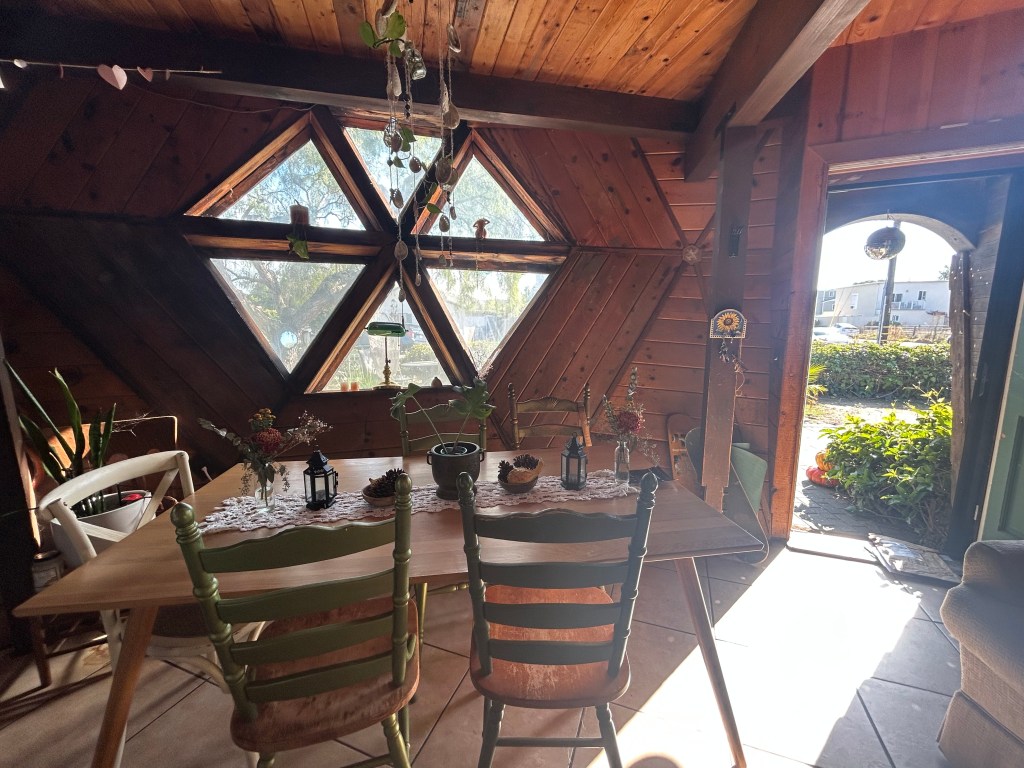
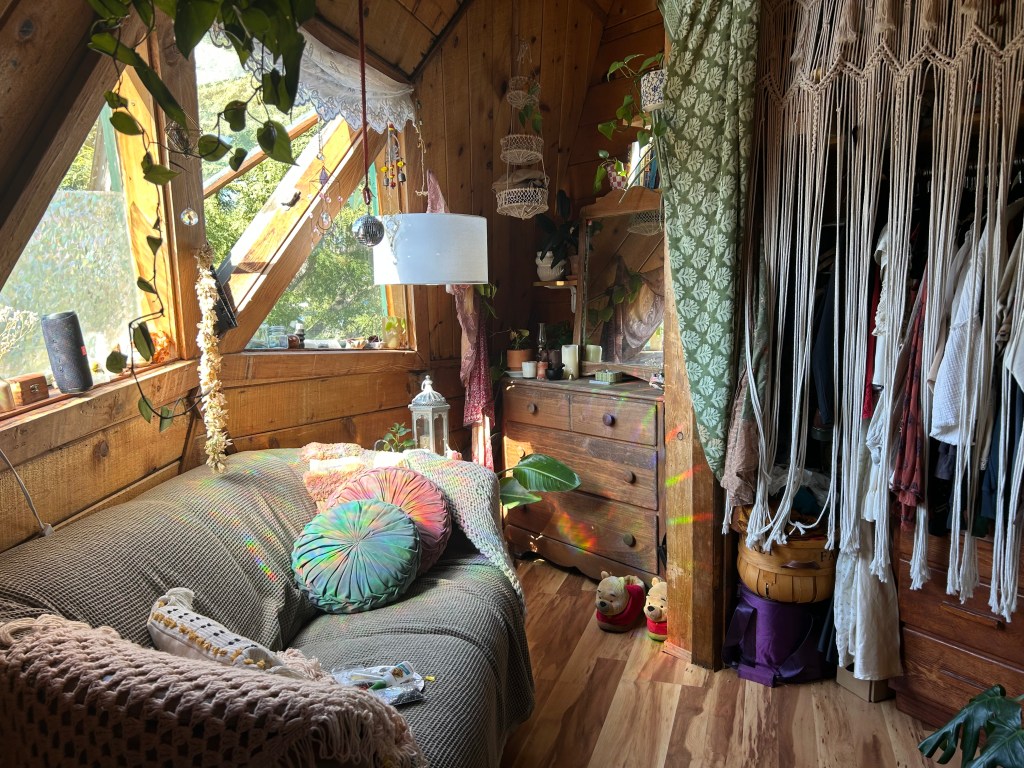
We’ve got one more stop this episode. Let’s head south, closer to the water. On Sabado Tarde, you’ll find a house shaped kind of like an egg. It’s Isla Vista’s dome house. Flowers grow in the yard around it. It’s a whimsical, peaceful corner lot.
In 1972 in Isla Vista, a man named Michael Hoover, alongside a colleague, George Buechley, decided to build the first geodesic dome house in Santa Barbara County.
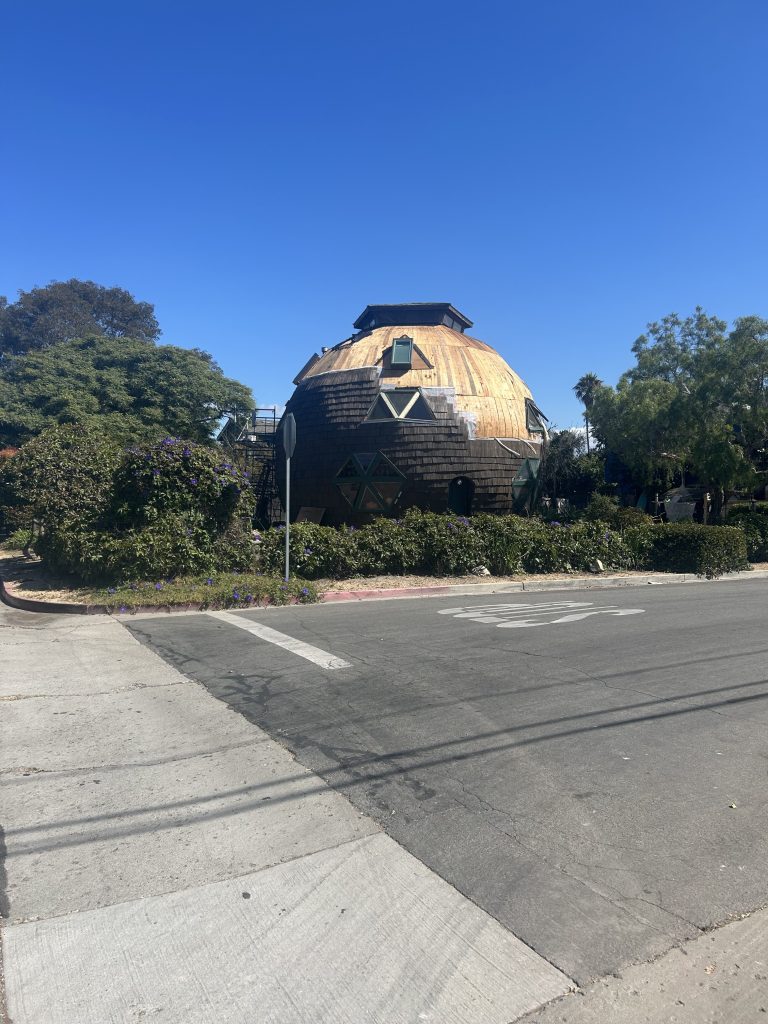
The dome house changed hands a few times. The current owner and his family have worked to reshingle the dome and added metal flashing to secure its windows and waterproof the structure.
It’s not cheap to maintain the dome house. To reshingle the dome cost the landlord upward of $70,000, they said. The windows, unconventional quadrilaterals or other non-typical window shapes, are difficult to keep from leaking.
Still, it feels like a wonderland inside. Wood stairs swirl up to the upper floor with rooms that capture light. The tenants clearly care about the space; there’s art and decor everywhere, and tenants add little improvements (with permission).
Gwen Sharp, a UCSB student, lives at the dome house.
“This house has just been such an amazing experience. Definitely my favorite part about it is the staircase and just having all the light that comes into the house. It just feels like you’re living in an acorn,” she said.
It struck me how much Sharp and her roommates seemed to like her space. The rent is reasonable for I.V., and the landlord said they specifically do not try to cram more people in.
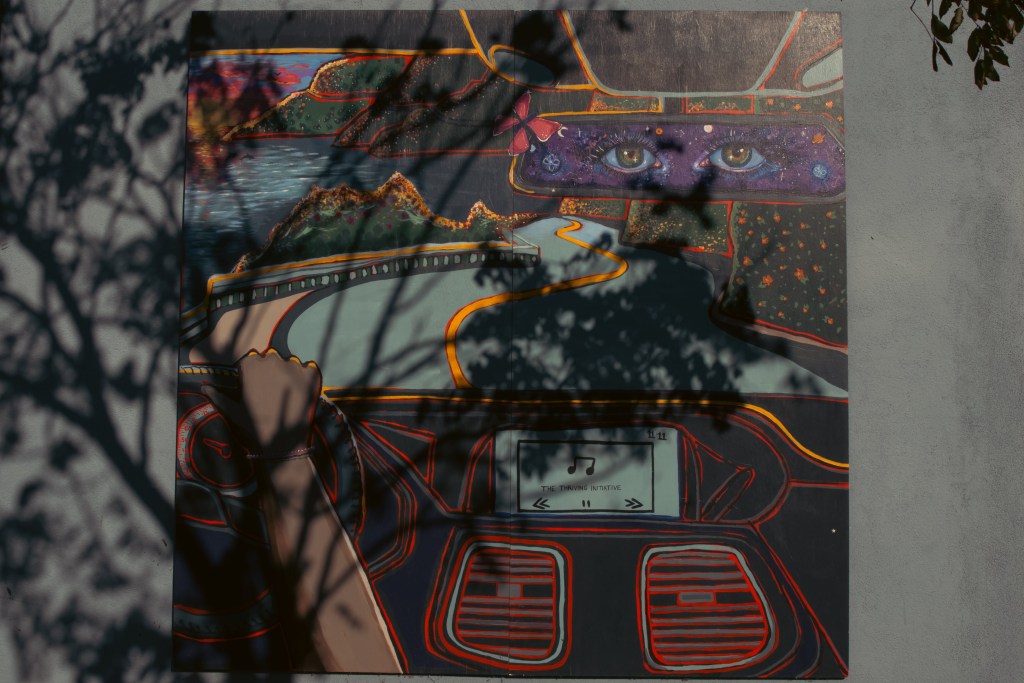
Let’s make one more stop this episode. If you head toward I.V.’s commercial core, you’ll see a mural on the side of a building of someone driving. In the rearview mirror, bright eyes on a purple face look back at you. Bear with me here, but those eyes make me think of the billboard of TJ Eckleburg in The Great Gatsby. But, unlike F. Scott Fitzgerald’s symbol, those eyes don’t strike me as judgmental, and they aren’t a sign of consumerism per se.
I look at that billboard, and I think about moving forward, even as we look back. Which is, in part, what I hope to do in Episode 6. We’ll go back in time again, yes, but we’ll also start to ask: What could help make I.V. better?
This is Welcome to Isla Vista.
That was Episode 5 of Welcome to Isla Vista. Next week, tune in to Episode 6 – The Cliff’s Edge. Property owners are cutting back parts of houses on Del Playa as the cliff erodes. Meanwhile, Santa Barbara County’s rental inspection program is underway. And in this episode, folks will talk about what could make I.V. a better place to live.
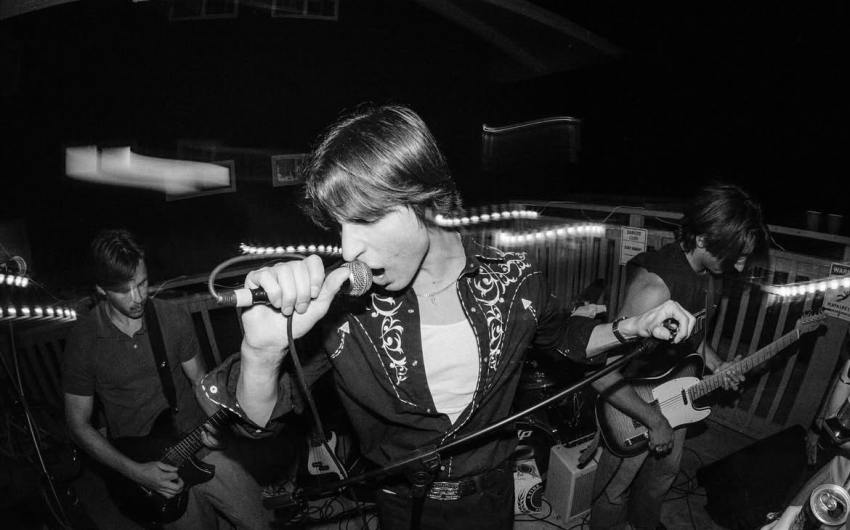
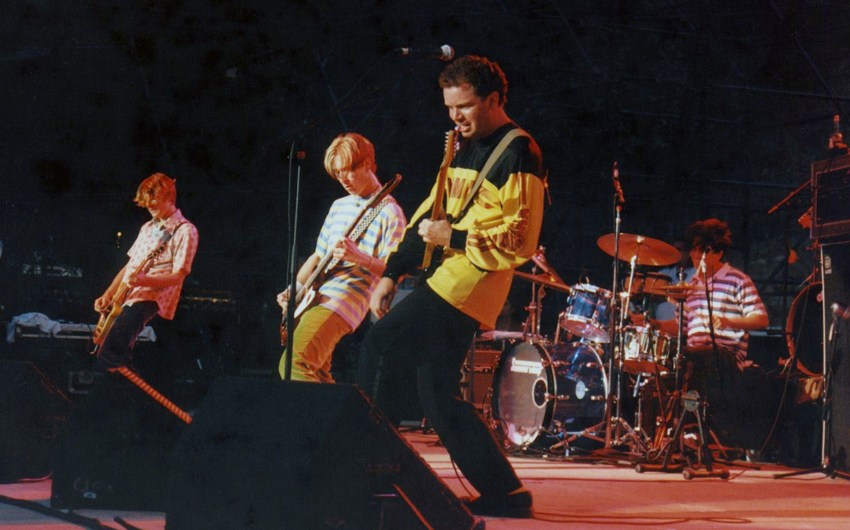
Episode 5 was written, fact-checked, recorded and produced by Christina McDermott. Episode 5’s script was edited by the Independent’s news editor, Jackson Friedman. The UCSB quote was voiced by Samantha Ausman. The audio on the renovation laws came from an April 6, 2023, Board of Supervisors meeting. The Munger Hall clip came from a KCBX news story by former News Director Ben Purper. And that song is “Sway” by Big Hungry [with Curran Hoxie on drums Avery Lindsey on bass, Moe Johnson on guitar and vocals, Stiles Fraser White on guitar and Nolan Guss on keyboard and vocals.]







You must be logged in to post a comment.