Lisa Hajjar, Front Row at Guantánamo Trial
UCSB Sociology Professor Observes Omar Khadr Proceedings

When Canadian-born Omar Khadr pleaded guilty last month as part of an agreement with prosecutors at the U.S. military commission at Guantánamo Bay Naval Base, Lisa Hajjar, associate professor of sociology at UC Santa Barbara, was among the observers who witnessed the proceedings.
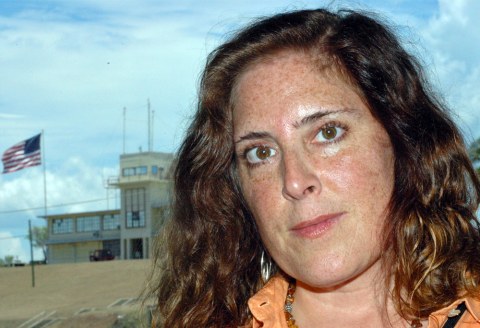
The most serious of the five charges against Khadr, who has been held at the naval base since October 2002, was the killing of a U.S. soldier in Afghanistan in July 2002. The Pentagon accused Khadr of throwing a grenade that killed Special Forces sergeant Christopher Speer. Khadr was 15-years old at the time.
“The case has a long and ignominious history,” said Hajjar. “We have a child soldier who was severely wounded when he was taken into custody; subjected to brutal interrogation and indefinite detention; and was one of the first 10 people charged – of all the 779 people who have passed through Guantánamo.”
Khadr is the last prisoner from a Western country at Guantánamo. Since July, Hajjar has attended three hearings on his case, the most recent and final one in the last week of October. Her interest in Khadr’s trial is part of a larger project that examines legal responses to American torture. “I’ve been interviewing lawyers and others involved in all kinds of work coming out of the war on terror, including people who defend Guantánamo detainees before the military commissions, and others who are habeas counsels for detainees who haven’t been charged and want to challenge the legitimacy of their indefinite detention,” she said. “I’ve also studied the legal work involved in Freedom of Information Act litigation because so much of the policy instituted during the (George W.) Bush years was secret.”
According to Hajjar, three significant issues were brought to light during Khadr’s trial: the veracity of the government’s evidence, which the defense contends was derived through torture; the legitimacy of militarily prosecuting a person who was a child at the time of arrest; and the legal legitimacy of the Bush-Obama reformulations of the laws of war that have, in essence, fabricated new kinds of war crimes.
“In April and May, during pre-trial hearings on defense motions to suppress Khadr’s self-incriminating statements on the grounds that they were the product of torture and are, therefore, involuntary and unreliable, numerous witnesses testified about the conditions under which he was interrogated,” Hajjar said. “Many trial observers had expected the presiding military judge to follow the pattern of other judges in previous military commission cases by retaining the statements from Guantánamo but excluding those from Bagram [Air Base], where Khadr had been held previously. Instead, the judge ruled that he found ‘no credible evidence’ that Khadr had been abused or that his treatment constituted violations of U.S. law. Therefore, all statements were admissible.”
Also of great significance are new interpretation of the laws of war, and how the terms “unlawful combatant” and “protected person” are defined. “We rewrote the laws of war in some ways to deal with Omar Khadr,” Hajjar said, noting that he is the only person ever charged with a “war crime” for killing a soldier in battle. “In the case against Khadr, if he actually threw the grenade that killed Sgt. Speer, he could be prosecuted for murder in Afghanistan. But a soldier is not a protected person under international laws of war,” Hajjar continued. “So to charge that the killing of a soldier in battle is a war crime is a post-9/11 novelty.”
Under the terms of the plea agreement, Khadr was sentenced to eight years in prison, the first of which he must serve at Guantánamo. At the end of that year he can apply for repatriation to Canada, where he will be subject to Canadian laws.
One concept that has struck Hajjar in her research and since observing the Khadr trial is how lawyers – particularly military lawyers – have been politically and ideologically transformed by their work. “Many military defense lawyers have been so disillusioned by the establishment of Guantánamo, the legalization of torture, and all kinds of aspects of the military commissions,” she said.
With the outcome of the Khadr case settled, questions now focus on the future of the Guantánamo detention center. “What does this mean for the way in which we’re going to enforce our international legal obligations?” Hajjar asks. “There is only one more case in the pipeline, and there are still 174 people in Guantánamo, 76 of whom have been cleared for release. In some ways, the Omar Khadr case stands as a precedent, and we don’t yet know how it will affect the future of Guantánamo or the military commissions.