

If you’ve ever driven through Goleta and felt a vague yet persistent urge to slap a “Keep Goleta Country” bumper sticker on your car, you’re not alone. The slogan has adorned cars, water bottles, and City Council meeting rants for decades. But as California’s Regional Housing Needs Allocation (RHNA) requirements crash headlong into local zoning politics, the quaint rural ideal of Goleta is facing an existential test.

RHNA makes up part of a state law that, since 1969, has required cities and counties to plan for their share of new housing across income levels. But the fight isn’t over whether Goleta should grow taller or pave over farmland — at least not on paper. Both planners and city leaders say they support “infill.” The real battle is over political will: urbanists argue that the city has shovel-ready sites it refuses to push forward, while officials point fingers at the state or at voters.
Depending on who you ask, the idea of keeping Goleta country is not only impossible — it’s already a figment of the past.
At the heart of the debate is a simple question with wildly complex answers: Where should the new housing go? On paper, Goleta must zone for 1,837 new housing units during California’s current eight-year RHNA cycle. In practice, that means choosing between infill development — more housing built within the urban core — or expansion into undeveloped land, including agricultural parcels. Goleta’s 2022 draft Housing Element was rejected by the state for relying on parcels unlikely to be developed and for failing to adequately address housing for special-needs groups.
“It is a privilege to not want change,” said Daniel Klemann, a UC Santa Barbara professor and assistant VP at WSP, an environmental planning firm. “It’s the people who already have theirs that want to keep everyone else out.”
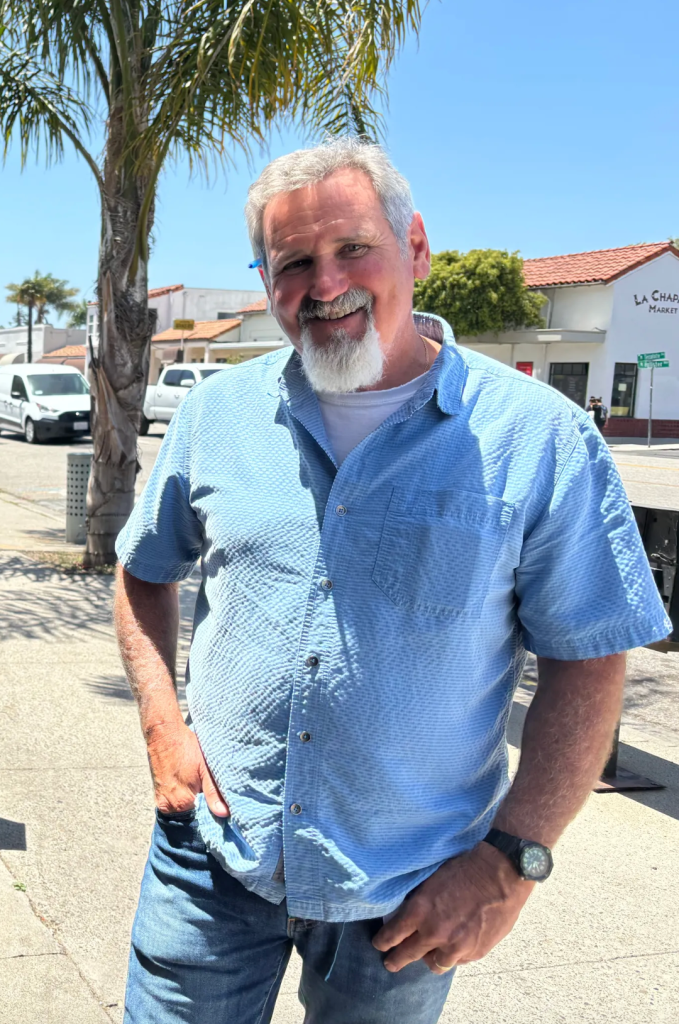
Klemann is also behind the Urbanize Goleta stickers — written in an edgy, Old English font with a black background; a stark contrast to the green and simple Keep Goleta Country emblems.
He advocates for what he calls environmental justice planning: higher-density housing built near jobs, transit, and services. He supports form-based codes and multi-modal access over suburban gridlock. For him, the fight isn’t about whether Goleta stays country; it’s about whether Goleta stays exclusionary.
But that battle of bumper stickers started with another voice — Goleta historian Tom Modugno. A transplant at six months old, Modugno is the man behind the original “Keep Goleta Country” design. The slogan, he admits, is a direct homage (or ripoff) of Oahu’s “Keep the Country Country” movement.
“We were over there on vacation, and I saw that sticker and thought — we need that for Goleta,” he said. “So I made it.”
Since then, the phrase has gained traction. It’s printed on T-shirts, hats, and mugs — and, according to Modugno, serves as a cultural rallying cry to preserve the city’s identity.
“To me, that means keep it agriculture, keep open spaces, keep it small town, keep the character of Goleta,” he said. “And the more we proceed into the future here, we are being taken over by people who don’t appreciate the culture that is Goleta and just want to build, build, build.” When asked where people should live, Modugno said infill is “a great thought” — but one he’s skeptical will ever materialize at scale.
Beyond Bumper Stickers

Meanwhile, Goleta Mayor Pro Tempore Stuart Kasdin pushes back on what he calls the state’s “cookie-cutter” approach. “What they want is vacant land from willing developers. And the only places that are going to satisfy that are ag lands,” he said. “It is a strategy of sprawl.”
Kasdin isn’t anti-density. He says he’s “perfectly comfortable” adding housing in transit corridors, and he doesn’t romanticize Goleta as pastoral paradise. “We’re not in a situation where Goleta is country anymore,” he said. “But we are in a situation where Goleta is residential, and how do we preserve the elements that are still here?”
The problem, Kasdin argues, is feasibility. Infill development is more expensive, complicated by commercial leases, demolition costs, and outdated zoning. “Nobody is helped if we build luxury condos and mansions,” he said. “If you want to make it more affordable, you have to advocate for unit size and amenities that serve students, seniors, and the working homeless.”
But according to Klemann, the state has already shifted gears. “The state is not incentivizing sprawl,” he said. “They are putting the pressure on cities to actually plan housing where people already live.”
He points to a growing stack of state-level reforms: recent CEQA streamlining laws, vehicle-miles-traveled (VMT) requirements, density bonus laws. All of them, he says, push cities toward urban development.
The California Department of Housing and Community Development (HCD) confirmed this, citing Government Code Section 65584(d), which requires that RHNA allocations promote infill, reduce greenhouse gas emissions, and protect environmental and agricultural resources.
This was reflected in the updated housing element — Goleta’s first draft of its Housing Element in 2022 leaned on parcels that were technically “available” but unlikely ever to become housing. For example, properties tied up in long-term leases, active commercial uses, or agricultural operations with no real prospect of redevelopment. By the time the certified version was adopted in early 2024, Goleta had shifted toward more realistic infill options and potential commercial conversions that had active interest from property owners.
So if the state is encouraging infill and local officials say they support it, why does new housing still seem to creep outward?
“Because it’s politically easier,” Klemann said. “Behind closed doors, I’ve had electeds tell me: ‘It’s a good project, but I can’t support it publicly or I’ll get voted out.'”
Meanwhile, in Isla Vista — the unincorporated student community immediately south of Goleta and home to most UCSB students — the housing shortage is already suffocating. Spencer Brandt, president of the Isla Vista Community Services District, called the housing shortage there a slow-burn crisis.

“When I lived in a three-bedroom on El Embarcadero seven years ago, we paid $6,580 per month. Today, the current tenants are paying double,” he said. “And the landlord is advertising it as accommodating two additional crowded-in tenants.”
Brandt sees a direct line from exclusionary zoning in Goleta to displacement in Isla Vista. “If we can’t accommodate our own housing needs in Isla Vista, Goleta, and Santa Barbara, we’re not stopping growth — we’re just pushing it into other communities and encouraging overcrowding.”
Even efforts to rezone Goleta’s commercial parcels — like the centrally located Yardi site on South Fairview Avenue — are slow to see progress. According to Kasdin, the site retained commercial zoning in an overlay, giving the owner the option to redevelop as housing but not requiring it. That lack of certainty, he said, made it ineligible for RHNA credit in a previous submission.
The site, however, was ultimately accepted in the city’s certified Housing Element in 2024 as a potential site for residential conversion. According to city spokesperson Kelly Hoover, Goleta’s Housing Element includes 26 vacant sites and 123 underutilized ones. She added that infill development remains the city’s stated priority, especially given the voter-approved Measure G, which requires a vote by the citizenry to rezone agricultural parcels larger than 10 acres.
Klemann says the loophole-closing is intentional. “The state’s learned its lesson,” he said. “Cities used to zone land for housing, which was completely unrealistic. Now the state’s closing the loopholes.” Earlier housing elements could count parcels that were unlikely to be developed — farmland, sites without infrastructure, or properties with long-term leases — toward their totals. Now HCD requires substantial evidence that sites are actually available.
State officials say cities can count new infill projects toward their RHNA numbers without resubmitting their housing elements, but any removal of farmland parcels from the site inventory would require a formal amendment.
Still, everyone agrees: The process isn’t working smoothly. Cities want flexibility to swap parcels. Residents want a say. The state wants enforceability. And somewhere in the middle, the dirt waits to be developed.
So what does “Keep Goleta Country” really mean in 2025? That depends on your ZIP code, your commute, your tolerance for change — and whether you think a two-bedroom should cost more than a year of UCSB tuition.
Related Posts





Premier Events

Sat, Mar 28
12:00 PM
Santa Barbara
Spring Fragrance Release Party

Sat, Mar 28
All day
Santa Barbara
Coffee Culture Fest

Sat, Mar 28
11:00 AM
Santa Barbara
NO KINGS 3!

Mon, Mar 30
6:00 PM
Santa Barbara
Art4Grief Support Group 2nd 2-Week Session

Thu, Apr 02
2:00 PM
Santa Barbara
S.B. Rescue Mission Annual Easter Feast

Thu, Apr 02
5:00 PM
Santa Barbara
Exhibit Opening: The Santa Barbara Independent: ‘Covering 40 Years’

Sat, Apr 04
9:00 AM
Santa Barbara
Mesa Harmony Garden Spring Plant Sale

Sat, Apr 04
9:00 AM
Santa Barbara
Passport Fair, hosted by Congressman Salud Carbajal

Sun, Apr 05
10:00 AM
Santa Barbara
Easter Brunch at Brass Bear

Thu, Apr 09
6:00 PM
Santa Barbara
Chaucer’s Books – Poetry Night

Sat, Apr 11
3:00 PM
Santa Barbara
SB Music Club Free Concert Saturday 🎶
Sat, Mar 28 12:00 PM
Santa Barbara
Spring Fragrance Release Party
Sat, Mar 28 All day
Santa Barbara
Coffee Culture Fest
Sat, Mar 28 11:00 AM
Santa Barbara
NO KINGS 3!
Mon, Mar 30 6:00 PM
Santa Barbara
Art4Grief Support Group 2nd 2-Week Session
Thu, Apr 02 2:00 PM
Santa Barbara
S.B. Rescue Mission Annual Easter Feast
Thu, Apr 02 5:00 PM
Santa Barbara
Exhibit Opening: The Santa Barbara Independent: ‘Covering 40 Years’
Sat, Apr 04 9:00 AM
Santa Barbara
Mesa Harmony Garden Spring Plant Sale
Sat, Apr 04 9:00 AM
Santa Barbara
Passport Fair, hosted by Congressman Salud Carbajal
Sun, Apr 05 10:00 AM
Santa Barbara
Easter Brunch at Brass Bear
Thu, Apr 09 6:00 PM
Santa Barbara
Chaucer’s Books – Poetry Night
Sat, Apr 11 3:00 PM
Santa Barbara


You must be logged in to post a comment.