

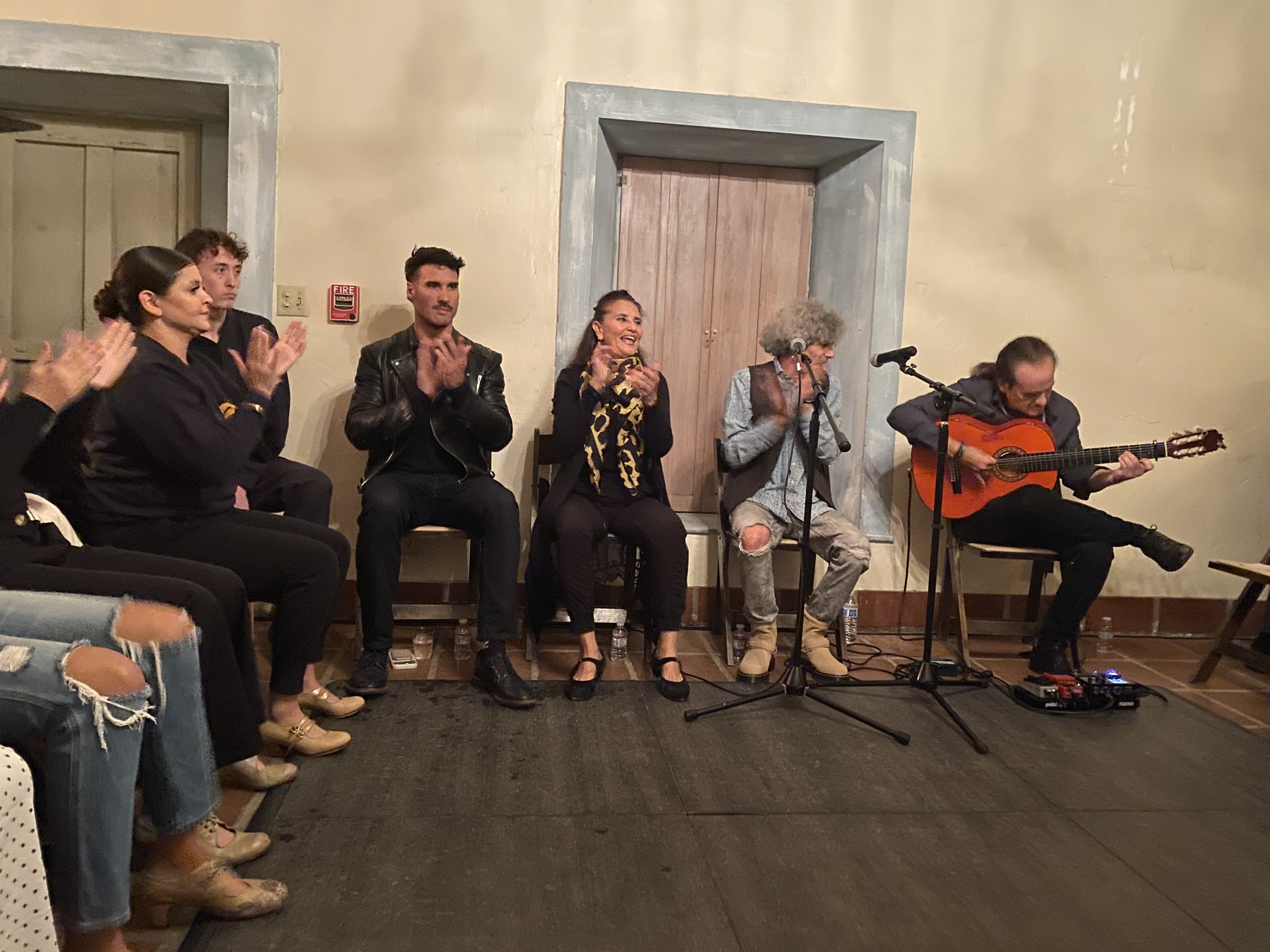
Joyful shouts of “¡Ale, ale!” and “¡Toma que toma!” surrounded the dancers as they improvised to music played by guitarist Alex Jordan from Cuba and singer Pepele Méndez from Jerez de la Frontera, with Jack “Joaquin” Harwood from Santa Barbara on cajón, and directors María Bermudez and Timo Nuñez leading the party.
Do you ever wonder how, besides going to class and rehearsal, the athletic young flamenco dancers whom we admire every summer during Fiesta, learn to perform with so much passion, precision, artistry, and duende?
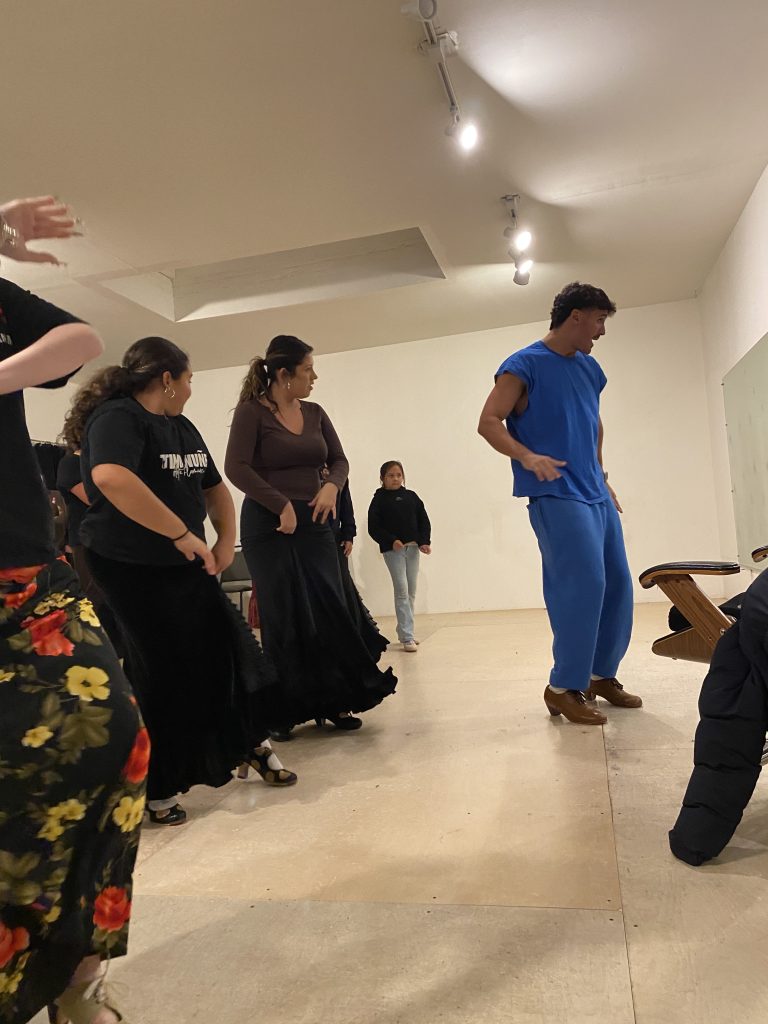
It is in the peñas, improvisational parties or jam sessions, put on by Flamenco! Santa Barbara, the Santa Barbara Historical Museum, and the Timo Nuñez Arte Flamenco studio, where students of all ages are invited to improvise with expert musicians, under the direction of María “La Chacha” Bermudez and Timo Nuñez. It is here that the young dancers practice the true art of flamenco and grow as artists.
In my story about the Peñas Flamencas la María last spring, I quoted José Velez, Secretary General of Cultural Innovations and Museums in Andalucía, as saying that it is in the peñas that the art of flamenco is kept alive, and where the next generation of flamenco artists is nurtured. You can experience this process in action at our local peñas, where the musicians and dancers bring Jerez de la Frontera to Santa Barbara.
Like many traditional music and dance styles from around the world, true flamenco is completely improvisational. The true flamenco artist is measured by how well he or she can improvise with musicians, in the various palos (musical styles) and compás (rhythmic structures) of flamenco.
As Nuñez explains in class, in every flamenco performance it is as important to play correct palmas as it is to dance. In addition to technique, dancers of all ages and levels train in compás — how to confidently express the various rhythms of flamenco in palmas (clapping) and zapateado (footwork).
At the peña Bermudez explained, “It’s very, very important to play palmas. [You must be] sensitive, listening to what the dancer is doing, but you also have to listen to what the guitarist is doing, what the singer is singing, because depending on what the singer’s singing, and the style that he’s singing in, the palmas can change.”
Out of the many palos of flamenco that are taught at the studio, the directors decided that the Tangos palo (in 4/4) should be emphasized at this peña. So, in the Thursday evening classes taught by Nuñez, Tangos was the theme.
As the music started, Maestra Bermudez called dancers to the floor one by one. Not to be confused with the ballroom version of tango which originated in Argentina, Tangos came from the regions of Cadíz, Jerez, Málaga, and Sevilla.
After around 30 minutes, everyone took a short break. Upon returning, Bermudez asked, “What shall we do next?” The answer: “Pepe wants to see you dance alegrías!” Alegrías, meaning joyful, has a 12-beat rhythmic structure which is slightly different from the 12-beat bulerías. Principal dancer Jack “Joaquin” Harwood, 2023 Spirit of Fiesta, danced a very beautiful alegrás.
Next on the program was soleá. “Who knows what soleá means? It means solo, or solitude,” said Bermudez. In this part of the program dancers improvised longer solos with the musicians, to slow, 12-beat-per measure, deeply emotional songs.
Then it was time to bring the mood up, so Nuñez called for the lively sevillanas. In 6/8 time and danced in couples, sevillanas is a festive, folk style performed at parties and gatherings by couples of all ages.
Nuñez selected three couples who each had to perform one copla (verse) of the sevillanas, and then all three had to perform the fourth and final copla together. It was admittedly a bit of a “nail biter” seeing who would be chosen, but all the couples performed flawlessly to thunderous applause. Then — what a treat! Bermudez and Nuñez danced sevillanas together, with some bulerías steps mixed in — just to show how it can be done.
The final palo of the evening was the popular bulerías, in 12 beats per measure. Bermudez explained the importance of bulerías in flamenco: “Who can tell me, Spanish speakers, what burla is? [Calls on someone.] Yes, a joke. Burla is joking. … So, a lot of the letras (verses) in bulerías are joking. They talk about life, and they’re very short. And listen,” she added, “Just FYI: In Spain, when we see dancers, bulerías is where we really critique them … If you can’t dance bulerías? Uh-uh [shakes her head ‘no’].” She turns to the singer, Pepele Mendez, and asks, “Right Pepe?” He asks, “¿Qué?” so she repeats in Spanish, “… En Jeréz … si no puede bailar por bulería? Ah-ah! Waaah! [noise like striking out in a game show],” and Mendez, who is from Jerez de la Frontera, the birthplace of flamenco, responds with a similar sound, “Aaah!” shaking his head. The audience all laughed.
Every dancer, and some of the “dance moms” as well, got up and improvised bulerías. All were amazing. It was a spectacular, joyful finale to the evening.
The peñas are educational and purely delightful experiences that happen approximately every three months at the Covarrubias Adobe in the Santa Barbara Historical Museum. All are welcome, dancers and non-dancers alike, from all studios! Keep checking the schedule on the Flamenco S.B. website for the next peña and other upcoming events. If you know nothing about flamenco, the peñas are a good place to get a taste of authentic flamenco, in an informal atmosphere.
And if you are not already a flamenco dancer, but want to learn, and maybe participate in a future peña, check out the class schedule at Timo Nuñez Arte Flamenco. You will be joining one of the most spectacular, friendly, welcoming and party-loving groups, who are also one of the most authentic, serious, hard-working, and interesting dance families in Santa Barbara, where all ages are welcome.
Related Posts


Premier Events
Fri, Mar 06
2:00 PM
Santa Barbara
Music & Meditation SB – Concert March 6, 2026
Sat, Mar 07
9:00 AM
Carpinteria
El Carro Park Cannabis Career Fair – Carpinteria

Sun, Mar 08
6:30 PM
Santa Barbara
6th Eco Hero Award Brock Dolman & Kate Lundquist
Fri, Mar 06
7:30 PM
Santa Barbara
An Evening with Steep Canyon Rangers

Fri, Mar 06
8:00 PM
Santa Ynez
Funk Band Kool & The Gang at Chumash
Mon, Mar 09
6:30 PM
Santa Barbara
Science Pub: Cyborg Jellies Exploring Our Oceans
Sat, Mar 28
All day
Santa Barbara
Coffee Culture Fest
Fri, Mar 06 2:00 PM
Santa Barbara
Music & Meditation SB – Concert March 6, 2026
Sat, Mar 07 9:00 AM
Carpinteria
El Carro Park Cannabis Career Fair – Carpinteria
Sun, Mar 08 6:30 PM
Santa Barbara
6th Eco Hero Award Brock Dolman & Kate Lundquist
Fri, Mar 06 7:30 PM
Santa Barbara
An Evening with Steep Canyon Rangers
Fri, Mar 06 8:00 PM
Santa Ynez
Funk Band Kool & The Gang at Chumash
Mon, Mar 09 6:30 PM
Santa Barbara
Science Pub: Cyborg Jellies Exploring Our Oceans
Sat, Mar 28 All day
Santa Barbara


You must be logged in to post a comment.