
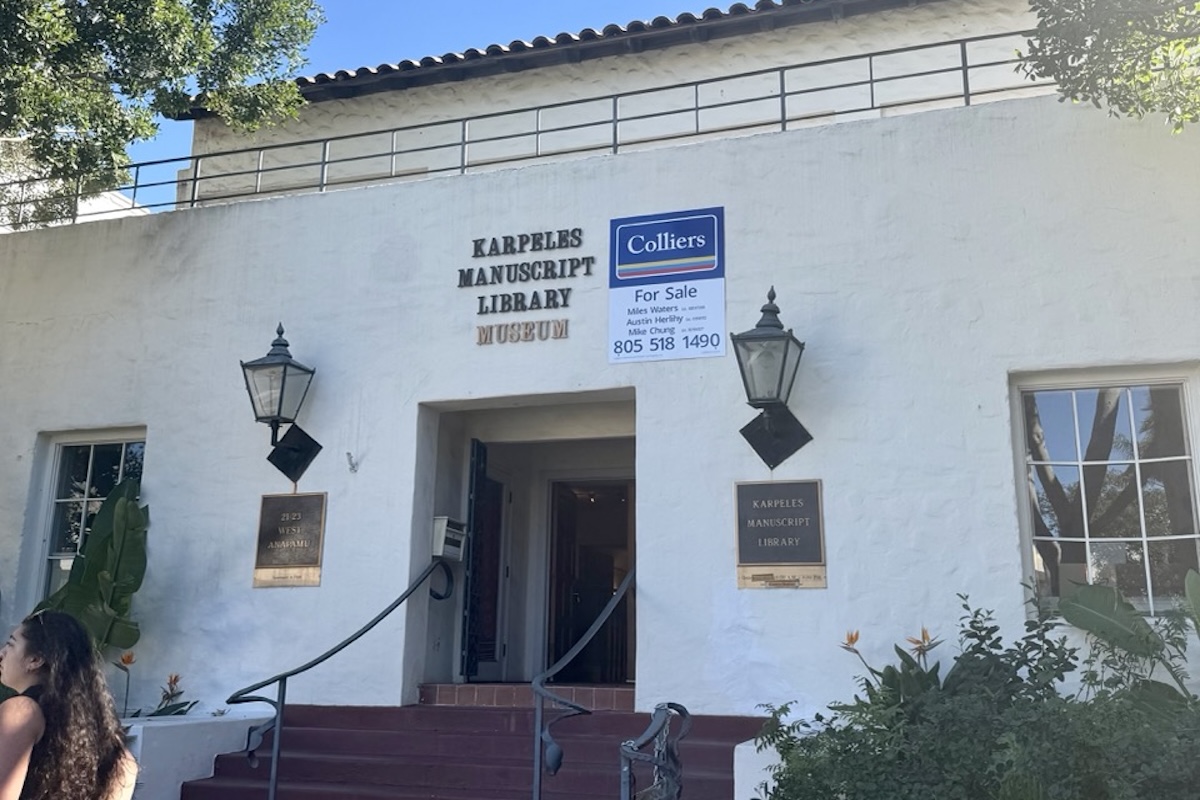
Indiana Jones went far and wide on his crusade for the Holy Grail. Dr. David Karpeles did not have to go nearly as far, though he shared the same fixation on significant historical objects. Instead of a whip and fedora, Karpeles had a checkbook — one that allowed him to open a trove of treasures, a trove which he has shared, free of charge, with the public for the last 43 years in Santa Barbara.
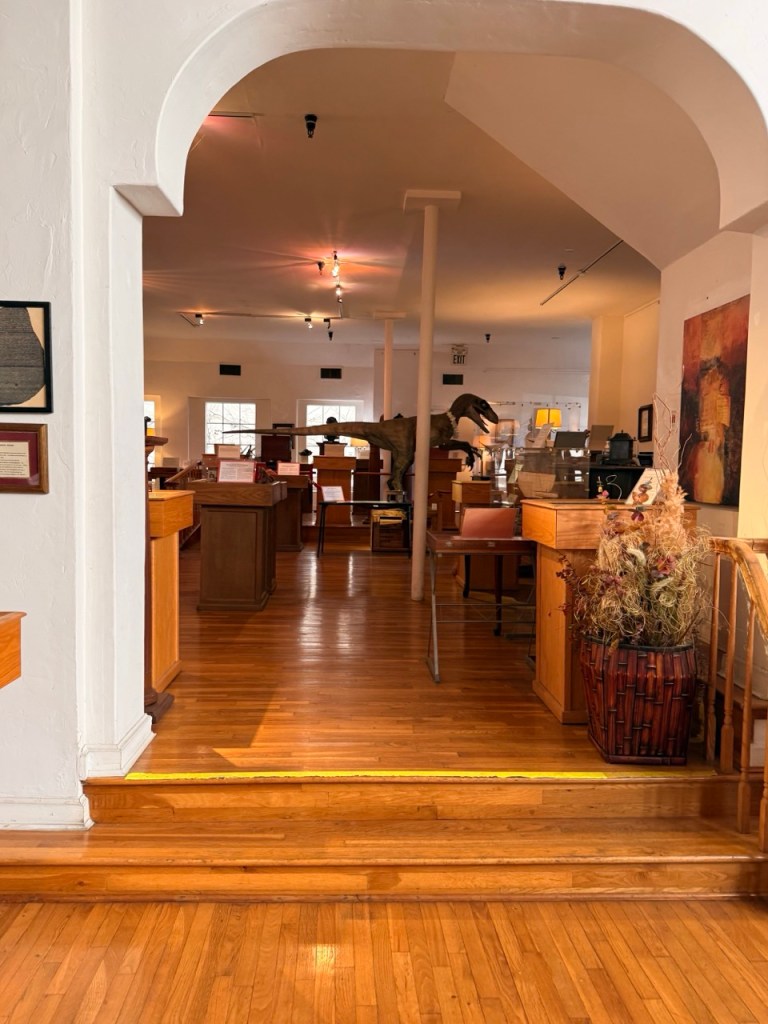
Honestly, it wouldn’t be entirely out of place if the cup of Christ were tucked away somewhere inside the unassuming building just off State Street. Now, the space that houses the original Karpeles Manuscript Library Museum — a place where the introduction page of the Declaration of Independence is held and a dinosaur egg sits encased in glass — is officially up for sale.
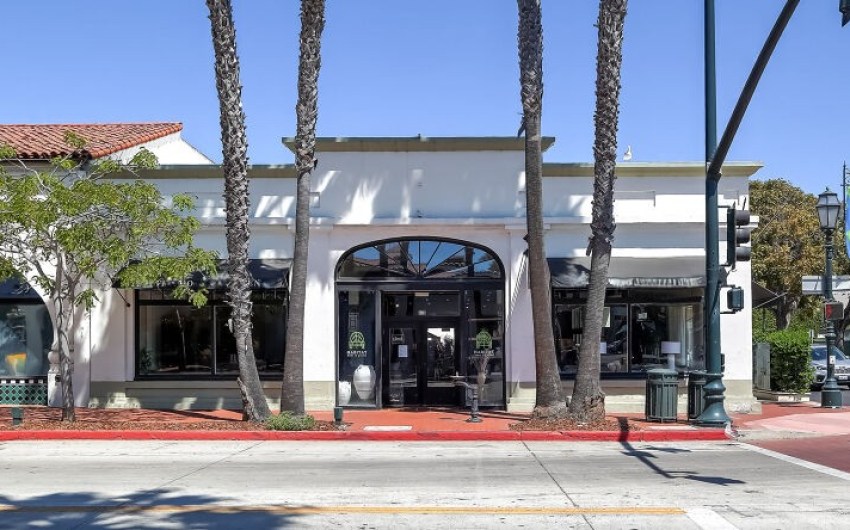
The downtown Santa Barbara building at 21 West Anapamu Street, the original and flagship Karpeles museum, is currently listed by Colliers for $3.9 million. The commercial listing notes the property will be delivered vacant at the close of escrow, even as the museum continues to operate its regular public hours.
The eventual closure, said Museum Director Norman Cohan, is tied not to a lack of interest or attendance, but to a broader shift following Karpeles’s death in 2022. His family, now based in Florida, has been consolidating the once-national network of Karpeles museums into a single primary location in St. Augustine, Florida, where renovations are ongoing.
“Their idea was always quality, rather than quantity,” Cohan said.
At its height, the Karpeles Manuscript Library Museum network included more than a dozen locations nationwide, all free to the public. First opened in 1986, Santa Barbara’s site was the first — and for years, the heart of the operation. Karpeles himself lived locally, bringing manuscripts up from a climate-controlled vault beneath his Montecito home.
That vault, which housed more than one million original documents, has since been moved to Florida. What remains in Santa Barbara is the museum experience Karpeles envisioned: rotating exhibitions, original and reproduction manuscripts, and a curator who reshapes the collection daily based on who walks through the door.
“These are significant manuscripts that change history,” Cohan said.
On any given day, visitors might encounter handwritten drafts of the Bill of Rights, early versions of the Emancipation Proclamation, correspondence from Albert Einstein and Charles Darwin, or a fragment of the Gutenberg Bible. There are ancient Egyptian artifacts, early scientific instruments, and relics from the Apollo 11 mission. The effect can be disorienting — to see pieces of history told millions of times right before your eyes, all tucked inside a modest, 1935-built structure that has lived many lives before this one.

Karpeles, a mathematician and professor who once worked in early computing and artificial intelligence, did not bankroll his collecting through inheritance or institutional backing. He built it. Beginning in the late 1960s, he turned his analytical mind toward Santa Barbara real estate. Over time, he amassed a portfolio of more than 300 residential properties, many concentrated in Santa Barbara and in cities where he later opened museums. He even earned recognition from then-Governor Jerry Brown in 1981 for a housing model that helped tenants transition into ownership through structured financing plans.
The income from those properties underwrote everything else: The auction paddles at Sotheby’s and Christie’s, the climate-controlled vault beneath his Montecito home, and the network of free museums that eventually stretched across more than a dozen states. To keep the doors open, court filings show that David and his wife, Marsha, routinely infused the museums with personal funds — sometimes thousands of dollars per week — as needed. At auction, Karpeles became known for edging out competitors by a single dollar, acquiring manuscripts that billionaires circled but did not quite secure.
“He always saw himself as one step ahead,” Cohan said.
Since Karpeles’s death in January 2022 — and after Marsha became incapacitated the year prior — stewardship of both the manuscripts and the real estate holdings has shifted to the children and grandchildren. Public property records show sales of former Karpeles holdings in Santa Barbara and other states where museums once operated, part of a broader consolidation effort as the family focuses on a single flagship location in St. Augustine, Florida. The empire that once funded a constellation of free museums is being streamlined.
The family has also pushed to digitize the archives, making thousands of manuscripts available online with interactive tools powered by artificial intelligence. “Right now, the grandchildren are putting us on the web,” Cohan said.
Even so, the Santa Barbara museum continues to draw a small but steady stream of visitors — about 20 people a day, Cohan said, with spikes during major exhibitions such as Titanic or Anne Frank. Over the years, tens of thousands of schoolchildren have passed through its doors.
Some visitors are longtime regulars. Others stumble in for the first time, expecting a small local exhibit and leaving stunned.
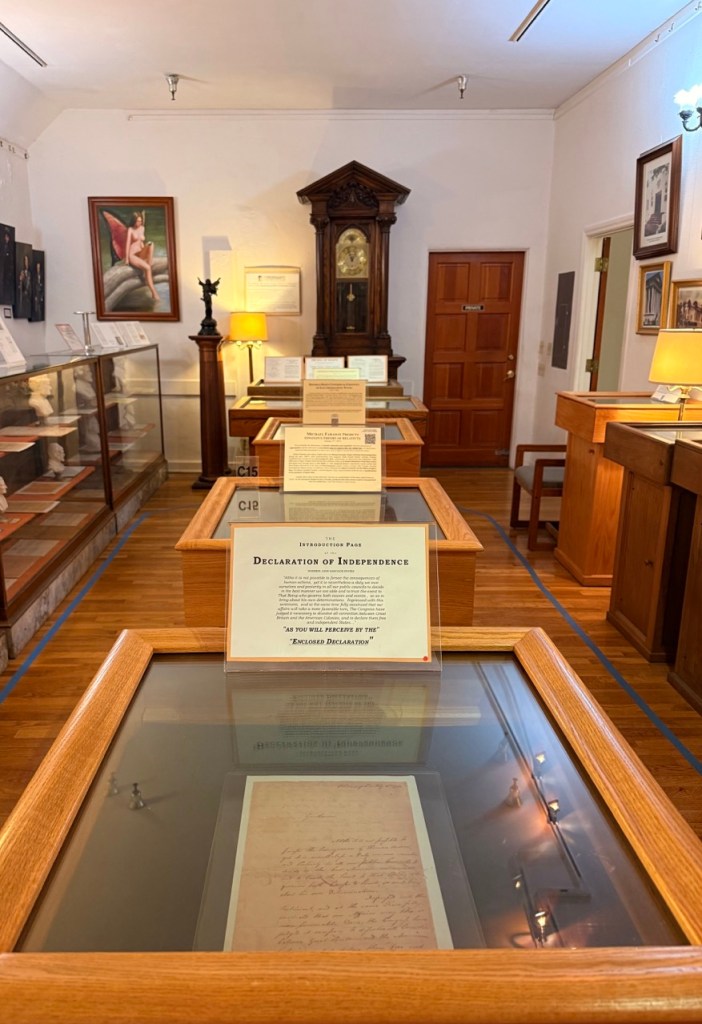
“People come in, and their minds are blown,” Cohan said.
Cohan is careful with superlatives, but he doesn’t dodge them. While institutions such as the Huntington Library hold millions more documents, he said Karpeles focused on manuscripts that mattered — documents tied to moments, people, and decisions that bent history’s arc. The collection favors the singular and the consequential: firsts, lasts, and one-of-ones. Among them is the Lettera Rarissima, the famously rare letter Christopher Columbus wrote to Queen Isabella after his fourth voyage to the Americas — a document so elusive that its very name translates to “the rarest of rare letters.” Karpeles owned one. It sat, improbably, in a downtown Santa Barbara museum.
Just how much the entire collection is worth is harder to pin down. Cohan said the shorthand estimate — more than one million manuscripts valued at roughly $1 billion — has circulated for years. In truth, he said, many of the documents defy pricing altogether. Provenance records trace ownership back centuries, and some manuscripts are so historically specific that replacement is impossible, giving “priceless” a new meaning.
What never changed, even as the collection grew in value, was access. Cohan points to the mission statement posted at the front of the building, which emphasizes preserving historical knowledge for future generations — especially children. The idea, he said, was simple: History works when people see it. Original documents offer a direct line to the past, unfiltered by retellings or algorithms, and remind visitors not just what happened, but how fragile that knowledge can be if it isn’t actively protected — how easy it is to repeat history when you don’t know your own.
“If you want the right answer, you go to the original source,” Cohan said. “An original-source document will give you the right answer.”
The building itself, zoned for a wide range of commercial and institutional uses, has survived more than a century of reinvention — from funeral home to fraternity house to nightclub before becoming a museum. It will likely find another purpose once sold.
But for the record, at one point in time, for multiple decades, the cream-colored, two-story building off Anapamu housed some of the rarest, most meaningful artifacts that shaped human history. And you do not have to survive a snake pit or dodge a giant rolling boulder to access it.
Karpeles Manuscript Library (21 W. Anapamu St.) is open 10 a.m.-4 p.m., Tuesday-Sunday.
Related Posts




Premier Events
Sat, Feb 28
2:00 PM
Santa Barbara
The Rhythm Industrial Complex: Live at Fox Wine
Fri, Mar 06
2:00 PM
Santa Barbara
Music & Meditation SB – Concert March 6, 2026

Sun, Mar 08
6:30 PM
Santa Barbara
6th Eco Hero Award Brock Dolman & Kate Lundquist
Fri, Feb 27
2:30 PM
Santa Barbara
Opera Santa Barbara presents “Caesar and Cleopatra

Fri, Feb 27
8:00 PM
Santa Ynez
Taylor Dayne at Chumash
Sat, Feb 28
10:00 AM
Santa Barbara
Celebrate African American & Black History Month
Sat, Feb 28
1:00 PM
Santa Barbara
Black History Month Art Salon: “Images with a Global View”
Sat, Feb 28
2:00 PM
Santa Barbara
CWC Global: The Art of the Benshi
Sat, Feb 28
7:00 PM
Santa Barbara
Schnack ‘N Bari Trio at Roy
Sat, Feb 28
8:00 PM
Goleta
NO PEACE – An 805 Hardcore Show and Fundraiser for 805 Undocufund

Sun, Mar 01
7:00 PM
Goleta
Natalie MacMaster, Donnell Leahy, Celtic All Stars
Fri, Mar 06
7:30 PM
Santa Barbara
An Evening with Steep Canyon Rangers
Fri, Mar 06
8:00 PM
Santa Ynez
Funk Band Kool & The Gang at Chumash
Sat, Feb 28 2:00 PM
Santa Barbara
The Rhythm Industrial Complex: Live at Fox Wine
Fri, Mar 06 2:00 PM
Santa Barbara
Music & Meditation SB – Concert March 6, 2026
Sun, Mar 08 6:30 PM
Santa Barbara
6th Eco Hero Award Brock Dolman & Kate Lundquist
Fri, Feb 27 2:30 PM
Santa Barbara
Opera Santa Barbara presents “Caesar and Cleopatra
Fri, Feb 27 8:00 PM
Santa Ynez
Taylor Dayne at Chumash
Sat, Feb 28 10:00 AM
Santa Barbara
Celebrate African American & Black History Month
Sat, Feb 28 1:00 PM
Santa Barbara
Black History Month Art Salon: “Images with a Global View”
Sat, Feb 28 2:00 PM
Santa Barbara
CWC Global: The Art of the Benshi
Sat, Feb 28 7:00 PM
Santa Barbara
Schnack ‘N Bari Trio at Roy
Sat, Feb 28 8:00 PM
Goleta
NO PEACE – An 805 Hardcore Show and Fundraiser for 805 Undocufund
Sun, Mar 01 7:00 PM
Goleta
Natalie MacMaster, Donnell Leahy, Celtic All Stars
Fri, Mar 06 7:30 PM
Santa Barbara
An Evening with Steep Canyon Rangers
Fri, Mar 06 8:00 PM
Santa Ynez


You must be logged in to post a comment.