
This article was underwritten in part by the Mickey Flacks Journalism Fund for Social Justice, a proud, innovative supporter of local news. To make a contribution go to sbcan.org/journalism_fund.
A federal judge has dismissed a lawsuit alleging that a state law illegally targets a single housing development behind the Santa Barbara Mission. In his June 2 ruling, District Judge Hernán D. Vera said that while the law in question, Senate Bill 158, raises “serious constitutional questions,” the case itself is unripe and does not provide a legitimate exemption to the state’s sovereign immunity. The ruling allows the housing developers to modify their complaint.
In October, The Mission LLC filed a lawsuit against both the State of California and the City of Santa Barbara. The suit alleged that the recently passed SB 158, a new law attached to the budget as a trailer bill, illegally singled out The Mission LLC’s project. Additionally, it said that the City of Santa Barbara did not have a compliant housing element.
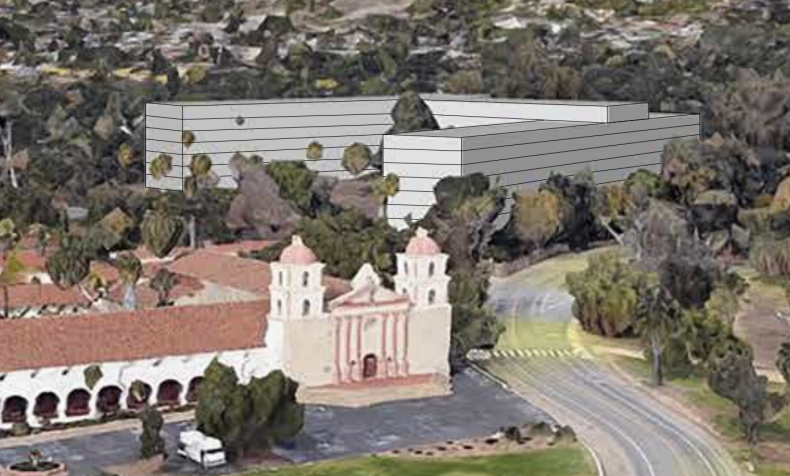
The Mission LLC is a shell company and the front-facing entity proposing a major housing project behind Santa Barbara’s Mission. The project leverages a state housing provision called builder’s remedy, allowing it to bypass zoning restrictions. The project would build 270 units in an eight-story building. Fifty-four of those units would be marked as low-income and rented for below market rate. It would also construct three stories of underground parking.
In June, state legislators passed laws to streamline the development of housing by allowing some projects to bypass environmental review. Then, in October, when state legislators accepted the fiscal year’s budget, they passed SB 158, which includes a specific list of factors that would “de-exempt” a project. Specifically, the law stated that builder’s remedy projects that meet the following criteria are not exempt from environmental review.
- Located in a city with a population between 85,000 and 95,000 and a county with a population between 440,000 and 455,000
- A property that is four acres or more
- A property with floodways as identified by FEMA
- A property with wetland as identified by the Department of Fish and Wildlife
- A property adjacent to a state historic landmark
The only project in the state that SB 158 appears to impact is The Mission LLC’s.
Environmental review would address a range of factors related to the project’s impact on its surrounding environment, from disruptions to archaeology to changes to traffic patterns and more. Along with its flood zones and wetlands, the property abuts a historic graveyard and has known archaeological resources on it. It also contains an underground creek and is located in an area with the potential for landslides. Locals have raised concerns over added traffic: Traffic would circulate on a narrow road that serves as an exit out of the Mission Canyon neighborhood, which is in a “very high”–severity zone for fire risk, according to the CalFire.
In his ruling, Judge De Vera writes that The Mission LLC’s complaint is “woefully short” on the specifics needed to prove the case involves a real, ongoing dispute, rather than a hypothetical. De Vera writes that the project’s application is still under review and that although during oral arguments, The Mission LLC’s attorney spoke about administrative delays that might evoke financial hardship (which would give it concrete injury), discussion of these delays are nowhere in the legal complaint, and are therefore not on record.
Additionally, De Vera said The Mission LLC “fails to seriously wrestle with the 11th Amendment issues presented.” The 11th Amendment gives states immunity from being sued without their consent. Further case law provides specific exemptions to this amendment, but De Vera rules that The Mission LLC does not sufficiently satisfy the requirements for an exemption.
Still, De Vera’s ruling called SB 158 “troubling.”
“Without expressing any opinion on the merits of Plaintiff’s arguments, the Court concludes on a first reading that there are serious constitutional questions raised here,” De Vera wrote.
De Vera’s ruling said that the case’s “ripeness defects,” or lack of grounded controversy, is “eminently curable” should the Mission LLC include its oral arguments in its complaint, and gives the Mission LLC a chance to “edit” the complaint. The company has until June 22 to do so.
This lawsuit is not the Mission LLC’s first. The company, which is managed by real estate investor Ben Eilenberg, sued the City of Santa Barbara in Superior Court in 2025, alleging the city deliberately tried to hold up the project’s application process. In April, Judge Thomas Anderle tentatively ruled to dismiss the case.
In June 2025, the Mission LLC sued Santa Barbara County over its request for property tax payments. The Mission LLC alleges it rents to a church, the Universalist Unitarian Mission, and is therefore exempt from paying property taxes. A husband-and-wife team, Craig and Stephanie Smith, who are working with Eilenberg on a development at 1609 Grand Avenue in Santa Barbara, are listed as the chief officers for the Universalist Unitarian Mission LLC, the other plaintiff in this suit. The Universalist Unitarian Mission is unrelated to the Unitarian Society of Santa Barbara. Judge Anderle will make his judgment in that case on August 5. Currently, The Mission LLC owes $319,000 in property taxes at 505 E. Los Olivos Street.
The Mission LLC did not respond to a request for comment in time for this story.
Related Posts







Premier Events

Mon, Oct 26
7:00 PM
Santa Barbara
Beauty and the Origins of Electrophysiology, Telecommunications & the Global Theater
Mon, Oct 26
5:00 PM
Montecito
Halloween at The Speakeasy at San Ysidro Ranch

Mon, Oct 26
6:00 PM
Santa Barbara
Chaucer’s Book Talk & Signing with Jennifer Chassman Browne “See Us, Know Us: Profiles of Disability”

Wed, Oct 28
5:00 PM
Santa Barbara
Fundraiser for Domestic Violence Solutions

Wed, Oct 28
7:00 PM
Santa Barbara
Reel Rock 20 Climbing Film Tour

Wed, Oct 28
7:00 PM
Goleta
IVRPD Presents : Halloween Pumpkin Patch

Thu, Oct 29
6:00 PM
Santa Barbara
Halloween Paint & Sip at Goodland Wine Shop
Fri, Oct 30
12:00 AM
Montecito
Día de los Muertos at The Speakeasy

Fri, Oct 30
11:30 AM
Santa Barbara
🌼💀 Join us for Día de los Muertos! 💀🌼

Fri, Oct 30
2:00 PM
Santa Barbara
“Sea to Summit “Art Exhibit & Benefit Oct 30 & 31

Fri, Oct 30
3:00 PM
Santa Barbara
Family Movie Night at the Eastside Library: “Coco”
Mon, Oct 26 7:00 PM
Santa Barbara
Beauty and the Origins of Electrophysiology, Telecommunications & the Global Theater
Mon, Oct 26 5:00 PM
Montecito
Halloween at The Speakeasy at San Ysidro Ranch
Mon, Oct 26 6:00 PM
Santa Barbara
Chaucer’s Book Talk & Signing with Jennifer Chassman Browne “See Us, Know Us: Profiles of Disability”
Wed, Oct 28 5:00 PM
Santa Barbara
Fundraiser for Domestic Violence Solutions
Wed, Oct 28 7:00 PM
Santa Barbara
Reel Rock 20 Climbing Film Tour
Wed, Oct 28 7:00 PM
Goleta
IVRPD Presents : Halloween Pumpkin Patch
Thu, Oct 29 6:00 PM
Santa Barbara
Halloween Paint & Sip at Goodland Wine Shop
Fri, Oct 30 12:00 AM
Montecito
Día de los Muertos at The Speakeasy
Fri, Oct 30 11:30 AM
Santa Barbara
🌼💀 Join us for Día de los Muertos! 💀🌼
Fri, Oct 30 2:00 PM
Santa Barbara
“Sea to Summit “Art Exhibit & Benefit Oct 30 & 31
Fri, Oct 30 3:00 PM
Santa Barbara

