
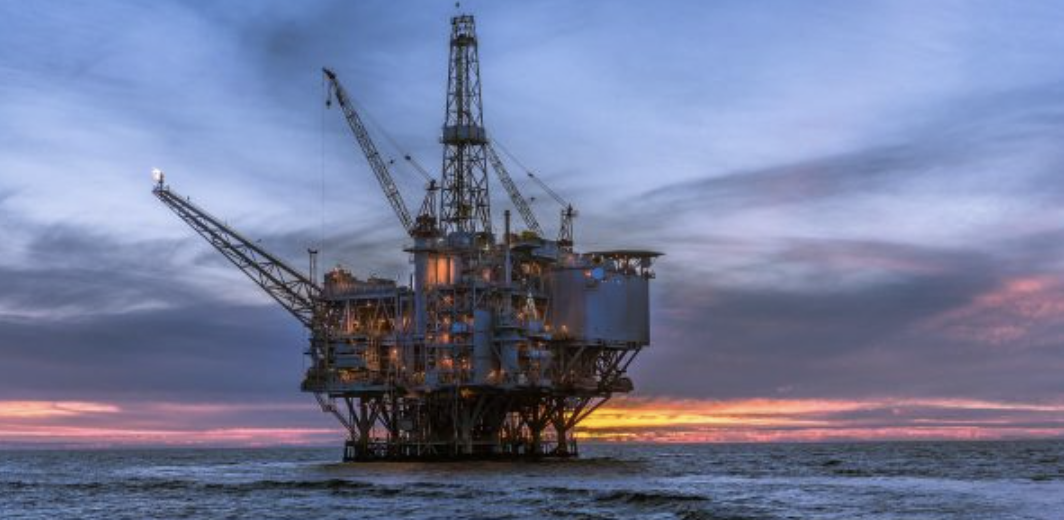
Terrence Dressler, the quasi-judicial hearing examiner for the Air Pollution Control District (APCD), granted Sable Offshore a five-day waiver — known technically as a variance — for having exceeded the amount of air pollution allowed under its permit allowing oil and gas production at Platform Heritage located eight miles off the coast. Dressler ruled in favor of the variance over opposition from environmental activists who have been opposing Sable for the past two years, explaining he believes Sable’s claims that it will fix the problems giving rise to these unforeseen air pollution exceedances within the next 90 days. If they don’t, he said, they will be in violation, and the district does not allow violations to continue.
In an interview shortly after last Thursday’s hearing, Dressler explained that the technical “hiccups” afflicting Platform Heritage are not uncommon when oil platforms first start up. Although Heritage is hardly a new platform, it has been shut down for the past nine years and only just started up again this March amid a swirl of ever-expanding political melodrama. Since then, the company reported in its application for a variance that Platform Heritage — one of the three Sable bought from Exxon two years ago — has experienced “an unexpected number of equipment malfunctions, onshore and offshore production balancing issues, and well production issues that are related to restart of the platform and which have resulted in excess unplanned flaring.”
Under its permit with the APCD, Sable is allowed to release up to a ton of emissions — reactive organic carbons mixed with nitrogen oxides — due to what are called “unplanned flarings” every three months. In this case, that would be June 30. But according to papers filed by company representative Patrice Surmeier, Sable had exceeded its 90-day limit on May 22. Without a variance, Sable could have been found in violation of its operating permits and be subjected to fines and other enforcement actions accordingly.
Sable’s representative told Dresser that the company had spent $110 million over the past year trying to get Heritage ready for start-up, dispatching no fewer than 180 crew and multiple additional technical specialists and consultants to the platform. Every piece of equipment that could be inspected and tested, she assured Dressler, had been tested and inspected. Still, the problems persisted and confounded the ingenuity of the best experts the company hired.
Dressler said he was not surprised. “In my experience, this is not unusual for a start-up,” he said. “I was with the APCD for 34 years before retiring 15 years ago, so I’ve seen this.” He added, “This is not a simple problem. It’s a complex problem. They [Sable] seem to be confident they have found a solution.” In fact, he added, platform permits typically contain special grace periods for platforms during their early start-up phase in anticipation of such technical jitters. Because Heritage is not technically a new platform — just one restarting after a nine-year hiatus after the Refugio pipeline spill of 2015 — no such grace period was written into Heritage’s permit. Hence, he said, the variance proceeding was held.
Dressler stressed Sable’s first three-month permit period expired on June 30. After that, a new three-month period begins during which time the company has said it can get its unplanned flaring emissions down to within permissible levels. The company will be required to provide regular monitor reports in the meantime.
While with the APCD, Dressler dealt extensively with offshore oil emissions permitting and enforcement issues and remembers sitting across the negotiating table from at least one high-ranking Exxon engineer — Steve Rusch — who is now part of Sable’s leadership team today.
Attorneys from the Environmental Defense Center (EDC) and the Center for Biological Diversity argued unsuccessfully for a time extension on the variance hearing; Linda Krop with the EDC objected that Dressler could not make the findings to legally support the variance because Sable provided no evidence to back up its assertions that a solution was within sight or that the company would actually lose $1.75 million a day in revenues if Sable were forced to curtail its production. Dressler needed more than Sable’s “conclusory” language to legally justify the variance.
Dressler was persuaded that if production were curtailed in response to the exceedances as Sable’s critics urged, that the air pollution problems stemming from unplanned flaring would be far worse than the exceedances to date. When asked by how much, Dressler said he did not have specific numbers, but stressed, “a whole lot worse,” adding, “far more pollution.” He explained that total curtailment would entail the complete and total depressurization of the entire platform, a process he said would trigger far more emissions than the unplanned flaring problems now are. As it is now, Dressler said, the APCD has not received any complaints that the emissions thus far constitute a nuisance, an annoyance, or a health threat. The platform is located eight miles off the coast.
Sable’s representative Patrice Surmeier obliquely warned Dressler that if he sought to curtail or modify production at Platform Heritage, the APCD would have the Trump administration to deal with, Trump’s Secretary of Energy Chris Wright having ordered Sable to commence production at the beginning of the year as a matter of nation security. In so doing, Wright invoked the Defense Production Act, passed in 1950 and signed into law by President Harry Truman. During the second week of July, the Ninth Circuit Court of Appeal is scheduled to hear legal arguments whether the federal government or state agencies have the final word over what rules and regulations Sable is forced to abide by.
Typically, variance hearings take place with a striking absence of public interest. But given Sable’s protracted high-profile legal warfare with multiple county and state regulatory agencies over the company’s refusal to recognize their regulatory authority, last week’s hearing drew attention from activists and the local media. Dressler, who was working with the APCD back when the agency went to the political mattresses against Exxon and the federal Department of Commerce several decades ago — and won — was mindful of the considerable ambient noise Sable generates and whether that might color his decision making.
“I had to ask myself, ‘If this was not Sable, would I have made the same decision?’ The answer is yes. We don’t have a special set of requirements for Sable because they’re Sable. Sable gets equal protection.”
Related Posts
Premier Events

Tue, Oct 13
7:30 PM
Santa Barbara
IWC Study Circle – October 2026 Program

Wed, Oct 14
5:30 PM
Santa Barbara
Free Home Hardening & Firescaping Workshop
Fri, Oct 16
7:00 PM
Santa Barbara
Divine Within: A Sufi Exploration of Love & Unity
Sat, Oct 17
9:30 AM
Santa Barbara
Divine Within: A Sufi Exploration of Love & Unity
Sun, Oct 18
9:30 AM
Santa Barbara
Divine Within: A Sufi Exploration of Love & Unity
Fri, Oct 23
2:00 PM
Santa Barbara
Music & Meditation: Clarinetist Nancy Mathison & Pianist Antonio Artese
Fri, Nov 13
7:00 PM
Santa Barbara
Divine Within: A Sufi Exploration of Love & Unity
Sat, Nov 14
9:30 AM
Santa Barbara
Divine Within: A Sufi Exploration of Love & Unity
Sun, Nov 15
9:30 AM
Santa Barbara
Divine Within: A Sufi Exploration of Love & Unity
Fri, Dec 11
7:00 PM
Santa Barbara
Divine Within: A Sufi Exploration of Love & Unity
Tue, Oct 13 7:30 PM
Santa Barbara
IWC Study Circle – October 2026 Program
Wed, Oct 14 5:30 PM
Santa Barbara
Free Home Hardening & Firescaping Workshop
Fri, Oct 16 7:00 PM
Santa Barbara
Divine Within: A Sufi Exploration of Love & Unity
Sat, Oct 17 9:30 AM
Santa Barbara
Divine Within: A Sufi Exploration of Love & Unity
Sun, Oct 18 9:30 AM
Santa Barbara
Divine Within: A Sufi Exploration of Love & Unity
Fri, Oct 23 2:00 PM
Santa Barbara
Music & Meditation: Clarinetist Nancy Mathison & Pianist Antonio Artese
Fri, Nov 13 7:00 PM
Santa Barbara
Divine Within: A Sufi Exploration of Love & Unity
Sat, Nov 14 9:30 AM
Santa Barbara
Divine Within: A Sufi Exploration of Love & Unity
Sun, Nov 15 9:30 AM
Santa Barbara
Divine Within: A Sufi Exploration of Love & Unity
Fri, Dec 11 7:00 PM
Santa Barbara

