
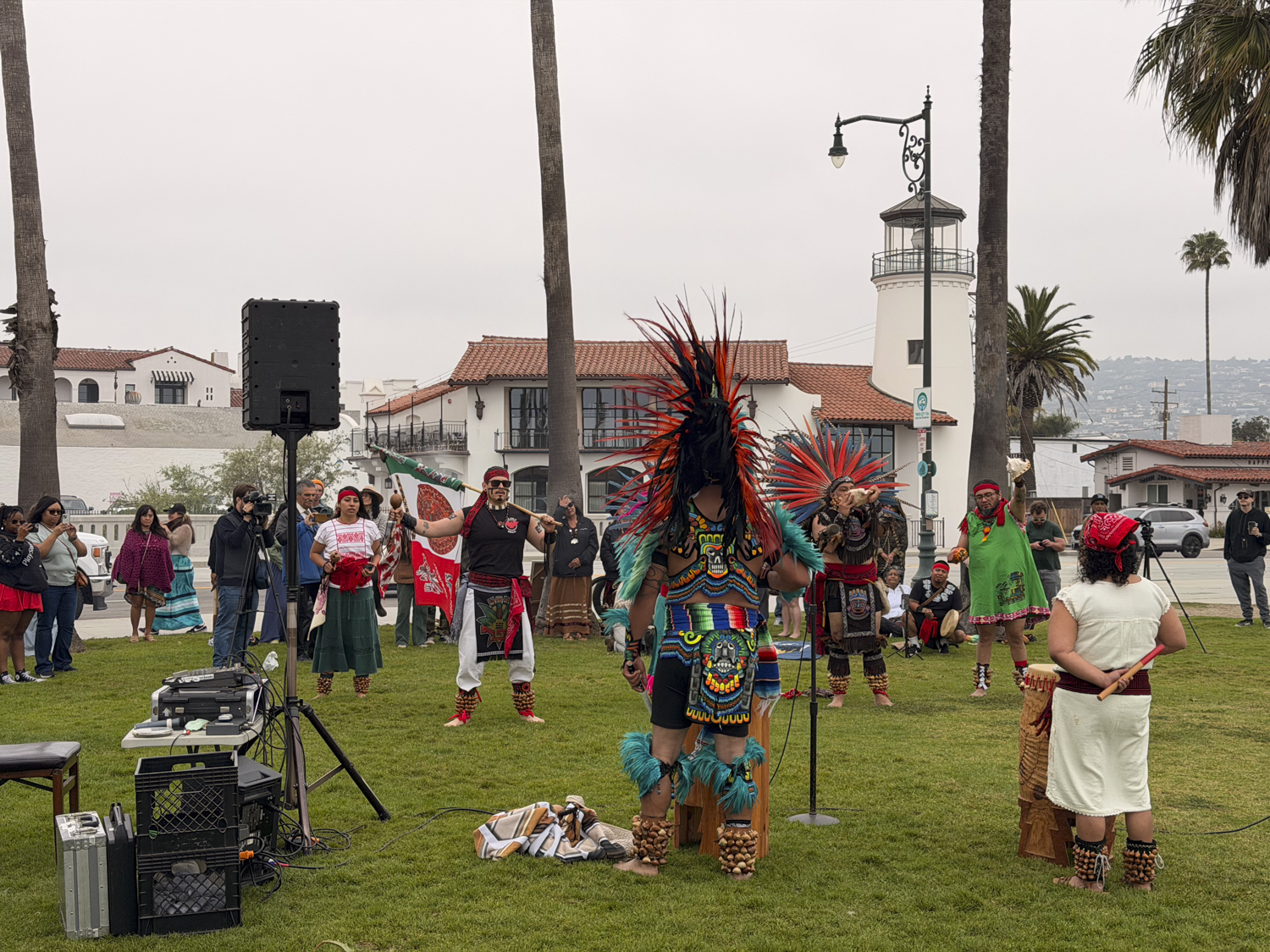
Friday morning, dozens of people gathered near the dolphin statue on Stearns Wharf to protest Sable Offshore and support Chumash matriarchs in their fight against oil drilling. Chumash songs were sung and Aztec dancers graced the lawn in dance that also served as prayer.
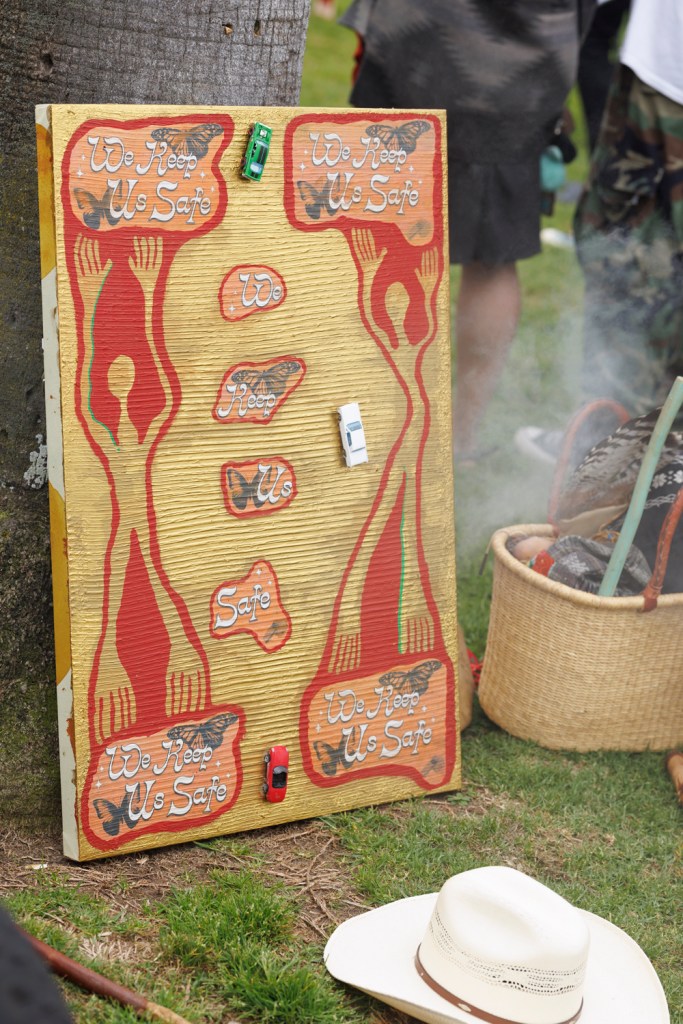
Almost two weeks ago, oil started flowing once again through pipelines owned and operated by Sable Offshore from Platform Harmony to Las Flores Canyon Processing Facility in Santa Barbara County. Trump issued an order for the company to resume pumping, invoking the Defense Production Act. Gas prices continue to rise across the country due oil shipping being blocked in the Strait of Hormuz — Iran’s retaliation on the U.S. and its allies after Trump’s unofficial war and continual U.S. and Israeli strikes on the country. California Attorney General Rob Bonta is actively suing the Trump administration over the pipeline restart, calling Trump’s invocation of the Cold War–era act “illegal” and “BS.”
“We’re lucky here in Santa Barbara to be able to show up and have events like this. And I want to thank you all for being here, for standing with us as we are standing with you,” said Mariza Sullivan, former tribal chair of the Coastal Band of Chumash of the Chumash Nation, and mother of Dr. Maura Sullivan.
“They’re continuing to pump our oil, they’re continuing to destroy our land and our water, and at what cost for us?” said Dr. Sullivan, a Chumash linguist and member of the Coastal Band of the Chumash Nation. She put on this event because she had grown frustrated by the lack of attention paid to Chumash voices, particularly on the subject of oil extraction on historic Chumash land and waters.
“It’s nice to see that we have Governor Newsom and we have local authorities who support us in the violation of our state rights, but it’s just not enough,” Dr. Sullivan said.
Mia Lopez, the former chair and now tribal representative of the Coastal Band of the Chumash Nation, said that Exxon and Sable claim that their activities are not affecting many people because their processing facilities are located in rural areas. But Lopez says, “We have purposely tried to keep those places undeveloped because those are our village sites.”
Drilling of oil “affects our villages and your homes,” Lopez said. “It affects our people, our way of life and yours. It affects our children and your children. It affects your ocean, your ability to enjoy this beautiful beach. We have to find ways to come together to fight against this oil.”
Maura Sullivan stressed the need for more Indigenous-inclusive events, saying that she is planning to host more around the area to continue these conversations and spaces for exchange.
“As the Indigenous people of this area, we need to set the tone to build a safer and sustainable future. We must have the courage to demand the stopping of exploitation and extraction of Mother Earth,” the Barbareño Chumash Tribal Council said in a statement. They went on to say “no drilling off the coast of California today, tomorrow or in the future.”
Amber Bassett Pagaling, a Chumash artist and poet, stressed that “centering Indigenous voices, Black voices, immigrant voices is so important and essential.”
She sang an original song and recited her poem on the transition out of empire titled “Peerless,” which captivated the crowd.
A gifted orator, Pagaling said, “Things may begin to shift, and pulleys may snap, but know this: Not even thunder can stifle a silent remembrance of the lineages of the earth, to render the law of love as the providence of our belonging. And if you hold my hand, I will hold your hand. And if you hold my gaze, I will hold your gaze.
“The ancestors have never forgotten the sound of our voices, if even in the numbness of adaptation, we’ve forgotten our own,” said Pagaling.
Related Posts


Premier Events

Fri, Sep 18
12:00 AM
Santa Barbara
Yesterday: A Tribute to The Beatles at SOhO
Fri, Sep 18
All day
Solvang
Solvang Danish Days
Fri, Sep 18
7:00 PM
Carpinteria
West Coast Premier: “Gloria’s Old Haunt”
Sat, Sep 19
All day
Solvang
Solvang Danish Days
Sat, Sep 19
9:00 AM
Santa Barbara County
Coastal Cleanup Day
Sat, Sep 19
10:00 AM
Santa Barbara
8th Annual Santa Barbara County Farm Day
Sat, Sep 19
6:30 PM
Santa Barbara
Feng E – Teen Ukulele Sensation at SOhO

Mon, Sep 21
5:30 PM
Santa Barbara
S.B. Independent: Santa Barbara City Council District 6 Forum
Tue, Sep 22
1:00 PM
Santa Barbara
“The Lost Weekend” – The Photography of May Pang

Wed, Sep 23
7:30 PM
Ojai, CA
Laurie Anderson at the Libbey Bowl
Fri, Sep 18 12:00 AM
Santa Barbara
Yesterday: A Tribute to The Beatles at SOhO
Fri, Sep 18 All day
Solvang
Solvang Danish Days
Fri, Sep 18 7:00 PM
Carpinteria
West Coast Premier: “Gloria’s Old Haunt”
Sat, Sep 19 All day
Solvang
Solvang Danish Days
Sat, Sep 19 9:00 AM
Santa Barbara County
Coastal Cleanup Day
Sat, Sep 19 10:00 AM
Santa Barbara
8th Annual Santa Barbara County Farm Day
Sat, Sep 19 6:30 PM
Santa Barbara
Feng E – Teen Ukulele Sensation at SOhO
Mon, Sep 21 5:30 PM
Santa Barbara
S.B. Independent: Santa Barbara City Council District 6 Forum
Tue, Sep 22 1:00 PM
Santa Barbara
“The Lost Weekend” – The Photography of May Pang
Wed, Sep 23 7:30 PM
Ojai, CA


You must be logged in to post a comment.