
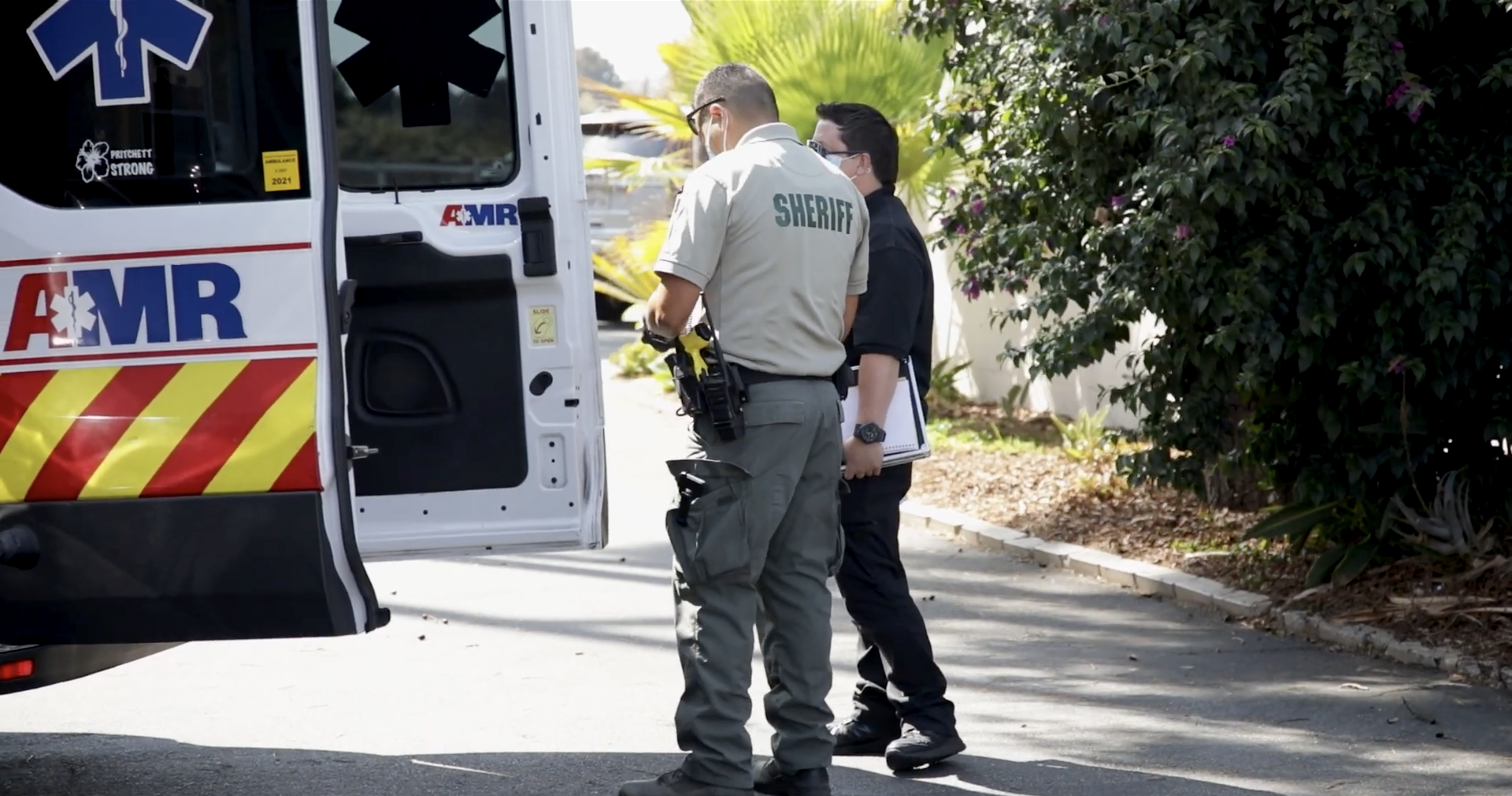
When a community member calls 9-1-1 in Santa Barbara County with a mental-health emergency, a co-response team may arrive at the scene. The cohesive partnership of a mental-health professional and a law enforcement officer has proved to de-escalate situations, and potentially provide solutions to the problem.
“What the officers do, what the clinicians do with our loved ones, it is like magic,” said Tom Franklin, the president of Santa Barbara County NAMI and former fire chief. “I’ve been in a situation where my loved one is completely out of control and have watched the officers talk him down to where he not only didn’t go to jail; he stayed home.”
Since 2018, the Santa Barbara County Sheriff’s Office and the Santa Barbara Police Department (SBPD) have partnered with Behavioral Wellness to create six co-response teams of crisis intervention trained law enforcement officers and licensed mental health practitioners. The program has proved to successfully de-escalate situations involving individuals facing mental-health crises, easing strain on both law enforcement officers and community members, and resulting in fewer arrests. But due to a lack of funding, staffing may need to be cut for the program, leaving just one team responding to all of North County’s needs.
Sheriff Bill Brown, Director of Behavioral Wellness (BWell) Toni Navarro, and Dr. Cherylynn Lee of the Sheriff’s Behavioral Sciences Unit gave a presentation to the Board of Supervisors on Tuesday expressing the successes of the program and the potential losses if funding is not secured.
Currently, there are four co-response teams — two in South County and two in North County — managed by the Sheriff’s Office and two teams based in Santa Barbara City managed by SBPD. Each team is composed of an officer trained in crisis intervention and a Behavioral Wellness licensed mental health practitioner who respond to calls as a team on 10-hour shifts.
In 2025, Santa Barbara County Public Safety Dispatch Center received 56,590 calls to 9-1-1. Of those calls, a little more than 4,500 were determined to be a mental-health emergency. Co-response teams were dispatched to 2,070 calls.
Of the calls responded to by the teams in 2025, only 2.6 percent resulted in arrests. According to Sheriff Brown, “Without the team, it would be much higher.” The majority of these situations were resolved by individuals voluntarily going to the hospital or being connected with other resources for them to receive care.
All sheriff’s deputies are required to complete eight hours of crisis intervention training. There is also a 40-hour training program, which in theory would be beneficial for all deputies to go though. But in practice, sending deputies through the lengthy program creates staffing shortages and has contributed to some of the excessive overtime pay — which reached up to $20.4 million in fiscal year 2024-2025 — that the Board of Supervisors voted back in February to limit.
By having mental-health professionals partner with deputies in co-response teams, the Sheriff’s Office does not have to invest as much training into its staff and allows both parties to perform their duties more effectively.
BWell Director Navarro said that 40 percent of the calls to BWell’s Crisis Response and Services Access Line come from law enforcement officers requesting assistance when they are in the field.
Sheriff Bill Brown compared the co-response team model to the Fire Department. Many times, firefighters are not fighting fires, “but they’re always there and always available when a big call comes in.”
“What is particularly unique and exciting about the co-response teams,” said Sheriff Brown, is that “when there is downtime or they’re otherwise not engaged in a mental-health crisis call, they do also assist with patrol calls.”
Funding for SBPD teams is secure through the next couple of years, but the sheriff’s team funding is less stable. With the passage of Proposition 1, much of the county’s funds for behavioral health treatment programs have been reallocated to housing programs. The four county co-response teams cost a total of more than $1.4 million for the upcoming fiscal year, or around $465,000 per team. Two of the four sheriff’s teams are set through fiscal year 2026-2027. One faces a funding vote on April 22 by the Santa Barbara County Community Corrections Partnership. The last team has no funding options currently.
If the money is not procured, only three sheriff’s teams will be operational. Based on call numbers and response times, it has been determined that only one co-response team will service the more than 2,000-square-mile North County area, leaving two sheriff’s teams for South County and two city teams servicing the City of Santa Barbara.
“There are going to be some really tough decisions we’re going to have to make as a board and try to balance a budget,” said Board of Supervisors Chair Bob Nelson. “I wanted to make sure we heard this today ahead of budget hearings so that we could have this front of mind as we went into that discussion.”
Related Posts



Premier Events

Tue, Sep 15
7:30 PM
Santa Barbara
Institute of World Culture (IWC) September Study Circle

Tue, Sep 15
10:00 AM
Santa Barbara
Volunteer Open House – S.B. Museum of Natural History and Sea Center

Tue, Sep 15
6:00 PM
Santa Barbara
Chaucer’s Books Hosts Ellen O’Connell Whittet

Tue, Sep 15
6:00 PM
Santa Barbara
Embroidered Brooch Workshop

Thu, Sep 17
5:30 PM
Santa Barbara
S.B. Independent: Santa Barbara City Council District 5 Forum

Thu, Sep 17
7:00 PM
Santa Barbara
Téka Brazilian Jazz at The Grand On State

Fri, Sep 18
All day
Solvang
Solvang Danish Days

Fri, Sep 18
12:00 AM
Santa Barbara
Yesterday: A Tribute to The Beatles at SOhO

Fri, Sep 18
7:00 PM
Carpinteria
West Coast Premier: “Gloria’s Old Haunt”
Sat, Sep 19
All day
Solvang
Solvang Danish Days
Sat, Sep 19
9:00 AM
Santa Barbara County
Coastal Cleanup Day
Tue, Sep 15 7:30 PM
Santa Barbara
Institute of World Culture (IWC) September Study Circle
Tue, Sep 15 10:00 AM
Santa Barbara
Volunteer Open House – S.B. Museum of Natural History and Sea Center
Tue, Sep 15 6:00 PM
Santa Barbara
Chaucer’s Books Hosts Ellen O’Connell Whittet
Tue, Sep 15 6:00 PM
Santa Barbara
Embroidered Brooch Workshop
Thu, Sep 17 5:30 PM
Santa Barbara
S.B. Independent: Santa Barbara City Council District 5 Forum
Thu, Sep 17 7:00 PM
Santa Barbara
Téka Brazilian Jazz at The Grand On State
Fri, Sep 18 All day
Solvang
Solvang Danish Days
Fri, Sep 18 12:00 AM
Santa Barbara
Yesterday: A Tribute to The Beatles at SOhO
Fri, Sep 18 7:00 PM
Carpinteria
West Coast Premier: “Gloria’s Old Haunt”
Sat, Sep 19 All day
Solvang
Solvang Danish Days
Sat, Sep 19 9:00 AM
Santa Barbara County

