
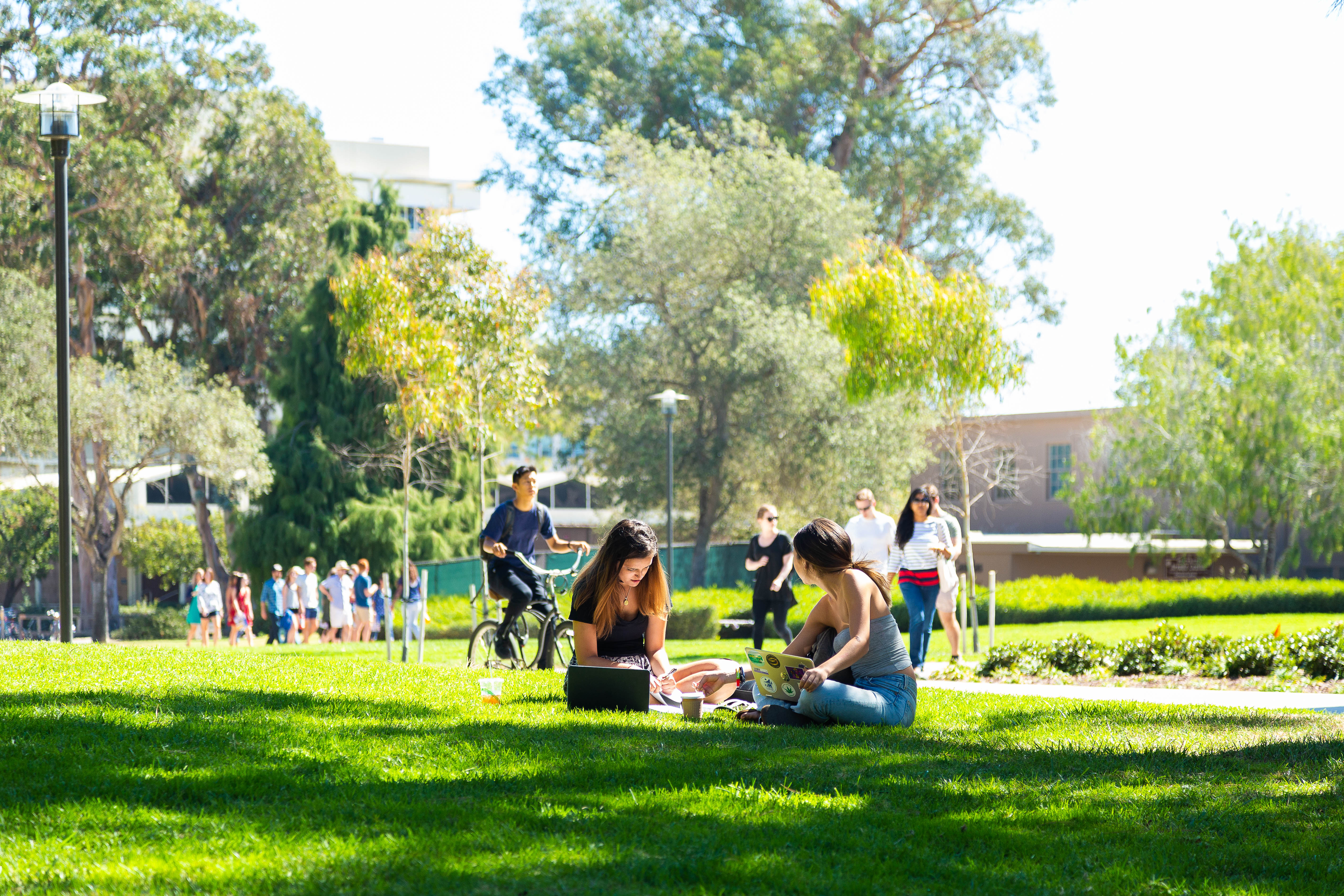
Language programs at UC Santa Barbara are being cut at an alarming pace. Across campus, instructors who have spent years — in some cases, decades — teaching language and culture now find themselves facing layoffs.
For David Moak, a lecturer in French, the impact is immediate. Asked how the downsizing will affect him, he answered matter-of-factly: “Oh, I don’t have a job next year.”
Moak has taught at UCSB for nearly eight years, working across multiple departments and programs. When he leaves, it’s not just his position that vanishes, but the classes he teaches. Among them is “The Holocaust in France,” a class that examines how persecution, genocide, and oppression shaped the country during World War II. He is the only instructor who teaches it.
So, it’s not just teaching students preparing for a study-abroad program how to order petit dejeuner in Paris. “We’re losing education not just in language, but history, culture, and literature that still has acute relevance to our world,” Moak said.
A Systemwide Shift
Cuts are ripping through the entire University of California system, due to apparent budget constraints — including a $30 million reduction in state funding for 2025-26 — and shifting enrollment patterns. Language programs have been hit especially hard.
When faculty have raised concerns about long-term damage to students and curriculum, those arguments fall flat, Moak said, adding that the burden lands disproportionately on workers with the least secure positions.
It may be easy to blame the current political climate, particularly under Donald Trump, whose administration has targeted higher education funding, diversity programs, and international students. But lecturers claim the cuts go to the heart of a different issue: a lack of respect for the humanities.
“It’s more about their bottom line and less about Trump,” said Lucy Peterson, UCSB union representative of the UC American Federation of Teachers (AFT), which represents language lecturers. The UC sits on a $12 billion endowment, she claimed, and “could easily rearrange things.”
But a gradual divestment in language programs — including Korean, Chinese, Japanese, and Portuguese — has been playing out across the UC system, Peterson said, especially impacting French and Italian recently at UCSB.
Shrinking Programs
The numbers tell a story. In the Department of French and Italian, course offerings have been slashed dramatically — from 33 classes in the 2024-25 academic year to 18 in 2025-26, with projections of just 13 the following year. This equates to roughly 60 percent reduction.
Faculty ranks are thinning, too. Four lecturers were laid off last year, leaving six. Additional cuts planned next year could reduce French instruction to just one full-time and one part-time lecturer.
Other language programs have faced similarly dramatic changes. Classes are larger. Instructors are fewer. And course sequences — e.g., taking French 2 after French 1 — are broken up into a bizarre schedule that doesn’t allow students to take these courses back-to-back.
All of this goes against basic language pedagogy, lecturers argue. Unlike other disciplines, language learning depends on continuity.
Last year, some students completed French 5 but could not enroll in French 6 the following quarter because it was not offered. For those pursuing majors such as Global Studies, the gap created a scramble to find alternatives, including taking courses at other institutions.
In a petition to Chancellor Dennis Assanis, signed by 90 lecturers so far, faculty warned that such disruptions “limit flexibility, disrupt student progression, and permanently shrink programs.”
The number of students taking a foreign language has dropped since the pandemic, but this roughly 20 percent drop in enrollment has been met with at least 50 percent in reductions in some language programs, according to lecturers.
A Precarious Position
Lecturers are highly qualified educators who are treated as “disposable,” and they often lack the job security of tenure-track faculty, Peterson said.
Many hold PhDs and years of teaching experience yet are employed on a contract-by-contract basis. Right now, the UC AFT is negotiating a new contract, with the main goal to “significantly strengthen job security for this category of workers,” Peterson said.
Adding injury to insult, many language lecturers also depend on their job to remain in the States. Non-citizen lecturers depend on their employment to maintain work visas, in a political climate where being in such a position is already very precarious. Losing their jobs can uproot lives — some have taught at UCSB for 15 to 20 years.
Personal Impacts
Marion Phillips, a lecturer in French in her eighth year teaching at UCSB, is having her job cut from full-time to part-time. Phillips is a U.S. citizen, she said, but many of her colleagues are not.

“I worry for them. I worry for myself, too,” she said. “I don’t know how much work I’ll have next year or if I’ll have benefits.” She fears these cuts are an omen of where things are headed in terms of cost-cutting and declining investment in the humanities.
For Valentina Padula Castleberg, who moved from Italy and started teaching Italian at UCSB 29 years ago, it has been “very tough” to watch the department “crumbling” around her.
She’s worked on expanding the Italian program to provide more robust course offerings over the last 15 years. “And now everything is gone. It’s like there was an earthquake. It’s devastating.”
Although she is retaining her job thanks to her seniority, she said. “The impression is that we do not count as professionals or human beings even after all we’ve done.”
Student Voices
Students, too, have begun to speak out.
Testimonials from more than 100 students across foreign-language programs at UCSB said language learning was a way to immerse themselves in culture, collaborate with other students, and connect to their own familial roots, whether pursuing the languages as majors or minors or to supplement other courses of study.
One student studying Japanese wrote that even as interest declines, it is “crucial to maintain some sort of care for these cultures through these classes.”
A Push to Online Learning
What lecturers seem to fear is the UC system’s plan to expand online language instruction through a new partnership with the Global Language Network, a not-for-profit language-learning organization.
According to the University of California Office of the President (UCOP), the program aims to “create an even richer set of options for language instruction” by allowing students to enroll in courses offered across campuses, particularly in less commonly taught languages. The UC system is planning to roll out new online language options by fall 2027, providing access to languages “including Punjabi, Romanian, Hebrew, Korean, and ASL, to name a few,” according to the UCOP.
Officials emphasized that online offerings are meant to complement, not replace, in-person instruction.
“Our core language curriculum remains robust, in-person, and a vital part of our campus identity,” said UCSB spokesperson Kiki Reyes.
“Like all universities, we routinely adjust instructional appointments based on enrollment patterns, student demand, and available budgets,” she added. For context, in March 2025, UCSB was facing a projected $24 million decrease in state funding, while costs were expected to climb by $45 million.
“We believe that systemwide collaboration has the potential to complement our in-person instruction,” she said.
But lecturers are skeptical. They said that asynchronous, online models could undermine the immersive nature of language learning.
Lecturer Asks
In their petition to the chancellor, UCSB lecturers have called for a “transparent transition plan,” to allow more time for “revitalization efforts” for programs and to “ensure a fair evaluation.” They also asked for a pause on further reductions, and a review and possible reversal of recent layoffs, “where individual merit and departmental need clearly outweigh the projected budgetary savings.”
“This matter extends beyond French and Italian,” it states. “It concerns shared governance, academic freedom, transparency, and the future of language education at our university.”
Related Posts







Premier Events
Sat, Oct 10
9:00 AM
Santa Barbara
Treble Clef Chorus Fall Treasure Sale

Sun, Oct 11
5:00 PM
Santa Barbara
Trinity Choir: Choral Evensong

Thu, Oct 08
7:00 PM
Santa Barbara
“A Night of Blues” with Morganfield Burnett

Fri, Oct 09
7:00 PM
Santa Barbara
Paseo Nuevo Spooky Movie Nights

Sat, Oct 10
9:00 AM
Santa Barbara
SBNC 1st Annual Health & Wellness Fair

Sat, Oct 10
1:30 PM
Goleta
🌴 Another Day in Paradise at S.B’s Premier Ice Rink

Sun, Oct 11
7:00 AM
Ojai
Flamenco Guitarist Tony Ybarra

Sun, Oct 11
10:00 AM
Santa Barbara
18th Annual Domestic Violence Solutions Brunch

Sun, Oct 11
10:00 AM
Santa Barbara
Free Community Day at S.B. Botanic Garden

Sun, Oct 11
10:00 AM
Santa Barbara
Downtown Classic Car Show Santa Barbara
Sun, Oct 11
11:00 AM
Santa Barbara
Raíces y Sueños: Bilingual Storytime at Santa Barbara Museum of Art

Sun, Oct 11
2:00 PM
Santa Barbara
The Theatre Group at SBCC Presents: “CLUE”
Sat, Oct 10 9:00 AM
Santa Barbara
Treble Clef Chorus Fall Treasure Sale
Sun, Oct 11 5:00 PM
Santa Barbara
Trinity Choir: Choral Evensong
Thu, Oct 08 7:00 PM
Santa Barbara
“A Night of Blues” with Morganfield Burnett
Fri, Oct 09 7:00 PM
Santa Barbara
Paseo Nuevo Spooky Movie Nights
Sat, Oct 10 9:00 AM
Santa Barbara
SBNC 1st Annual Health & Wellness Fair
Sat, Oct 10 1:30 PM
Goleta
🌴 Another Day in Paradise at S.B’s Premier Ice Rink
Sun, Oct 11 7:00 AM
Ojai
Flamenco Guitarist Tony Ybarra
Sun, Oct 11 10:00 AM
Santa Barbara
18th Annual Domestic Violence Solutions Brunch
Sun, Oct 11 10:00 AM
Santa Barbara
Free Community Day at S.B. Botanic Garden
Sun, Oct 11 10:00 AM
Santa Barbara
Downtown Classic Car Show Santa Barbara
Sun, Oct 11 11:00 AM
Santa Barbara
Raíces y Sueños: Bilingual Storytime at Santa Barbara Museum of Art
Sun, Oct 11 2:00 PM
Santa Barbara


You must be logged in to post a comment.