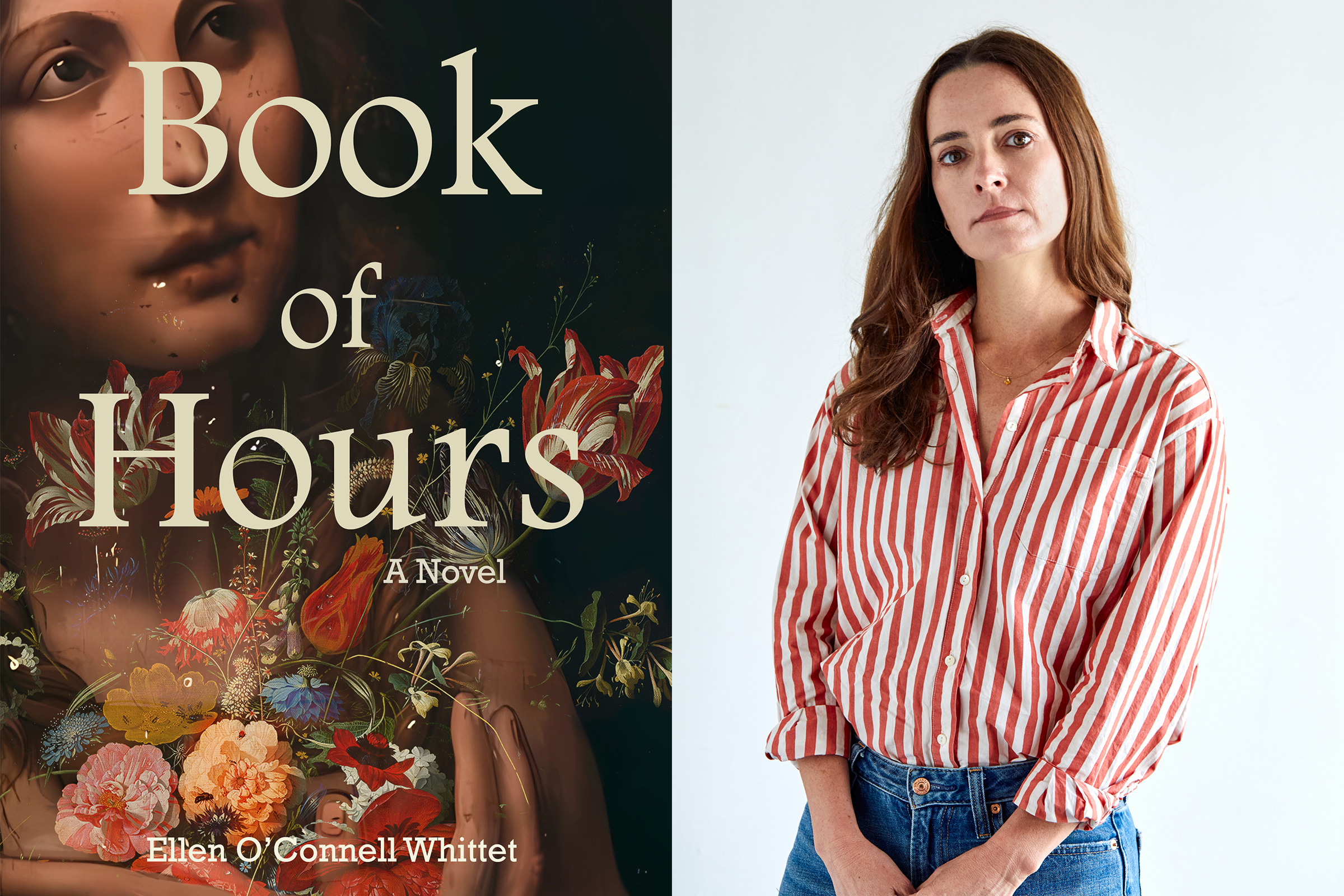
Even if you haven’t read What You Become in Flight, the first memoir from Ellen O’Connell Whittet, you’re able to tell that the writer and UCSB professor was a former ballerina. Whittet glides into every room — whether it’s a coffee shop, the UCSB pool for her kid’s swim lessons, or the classroom — with posture commoners are envious of.
She has a poise about her that feels comforting yet authoritative, which is why her debut novel, Book of Hours, is such a surprise. It’s at once a political statement and a deep dive into the fractured medical practices of American society, one in which mothers are left behind and alone, while also exploring religion and identity. Book of Hours is a story to which anyone — whether they’re a mother or not — can relate. “The story of giving birth is the story of America,” says Whittet. “The experience of being a politicized body in this country is not just ours [as mothers] to hold; it’s everyone’s to hold with us and to fight for the autonomy we deserve.”
I got a chance to chat with Whittet about her own birth story, her writing process, and her Catholic school upbringing. Her answers have been condensed and edited for clarity.
You’ve written about infertility and birth in the past. Your first book captured your world as a ballerina, and all the struggles that went into a lifetime of focus. Why didn’t you opt to write about yourself again?
After I wrote a memoir, I just felt like I didn’t have anything else to say about myself. Like, I had really left it all in the field and [thought], “I can’t write a memoir about getting birth; giving birth is the most common bodily thing that everybody my age is doing all the time. It’s not worthy of a memoir.” And that kind of bums me out. Although I still would probably say that to a friend who asked, “Should I write a memoir about giving birth?” Unless something truly extraordinary happened, I don’t think that there’s a market for autobiographical stories of giving birth, exclusively. I think it probably has to be part of a much larger story, which is too bad.
The writing of this particular book was a way to reckon with my own experience and some of the dissociation that I felt in the process of giving birth. Writing about a third person felt like the only way that I could understand or tell my own experience. It was like it didn’t happen to me.
I think that it was just me realizing I’m not gonna tell my own story. I wasn’t really ready to tell my own story, but I needed to do something — I needed to process it. I needed to move through the kind of great grief of having lost any kind of bodily autonomy in the birthing room. The only way I could really name that was by saying it happened to somebody else.
Did you write this novel with the intention of making a political statement?
Anytime you’re weaving large institutions, including the Catholic Church, the medical industry, or just being a woman in America, into your experience it suddenly becomes political. Ultimately, that’s the stuff that I think people connect to, because even if they haven’t given birth, maybe they grew up in a religion that had a lot of ideas about what was okay for their bodies to experience, or maybe they’ve given birth and so they know what it is to have their body acted upon by some third party. All of those cross sections can be meaningful for people who have felt the experience of trying to maintain control over their bodies under larger forces.
But I don’t want it to be a pro-religious or a pro-hospital birth story. I want it all to be complicated, as that makes for a much more interesting texture and narrative, and that’s the space that I think most of us live in. I hope none of us really have easy answers to any of the tough stuff we’re living through.
Tell me about why you added this mystical realism into the narrative of the protagonist and how she returns to the church in some ways because of her pregnancy.
Once I realized I was writing about a third person, it gave me a lot of permission to fictionalize other things or try to give magical realism elements to the story. I’ve never had a mystical vision myself, but there was something about those things that called to me. I went to Catholic school, so the saints are a really important part of my childhood.
I’ve been thinking a lot of Margery Kempe [a businesswoman and mother of 14 who dictated her story, The Book of Margery Kempe, beginning in 1432, which is considered the first recorded autobiography in the English language]. Her book opens with a story of giving birth and thinking she’s going to die. She doesn’t die, but she seems to really clearly have postpartum psychosis and is tethered to her bed for eight months and bites her own hand. No one will listen to her story, including the church she keeps trying to get absolution from, or her husband. I read it as a modern reader and thought, “Oh, she had postpartum psychosis.” So there was something about the saints that really called to me to tell the story of an experience I had and then just kind of fictionalized the hell out of it.
Join Whittet at Chaucer’s Books (3321 State St.) on Tuesday, September 15, at 6 p.m. for a discussion with Reverend Sarah Thomas. She’ll be signing books, which will be released that day. For more information, see bit.ly/4zPGITb.