

Legendary Brazilian guitarist and composer Sérgio Assad joins his daughter, Grammy-nominated composer, pianist and vocalist Clarice Assad, at UCSB Campbell Hall on Wednesday, October 21 at 7:30 PM. Ahead of their Arts & Lectures performance, the father-daughter duo joins Charles Donelan on Air Time to talk about growing up in one of Brazil’s great musical families, finding an artistic voice and the spontaneity that makes performing together so distinctive.
Sérgio recalls recognizing Clarice’s gift for improvisation when she was only three or four years old, while Clarice reflects on how that early encouragement gave her the confidence to become a composer and musical experimenter. They also discuss Brazilian musical tradition, Clarice’s adventurous work with electronics and AI and the unusual chemistry of their live performances, where improvisation, mutual trust and a shared sense of play mean that even they don’t always know what will happen next.
Charles Donelan
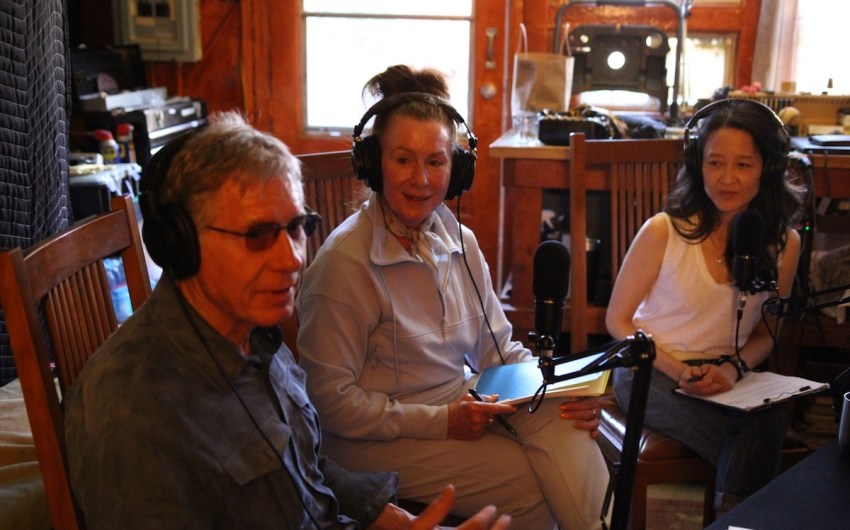
Welcome to Air Time, the podcast from UCSB Arts and Lectures. I’m Charles Donelan. On Wednesday, October 21st, at UCSB Campbell Hall, we will be delighted to welcome two extraordinary musicians to Santa Barbara: legendary guitarist and composer Sergio Assad and his daughter, Grammy-nominated composer, pianist, and vocalist Charisi Assad. Together, they will be performing an intimate program of original compositions, Brazilian songs, and new music that will bring their remarkable musical inheritance to life. Clarice and Sergio join me today to talk about growing up in one of the great musical families of Brazil, finding an artistic voice and the special experience of making music with a family member.
Clarice and Sergio, welcome to Air Time.
Clarice
Thank you.
Sérgio
Thank you for having us here on your program.
Charles Donelan
So I’m going to start a little different from what I planned, and I want to know about what. Well, I’ll ask Clarizzi the question I had intended. At some point, you must have realized your household was not like everyone else’s. Was there a moment when, or or maybe maybe there were other families where you thought. You know, oh, this is this is perfectly normal that there’s these guitars going all the time, but when did it register that you were part of a special clan, a special group of people?
Clarice
You know, it was actually something I heard from my own father who said when he was growing up in a family that played so much music, he expected to see musical instruments, musical instruments in everybody’s homes. He’s like, right? Where are the guitars? Like you know, it was normal, right? Yes.
Sérgio
Yeah.
Charles Donelan
And and Sergio, your father was a guitar player as well.
Sérgio
He actually played the mandolin, but he played a little bit of guitar as well, so he was responsible for getting us into music. It’s true what Clarice said that everybody that came to visit us played the guitar, so it was such a normal thing to see. So we thought that happened in any in every family,
Charles Donelan
Could this happen at any time of day or night that suddenly there would be just music happening, or were there special kind of ritual or moments when it was expected that people would perform.
Sérgio
It could happen any time of the day.
Clarice
It was all day long. What are you talking about? There was no break. I don’t remember a break.
Sérgio
I think it probably got even worse because then we became musicians and we were very serious about studying and practicing. And Clarice was hanging there with us, and I think it was normal for her to try to play the guitar. She did. She did attempt, you know, many times. She, I would have the guitar on my lap, and she would come and she would scratch the strings.
Charles Donelan
So, Clarice, I want to ask about the relationship with your dad. That well, I’m bringing something to this of my own experience. I think of fathers, my own father, but great fathers of all kinds, as being these figures who give permission. They say, “Go ahead, you can do that. You can be the one who writes the music. Now, did that happen to you? Did did Sergio tell you, “Go ahead”
Sérgio
Okay. Write music,
Charles Donelan
Go ahead, Sergio. You want to answer?
Sérgio
I think we can. I think Clarice showed very very early that she could, she had rhythm and she had a good voice, but she showed that she could improvise over the chord changes they made. You know, she was three four years old, very very soon, and I noticed that she could actually construct melodies, build this melody. So what I did was I would ask her to repeat when I found something that was nice. She said, “Can you repeat it? And she would repeat. Then I would say, “You are composing, and I think after a while she just just started doing it on her own. She didn’t need me anymore.
Charles Donelan
I love it because Clarice, these are your first commissions.
Clarice
That’s true, and also he lied. You know, he told me that the music was mine, and I believed it, so it’s like fake it till you make it. He said he gave me the gift of fake it until you make it.
Charles Donelan
Permission, I swear, it is the central, eternal power, superpower, if you will.
Clarice
I think so.
Charles Donelan
Clarice, I would like to take this a little into your career because I find it fascinating. First of all, I love all the different kinds of music you’re composing. I love that you’re a composer who’s also a performer, and more than anything else, I just see extraordinary confidence to attempt things that not only you haven’t done before, but that no one has done before. Could you give an example? Or I mean, I could point to a couple of things. There’s a concerto where you sang, right? Scat singing. I don’t think anyone has done that. I don’t know of any other. And then I saw a wonderful video of you performing with digital feedback and AI, and it was like nothing I’ve ever seen. So go ahead, tell me just a little bit, and you know we’ll get to the duo performance because that’s what people are coming to see, but I think it would be very interesting for my listeners to be aware of all your activity as a composer, and especially in new music.
Clarice
Well, first of all, thank you so much for your kind words about my work. I really appreciate it, and I think you’re referring to my early piece. It’s called Scattered and on purpose because you know the scat singing, but also because the piece itself is all over the place. The genres are so like… you know it’s Brazilian, it’s American, it’s European, it’s African, it’s everything in one piece, so that’s why I called it that. And it was, I think, as far as I know, the only scat singing concerto that was written at that time. So it’s a piece from 2010 that really opened a lot of doors for me to be a little bit more experimental.
And The Evolution of AI. This is the other one that you’re talking about, the electronics, that was a commission from the St. Paul Chamber Orchestra. It was part of this amazing series they had called Sandbox, where they allowed a composer to be there for a whole year workshopping a piece for them, and they basically say, “Do whatever you want,” but they give you a theme, and the theme at the time was, “Oh, you have, oh, I want to do a concert about from my life because of a piece that was, it was from my life. I don’t remember the composer. I should remember, but the theme became “from my life,” and I’m like, I don’t want to write about my own life. That sounds like a very narcissistic thing to do, to compose about my life. You know. I’m not at that stage. It’s Smetana, he is the composer. OK? So he wrote this piece about his life. Makes sense because he was at the end of his life. Looking back, I was like, OK, I would never do that. So I was obsessed with AI coming online for the first time. It was in the first few years, before it even became a thing,
Charles Donelan
That’s right.
Clarice
Because my brother is in video, he knew about the tidal wave coming our way before we even knew what was going to happen. So he was like making me so scared, and I decided to make a story about this AI creature, a hybrid human that comes to life and learns about music with an orchestra, and they let me do it. So I experimented with about 120 different digital sounds from different apparatus, like a framed drum that is made of MIDI electronic sounds. I had somebody out there taking notes and writing to me, like each of these settings work, and each of these settings don’t work. So it was really like a research project, you know. I can’t tell you how much I learned from that experience, and of course I was wearing this really weird super superhero suit. My dad went to one of the performances and I’ll never forget his face because he was in the front row, and I had to actually like the mark of this spot where I had to go was right in front of him, and he was there. I had to ignore him. It was very hard. I’m acting like a crazy person in front of him. He’s looking at me like, “Oh no, my daughter has gone mad.
Sérgio
I must say that she was very convincing, because she totally ignored me. Like I was not there at all.
Clarice
Yeah. Well, you know,
Charles Donelan
I love it that this is something that you can be so free and open about, and laugh and enjoy, because the piece is full of really interesting, important and serious musical and really scientific ideas, but it’s also very playful and just wonderfully enjoyable.
Clarice
Yes, it was interesting to see how the people reacted to it. Most of the audience was pretty conservative, and I already knew that coming in. I knew that even St. Paul [Chamber Orchestra] was worried about what are they going to do when they see this thing happen on stage, but it went really well. I think people understood the message.
Charles Donelan
I think it answers to that concept too of the sandbox, right? I know that term from the computer world.
Clarice
That’s true.
Charles Donelan
Sérgio, I want to pull you back in because I am so looking forward to the moments in this concert where Clarice is singing and you are accompanying her on guitar. Could you just make some observations? About the way that you work with a singer, or in this case with your daughter, but what the special relationship is, because I feel like the Brazilian guitar tradition and the Brazilian singers, it’s very special. It’s like nothing else in music.
Sérgio
Well, that’s a nice observation. I grew up with my father accompanying Brazilian popular music, so I would say that is the thing that I do the best. So I’m going to the stage with Clarice completely blank, like we don’t prepare. It’s hard to convince her to rehearse because it’s very spontaneous. What’s going to happen there? Of course, we know what we’re going to do, like the songs. I know the harmony, but what’s going to happen there? It happens once, right on stage, and she’s very surprising. She can surprise me every single time, which is good, because I kind of react to what she does. So it’s a unique experience for us as well.
Charles Donelan
That’s so great because you have anticipated my follow-up question, which is, does she ever surprise you? And I think you just said every time.
Sérgio
Every time, every time. And there are songs that we never rehearsed, ever. So I don’t know what she’s gonna do. You know, she has never repeated one particular song the same way ever. The end is always different. She plays with the public, and she surprised me every time. She made me sing once. I never did this in my life, and I mean, she just put the microphone in front of me. So I had to sing.
Charles Donelan
Clarice, when you’re working with your dad and you’re singing, he’s playing guitar. Does he do things that surprise you? Where does that chemistry come from? How does it feel?
Clarice
Well, I think that first of all, there’s a lot of mutual love and respect. We have a very similar approach to music at the core, which is like we take it very seriously, but we also love it so much that we have fun doing it, right? So yes, he does also sometimes play with things that almost like throw me under the bus in return, musically speaking, but in a in a fun way, you know? Like oh, here is this chord you weren’t expecting, and then I have to deal with it in the moment, and we are the only two people there who know that that’s happening.
It’s like the joke is on us. Nobody else knows that that’s happening. But I think that the energy of improvisation and being on the edge of your seat for the two of us is there because we have this feeling like “ooh, what’s gonna happen?” And the audience can feel that too. You know what I mean? It’s like yeah, it’s the energy of we don’t know what’s gonna happen. We know it’s gonna work out, but because we are so excited, and everybody else feels it too. And we feel like then that fourth wall becomes very porous.
Charles Donelan
Yes, it really is a conversation, and also it really is about that moment and only that moment. It’s truly present. Yeah, that is just fascinating. I love that about that music. So many so many interesting things to talk about.
Tell me a little bit about the Brazilian tradition. Sergio, you and your brother and other people in your orbit are incredibly central to the perception of that tradition worldwide at this point. You’re really strongly associated with it, but it feels like it’s not fixed. It seems like it keeps changing, and keeps moving forward. Certainly Clarice, in your work it seems to be able to recombine and spin off into other kinds of composition. But Sergio, tell me, do you represent a tradition or do you transform it? Tradition. How do you think about that?
Sérgio
I think I’m very tied to Brazilian music in the sense that I try to write things pretty much based on what my experience was growing up with Brazilian music, and Clarice did the same. But I think she went off that track because that’s also something productive in the sense that you can create a lot of Brazilian stuff, but at the same time it ties you up to a particular particular genre of music. I always thought that Clarisse could develop further what she did. She developed her own voice and she writes a type of music that’s hard actually to classify now, and and she’s still evolving so I don’t know how far she’s going to go with this but definitely she in that sense she surprised me because I thought she would keep it the same sphere like like I did, you know. It’s gravitating around Brazilian music, which I know well, you know. But I mix a little bit with other stuff outside, but in a very shy way. No, she went on, and it’s still moving. Still moving very fast.
Charles Donelan
Yes, I’m also so struck in both your work by the extreme cosmopolitanism of Brazilian culture, that it’s really sophisticated, international and globally aware. I mean, Clarice, your namesake, Clarice Lispector, the writer? I thought she was French, honestly, when I first encountered her, because I encountered her through French intellectuals who were obsessed with her writing. And I know, Sergio, you well, you both spent time in France. Is that right?
Sérgio
Yes, I was there for 10 years. Clarice spent some time there with me as well.
Charles Donelan
And then, of course, both of you are very conversant with all the various things that are happening here in the United States, especially in the academic world. You know, we have wonderful physicists at the University of California in Santa Barbara, and I understand that you’ve got a connection to the world of physics.
Sérgio
That’s because of my wife. My wife is an astrophysicist.
Charles Donelan
I’m a graduate of Columbia University, so these things interest me. But let’s go back to the conversation that you’re going to have for the audience here in Santa Barbara. Tell me, you know, if you were to introduce the program to somebody who was coming in, maybe they’ve seen the Assad duo before. What’s going to be special about seeing this combination, father and daughter, or just Clarice and Sérgio, not father and daughter, but just as two artists? What can they expect and how would you frame this evening? What can people look forward to?
Clarice
I think I can answer that just because you mentioned Angela Olinto. She’s my father’s wife. She’s the amazing now provost of Columbia University. She’s also a great thinker, and I think the way she described the two of us, because you know the Assad brothers are this extraordinarily like legendary duo of guitarists who have changed the face of classical guitar in the world. I mean you know they’re like the top. They still are and they will always be the top two guitarists who pretty much invented that genre, I think. But then, if you’ve seen that version, and you come to hear the two of us, it’s going to be a shock because seeing the two of us is like watching the two of us play in our living room. You know what I mean? I think that’s what she said. She said that instead of yeah, you are in a concert hall, and when you watch the Assad Brothers, you’re watching them in a concert hall with all the etiquette and all of the things that go along with it. The repertoire, all the notes have to be perfectly correct and nice and perfect, and everybody knows the pieces. They know that if they make one a little different, if they play another note, they’re gonna know. So there’s a lot of stress that is also built into that classical music, I’d say. But the way we play is more free and more playful, and we definitely have this father/daughter-like beautiful rapport. That translates as just having fun on stage. Does that make sense?
Sérgio
For me it does.
Charles Donelan
And for me as well. I could not be looking forward to this concert more. It is one of the highlights of our season, and it has been such a pleasure to meet both of you. Are there any final thoughts, things that we didn’t get to that you would like to make sure that people are aware of? The concert is coming up in exactly a month. It’s on a Wednesday night, October 21st, at Campbell Hall at the University of California, Santa Barbara, and it will be wonderful and intimate and also surprising and spectacular. Thank you.
Clarice
Oh, thank you. Anything else to add?
Sérgio
I have to tell you this because it’s funny. We went to see Clarice here in New York at Joe’s Pub, and she was playing with this amazing percussionist Keita Ogawa. We brought many friends for this concert, and people were there. They were happy to see Clarice. They were very excited with her, and then there’s a friend that didn’t know her and came to me and said, “Wow, I felt sorry for the percussion player, nobody was paying attention to him.” I turned to her and said, “Yeah, that’s what happens to me. We all want to play with her, but then nobody pays attention to me.”
Clarice
Nobody says that. Oh my God! That’s terrible. Whoever says that, no, no. It’s amazing, and we are really like… It’s not okay. It’s not true with the two of us. If that’s because my father and I were like, there is no one without the other in this concert!
Charles Donelan
I can feel that wonderful warmth of your connection, and I know we will experience it in a month. Thank you both so much. All right.
Clarices
Thank you.
Charles Donelan
Okay. Take care, and we’ll talk to you. We’ll see you soon. Yes.
Sérgio
Thank you. Goodbye.












You must be logged in to post a comment.