
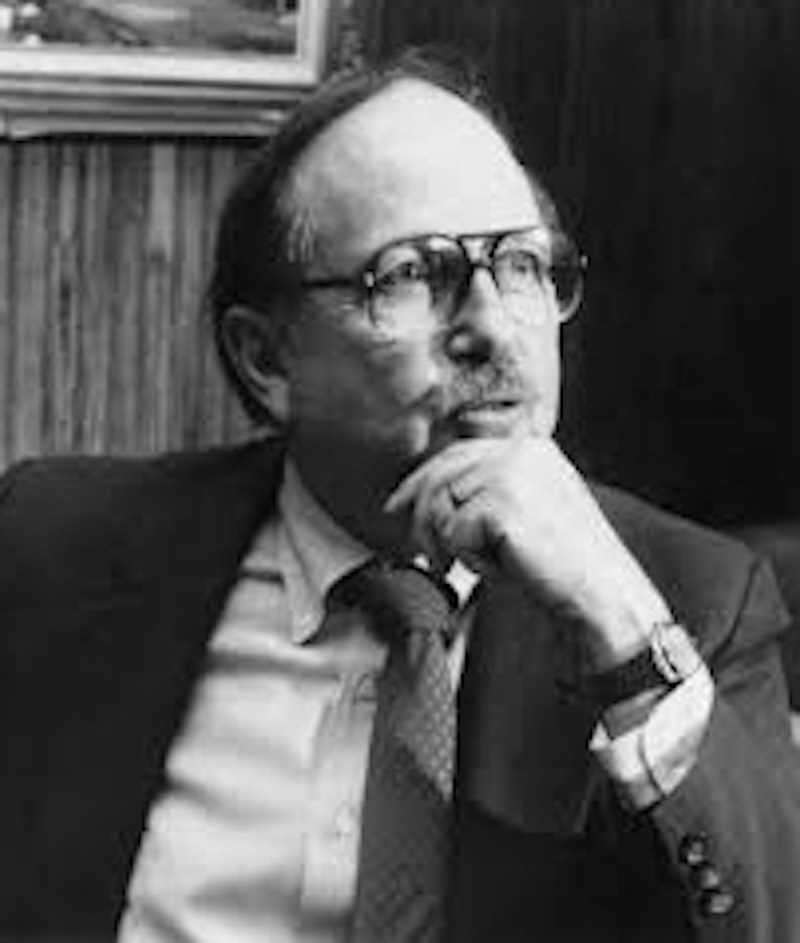
Lou Cannon, one of the great silverbacks of American journalism and a longtime resident of Summerland, died this week at age 92 of a stroke while in hospice care. Nationally, Cannon is perhaps best known for the five books he wrote on Ronald Reagan — from Reagan’s days as governor of California to his two terms in the White House.
As with many portentious happenstances, Cannon — when still a young reporter — just happened to be covering the state legislature in Sacramento when a former actor named Ronald Reagan burst upon the political scene. At that time, Cannon saw things in Reagan that Reagan’s opponents — too eager to dismiss the former Bed Time for Bonzo star as an reactionary airhead and political lightweight — totally missed. Cannon’s reporting was nuanced, complicated, detailed, and precise. “Facts are precious,” he would write later. “Opinions are cheap.” The Reagan Lou Cannon got to know and write about was also complicated and contradictory. And that’s how Cannon — who would move to Summerland in 1990 — wrote it.
Eventually, hundreds of books would be written about Reagan, but Cannon’s bird’s eye view on the 40th President over the decades — not just years — gave him unrivaled access and breadth. But there was more to the chemistry between writer and subject than mere time and proximity. Like Reagan, Cannon was the son of an alcoholic father named Jack; both men grew up moving around a lot. Both experienced childhood economic instability. Both saw themselves as children of the West, though they both were born elsewhere.
But even having written five of the most foundational biographies on Reagan, Cannon admitted that there was still much about the former president — so famously elusive and distant — that Cannon never managed to figure out.
Cannon was old-school serious. He took the mission and responsibility of journalism serious. He took facts serious. He took politicians serious. He didn’t start with an a priori posture of scorn or contempt. He genuinely enjoyed them, flaws and all. Government to Lou Cannon mattered. Power mattered. How it was exercised really mattered. And it was the job of journalists to figure all that out. For more than 45 years — 26 spent as White House correspondent for the Washington Post — Lou Cannon would do just that.
In 2007, Cannon lent his professional credibility and gravitas to the News-Press journalists, including its editor Jerry Roberts, who were resigning en masse to protest against owner Wendy P. McCaw’s newsroom intrusions. After Cannon wrote a commentary in the Los Angeles Times attacking her actions, McCaw attempted to discredit her dissenting employees, most notably by publishing an unsigned, front page story all but accusing editor Roberts of having child pornography on his computer hard drive. The article did not include the fact that forensic experts with local law enforcement agencies had already thoroughly investigated these claims and determined they could not be substantiated.
McCaw shot back with an op ed in her own paper: “Mr. Cannon exemplifies what is wrong with today’s journalistic elite,” she wrote. “The misery of these exploited children is meaningless to him. Mr. Cannon, you ignore the fact that perhaps one or more of your fellows may have engaged in this conduct. It is now apparent to all where your true sympathies lie.”
Cannon fired back with an op-ed of his own published in the Santa Barbara Independent. “Considering your track record, for you to lecture me on journalistic ethics is a bit like Willie Sutton instructing someone on bank management,” he wrote. (Sutton was the notorious bank robber who famously explained his choice of targets by stating, “Because that’s where all the money is.”) Cannon stormed on, “My reputation has been earned, not inherited or won in a legal settlement,” a clear reference to the billion-dollar divorce settlement McCaw won from her former husband. “I am not beholden to any party, government, sect, faction, corporation, union, nor to anyone, like yourself who believes that your wealth entitles you to harass, smear, and intimidate honest people.”
For a reporter of Cannon’s stature and gravitas to weigh in so forcefully and so publicly played a significant role in elevating what might otherwise have been a local dust up into a story of national implications.








You must be logged in to post a comment.