

Intently focused, Santa Barbara artist Sue DiCicco’s hands manipulate a single sheet of square paper. She has done this thousands of times.
Back and forth, flip, fold, crease, invert. Eventually, a figure starts to emerge: a delicate crane, wings spread in flight.
“When I did this for the post office, it took me like half a day because I was just so meticulous,” she said.
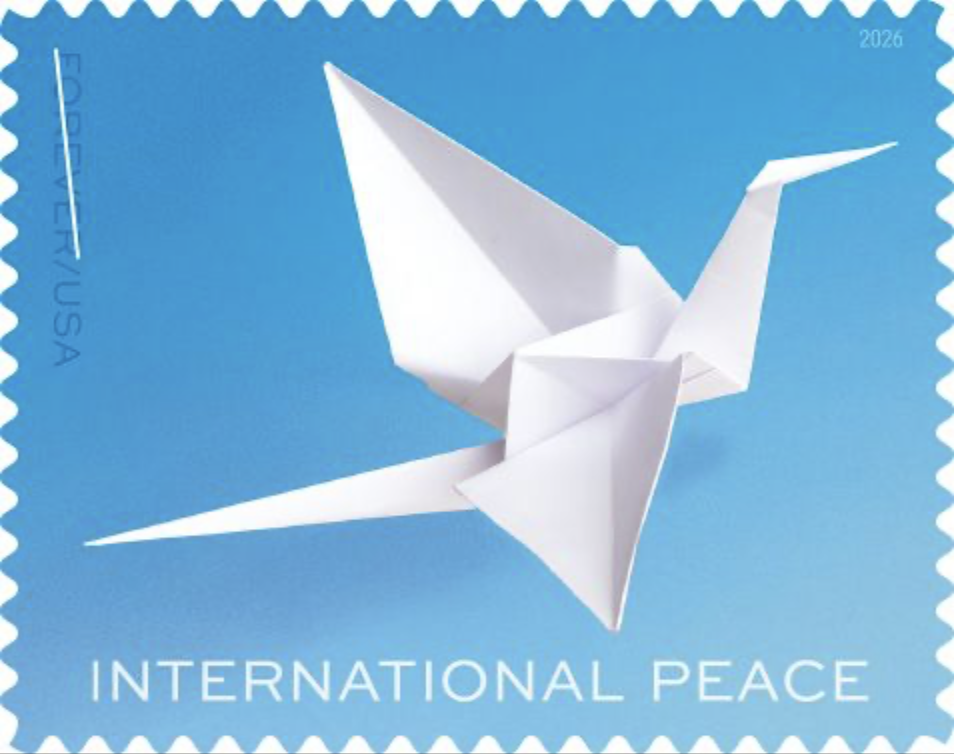
Of the 30 new stamps released annually by the U.S. Postal Service, one design this year was directly inspired by DiCicco and her creations. The International Peace Stamp will be unveiled at the Boston World Expo on Memorial Day weekend.
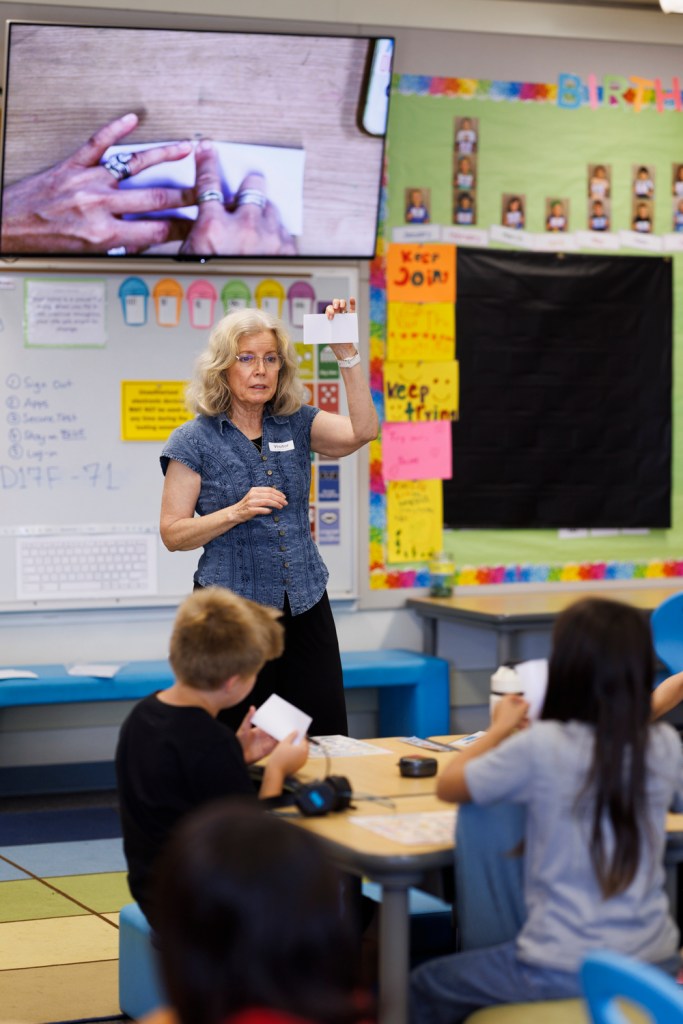
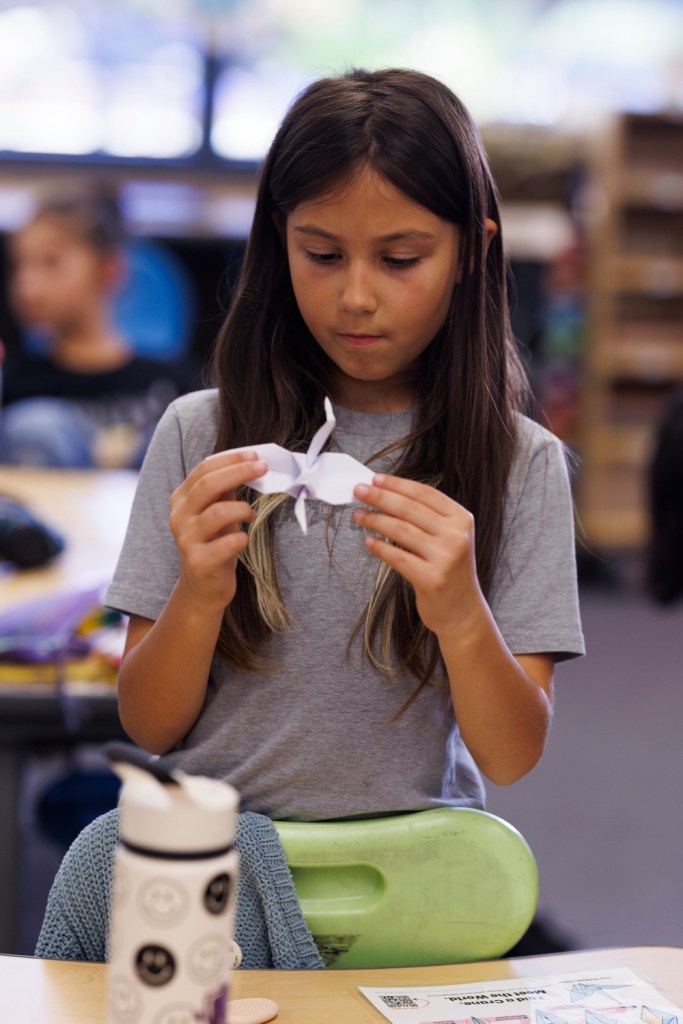
After the catastrophic Sandy Hook school shooting in 2012, DiCicco started the Peace Crane Project to “arm children with arts, not guns” through the exchange of paper cranes inscribed with messages of peace and joy. It has now reached more than two million students across 150 countries.
Two-and-a-half years ago, DiCicco was contacted out of the blue by fact-checking and legal research company PhotoAssist Inc., which is hired by the Postal Service to vet stamp designs for accuracy and continuity. They informed her of the stamp design proposal, and asked her to fold the featured crane.
“It was such a shock when they contacted me,” said DiCicco. “It was nothing I ever sought out.”
Creating a new postage stamp is a lengthy process. Proposals are first submitted to the Citizens’ Stamp Advisory Committee (CSAC), which was established in 1957. The group of 11 members meets confidentially each quarter, reviewing the proposals before sending their recommendations to the Postmaster General of the United States for final approval.
The exact origins of the International Peace Stamp are a mystery; DiCicco did not submit a proposal to the committee, and she has no clue as to who may have nominated the Peace Crane Project.
According to Postal Service spokesperson Jim McKean, there was a submission from the public coupled with interest from both the committee and the Postal Service for a stamp representing peace, “and they thought that this would be an appropriate subject to use for that stamp.”
McKean made it very clear that the selection of the International Peace Stamp, and the timing of its release, is not related to any specific geopolitical event.
Originally, DiCicco recommended featuring cranes folded by kids across the world, but stamp designer Antonio Alaclá had a vision: a singular white origami crane flying over a serene sky-blue background ― a design choice that references another symbol of peace: the white dove.
“A jumble of paper or lots of different textural elements are aesthetically pleasing, but I thought that the message came through a little bit clearer with a single paper crane,” said Alaclá.
Alaclá has been working with the Postal Service for about 15 years, and has designed more than 100 stamps, including one for the 2017 total solar eclipse that used thermochromatic ink.
Immediate recognition is an essential component of any design, as Alaclá has about one square inch of real estate to work with. “My thinking was, the clearer that we can make the message, the easier it is for somebody to see what we’re talking about, and the more effective it will be as a piece of communication,” he said.
For DiCicco, that meant multiple days of making cranes of different sizes, making sure each fold was precise and crisp. “I wanted to make sure the proportions were perfect,” she said.
She ended up mailing a box of the folded birds from her studio in Santa Barbara to photographer Sally Andersen-Bruce in Connecticut. When they arrived, Andersen-Bruce gently lined up each of the options, allowing them to settle after their cross-country journey.
“White on white is extremely rough to photograph,” she said. “The crane is small, and to get the shadows and the highlights to define the form is very difficult.”
Andersen-Bruce was tasked with emphasizing the facets of the wings, to make the crane feel mid-flight, and to create the proper shadowing underneath. Luckily for her, her decades of commercial photography experience ― much of it before Adobe Photoshop ― had honed her studio lighting skills.
Andersen-Bruce’s husband, an industrial engineer, also had a hand in the final product. He helped fashion a rig of little rods that suspended the crane so it would fly. “We tipped it up, and tipped it down,” she said. “And sometimes it looked like it was crashing!”
The stamp was Andersen-Bruce’s 20th, “and so this particular one, I wanted it to be fabulous,” she said. She sent her images to Alaclá, where he made his pick, did some touchups to the drop shadow, and added the text.
“I was so just awestruck by the subject matter, that the U.S. Postal Service and Antonio had chosen me,” Andersen-Bruce said. “International peace ― it’s so spot-on to be released right at this moment in history.”
DiCicco will be at the Boston World Expo, where the stamp will be released in front of an international crowd of stamp enthusiasts. “I wouldn’t miss that,” she said. She will offer paper crane folding lessons to kids who pass through the expo, and give a small talk.
“I’ve been calculating,” said DiCicco, who is planning on picking up a large supply. “I’m 66 years old right now, and I think, like, how many stamps will I need for the rest of my life?”
Related Posts

Premier Events

Tue, Oct 13
7:30 PM
Santa Barbara
IWC Study Circle – October 2026 Program

Wed, Oct 14
5:30 PM
Santa Barbara
Free Home Hardening & Firescaping Workshop
Fri, Oct 16
7:00 PM
Santa Barbara
Divine Within: A Sufi Exploration of Love & Unity
Sat, Oct 17
9:30 AM
Santa Barbara
Divine Within: A Sufi Exploration of Love & Unity
Sun, Oct 18
9:30 AM
Santa Barbara
Divine Within: A Sufi Exploration of Love & Unity
Fri, Oct 23
2:00 PM
Santa Barbara
Music & Meditation: Clarinetist Nancy Mathison & Pianist Antonio Artese
Fri, Nov 13
7:00 PM
Santa Barbara
Divine Within: A Sufi Exploration of Love & Unity
Sat, Nov 14
9:30 AM
Santa Barbara
Divine Within: A Sufi Exploration of Love & Unity
Sun, Nov 15
9:30 AM
Santa Barbara
Divine Within: A Sufi Exploration of Love & Unity
Fri, Dec 11
7:00 PM
Santa Barbara
Divine Within: A Sufi Exploration of Love & Unity
Tue, Oct 13 7:30 PM
Santa Barbara
IWC Study Circle – October 2026 Program
Wed, Oct 14 5:30 PM
Santa Barbara
Free Home Hardening & Firescaping Workshop
Fri, Oct 16 7:00 PM
Santa Barbara
Divine Within: A Sufi Exploration of Love & Unity
Sat, Oct 17 9:30 AM
Santa Barbara
Divine Within: A Sufi Exploration of Love & Unity
Sun, Oct 18 9:30 AM
Santa Barbara
Divine Within: A Sufi Exploration of Love & Unity
Fri, Oct 23 2:00 PM
Santa Barbara
Music & Meditation: Clarinetist Nancy Mathison & Pianist Antonio Artese
Fri, Nov 13 7:00 PM
Santa Barbara
Divine Within: A Sufi Exploration of Love & Unity
Sat, Nov 14 9:30 AM
Santa Barbara
Divine Within: A Sufi Exploration of Love & Unity
Sun, Nov 15 9:30 AM
Santa Barbara
Divine Within: A Sufi Exploration of Love & Unity
Fri, Dec 11 7:00 PM
Santa Barbara



You must be logged in to post a comment.