

This article was originally published in UCSB’s ‘The Current‘.
Wall Street executive turned best-selling author Julissa Arce moved to the United States from Mexico when she was 11. She learned English, graduated from high school and, thanks in part to a Texas law that allowed undocumented students to go to college, pay in-state tuition and receive financial aid, she earned a finance degree, with honors, from the University of Texas at Austin. By the age of 27, she was a vice president at investment giant Goldman Sachs.
Along the way, Arce kept the secret that threatened to upend the life she was building — for nearly 15 years she had been an undocumented immigrant.
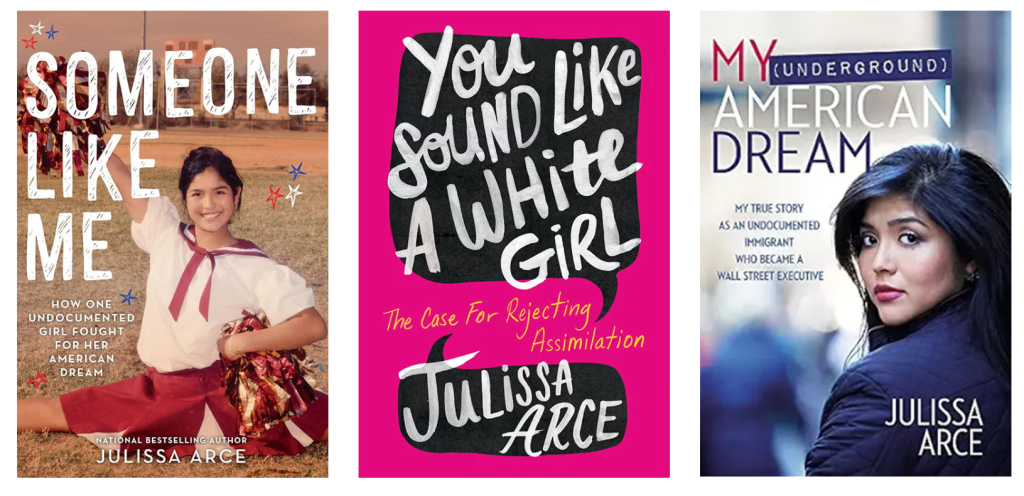
Arce has since left her high-paying Wall Street career to write. Her memoirs, “My (Underground) American Dream” (2016), “Someone Like Me: How One Undocumented Girl Fought for Her American Dream” (2018), and a polemic, “You Sound Like a White Girl” (2022), have earned her the 2026 Luis Leal Award for Distinction in Chicano/Latino Literature at UC Santa Barbara. The award ceremony and discussion take place 4–5:30 p.m. on Feb. 4 in the McCune Conference Room on the sixth floor of the Humanities and Social Sciences Building. The event is free and open to the public.
“I am so honored to receive this award and be in the company of so many writers I admire, such as Reyna Grande, Hector Tobar, Norma Cantu and so many others,” Arce said, noting previous winners. “In today’s environment, it’s a community win that our writing and work in Chicano literature is recognized at this level.”
Acknowledging the caliber and reach of her autobiographical narrative, award founder Mario Garcia, UCSB emeritus professor of history and Chicano/a studies, said, “Julissa Arce is a voice for the courage and fortitude of young Americans of immigrant backgrounds who deserve to be granted citizenship.” Now in its 21st year, the Leal Award is named for the late professor Luis Leal, distinguished professor emeritus of Chicano and Chicana studies and an internationally recognized scholar.
Ahead of the event, The Current caught up with Arce about her move to Texas, writing career and pursuit of the American Dream.
When did your parents first move from Taxco, Mexico, to San Antonio, Texas, and what kind of work were they doing?
My parents first started traveling to the U.S. in the early 1980s, importing sterling silver jewelry and other Mexican arts and selling them at trade shows all over the country. It’s a long story, but due to economic hardships, policies and thefts, that business shut down. We eventually settled in San Antonio and sold jewelry, funnel cakes, snow cones and roasted corn at music festivals, dog shows, summer parties, anywhere we could. My parents were such hard workers and no honest work was beneath them.
You lived with your grandparents in Mexico as your parents relocated to Texas, and you joined them later. What about your siblings?
I was 11 when I moved to the U.S. to join my parents. My older sisters were already in high school and college, and they stayed in Mexico. My youngest brother was born in the U.S. He moved with my parents when they went back to Mexico when he was eight. Eventually, I became his legal guardian and he moved back to the states when he was in high school.
What appealed to you about majoring in finance?
For many of us, as children of immigrants or immigrants ourselves, the question of what do you want to be when you grow up is not really about what we want to do. It’s about what we have to be to meet the responsibilities we will have when we grow up. Finance seemed like a way I could make a lot of money and take care of my family. It helped that I liked math and was good at it.
What compelled you to leave a high-salary career and write about your life?
I had a great career on Wall Street. But it wasn’t my forever path. I needed to tell my story and fulfill my dream of writing a book. It’s been 10 years since I left, and I am now writing my fourth book.
Were you an avid reader growing up? Are there any other writers in your family?
My uncle Mike loves books. He had a big library and I grew up surrounded by his books. He instilled in me a love for books and everything they teach us about all sorts of things, including our humanity.
How did becoming bilingual affect your storytelling?
Knowing two languages doesn’t just expand your vocabulary, it expands your mind. Being bilingual is a gift, one that helps me to see what others can’t. It’s made me a better writer, a more imaginative one.
When you started writing, did you ever fear that your “no papers” secret would jeopardize your literary career or anger your family?
I started my career as a writer by telling my story of having been undocumented while I worked on Wall Street. It’s been the most freeing feeling to share my story and to let go of those secrets.
A lot of media coverage portrays your life as a fulfilled American Dream. Did you see it that way as it was happening? Do you see it that way in retrospect?
I bought into the idea of the American Dream for a long time. But now I recognize that a lot of times the dream is a carrot that is dangled in front of us. When the media portrays my life as a dream achieved, they don’t often talk about the costs of that dream. My job as a writer is to tell the full story.
Do you think the American Dream still exists?
I do still believe in the promise of the American dream, that is why I continue to fight so more people can become what they want. But the reality is that today that dream is inaccessible to many people, including immigrants and children of immigrants. I am honest with young people. Things are harder today than when I was growing up. Wealth inequality is increasing, opportunities are less — but that doesn’t mean we can’t fight to fix the system.
Related Posts
Premier Events
Sat, Oct 10
9:00 AM
Santa Barbara
Treble Clef Chorus Fall Treasure Sale
Tue, Oct 06
All day
Santa Barbara
New and Emerging Technologies in the Hands of Artists: Brave New Work 2.0
Tue, Oct 06
6:00 PM
Santa Barbara
Chaucer’s Books- Horror Stories with Joseph Fink
Wed, Oct 07
7:30 PM
Santa Barbara
Ensemble Theatre Company Presents: “Buyer & Cellar”
Wed, Oct 07
7:30 PM
Santa Barbara
The Theatre Group at SBCC Presents: “CLUE”
Thu, Oct 08
7:00 PM
Santa Barbara
“A Night of Blues” with Morganfield Burnett
Fri, Oct 09
7:00 PM
Santa Barbara
Paseo Nuevo Spooky Movie Nights

Sat, Oct 10
9:00 AM
Santa Barbara
SBNC 1st Annual Health & Wellness Fair

Sat, Oct 10
1:30 PM
Goleta
🌴 Another Day in Paradise at S.B’s Premier Ice Rink

Sun, Oct 11
7:00 AM
Ojai
Flamenco Guitarist Tony Ybarra

Sun, Oct 11
10:00 AM
Santa Barbara
18th Annual Domestic Violence Solutions Brunch
Sat, Oct 10 9:00 AM
Santa Barbara
Treble Clef Chorus Fall Treasure Sale
Tue, Oct 06 All day
Santa Barbara
New and Emerging Technologies in the Hands of Artists: Brave New Work 2.0
Tue, Oct 06 6:00 PM
Santa Barbara
Chaucer’s Books- Horror Stories with Joseph Fink
Wed, Oct 07 7:30 PM
Santa Barbara
Ensemble Theatre Company Presents: “Buyer & Cellar”
Wed, Oct 07 7:30 PM
Santa Barbara
The Theatre Group at SBCC Presents: “CLUE”
Thu, Oct 08 7:00 PM
Santa Barbara
“A Night of Blues” with Morganfield Burnett
Fri, Oct 09 7:00 PM
Santa Barbara
Paseo Nuevo Spooky Movie Nights
Sat, Oct 10 9:00 AM
Santa Barbara
SBNC 1st Annual Health & Wellness Fair
Sat, Oct 10 1:30 PM
Goleta
🌴 Another Day in Paradise at S.B’s Premier Ice Rink
Sun, Oct 11 7:00 AM
Ojai
Flamenco Guitarist Tony Ybarra
Sun, Oct 11 10:00 AM
Santa Barbara


You must be logged in to post a comment.