

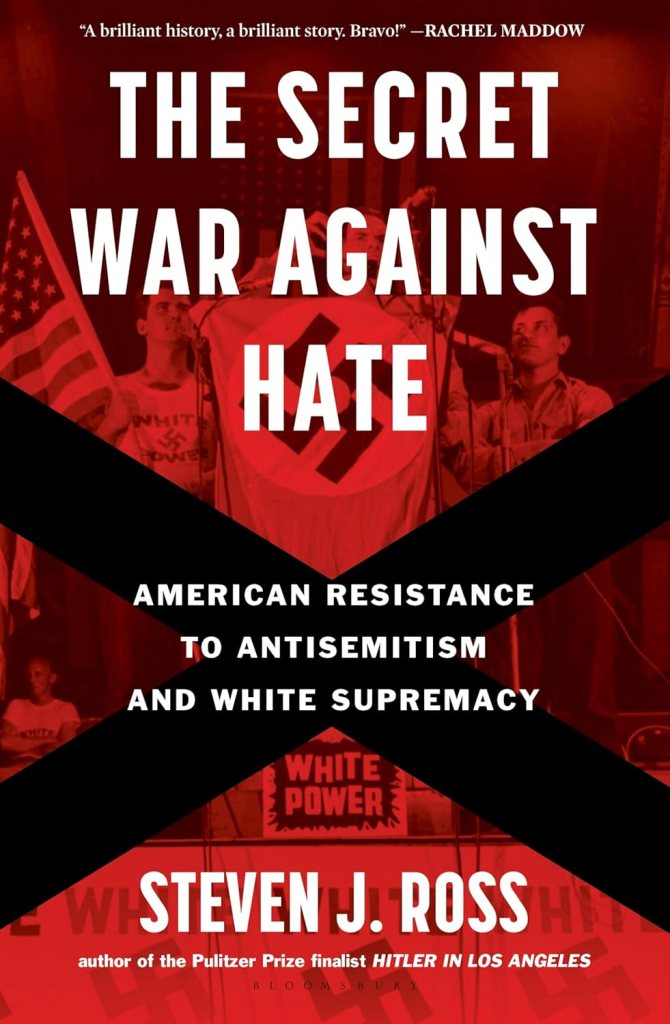
I read The Secret War Against Hate when federal immigration agents were terrorizing the citizens of Minneapolis, which made the experience eerie and chilling. Steven J. Ross begins his investigation of virulent antisemitism and unabashed white supremacy after World War II, when returning white veterans, particularly in the south, were angry about competition for jobs and housing from Jews and Blacks. That many Black and Jewish Americans had fought in the war didn’t matter; significant numbers of white veterans felt betrayed and many found confirmation in the Ku Klux Klan or White Citizens Councils (WCC). In the early 1950s, membership in WCCs was estimated at half a million men and women.
Using a variety of sources, including newspaper accounts, FBI documents, and the official publications of the central protagonists — on one side, the Anti-Defamation League (ADL), the American Jewish Committee (AJC), and the Non-Sectarian Anti-Nazi League (ANL), and on the other the major Nazi and White Supremacist organizations of the time, including the Colombians, the National Renaissance Party, the American Nazi Party, and the National States’ Rights Party — Ross identifies the key individuals involved with each group. It’s a fascinating and yet relatively obscure history that was overshadowed by the Cold War and fears of communism.
What becomes clear is not only how common and widespread antisemitism and racial hatred were in the United States, but how far men like James H. Madole, George Lincoln Rockwell, and Jesse Benjamin Stoner were willing to go to bring about an America free of Jews and Black people. Violence, including the bombing of Black churches and synagogues was a primary tactic, as were public displays of solidarity — marches, rallies, demonstrations — featuring Nazi iconography. This activity wasn’t restricted to the Deep South. In August 1959, for example, Jesse B. Stoner wrote to the New York City police commissioner suggesting that, if given police uniforms and weapons, 5,000 Klansmen could suppress the emerging Black Muslim movement.
While the primary focus of Ross’s account is how the ADL, AJC and ANL managed to infiltrate the main white nationalist and antisemitic groups, often passing internal documents and other information to local law enforcement agencies, who typically did nothing, or to J. Edgar Hoover’s FBI, which also declined to take more than token action, it also exposes the inability of far-right groups to form a lasting and viable coalition. Some groups were too extreme, or not extreme enough; too focused on Jews and not enough on Blacks or vice versa; too willing to display Nazi symbols or unwilling to do so. Of all the leaders on the extreme right, Jesse B. Stoner was perhaps the most astute; unlike his peers, Stoner was willing to change tactics as conditions changed. “From 1942 until his death in 2005,” Ross notes, “Jesse Stoner waged a relentless war on behalf of White Supremacy.”
After what many Americans viewed as an outrageous and radical Supreme Court decision in Brown v. Board in 1954, and as the nonviolent civil rights movement gave way to the more militant Black Power movement, Stoner began looking to electoral politics rather than armed revolution. Stoner mounted campaigns for various elected offices in the subsequent years; though he usually captured a slender number of votes, by presenting himself as an unabashed White Power candidate, he created opportunities for others, including Alabama Governor George Wallace.
In the mid-1960s, Stoner and his ilk identified demographic trends that Tucker Carlson and Donald Trump would exploit decades in the future, namely, the growing population of non-white Americans. Stoner, Carlson, and Trump stoked fears that the white race was in danger of being eclipsed and erased. Ultimately, it was Donald Trump, with significant assistance from evangelical Christians and social media, who assembled the durable coalition of extreme right groups that Madole, Rockwell, and Stoner dreamed about.
While antisemitism remains a problem in America, overtly demonizing Jews is less effective than raising fears of rampaging immigrants. Some of the thousands of white supremacist and white Christian nationalist groups in America no doubt still believe, as Jesse B. Stoner did his entire life, “that to be Anti-Jewish is a leading Christian virtue and an essential White American virtue,” but targeting Jews is now less acceptable than going after Haitians, Venezuelans, and Somalis.
Ross observes that movements and leaders come and go, but ideas persist. Even ideas as thoroughly debunked as white supremacy, or that America was always intended to be a country for whites alone, remain as emotionally and politically charged today as they were immediately after World War II.
This review originally appeared in the California Review of Books.













You must be logged in to post a comment.