
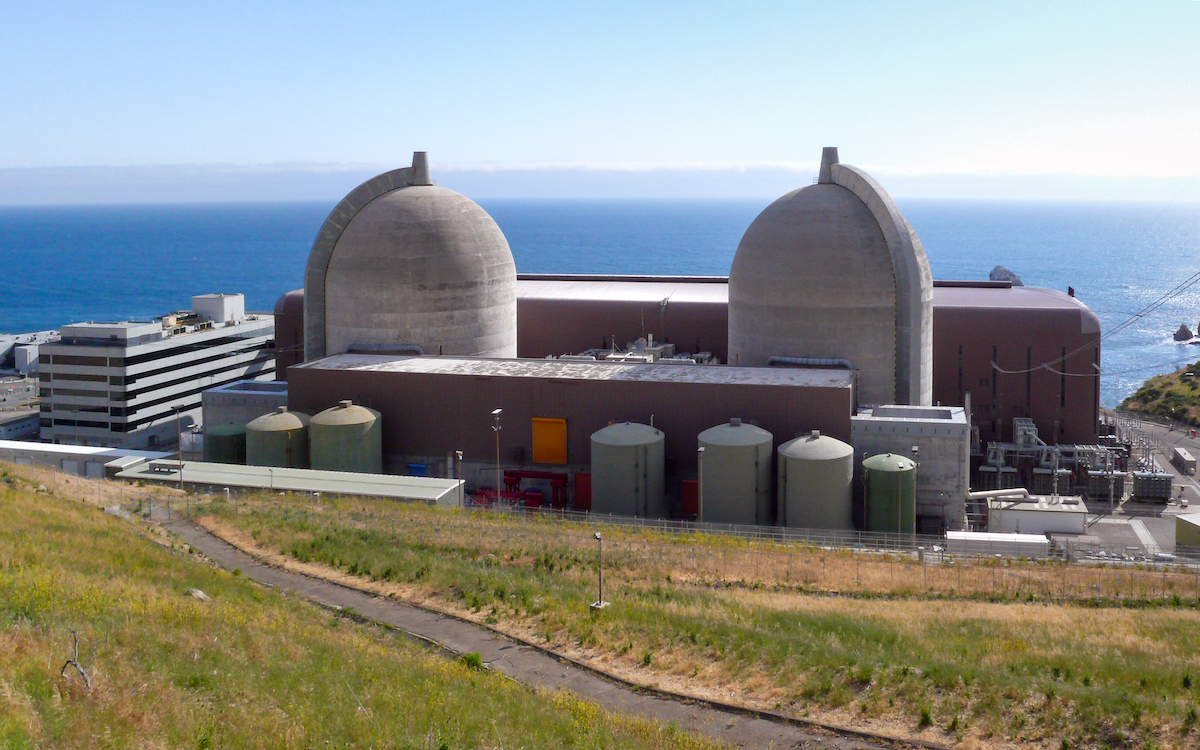
Shortly after Diablo Canyon Nuclear Power Plant received official clearance to operate until 2030, a report released by UC Santa Barbara indicated that customers may be overpaying to keep it running.
The plant’s operators, Pacific Gas & Electric (PG&E), originally planned to retire the plant’s two nuclear reactors by 2025. But the state granted the plant an extension in 2022 to allow it to keep operating until 2030, based on concerns that shutting off a power source that provides 8 percent of California’ s electricity — without other clean energy replacements — would lead to power shortages, especially during heat waves.
The utility company needed extra funds to extend the plant’s lifetime, so it sought a $1.4 billion loan from the state legislature under the assumption that it would be paid back with federal grant money. Additional ratepayer fees were added on top of that.
However, the university’s 2035 Initiative alleges in a new paper that PG&E “significantly inflated the costs of operating Diablo Canyon” when it requested the state loan and will likely not have the federal funds to repay it, instead placing the responsibility on taxpayers, if the state does not take action.
Three climate policy experts analyzed PG&E’s public filings and the Department of Energy’s evaluation of plant costs to produce the report.
They found that California residents are overpaying to the tune of $658.6 million in public financing and $2.65 billion in ratepayer fees, the report claims — and it’s unnecessary. “Without these excess subsidies, the plant can still continue operating economically,” it states. The utility is setting record profits year after year, the authors note — increasing rates 65 percent since 2020, with profits of $2.59 billion in 2025. Diablo Canyon could recover its costs just by selling electricity, they found, and if the fees were eliminated from 2027 to 2030, it could save California utility customers an estimated $1.84 billion. That equates to around $250 per PG&E ratepayer and $80 per Southern California Edison ratepayer.
When PG&E requested the $1.4 billion loan, it only applied for $1.1 billion in funding from the Department of Energy; and a DOE analysis found that the plant only needed $741.4 million to continue operating, according to the report. The utility could repay the full loan with just 6.25 percent of its annual profits, the authors claim.
“These numbers show just how much PG&E misled California legislators and taxpayers, raising electricity bills for regular people all across the state,” said Leah Stokes, associate professor in energy policy at UC Santa Barbara, and lead author on the report. “Through closed-door negotiations, they secured a much larger taxpayer loan than they actually need. Now they plan to stick everyday Californians with the bill. They should have to pay it back in full.”
The plant’s revenues exceed its costs, the authors say, and many ratepayers do not even benefit from the power generated.
PG&E has denied all the report’s allegations. A PG&E representative told the Los Angeles Times that all loan money will be spent on eligible projects and activities by the end of the year. Lynsey Paulo, a spokesperson for PG&E, told the Times in a statement that the Department of Water Resources — which administers the loan — found PG&E’s loan expenditures to be “reasonable with no disallowances.” She also said that, legally, the loan can only be repaid with federal grant money and excess revenues from the plant. But it was unclear how PG&E expected to cover the full $1.4 billion — the current default being for the state’s taxpayers to cover the costs if it is not repaid.
The report is especially timely, as Diablo Canyon just received federal approval to operate until 2045. However, the California Legislature must give PG&E permission to operate beyond 2030.
“Diablo Canyon is a useful clean energy asset for California, but its costs should not be inflated by PG&E, causing ratepayers and taxpayers to pick up excess costs,” the report’s authors state. “With California facing a budget shortfall, state legislators can use this as an opportunity to both negotiate a better deal for California taxpayers and ratepayers, while protecting grid reliability and meeting clean energy goals.”
Related Posts




Premier Events

Sun, Oct 04
11:00 AM
40th California Avocado Festival

Sun, Oct 04
1:30 PM
Goleta, CA
📚 Library Card Day

Tue, Oct 06
All day
Santa Barbara
New and Emerging Technologies in the Hands of Artists: Brave New Work 2.0

Tue, Oct 06
6:00 PM
Santa Barbara
Chaucer’s Books- Horror Stories with Joseph Fink

Wed, Oct 07
7:30 PM
Santa Barbara
The Theatre Group at SBCC Presents: “CLUE”

Wed, Oct 07
7:30 PM
Santa Barbara
Ensemble Theatre Company Presents: “Buyer & Cellar”

Thu, Oct 08
5:30 PM
SANTA BARBARA
Oh the Horrors! New Book Club at S.B Public Library

Fri, Oct 09
7:00 PM
Santa Barbara
Paseo Nuevo Spooky Movie Nights

Sat, Oct 10
10:00 AM
Ojai
Ojai Design x Vintage

Sat, Oct 10
10:00 AM
Ojai
Ojai Studio Artists Open Tour
Sun, Oct 04 11:00 AM
40th California Avocado Festival
Sun, Oct 04 1:30 PM
Goleta, CA
📚 Library Card Day
Tue, Oct 06 All day
Santa Barbara
New and Emerging Technologies in the Hands of Artists: Brave New Work 2.0
Tue, Oct 06 6:00 PM
Santa Barbara
Chaucer’s Books- Horror Stories with Joseph Fink
Wed, Oct 07 7:30 PM
Santa Barbara
The Theatre Group at SBCC Presents: “CLUE”
Wed, Oct 07 7:30 PM
Santa Barbara
Ensemble Theatre Company Presents: “Buyer & Cellar”
Thu, Oct 08 5:30 PM
SANTA BARBARA
Oh the Horrors! New Book Club at S.B Public Library
Fri, Oct 09 7:00 PM
Santa Barbara
Paseo Nuevo Spooky Movie Nights
Sat, Oct 10 10:00 AM
Ojai
Ojai Design x Vintage
Sat, Oct 10 10:00 AM
Ojai

