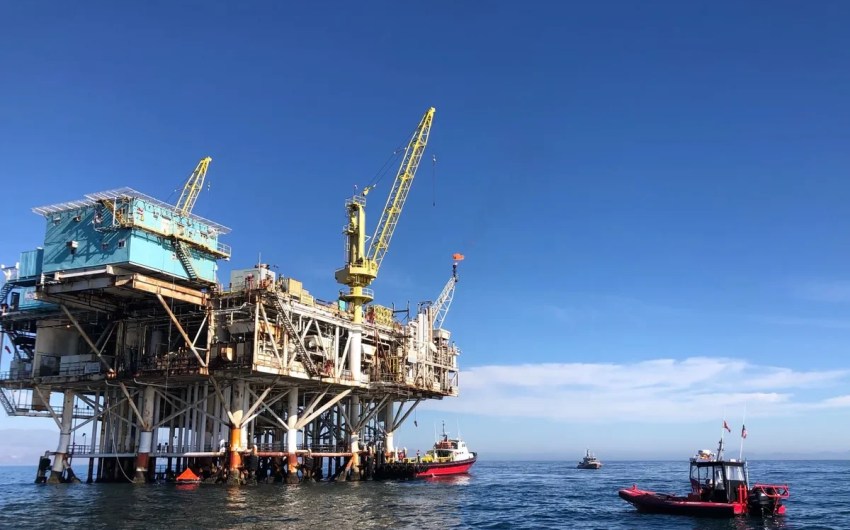
By shutting down Platform Heritage eight miles off the coast of Santa Barbara, oil company Sable Offshore would release 17 tons of emissions into the atmosphere — equivalent to 34,000 cars driving one mile in tandem. That’s compared to the 0.04 tons of excess emissions that currently puts them over the total permitted by the county’s Air Pollution Control District (APCD), Sable representatives argued on Friday morning.
It was a rehearing on the pollution waiver — called a variance — that the APCD granted to Sable in June to allow for excess emissions due to “unplanned flaring” at Platform Heritage. Despite opposition from environmental groups, the full hearing board re-approved the variance.
Flaring is required to take care of unprocessed, combustible gas that cannot be transported onshore to avoid environmental and safety impacts, Sable representatives said. All production platforms have these systems. Unplanned flarings are expected from starting operations at a new or long-idle platform such as Heritage, according to Terry Dressler, APCD hearing board chair. Heritage was shut down for nine years, and only recently came back online in March.
Since then, the company reported in its application for a variance that Platform Heritage — one of the three Sable bought from Exxon two years ago — has experienced “an unexpected number of equipment malfunctions, onshore and offshore production balancing issues, and well production issues that are related to restart of the platform and which have resulted in excess unplanned flaring.”
Requiring immediate compliance with the APCD permit, which only allows up to a ton of emissions from unplanned flaring over a three-month period, would have forced Sable to shut down the platform and take it offline, Sable argued. That process would actually result in more flarings — those 17 tons — in the short-term than just granting them the variance, Sable said. Additionally, shutting down would cost Sable approximately $1.75 million per day, the company claims.
Sable exceeded its 90-day emission limit on May 22, leaving them vulnerable to penalties without the variance. On June 25, Hearing Board Chair Terence Dressler heard and approved Sable’s case for a waiver to cover them until June 30, under the assumption that within the next 90 days, Sable will fix the problems resulting in air pollution exceedances.
After the hearing, on the same day, the Center for Biological Diversity — a steadfast Sable opponent — appealed the decision. If any member of the public contests a decision made by a single member of the hearing board, according to California law, the application must be reheard by the entire hearing board, which is what happened on Friday.
The variance period is technically complete, and should it have been denied by the full board, it would have superseded the previous decision and Sable would have faced penalties for the five days it was in violation.
Members of the APCD’s five-person hearing board said they felt they had no choice but to grant the variances — stuck between extra emissions and extra extra emissions. There seemed to be hesitancy and frustration toward the vote and the system. If they do anything dramatic to respond to exceedances — i.e., shutting down the platform — it would lead to more emissions, something board member Robert J. Saperstein characterized as a flaw in the system.
“Its very unsatisfying as a resident of Santa Barbara County that the permittee is doing exactly what was expected of them; we’ve heard from every operator that it’s dangerous, a monstrous process to shut down, so they come in and ask for a variance,” said Saperstein. “We’re left with no choice. It’s a Kabuki dance.”
Sable representatives reiterated that Sable self-reported the excess emissions to pursue compliance, and assured the board it was taking steps to address them.
However, a denial of the variance would not necessarily lead to the dramatic, worst-case scenario of a shutdown, the Center for Biological Diversity argued in its written objection to the variance. It would be up to Sable to decide whether to shut down and make necessary repairs, or, perhaps, continue operating in noncompliance and shoulder the consequences while it worked to bring the platform into compliance, the center suggested.
The center joined other environmental groups during public comment on Friday to urge the board to reverse the approval and reject the variance. They noted that Sable, thus far, has relied on 11 emergency variances to keep operating.
Representatives with the Environmental Defense Center again argued that Sable has not provided sufficient evidence that it qualifies for the variance at all, lacking support for its findings that the unplanned flares were beyond the company’s control nor that it would lead to millions of dollars in losses to delay production and shut the platform down.
Nor has Sable provided evidence that it has reduced emissions since being granted the variance, they argued, despite Sable’s claims that it has updated infrastructure to address the restart issues leading to the excess emissions. They said Sable has not provided reasonable evidence that it will reduce emissions to be under the permitted limit, either.
Maureen Ellenberger, chair of the Sierra Club’s Santa Barbara-Ventura chapter, acknowledged the board was faced with a kind of “Hobson’s choice.” But she cited Sable’s $76 million payout to its CEO, Jim Flores, saying that if the company can afford to spoil its CEO, it can afford to do what it takes to comply with air permits.
“If production is causing flaring, curtailment is the answer,” she said. “The Board should not be a rubber stamp … granting variance after variance turns into standing permission slip to pollute.”