[Updated: July 28, 2026, 2:00 p.m.]
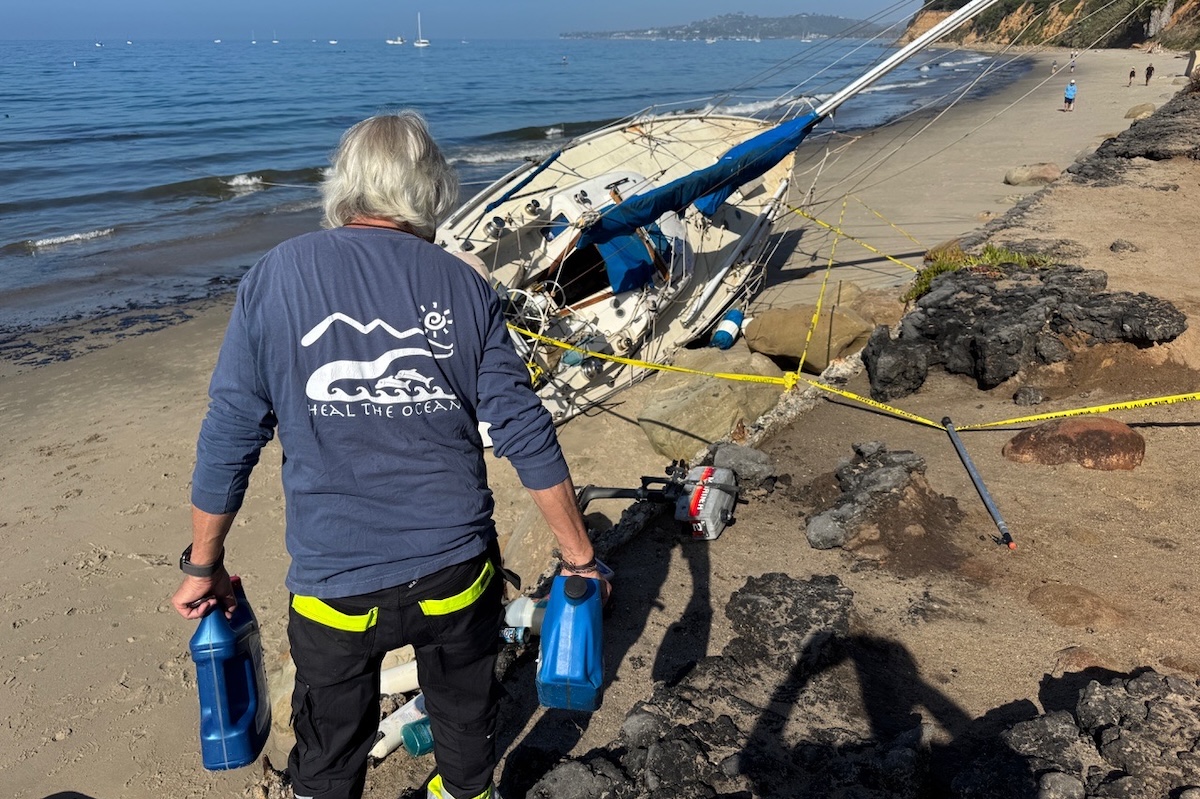
Like manmade whale carcasses, two boats broke anchor and beached on the shores of Montecito last week.
To prevent these vessels from shedding toxic fluids and materials into the environment, nonprofit Heal the Ocean (HTO) teamed up with MarBorg to haul them away. Heal the Ocean foots the bill, paying anywhere from $5,000 to $30,000 for cleanup, depending on the boat’s size. Fortunately, the two last week were on the smaller side.
Beached and abandoned boats pose a persistent and notoriously challenging problem for the county. Jurisdiction, enforcement, and responsibility are all slippery when it comes to the water — and the sand when the boats wreck onshore. But someone has to deal with them.
“All the crap from these boats gets into the ocean,” said Harry Rabin, field advisor for HTO. “It’s a public safety concern and an environmental issue.”
The first boat beached on Butterfly the weekend before last. Marborg cleaned it up by Monday morning, July 13, only for HTO to receive another report of a second stranded sailboat, named Riches to Rags, bobbing along the surf line by Tuesday evening. It was cleaned up by dawn on Friday. Each time, crews broke up the boat and hauled it away.
Beached boats are not unusual, but two in one week is excessive. Rabin suggested that the double-whammy last week may be linked to the fuss around an area nicknamed “Fool’s Anchorage,” which lies just east of Stearns Wharf, and where boaters have historically anchored for free during the summer. With the city’s plans to replace the seasonal, rent-free waters with fee-based moorings, boaters were essentially evicted, being told on June 1 that they’d have to relocate by June 15. Some of those boaters may have simply drifted down the coast.
“Those who cannot pay the new mooring fees just kick the can,” Rabin said. “Problems are pushed down the coastline.”
There are respectable boaters who use the seasonal anchorage because they have been priced out of city slips, which, depending on size, have recently sold for $45,000 to $200,000, alongside increasing fees for transfers and guest slips, boaters reported. Genuine derelict boats may have moseyed into county waters, but many using the seasonal anchorage are responsible boat owners who would be willing to anchor in city moorings if it was an accessible option, boaters have said.
The change to fee-based moorings will significantly reduce public anchoring opportunities, forcing anyone unable or unwilling to pay into rougher waters, compromising safety standards, argued resident Graham Martin-Setaro at the July 28 city council meeting.
Nevertheless, the city is moving forward with its plan to replace the seasonal anchorage with fixed mooring balls that boaters can rent nightly, weekly, or monthly. It is intended to “provide a much safer alternative to anchoring and will result in less boats coming ashore which has been a targeted issue over the years,” said Mike Wiltshire, waterfront director for the City of Santa Barbara.
The county does not have as good of a grasp on derelict boats as the City of Santa Barbara, which has established resources for watercraft abatement and even a boat task force for its more-manageable waterfront, fronting the city and extending three miles out to sea. The city has worked collaboratively with Heal the Ocean to address derelict boats for years, Wiltshire said. Beached and abandoned vessel disposal typically costs the Waterfront Department $50,000 to $100,000 per year, he said. Even though it is the vessel owner’s responsibility to cover all costs, he noted, the city is often unsuccessful in recouping costs from boat owners.
To get in front of the problem, the city established an incentive program that offered owners of derelict boats $500 to turn them into the Waterfront Department for disposal, which resulted in several boats turned in. Since costs also fall solely on the department, and result in the need to generate more revenue through slip holders and other sources, Wiltshire added that the Waterfront Department has spent the last 18 months “further regulating city waters to help with this issue.” For example, as of this January, the city now requires all vessel owners docking, mooring, or anchoring in City waters to have basic liability insurance for their vessel. “This policy change has already paid off as we have already successfully received insurance reimbursements for two vessels that have gone ashore on East Beach,” Wiltshire said.
“We work closely with the County and Heal the Ocean to try and improve the issue with derelict and beach boats and often meet to discuss issues and improvements,” he said. “Improvements have been made and the number of beached vessels is decreasing but there are still boats going ashore every year.”
However, the county does not have similar regulations, nor dedicated funds to pay for cleanups. When derelict boats drift into the county’s larger jurisdiction, they evolve into a bigger headache for a government agency with fewer avenues for relief.
Owners are given the chance to salvage the vessel, and if they do not, it is tagged for removal — which falls on HTO and Marborg. Usually, they are removed. Tracking down the owner can be quite difficult.
Typically at the heart of the problem are boat dealers who buy boats for a penny and resell them for a dime, so to speak, often to unhoused people looking to put a roof over their heads without a lick of knowledge on boat maintenance nor the resources to maintain them. The boats wind up neglected and drift ashore. Rabin alleged that they have recently cleaned up seven boats all connected to the same seller.
“There’s a lot of boats out there that are ticking time bombs — there’s one out there we’ve been watching for a while. It’s huge. It’s covered in bird poop. We’re gonna have to call the health department for that one,” Rabin said. “It begs the question: What is the definition of seaworthy?”
Under California law, a vessel must be seaworthy — i.e., structurally and operationally sound enough to not pose hazards to navigation, the environment, or the public — to be moored or operated in state waters, and those that are not can be subject to removal, impoundment, or disposal.
The issue has long been on the county’s radar, but it is the furthest thing from cut and dry. Supervisor Roy Lee’s office confirmed that the Board of Supervisors will be putting a discussion on the docket for the fall, once the board is back from recess in mid-August. County staff may then be directed to come back to the board with options to address the problem. But, again, it is tricky to navigate when jurisdiction is blurry, enforcement is challenging, and some people call these boats home. Removing the roof from over their head just trades one problem for another.
To help pay for the cleanups, the County Sheriff’s Office can lean on the state’s Surrendered and Abandoned Vessel Exchange (SAVE) grant, which reimburses public agencies for costs associated with removing and disposing of derelict marine vessels. Rabin said HTO bankrolled the recent cleanups in hopes the Sheriff’s Office will soon secure more funding.