• CREATE AN ACCOUNT
  • LOG.IN
  • CONTENTS
  • CLASSIFIEDS
  • ARCHIVE
  • INFO | ADVERTISING | CONTACT US

  • Home
  • News
    • Business
    • NewsFlash
  • A&E
    • Movie Times
    • TV Listings
    • A&E Blog
    • Art Galleries
    • Best Bets
  • Opinion
    • Columns
    • Voices
    • Letters
    • In Memoriam
  • Events
    • Today
    • Search
    • Submit
    • Best Bets
  • Living
    • Travel
    • Sports
    • Peeps
  • Food & Drink
    • All Restaurants
    • Delivery
    • All Bars & Clubs
    • Drink Specials
    • Open Now
  • Outdoors
    • Outside Insider
    • Spotlight On
    • Features
  • Classifieds
    • Real Estate
    • Jobs
    • Autos
  • Personals
  • Obits

Paul Wellman

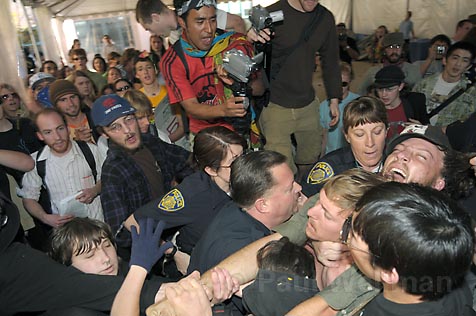
Police tussle with protesters outside UCSB’s Corwin Pavilion, resulting in the arrest of Michael Miller (the light-haired man in the foreground) and Alex Harrison (the man wearing a hat and standing behind Miller).


Military Conference Sparks UCSB Protest

3 Arrested and 1 Buffet Destroyed in Antiwar March

Wednesday, February 13, 2008
By Adrian Castañeda
Article Tools
Print friendly
E-mail story
Tip Us Off
iPod friendly
Comments
Bookmark This
del.icio.us. del.icio.us.
Digg! Digg!
furl furl
google google
newsvine newsvine
reddit reddit
technorati technorati
Facebook Facebook
Yahoo! My Web 2.0 Yahoo!

As a Sheriff’s Department helicopter circled above UCSB at noon on Tuesday, protestors clogged Pardall Tunnel, the underpass that connects the school’s campus with Isla Vista. Student activist group S.B. Antiwar had organized them to decry the Institute for Collaborative Biotechnologies (ICB) conference, which brings UCSB researchers together with military officials and representatives from corporations like Raytheon. Police watched from a distance as several speakers explained their grievances with the meeting as well as their goals for the protest — among them, a survivor of Hurricane Katrina and an Iraq War veteran who faulted the government for what he perceived as its failures to properly care for military members.

Photo Gallery

Anti-War Protest Disrupts UCSB Conference

Student activist group S.B. Antiwar gather at the end Pardall street in Isla Vista to protest UCSB's involvement with the military

Enlarge photos | View thumbnails

Come that evening, the two gatherings — the conference and the protest —resulted in some tense showdowns between dissenters and those in various positions of authority, exchanges that got to the heart of the hawks-versus-doves debate concerning current U.S. military efforts, and the arrest of three people. While UC Police estimated that between 200 and 300 protesters were present, S.B. Antiwar claimed more than 400. Numbers fluctuated as classes ended. Some professors even cancelled classes so students could attend the event.

And while those involved initially amassed at Pardall Tunnel around noon, by 1 p.m., they set out for UCSB’s Corwin Pavilion, which held the ICB conference. The few police at the conference were instantly overwhelmed by the mob of protesters, and lunching conference-goers were suddenly beset with rowdy intruders. Tables were overturned and students stormed the buffet, quickly devouring anything edible. Most conference participants were able to get back into their meeting room before police forced their way to the door and sealed it off to prevent protesters from entering. An unlucky few were stranded outside staring down bullhorns and angry, painted faces. Some protestors attempted to calmly ask conference-goers why they had participated. Others merely shouted. Most lunchers appeared angered by the crowd, but U.S. Army Col. Jonathan Jaffin shrugged and chuckled at the mob, saying, “They’re doing their thing.” Once the conference room had been sealed off by police, protesters chanted and made as much noise as they could to be disruptive.

When the police car attempted to leave, protesters sat down and blocked the only exit out of the lot.

The crowd flared when Goleta resident Michael Miller, 22, was arrested on charges of obstructing an officer. As police attempted to take him into custody, the young man held on tightly to a pole and fellow protesters attempted to anchor him down. Police shoved, and the students shoved back. Eventually, officers moved the man to a squad car in a nearby parking lot. When the police car attempted to leave, protesters sat down and blocked the only exit out of the lot. In the mêlée, police also arrested Alex Harrison, also on obstruction charges. Harrison was placed in a second squad car. When this car attempted to leave, another group moved quickly to sit in front of it. The protest abruptly became a stalemate, however, with both sides eager for action but hesitant to act. Police eventually manipulated the crowd enough that the first man could be moved into another car and both could escape. Both men were later released.

Despite the ruckus, the ICB conference had resumed, with protesters chanting all the while. At one point, two conference participants came out to speak to the students and explain the purpose of their meeting, but the crowd was not appeased. A third arrest took place when UCSB student Patricia Zavala infiltrated the conference. According to UC Police, Zavala began ripping down posters for ICB and was arrested on charges of petty theft, resisting an officer, trespassing, and vandalism. Conference members eventually trickled out through the UCen. A few researchers stopped to debate with students, but most refused to comment. This reporter overhead one remark: “These children ought to know what their fathers think of them.”

Many in the crowd were disappointed with the turnout, especially in light of previous UCSB protests, like the historic 1970 one that resulted in the burning of Isla Vista’s Bank of America building or even last year’s, in which more than 500 students marched onto Highway 217, shutting it down for several hours and resulting in two arrests. Aileen Santos, a fourth-year women’s studies and sociology major who was present last year, was worried that few people would show up to this year’s event as a result of what happened last year. “I didn’t think it was really responsible,” she said of the roadway march.

Also among those present was UCSB Campus Republicans chairman Jerad Ferguson, a political science and history major, who said his group attended to show that not everyone is against the war. “If we had a pro-war protest, I don’t think professors would have cancelled classes,” he said. Many passersby commented that they would have attended the protest but they had class and, more importantly, midterms.
Related Links

  • Last year's Highway 217 protest
Story Help (Click-ability)
Double-clicking on any word or phrase in this story will open a reference window with definitions and links to other reference material.

Comments

Discussion Guidelines

Good for the students!

UCSB's collaboration with the military is reprehensible. It is not the role of universities to be "chop shops" for weapons research. The ICB is basically an institute that creates weapons systems for the military. A lot of people try to justify military funded research, but it's science for war.

The students are brave to have shut this down. I appreciate their message because they move beyond "this war" and are criticizing more systematic problems with US society. The militarization of our economy and schools has to be opposed.

LawrenceGramm (anonymous profile)
February 13, 2008 at 5:53 p.m. (Suggest removal)

what do the students know about ICB? they couldn't even name a single ongoing project. nobody is creating weapons in ICB, as a matter of fact.

the military funds many research projects. internet was one of them.

if the students really want to show their anti-war position, do some homework and at least know what they talk about. don't come out and show their ignorance.

do these cowards dare to do such nasty things in front of the white house, at a military base or los alamos national lab where research on nuclear weapons is going?

"quickly devouring anything edible", what a joke!

university_researcher (anonymous profile)
February 13, 2008 at 9:28 p.m. (Suggest removal)

in response to university_researcher:

i'm not going to jump into a run-around debate about who knows what. i just want to say that regardless of how informed most students are about specific projects, we do not want our university to collaborate with the US military industrial complex (period). UCSB collaborates with the military and the parallel industry (and not on methods for nonviolent conflict resolution), so thats all that is necessary to know in order to form an opinion on this matter. students are the core of the university and their voices must be heard.

concernedgradstudent (anonymous profile)
February 14, 2008 at 1:07 a.m. (Suggest removal)

I'm no supporter of the Bush administration or the Iraq war, and I admit I don't know anything about the ICB, but I can't help but think the complexities of the issue are being lost on some of the students. When I was a grad student @UCSB, I recall Dr Kroemer's semiconductor equipment was funded by the U.S. Army - he went on to win the Nobel Prize and his research has arguably way more non-military benefits than military. And what about the DARPA-funded research that helped UCSB pave the way for the internet - that has had tremendous beneficial impact on the lives of people around the world. Issues like this aren't black and white - that's ironically an analytical strategy hawkish Republicans like to use.

EastBeach (anonymous profile)
February 14, 2008 at 1:29 a.m. (Suggest removal)

Sure, some military funded research can and has resulted in useful civilian technologies, but to justify a $50 Army-Industry institute on UCSB's campus on these grounds makes no sense.

Look at how the Army describes ICB:
"With the Army Research Laboratory's Army Research Office playing a key role in oversight, the center will provide the interdisciplinary fundamental knowledge and technical capabilities to manipulate biological systems and components, and to exploit biologically derived products and processes for both the soldier and engineered systems and platforms." (http://www4.army.mil/ocpa/read.php?story...)

Or check this out: http://asc.army.mil/docs/pubs/alt/2007/4...
_magazine_Full_Issue_200710.pdf
[open and search for ICB]

The ICB is set up so that the Army makes a "task order" and UCSB provides some research for that order. Orders are directly connected to basic research questions involved with the production of new weapons systems.

I think the students clearly know what they're talking about.

LawrenceGramm (anonymous profile)
February 14, 2008 at 2:07 a.m. (Suggest removal)

KCSB covered the event from the gritty ground.
Hear the full audio story here:
http://www.kcsb.org/?p=593

David_Pritchett (anonymous profile)
February 14, 2008 at 8:56 a.m. (Suggest removal)

to LawrenceGramm:
I don't see weapons mentioned anywhere. I don't think you address any point in my post above.

to concernedgradstudent:
you can't debate because you have no logical points. any uninformed opinions are unfounded.
students are only part of the university. surely they have the right to be heard but not in this way. this is a riot!
you may choose not to work with the military but ICB has every right to collaborate with the army. you should learn to how to respect that.

university_researcher (anonymous profile)
February 14, 2008 at 1:30 p.m. (Suggest removal)

to University_Researcher:

I challenge you to find the word "weapon" anywhere in military science and technology doctrine literature. It's always couched in euphemistic terminology.

But if you really want a clear picture painted for you, I did some digging on the web. Check out Chief Army scientist Dr. Killion's remarks about ICB before the House Armed Services Committee:

" Last month we opened the Institute for Collaborative Biotechnologies (ICB) at the University of California, Santa Barbara. The ICB integrates biosciences with the physical and engineering sciences to provide an understanding of the biological construction of novel materials such as biologically-derived, functional electronic, magnetic and optical materials; integrated multi-modality sensing; biologically-derived network concepts; and, sense and respond actuation capabilities. This will influence the development of technology that improves military capabilities in the areas of precision strike, signature management, network design and implementation and “identification of friend or foe.” (http://www.globalsecurity.org/military/l...)

So you're going to tell me "precision strike" means cancer research? You're going to tell me "identification of friend or foe" is so that soldiers know who to give hugs to? Give me a break.

Those of you interested in justifying military funded weapons research on college campuses need to really get your facts straight.

Finally, I think it's interesting that you're first instinct is to deny that this is weapons research. Might that mean that you too recognize the moral bankruptcy of making weapons systems for the US military?

LawrenceGramm (anonymous profile)
February 14, 2008 at 2:11 p.m. (Suggest removal)

It doesn't matter whether the research done by professors affiliated with the ICB will eventually trickle down to the civilian sector. The research is being funded and directed by the Army and by miltary corporate contractors. The research may be unclassified, but it is specifically geared toward fulfilling the army's mission. Once the research is complete, the Army and the military contractors have total access to any University patents created through the ICB. That means they can do whatever they want with the technology, including combining research done on sensors, electronics, communication systems, etc. with classified research done by other institutions. The Army and its contractors should have to jump through hoops to hijack civilian technology in order to make war, not the other way around. We need to get the military off of our campuses and out of our communities if we want them to stop invading other countries and establishing bases on foreign soil. Furthermore, arguments such as, "lots of civilian technology was originally funded and produced through the military" does not hold any water in this case. Just because that is the case now does not mean that it should be the case or needs to be the case. That is a logical fallacy. Are people seriously arguing that the internet or airplanes or any other technology would never have been produced without the military? That is insane. The filtering of any of this technology through the military is antithetical to the ends of a just and free society. Even if it were true, I'd give up internet and airplanes in a second if it meant that there were no more imperialist military destroying the planet. Don't forget, human beings need good food, clean air, clean water, clothing, shelter, and community to survive. The rest is just icing on the cake. Let's not forget our priorities.

UCSBALUM (anonymous profile)
February 14, 2008 at 3:53 p.m. (Suggest removal)

if you call any research that could be used in the military "weapon research", i can only say you are really ignorant about research or you choose to be ignorant in order to promote your opinions. why don't you try to shut down intel, boeing, raytheon (in town) or lockheed martin? their direct products are used in weapons. or maybe you can refuse to pay tax to make sure your money is not used in the war.

by the way, your logic in linking cancer research in ICB to "precision strike" is flawed. do you know the meaning of "could" and "influence"?

I'm not interested in justifying anything. it is the protesters who need to find the facts. I'm a researcher, and I know what I'm doing. i don't see anything wrong with weapon research on college campuses, let alone ICB is not doing any. this is a free country. if you don't like being here, go somewhere else. you have absolutely no right to disrupt a normal research conference.

hey, i deny that ICB is doing weapon research because I know/understand the research here. i'm not saying the war is morally correct. you got to find the right target to protest against. who makes the decision to have a war? use your brain.

university_researcher (anonymous profile)
February 14, 2008 at 3:56 p.m. (Suggest removal)

university_researcher,

Wow, your last comment is really scattered and incoherent. I'm sorry that you feel the way you do. I hope that you muster the courage someday to face reality.

But enough about you, bravo to the students!

LawrenceGramm (anonymous profile)
February 14, 2008 at 4:06 p.m. (Suggest removal)

I am a graduate student at UCSB, and much of my funding comes from the ICB. In my four years here, I have not made any weapons. I have been working with other researchers to develop tools to help with the long-term goals of understanding, diagnosing, preventing and curing diseases. The army seems to think that this is important--and, even though I am staunchly anti-war, I agree.

I would rather not work for the military. I wish that there were *no* military. However, research funding in the US is pathetic. Funding for the NSF and the NIH is meager and in constant jeopardy. Meanwhile, our population is expanding and aging and our health and environment are deteriorating. Until taxpayers are willing to pay directly for the basic scientific research needed to keep this country alive and healthy, researchers are going to be forced to look to the DOD, DOE and industrial partners for funding.

Remember that as university researchers, we are continually encouraged to publish *all* of our work. Academics rate themselves according to the length of their publications lists. If mine is bigger than yours, I'll get tenure and you will not. When UCSB (or another university) gets research funds from the military, the entire world *may* benefit from that research. I wish that every researcher could say as much--you don't see drug or weapon manufacturers lining up to disclose their findings.

I feel that protesters are wrong to demand that UCSB relinquish its research funding. Instead, they should seek to understand and help *guide* the research efforts at UCSB for the good of the world. They should demand that *more* US research funding be allocated to universities where the public can enforce some degree of oversight and *less* funding should be given to secretive multinational cooperations. In this manner the protesters may find that they can have far more input in the direction this country will take in its scientific progress.

brianem (anonymous profile)
February 14, 2008 at 4:48 p.m. (Suggest removal)

I was at the protest. I don't know what the ICB is, but the free food was great and it was fun to yell and stamp my feet and talk to the chicks with hairy armpits.

I think I made the world a better place.

Kratatoa (anonymous profile)
February 15, 2008 at 5 p.m. (Suggest removal)

"Now there's revolution, but they don't know, what they're fighting" -Jethro Tull- ("living in the past")

I'm sure the people storming the place and stealing food made quite an impression on those who support the war.

I wonder how many of these spoiled brats are actually going to vote for true change and if any of them can articulate the dangers of imperialism in a way that make people who are on the fence see how the U.S. is throwing away its potential on the altar of the military-industrial complex.

"Beware of foreign entanglements" -George Washington- (In his farewell address)

billclausen (anonymous profile)
February 15, 2008 at 10:59 p.m. (Suggest removal)

Could anybody provide more information on the following (name of the researcher, the context in which his claim was made as to the link between UCSB and the bomb dropped on the wedding party, etc.), found at the Santa Barbara Indymedia website:

"For example, A UCSB researcher worked on technology for a new type of bomb which was dropped on an Afghan wedding, killing 40 Afghanis gathered to celebrate the love between two people and their families. U.S. officials denied responsibility for the bombing until camera footage made it impossible to deny. To the researcher's horror, his teammates working on the bomb expressed no remorse for the innocents killed by their invention. Instead, they celebrated the news because the bomb worked as they intended it to."

KlausNordmeyer (anonymous profile)
February 16, 2008 at 9:35 a.m. (Suggest removal)

KlausNordmeyer, all it takes is a working knowledge of Google to find information about the incident. Here's some starters from the first page of Google:

http://archives.cnn.com/2002/WORLD/asiap...

http://www.guardian.co.uk/world/2002/jul...

http://www.hrw.org/reports/1991/gulfwar/...
(under the heading of CITIES AND TOWNS IN WESTERN AND NORTHERN IRAQ)

http://query.nytimes.com/gst/fullpage.ht...

angiewoot (anonymous profile)
February 16, 2008 at 10:05 a.m. (Suggest removal)

angiewoot, all it takes is a working knowledge of "reading comprehension" to see that's not what he was asking.

Kratatoa (anonymous profile)
February 16, 2008 at 3:59 p.m. (Suggest removal)

As Kratatoa is indicating, the important thing here is the connection between UCSB and the bomb used in wedding bombing incident.

This seems hugely significant, and it would be great if anyone could fill in the details.

Would definitely seem to put to rest the claim that "nobody is creating weapons" at UCSB.

KlausNordmeyer (anonymous profile)
February 16, 2008 at 5:34 p.m. (Suggest removal)

Army sees ICB research as fulfilling need for "revolutionary advances in performance of Army weapons systems"
http://www.dtic.mil/descriptivesum/Y2008....

ARMY RDT&E BUDGET ITEM JUSTIFICATION (R2a Exhibit) Budget Item Justification ExhibitR-2a February 2007

2 - Applied Research 0602120A - Sensors and Electronic Survivability

SA2 BIOTECHNOLOGY APPLIED RESEARCH

A. Mission Description and Budget Item Justification: The objective of this project is to transition maturing biotechnology research from the Army's Institute for Collaborative
Biotechnologies (ICB), a University Affiliated Research Center (UARC). The ICB is led by the University of California, Santa Barbara (Santa Barbara, CA)...

Projects are intended to cover the entire breadth of the ICB 6.1 program. The process of transformation requires
revolutionary advances in performance of Army weapons systems, including improvements in engineered systems impacting Soldier survivability. The ICB will conduct
unclassified basic scientific research in: sensors, electronics, information processing and the technical fundamentals enabling development of advanced capabilities in these
application areas.

Or how about this --
ICB is a conduit for turning UCSB into military researchers

http://www.dtic.mil/descriptivesum/Y2005...

A. Mission Description and Budget Item Justification:This Project supports the Army’s Institute for Collaborative Biotechnologies (ICB), a University Affiliated Research
Center located at the University of California-Santa Barbara
...
A second ICB objective is to educate and train outstanding students and post doctoral
researchers in revolutionary areas of science for Army Transformation. ICB has many industrial partners such as IBM and SAIC, and it is has strong collaborations with six
National laboratories, the Army’s Institute for Soldier Nanotechnologies, the Institute for Creative Technologies, and Army materiel and medical research laboratories. The
cited work is consistent with Strategic Planning Guidance, the Army Science and Technology Master Plan (ASTMP), the Army Modernization Plan, and the Defense
Technology Area Plan (DTAP). Work in this project is performed by the Army Research Laboratory (ARL).

Not convinced that your research is being put to use by the military? (and that the extreme level of sensitivity or robustness of the things you're researching aren't nearly as useful for civilian applications...)
check out this slick slide show: www.hbcumiconference.com/speakers/Parmen...

polarbear (anonymous profile)
February 19, 2008 at 8:34 a.m. (Suggest removal)

for those of you who forgot to take bio-ethics back in college

Current Nano-Bio-Info-Cogno research is irresponsible until there are omnibus international regulations. status quo protections aren't good enough to prevent an arms race that would make CBWs easier to obtain than nukes

www.bioethicsanddisability.org/Wolbringw...

Nanowerk has identified current and near-term (to 2010) projects that will incorporate nanoparticles. It lists organizations and institutes such as ...ICB - Institute for Collaborative Biotechnologies...

A recent NATO study group outlined numerous issues around the security implications of nanotechnologies, observing: "The potential for NT [nanotechnology] innovations in chemical and biological weapons is particularly disquieting, as NT can considerably enhance the delivery mechanisms of agents or toxic substances. The ability of nanoparticles to penetrate the human body and its cells could make biological and chemical warfare much more feasible, easier to manage and to direct against specific groups or individuals. Dr. Sean Howard, in his work on NT security implications, has even called the threat of chemical and biological warfare a 'real nano goo.' "

Nano-Bio-Info-Cogno are known fields of military products and combat personal interventions. Synbio is just as involved, although less known. The new field of synthetic biology can obviously be misused to design biological and synthetic biology weapons. ...

The start of a nano arms race, and the lack of willingness to regulate potential synthetic biology through the modification of existing treaties or the application of existing treaties or the development of new regulations is short sighted. Nano or synthetic biology weapons will diffuse into hands other than the inventor and first user, and it is easier to reverse engineer nano or synthetic biology military products than to make a nuclear weapon. Once they exist they can be copied, and diffusion of the resulting products will make local and global security nearly impossible.

polarbear (anonymous profile)
February 19, 2008 at 8:37 a.m. (Suggest removal)

or what about the other consequences you may not have considered?

http://wolbring.wordpress.com/2006/11/14...
"Military Nanotech Risk Factors Go Beyond Civilian Risk
...
1) Military activities often result in stuff being blown up. Blasts by high-tech weaponry could release toxic nanoparticles (which already is the case with depleted uranium munitions) as well as large quantities of nanoengineered particles contained in both munitions and defensive weapons systems and armors (e.g., coatings could release particles into the environment, especially during weapons impact).
2) Large-scale use of nanotech sensors could have an impact on the environment when these sensors start to degrade and engineered nanoparticles leak into the soil.

Of considerable concern is the question to what degree military nanotech could lead to destabilization (when one military power develops a technology that others cannot effectively defend against) and undermine arms-control agreements like the Biological Weapons Convention. A NATO study group states that “the potential for nanotech-driven innovations in chemical and biological weapons are particularly disquieting as they can considerably enhance the delivery mechanisms of agents or toxic substances. The ability of nanoparticles to penetrate the human body and its cells could make biological and chemical warfare much more feasible, easier to manage and to direct against specific groups or individuals.”

Other, longer-term risk factors arise from hotly debated concepts dealing with molecular assembly and self-replicating nanomachinery or from societal issues such as the potential destabilization posed by military nanotechnology applications (e.g., What will be the impact of omnipresent sensor nets and autonomous fighting systems? What are the ethical implications of non-medical implants in soldiers?).

Here are current and near-term (from today until 2010) projects that will incorporate “free” engineered nanoparticles…
....
5. Nanocomposites and engineered nanoparticles for high-energy munitions (ICB – Institute for Collaborative Biotechnologies)
...
This list is far from exhaustive. More visionary applications and materials such as performance- enhancing nanoengineered protheses and bio-engineered weapons are conceptually feasible but are unlikely to see realization within the next 10-15 years.

need more?

polarbear (anonymous profile)
February 19, 2008 at 8:38 a.m. (Suggest removal)

Post a comment

Username:
Password: (Forgotten your password?)

Comment:

EVENT CALENDAR

Previous Month | Next Month

Today's Events Best Bets Submit an Event

Local Weather

Currently:
Haze; Smoke
Temperature:
62.1°
Wind:
8 S

Surf Report
  • Specials
  • InPrint
  • Top Emails
  • Blue Green Guide 2008
  • Summer Camp Guide 2008
  • Wedding Guide 2008
  • SBIFF 2008 All Access
  • 2008 Election Info
  • Best of Reader's Poll 2007
  • Calendar of Fundraisers
  • Local Bands
  • Kid's Mother's Day Issue
  • Made in Santa Barbara
  • Zaca Fire 2007
  • UCSB Students Connect with Veterans and Others Touched by the Horrors of War
  • Cory Cordero-Rabe’s Sound Lab Brings a Community - Based Studio to S.B.
  • Goleta Tax Won’t Endanger Measure A
  • Let the Dog Days Begin
  • New Hires and New Roles at SBMA, the Arts Fund, Westmont, and UCSB
  • Brooks Institute’s Mariah Tauger Is Taking Her Camera to Beijing
  1. Early Morning Gap Fire Update
  2. Gap Fire Reaches Critical Stage
  3. Gap Fire Morning Outlook
  4. Gap Fire Intensifies
  5. Gap Fire Map Online
  6. Wildfire Burns Above Goleta
  • CREATE AN ACCOUNT
  • LOG.IN
  • CONTENTS
  • CLASSIFIEDS
  • ARCHIVE
  • INFO | ADVERTISING | CONTACT US
Google
 
Independent.com Web
Copyright ©2008 Santa Barbara Independent, Inc. Reproduction of material from any Independent.com pages without written permission is strictly prohibited. If you believe an Independent.com user or any material appearing on Independent.com is copyrighted material used without proper permission, please click here.
This is our Privacy Policy.