Sanford Biggers’s Moon Medicine at Contemporary Arts Forum
Solo Show by New York Artist Reflects CAF’s MissionThis New York artist has grabbed the attention of Santa Barbara’s contemporary art scene with this dynamic and theatrical participatory installation.

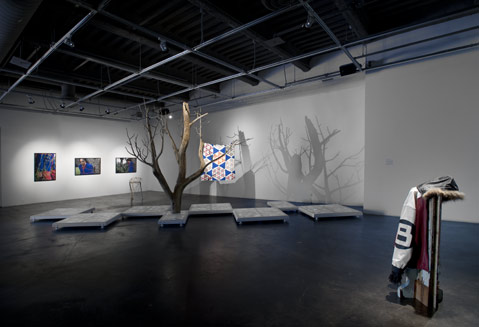
In the warm afternoons and bright early evenings of spring, the mosaic tile stairs that ascend from De la Guerra Street to the terrace at Paseo Nuevo make one of downtown’s great public spaces — a broad and open complement to the adjacent archway and an easy gathering place for visitors to the mall. But past the top of those stairs, and just this side of the infinite blue sky that stretches beyond them, other worlds unfold. Inside the Contemporary Arts Forum (CAF) this month, a bare tree sporting a quilt and floating in a field of stars sprouts amid the detritus of an obscure artistic carnival. The tree signifies the presence of Sanford Biggers, the artist behind Moon Medicine: a new one-man show occupying the main galleries there. Poetic in its indeterminacy, the tree piece, which is called “Constellation,” nevertheless remains rooted in certain iconic aspects of the African-American experience — the tree stands for lynching, the quilt for the coded signals that marked the stations of the underground railroad, and the stars below invert the ones above that guided Harriet Tubman’s journey back to the south to save her people.
CAF has gone all out for this major exhibition. They’ve commissioned a beautiful, locally written and designed monograph for the show. Biggers, who’s been in town for the installation and opening, will return to the gallery for a performance on April 1 and an artist seminar on April 2. Strong in its own right, Moon Medicine offers an opportune moment to reflect on the evolution of CAF as an institution.
Biggers was born in Los Angeles in 1970, attended Morehouse College, and lived for several years in Japan before graduating with his MFA from the School of the Art Institute of Chicago. He broke through to the highest level of recognition in contemporary art with his inclusion in the Whitney Biennial of 2002, and he has been showing and teaching art in a wide variety of prestigious venues ever since. He was made an assistant professor at Columbia’s School of the Arts in 2009, and he’s a veteran of both Harvard University’s Public Art program and the burgeoning “new Harlem Renaissance” announced by the Studio Museum’s 2003 group show Freestyle. Biggers uses multiple media and an inclination toward the participatory, the collaborative, and the theatrical in his work, much of which plays with icons of black identity.
No amount of dry aesthetic definition or listing of prestigious accolades, however, can communicate the immediacy and excitement that suffuses the environment wherever this artist appears. CAF Head Preparator Saul Gray-Hildenbrand worked closely with Biggers on the installation of the show, and he described Biggers as “both the hardest-working artist we’ve shown since I’ve been here, and the one who made us work the hardest.” The most impressive thing about Biggers to Gray-Hildenbrand, an artist himself and an active participant in the scene of younger artists that has formed around the current incarnation of CAF, is “the way he carries himself and how open he is to his surroundings.”
These are among the qualities that first caught the attention of Miki Garcia, current Executive Director of CAF and the impetus behind this show. “He’s really good at being descriptive about his work,” she said, “and while he’s African-American, and he draws from that heritage, he’s also a practicing Buddhist, and that, I think, helps him attain a kind of universality with what he does. The work takes black history as its point of departure in many instances, but it employs art as a kind of universal language to tell a story about how all of us are on a path and need to let go of resentment and seek signposts for our journeys.”
CAF in Four Decades
For five years, Garcia has been the driving force behind the exhibitions at CAF, traveling around the world in search of new and exciting artists to bring to Santa Barbara’s expanding contingent of practicing artists and collectors who have come to see the gallery as a focal point of their perspective on the contemporary art world. A successful mentor and developer of talent, Garcia has had plenty of help herself: from the generous patrons who keep contemporary art in Santa Barbara afloat to her board and staff members to the entrants in the organization’s Million Dollar Home raffle, the fundraising event begun byBill and Joan Crawford, and Jill and Barry Kitnick in 2004 that put CAF on a new footing financially, allowing for an endowment and staff commensurate with its current functions.
CAF was not always in Paseo Nuevo, nor was it in any particular location. When it began in 1976, founding member and distinguished artist Joan Tanner described it as a collaborative idea that imagined art beyond the boundaries of the conventional white-room exhibition space. Along with Dick Dunlap, Wayne McCall, and several others — all of them practicing artists — Tanner envisioned something that didn’t need a specific location, because “we wanted to bring artists here in the most uncomplicated way possible. We had no interest in having an administration, or even a space. Our process was to ask the visiting artist, ‘What do you need?’ We would put on events wherever people wanted them to take place. ‘Do you need a tunnel? Then we’ll find you a tunnel.’ That was the attitude. The gallery space, the exhibition calendar — that all came later.”
It wasn’t all that much later; no sooner did the performance-oriented activities of the nascent CAF become a Santa Barbara institution than Robert and Betty Klausner stepped forward to house the group’s activities in the Balboa Building. Although the primary intention was to bring in out-of-town artists, soon the community around these events and the new space burgeoned into a social scene, one made up of intimate dinner parties with visiting artists, and for some, the promise of a space in which to show their own work.
It was on this rock — the familiar stone that stands on the moving boundary between the international and the local — that CAF met its first challenges as an institution. As Tanner told it, “People who weren’t involved at the beginning didn’t necessarily understand that CAF wasn’t just a co-op where everyone gets a show.” Nevertheless, and despite tensions between the goals of supporting Santa Barbara artists and of bringing the best in contemporary art from elsewhere to town, the institution continued to grow under a series of directors, including Nancy Doll and Rita Ferri. The construction of Paseo Nuevo in 1990 took the galleries out of the Balboa Building storefront and moved them into the second-floor space they occupy now — a situation that causes mixed emotions among those who support the institution. Some see the lost street-level exposure and minimized foot traffic as a missed opportunity, while others cherish the combination of convenience and seclusion that being just above the mall affords.
For Ginny Brush, an artist and the executive director of the County Arts Commission, the latest incarnation of CAF reflects the good fortune of a number of factors all coming together to create a scene that “feels a lot like the good old days” of the CAF’s original period. “If you take the personalities out of it,” said Brush, alluding to the controversies over control and succession that swirled around Garcia’s appointment back in 2005, “Miki’s connections to New York and elsewhere have definitely elevated Santa Barbara’s presence on the international scene.” Brush went on to note, “There’s been an influx of new personalities in positions of authority — Julie Joyce at SBMA, Judy Larson at the Reynolds Gallery, Kathryn Kanjo and Elyse Gonzalez at UCSB’s University Art Museum, Nina Dunbar at The Arts Fund, and Heather Jeno Silva, who curates CAF’s Forum Lounge performance nights — who have all, in one way or another, arrived in the five years since Miki’s tenure began, and we are only now beginning to reap the benefits of this new synergy that’s possible.” Although the critical mass of curators and directors that Brush identifies may not have reached its potential yet, there’s still plenty of evidence that the future of contemporary art in the community is a bright one. From SBMA’s recent Yinka Shonibare exhibition to the outstanding Alison Saar show at SBCC’s Atkinson Gallery to Biggers’s current show at CAF, there have been more original exhibits by important international artists of color in the last year in Santa Barbara than there have been in the four years prior to that combined. And Garcia, who is Latino, has, along with curators Joyce at SBMA and Dane Goodman at the Atkinson Gallery, pioneered a new way of looking at the art of racial identity.
Post-“Post-Black”
Biggers, for example, belongs to a generation of artists that have been referred to as “post-black,” a term that he accepts with reluctance. “Maybe now we should be saying post-post-black,” Biggers suggested. “I’m more interested in evading categorization than I am in courting it. I’d rather tear the labels off than make them up and keep them up.”
Biggers belongs to a generation of artists who grew up in the atmosphere of heightened racial and gender consciousness typical of the art of the 1970s and 1980s, and who have adopted a less didactic, more exploratory approach to the facts of their cultural inheritance. Like Kara Walker and Saar, both of whom work with imagery drawn from the slave experience but filtered through a generationally inflected sensibility, Biggers is trying to tell his own truth as part of a larger narrative that could apply to others, even those outside his own apparent interest group.
For example, his understanding of the icon Harriet Tubman really only took shape in relation to his Buddhist studies. “For me, visual stimulation has always had layers of meaning attached to it,” he explained. “I see Harriet Tubman and I think of her as a kind of black astronaut. This poetic and beautiful image of a lone black woman who goes back under the shade of night and navigates by the stars is an early instance of space travel, or at least astral navigation, and that’s why I put the stars into the floor, to invert that image. But then there’s also something that I learned from Buddhism at work here, the concept of the bodhisattva, who comes back from enlightenment to serve others. Tubman is a black bodhisattva, and as such, she’s among the most powerful mythological heroines in history because she’s a real historical person and yet she incarnated this principle so concretely.”
Thus what was at one time perceived as the particular story of a relatively small group of people — the African-American journey from slavery to freedom — has been transmogrified by art and allusion until it has come to represent the aspirations toward transcendence of all Americans, and finally, of all people worldwide as they struggle for personal independence. Unlike those who seek to limit such identification through codes of responsibility, Biggers welcomes the generalization of his experience that occurs when an audience comes in contact with his work. For example, in “Shuffle,” the video installation that occupies the side gallery to the right of the main space at CAF, Biggers worked with a Brazilian expatriate named Ricardo, whom he met while doing a residency in Stuttgart. Together, they reimagined and performed an experience that Biggers had on the IRT train riding south from Harlem into downtown Manahattan:
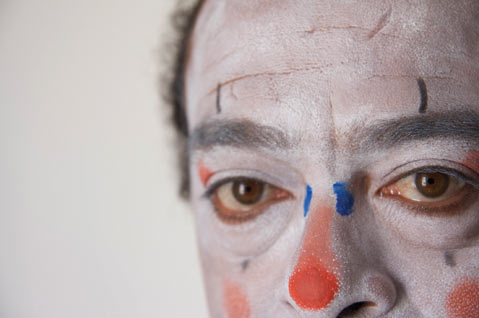
“There was an older black man on the train accompanied by a small child, a boy, most likely his son. And the man was putting on clown makeup, doing it right on the train with no mirror, just matter-of-fact, getting ready to perform at wherever he was going. And as he proceeded, the child dabbed his face, too, not as well, but with seriousness, in imitation of his father. And for me, this image, which I saw with a soundtrack of electric Miles Davis swirling into my ears through headphones, was so poignant because it captured everything I knew about what it takes to get along in the world, the lonely job we all have of making up a mask to get through the day with. So I thought about that for a while, and finally, with “Shuffle,” I found a place and a time in which to use it.”
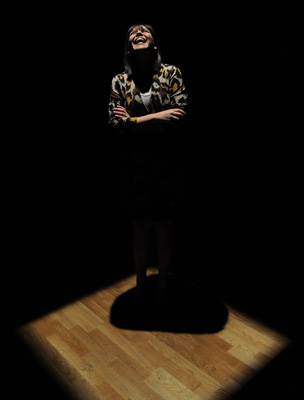
Then there’s the untitled piece Biggers created specifically for the CAF back room. Behind a pair of blackout curtains, there’s a tiny dance floor or stage, it’s not clear which, spotlit from above and rigged to a motion detector that triggers a soundtrack loop. On the soundtrack are, alternately, the noises of tap dancing and the roar of a wildly enthusiastic ovation. “I’ve made many dance floors in my work over the years, and they are always portals to another reality,” Biggers said. “In this case, I asked myself, ‘What would the Invisible Man dance like?’ and almost as soon as I asked it, I answered that he would tap dance — of course. From there, what I constructed was something designed to draw the viewer in, and to make him or her participate in the construction of the piece’s meaning. Whether you remain standing on the edge of the piece, looking at the empty space as the sounds wash over you, or if you get up on the stage yourself, and interact with the soundtrack — that’s going to have a big impact on your experience. I still don’t completely understand it myself, and that’s typical of what I feel is my best work right now. I like to keep myself somewhat confused.”
There was nothing confusing about the impact of the untitled piece on the night of March 6, at Moon Medicine’s opening. After a jam-packed artist’s talk in which Biggers led the assembled crowd from one work to another, causing heads to nod as he explained the social and personal history behind his iconography, the party took over. I watched viewers enter the small room where the stage was, some unwilling to step on the art, others only too happy to use it as a platform from which to take bows as the sound of recorded applause and cheers blasted through the tiny space. But it wasn’t until two young children seized the moment that I felt the transformative capacity of the work. The children took turns leaping onto the slab and tapping along with the soundtrack with wild abandon, their moves only intensifying as the applause took over and swelled to a crescendo. This, I felt, was the art of the future, and these were the forerunners of its audience, the ones who could see the piece’s true meaning and dance with abandon alongside the Invisible Man.
4•1•1
Moon Medicine runs at CAF through May 2. On Thursday, April 1, at 7pm, Biggers will perform in the gallery, and on Friday, April 2, the artist will lead a seminar from 6-8 p.m. For more information, call 966-5373 or visit sbcaf.org.