
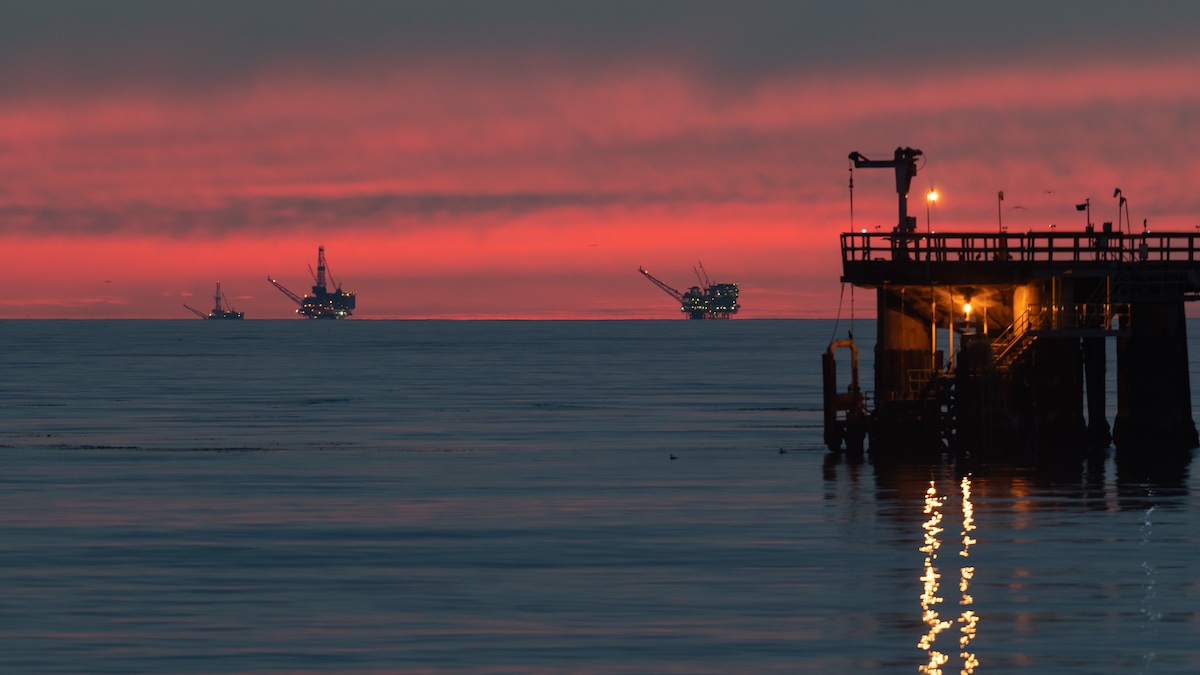
Sable Offshore Oil Company announced on Monday, September 29, it would seek federal permission to install an offshore storage and treatment (OS&T) facility located in federal waters, three miles off the California coast. The oil will be pumped from its three offshore platforms also in federal waters. This will put the company safely beyond the authority of state or local regulatory agencies, something that has frustrated Sable since it bought the Santa Ynez Unit oil facilities from Exxon two years ago.
The company announced that if it is not permitted to restart its onshore pipeline soon, it will implement the OS&T option, a significant shift from its current plans which rely on a working pipeline. This dramatic announcement was made earlier in the day in a notice sent to investors and later in a press release.
In the same notice, the company also announced that it had just submitted to the Office of the State Fire Marshal an official request to restart its Santa Ynez Unit. The unit, which includes the three platforms, a processing plant, and a 120-mile pipeline, has been effectively shut down since the catastrophic 2015 oil spill. At that time, its deeply corroded pipeline leaked 142,000 gallons of oil into the Pacific Ocean off the Gaviota Coast.
Sable contended that it had satisfied all the major conditions in a consent decree required by the state fire marshal — who wields the last word when it comes to restarting the pipeline. Whether the fire marshal sees it the same way has yet to be confirmed. Calls and emails to the fire marshal for comment had not been returned by deadline.
Sable stated that it was pursuing the OS&T option because of its frustration over regulatory delays at the state and county level. “Continued delays related to the Onshore Pipeline will prompt Sable to fully pivot back to a leased OS&T strategy which was utilized to process SYU (Santa Ynez Unit) production in federal waters from 1981 to 1994. Over this time, the SYU produced [more than] 160 million barrels of oil equivalent.”
State Senator Monique Limón took a dim view of Sable’s threat to take its oil offshore and accused the company of crossing the line on multiple occasions. “In the time Sable Offshore has owned the pipeline, they’ve broken the law, shirked multiple cease-and-desist orders, and have yet to pay the $18 million fine for defying stop-work orders. Whether they intend to use the Las Flores Canyon pipeline or proceed with the offshore storage and treating vessels, the threat surrounding public health and well-being is still there.”
In the past three weeks, Sable has sustained multiple setbacks that — cumulatively — could seriously hamper the company’s regulatory path forward. The Santa Barbara District Attorney’s Office filed 21 counts of criminal wrongdoing against the company — five felonies and 16 misdemeanors — for polluting various coastal streams and creeks while doing un-permitted repair work on the heavily corroded pipeline.
The company has denied any wrongdoing, and the case has yet to see the light of a county courthouse. The governor signed a sprawling energy bill two weeks ago that would — among other things — mandate that the company obtain a coastal development permit from the California Coastal Commission before restarting the old Exxon project. That requirement will go into effect January 1, 2026.
Relations between Sable and the Coastal Commission have been notably contentious with the commission voting earlier this year to impose the $18 million fine on the company for doing repair work on the corroded pipeline located in the coastal zone without first obtaining the necessary permits. Sable has insisted the Coastal Commission has no jurisdiction to impose such requirements.
Sable contends that it has made the offshore pipeline safe, made the necessary repairs, and agreed to an increased number of inspection and testing requirements imposed by the state fire marshal.
On another front, the county supervisors have been deadlocked 2-2 for months on whether the company has shown that it has the financial resources needed to clean up any future oil spills similar to the one in 2015. That spill has reportedly cost the pipeline owner at the time of the spill — Plains All American — close to $900 million in clean-up and legal costs. In fact, Plains All American is still wrangling with its insurance carrier over coverage claims.
Sable has reported it has $700 million worth of insurance coverage and has noted that state law requires only $100 million of coverage. It further contends that the county has overstepped its legal bounds in holding up approval for the transfer of title and permits from Exxon, which bought the pipeline from Plains All American, and then sold it to Sable.
A federal judge ruled that the county supervisors must re-hear the matter until they manage to break the tie one way or the other. The next hearing is scheduled for November 4.
The threat of an OS&T off the coast of Santa Barbara changes the fundamental chemistry of all these negotiations. With President Donald Trump — famous for his support of the oil industry and his hostility to California — there’s little doubt Sable will get whatever permits it wants from federal regulators charged with overseeing oil development in federal waters. Sable has assured its investors that it could begin production no later than the last quarter of 2026 should it decide to go the OS&T route.
Whether the OS&T threat is logistically feasible and cost effective for the company remains to be seen. Whether such a move could withstand the inevitable barrage of environmental litigation — even with Trump in the White House — has yet to be seen. Would an environmental impact statement (EIS) be required? Where along the California coast would Sable be permitted to offload the oil? Into what pipeline? If California has jurisdiction, Sable would be required to follow its laws. Sable has made it clear it would consider locations outside state boundaries to take its oil.
If it took such an action, the company has argued, California would be deprived of the necessary oil volumes required to keep California’s struggling oil refineries humming. With two refineries shut down in recent years, Governor Newsom expressed deep concern whether California will have enough refinery capacity to meet the demand for gas.
For a politician looking at a run for the White House — as Newsom appears to be — the prospect of $8-a-gallon gas is the kiss of death. That’s in part why Newsom just passed the aforementioned energy bill; it would allow up to 2,000 new oil wells to be drilled a year in Kern County. But as a sweetener to Santa Barbara representatives Monique Limón and Assemblymember Gregg Hart, the governor included language in his bill that would make Sable’s regulatory climb for pipeline approval infinitely steeper.
It’s worth noting that Exxon did operate an OS&T off the coast of Santa Barbara for many years. It was bitterly fought by local environmentalists and many county supervisors who worried that the barges offloading the oil and the facility itself posed serious environmental risks. The solution they settled upon? The pipeline.
Editor’s Note: An earlier version of this story mistakenly featured a photo of Platform Holly, which is a decommissioned platform in state waters and not one of Sable Offshore’s three platforms in federal waters. The photo has been updated.
Related Posts




Premier Events

Thu, Apr 02
5:00 PM
Santa Barbara
Paintings by Michael Vilkin at ART & SOUL GALLERY

Thu, Apr 09
7:00 PM
Santa Barbara
POSTPONED – Journey Within: Wisdom & Meditation with Gurudev – POSTPONED

Fri, Apr 10
2:00 PM
Santa Barbara
Music & Meditation SB – Concert April 10, 2026

Sun, Apr 12
11:00 AM
Solvang
Santa Ynez Valley Home + Build Showcase

Sat, Apr 04
9:00 AM
Santa Barbara
Passport Fair, hosted by Congressman Salud Carbajal

Sat, Apr 04
9:00 AM
Santa Barbara
Mesa Harmony Garden Spring Plant Sale

Sat, Apr 04
9:30 AM
Santa Barbara
The Great Egg Hunt

Sat, Apr 04
5:00 PM
Santa Barbara
Classical Guitar at Art & Soul

Sun, Apr 05
10:00 AM
Santa Barbara
Easter Brunch at Brass Bear

Tue, Apr 07
7:30 PM
Solvang
ABRA Cadabra – ABBA Tribute Band

Wed, Apr 08
11:00 AM
Santa Barbara
True Story of Fremont Foxen & the San Marcos Pass

Wed, Apr 08
1:00 PM
Santa Barbara
Día de los Niños

Wed, Apr 08
2:00 PM
Santa Barbara
Online Talk: The Work of a Fashion Curator w/ ASU FIDM Director

Thu, Apr 09
6:00 PM
Santa Barbara
Chaucer’s Books – Poetry Night
Thu, Apr 02 5:00 PM
Santa Barbara
Paintings by Michael Vilkin at ART & SOUL GALLERY
Thu, Apr 09 7:00 PM
Santa Barbara
POSTPONED – Journey Within: Wisdom & Meditation with Gurudev – POSTPONED
Fri, Apr 10 2:00 PM
Santa Barbara
Music & Meditation SB – Concert April 10, 2026
Sun, Apr 12 11:00 AM
Solvang
Santa Ynez Valley Home + Build Showcase
Sat, Apr 04 9:00 AM
Santa Barbara
Passport Fair, hosted by Congressman Salud Carbajal
Sat, Apr 04 9:00 AM
Santa Barbara
Mesa Harmony Garden Spring Plant Sale
Sat, Apr 04 9:30 AM
Santa Barbara
The Great Egg Hunt
Sat, Apr 04 5:00 PM
Santa Barbara
Classical Guitar at Art & Soul
Sun, Apr 05 10:00 AM
Santa Barbara
Easter Brunch at Brass Bear
Tue, Apr 07 7:30 PM
Solvang
ABRA Cadabra – ABBA Tribute Band
Wed, Apr 08 11:00 AM
Santa Barbara
True Story of Fremont Foxen & the San Marcos Pass
Wed, Apr 08 1:00 PM
Santa Barbara
Día de los Niños
Wed, Apr 08 2:00 PM
Santa Barbara
Online Talk: The Work of a Fashion Curator w/ ASU FIDM Director
Thu, Apr 09 6:00 PM
Santa Barbara

