

Attorneys for Sable Offshore learned the hard way this week what local court watchers have known now for nearly 30 years: Judge Thomas Pearce Anderle never changes his tentative ruling. It’s practically a law of physics.
Late this past Wednesday afternoon, Anderle stuck to his tentative ruling — released just the day before — against Sable Offshore in its long-festering, high-stakes showdown with the California Coastal Commission over major repair work the company did on its oil pipeline up the Gaviota Coast. But in the same hearing, Anderle also did something utterly out of character. For two and a half hours, he allowed attorneys for Sable to try to persuade him why he was wrong. Typically, Anderle restricts such arguments from attorneys on the losing side to just a few minutes. Ten, tops.
When the dust settled and the last word was spoken, Anderle hadn’t been moved an inch.
“I thank you for your presentation,” the judge said with all the hearty congeniality for which he is known. “I’m going to stand by my tentative the way it’s written. Thank you very much. Have a great day.”
While this hardly qualifies as the stuff of stirring courtroom melodrama, it’s absolutely a very big deal for Sable Offshore, for the California Coastal Commission and for the County of Santa Barbara, whose planning department came off very much on the short end of the stick in Anderle’s tentative and final ruling.
For the better part of the last year, Sable and the Coastal Commission have been enmeshed in an almost do-or-die struggle over the state agency’s jurisdictional authority to require Sable to apply for and obtain coastal development permits for its pipeline repair work. In April, the commission fined Sable $18 million for defying two cease-and-desist orders — issued by the commission executive director, no less — for doing work on the pipeline despite having been informed the company needed to apply for and obtain coastal development permits from the commission to do so.
More recently, Sable returned the favor by filing legal papers seeking $347 million in damages against the Coastal Commission for slowing down its efforts to restart production of Exxon’s plant along the coast—and its three offshore oil platforms and oil pipeline as well. Exxon’s operations came to a standstill in 2015 with the rupture of this pipeline and attendant spill of 142,000 gallons of oil into the ocean. Two years ago, Sable purchased Exxon’s Santa Ynez operations and has been racing pell-mell ever since to resume production within a two-year time limit reportedly imposed by Exxon as a condition of that sale.
Given that 121 sites along the company’s 135-mile stretch of pipeline had been deemed sufficiently corroded as to require repair work, this is not a theoretical dispute over a hypothetical problem. That pipeline has to be fixed before Sable can reactivate production. The amount of oil said to be within striking distance of Sable’s three offshore platforms is said to be massively major.
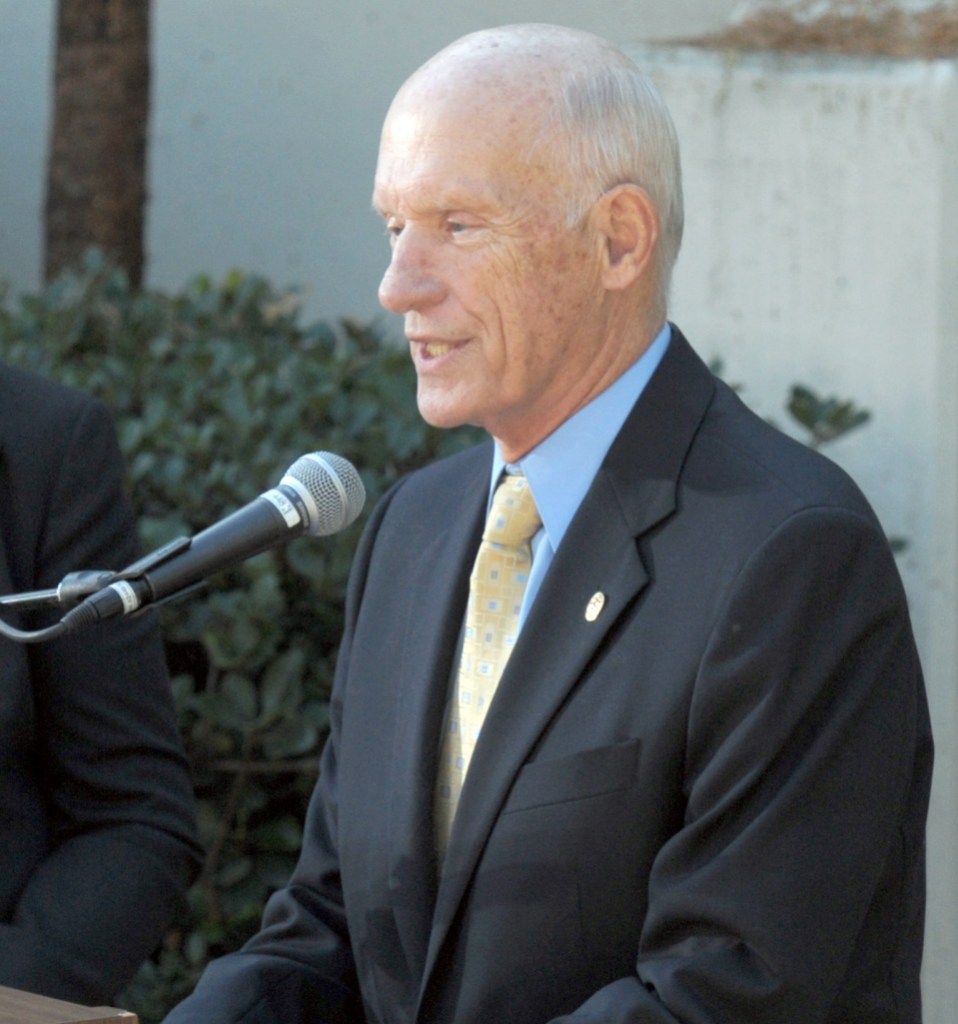
In 27 pages, Judge Anderle painstakingly explained why he concluded that Sable was, in fact, required to get development permits from the Coastal Commission. This means that the work the company has done to date has been in violation of the California Coastal Act, which governs development along the state’s coast.
Even more painstakingly, Anderle dismantled Sable’s argument that its repair work was, in fact, covered by a 1986 coastal development permit issued by the County of Santa Barbara. More painstakingly still was Anderle’s refutation of a letter submitted by county planners earlier this February agreeing with Sable that the terms and conditions imposed by that 1986 permit fully allowed Sable to proceed with its pipeline repair work without having to secure permits from the Coastal Commission. The county’s letter — signed by County Planning Director Lisa Plowman and Energy Planner Errin Briggs — was foundational to Sable’s arguments in front of Judge Anderle.
In a nutshell, Anderle concluded that the scale, intensity, and magnitude of the earth moved and the habitat disrupted in Sable’s repair work at 121 sites along the pipeline — many of which crossed coastal creeks and waterways — far exceeded anything contemplated in the 1986 permit so heavily relied upon by Sable and the County of Santa Barbara. Its impact was likewise far more intense, he said, than what the 1986 permit envisioned.
The pipeline, he noted, had been shut down for 10 years. That’s significant, he found, because in just a few months shy of a year, Sable had initiated the same number of repair jobs that normally would have been spaced out over a nine-year span. That work, he noted, “was significantly more intense than prior maintenance activities.” He added, “The work done by Sable involved work at 121 sites done in a single year, rather than the limited work done throughout the decade.”
Along the way, anywhere from 4,500 to 7,200 dump trucks’ worth of dirt had been excavated. All this exceeded the normal rate of repair, he said, that was permitted by the 1986 coastal development permit.
Given that the original pipeline permit of 1986 envisioned a pipeline with a 30-year life, Anderle concluded, the work Sable envisions is more akin to “reconstruction” of the pipeline. And “reconstruction,” he added, was not mentioned in the 1986 permit.
The Coastal Commission, he noted, had twice notified the County of Santa Barbara that Sable was operating outside the bright lines of its 1986 permits and twice asked the county to intervene and enforce the terms and conditions of that permit. Twice, the county replied that Sable was, in fact, in compliance with those permits and that it would not be taking any enforcement action. Anderle ruled that the California Coastal Act empowers the Coastal Commission to step in and take enforcement matters into its own hands if and when the local government agency assigned more immediate and direct enforcement responsibility declines to do so. Because of that, he ruled, the Coastal Commission was not exceeding its authority in requiring a coastal development permit.


As a practical matter, the implications of the ruling are wide open to conflicting interpretations. Jim Flores, Sable CEO, issued a press release stating, “Although the tentative ruling is very disappointing, it has no impact on Sable’s business strategy of either resuming petroleum production through the Las Flores Pipeline System or selling its Santa Ynez Unit petroleum through an offshore storage and treatment facility.”
Sable has vowed to appeal Anderle’s ruling.
On the flip side, Linda Krop, attorney for the Environmental Defense Center, which is leading the legal charge against Sable’s efforts to restart production, stated that the ruling leaves intact the injunction the Coastal Commission secured blocking Sable from doing any more repair work until it gets the necessary permits. As long as that injunction remains intact, Krop suggested, the Office of the State Fire Marshal will not be able to approve Sable’s application to restart production and pumping through the pipeline. Without the ability conduct repairs, Krop reckoned, Sable would not be able to operate.
While the ruling does not totally resolve the matter of the $18 million fine imposed by the Coastal Commission against Sable, that fine remains very much a live issue with this ruling. Likewise, the ruling doesn’t automatically strike Sable’s $347 million claim, but that claim’s chances appear highly unlikely.
The ruling comes at a time when Sable has recently been the target of criminal charges by the Santa Barbara District Attorney, including five felonies, for the impact the unpermitted repair work has had on streams and creeks in the state’s coastal zone. The Attorney General has filed parallel charges on pretty much identical grounds.
In the meantime, Sable has announced it is seeking federal approval to bypass the pipeline altogether by locating an offshore storage and treatment facility in federal waters and tankering its oil to refineries of its choosing. Should Anderle’s ruling hold, Sable’s stated interest in the offshore option will all but certainly grow louder.
The next court date on the matter is December 3. At that point Anderle will address Sable’s motion to compel the Coastal Commission to turn over internal memos and documents that company officials believe will reveal an intensity of bias and hostility by Coastal Commission staff that would buttress the company’s claim for damages. But with Anderle’s ruling that the Coastal Commission does, in fact, have jurisdiction, the other side will argue such issues have been rendered moot.
Related Posts





Premier Events

Sat, Oct 24
2:00 PM
Santa Barbara
Japanese Sacred Architecture: Shinto and Buddhism

Sat, Oct 24
10:30 AM
Santa Barbara
Picnic in the Cemetery: A Live Historical Event

Sat, Oct 24
11:00 AM
Goleta
2nd Annual Charger Cup to Benefit DP High Golfers

Sat, Oct 24
12:00 PM
Santa Barbara
Makers Hive Market
Sat, Oct 24
2:00 PM
Santa Barbara
Japanese Sacred Architecture: Shinto and Buddhism

Sat, Oct 24
2:00 PM
Santa Barbara
Thriller 2026 – Get Scary for Charity!

Sat, Oct 24
3:00 PM
Santa Barbara
Downtown Santa Barbara Trick-or-Treat

Sat, Oct 24
5:00 PM
Santa Barbara
15th Annual DSASBC Halloween Hoedown

Sat, Oct 24
5:30 PM
Solvang
Solvang Haunted House and Street Fair

Sat, Oct 24
7:00 PM
Santa Barbara
Anima: Theater of the Feminine Underground

Sun, Oct 25
11:00 AM
Santa Barbara
Free Family Day: Día de los Muertos
Sat, Oct 24 2:00 PM
Santa Barbara
Japanese Sacred Architecture: Shinto and Buddhism
Sat, Oct 24 10:30 AM
Santa Barbara
Picnic in the Cemetery: A Live Historical Event
Sat, Oct 24 11:00 AM
Goleta
2nd Annual Charger Cup to Benefit DP High Golfers
Sat, Oct 24 12:00 PM
Santa Barbara
Makers Hive Market
Sat, Oct 24 2:00 PM
Santa Barbara
Japanese Sacred Architecture: Shinto and Buddhism
Sat, Oct 24 2:00 PM
Santa Barbara
Thriller 2026 – Get Scary for Charity!
Sat, Oct 24 3:00 PM
Santa Barbara
Downtown Santa Barbara Trick-or-Treat
Sat, Oct 24 5:00 PM
Santa Barbara
15th Annual DSASBC Halloween Hoedown
Sat, Oct 24 5:30 PM
Solvang
Solvang Haunted House and Street Fair
Sat, Oct 24 7:00 PM
Santa Barbara
Anima: Theater of the Feminine Underground
Sun, Oct 25 11:00 AM
Santa Barbara


You must be logged in to post a comment.