

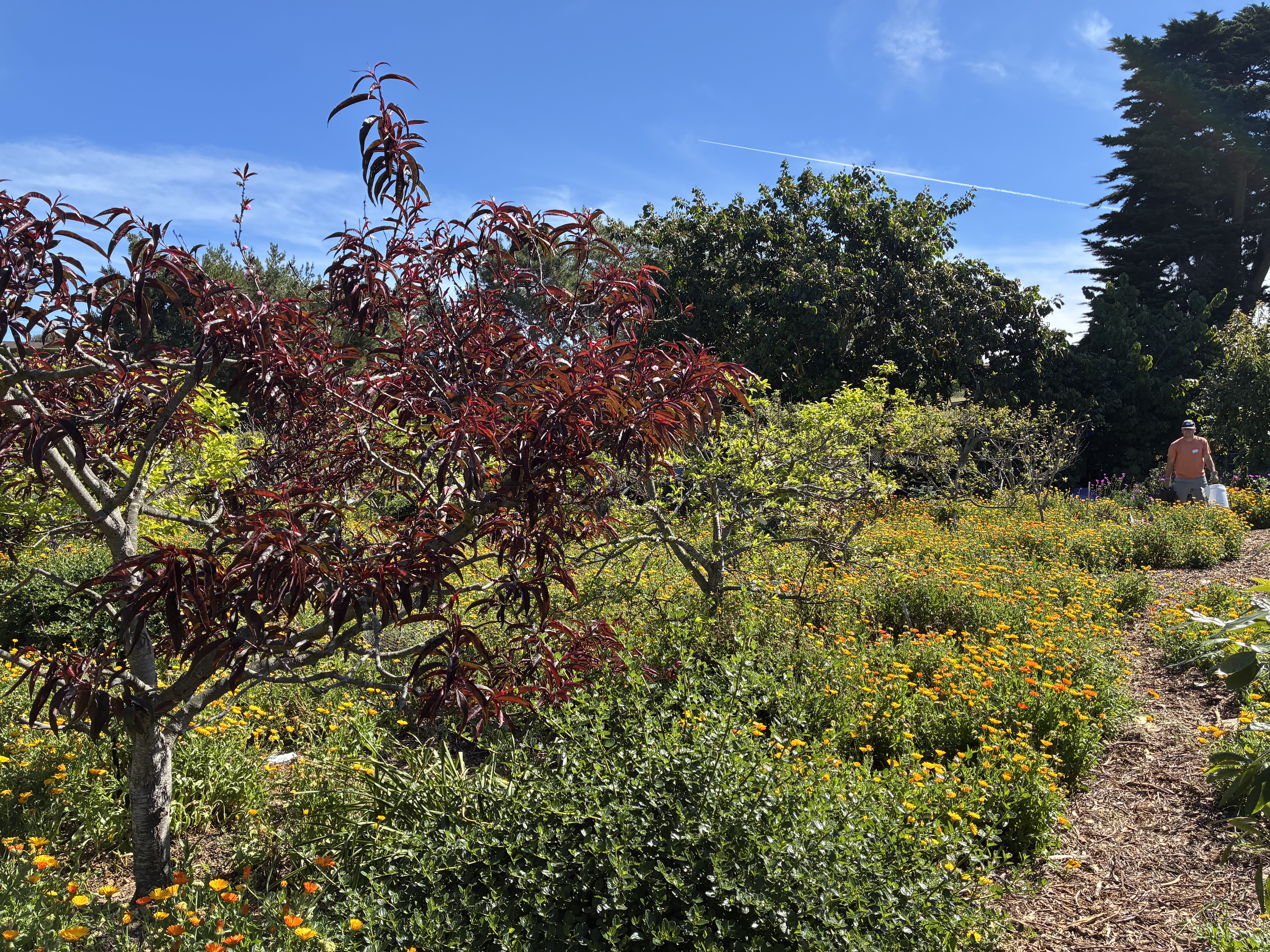
Take a tour of Mesa Harmony Garden — as all new volunteers begin by doing — and you will immediately lose sight of the fact that the humble plot, located on the corner of Meigs Road and Dolores Drive, occupies just two-thirds of an acre. Packed to the brim with orange trees, chayote plants, and blooming calendula, the community garden feels much larger.
A nursery and a tool shed are located against one fence, next to a patch of onions, artichokes, and a gargantuan passionfruit vine. There’s one section for native plants that thrive in the shade and another for those that thrive in the sun. Several banana trees dot the southwest corner, offering up hefty bunches of pups. At the top of the plot’s gentle slope, there’s a circle of benches where volunteers gather. And throughout the whole garden, plants are flowering, lining the narrow footpaths, covering the gaps between trees.
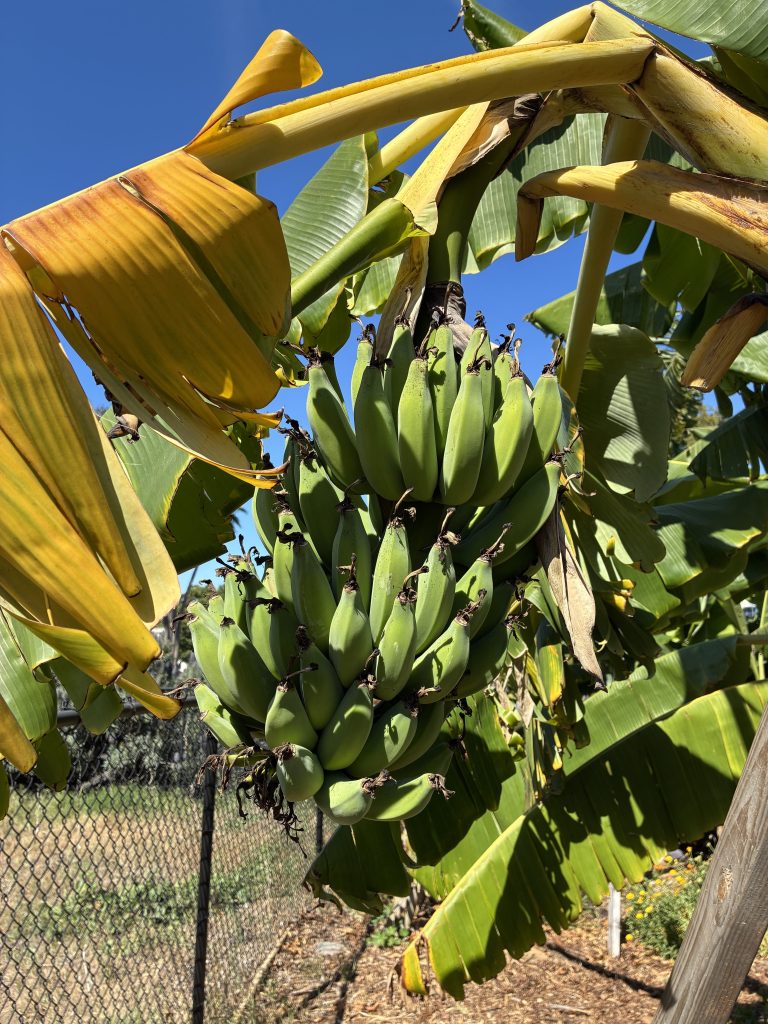
The garden’s density is by design. It’s a “food forest,” a permaculture concept where gardeners try to re-create the dynamics of a natural ecosystem. Hence the blankets of vibrant calendula, which have taken on “a life of their own,” in treasurer Pam Lombardo’s words. The orange flowers may not be edible, but they benefit the garden nonetheless by attracting pollinators. Other plants contribute to soil health by fixing nitrogen or offering shade or fertilizer, and still others provide a windbreak against the constant ocean breezes.
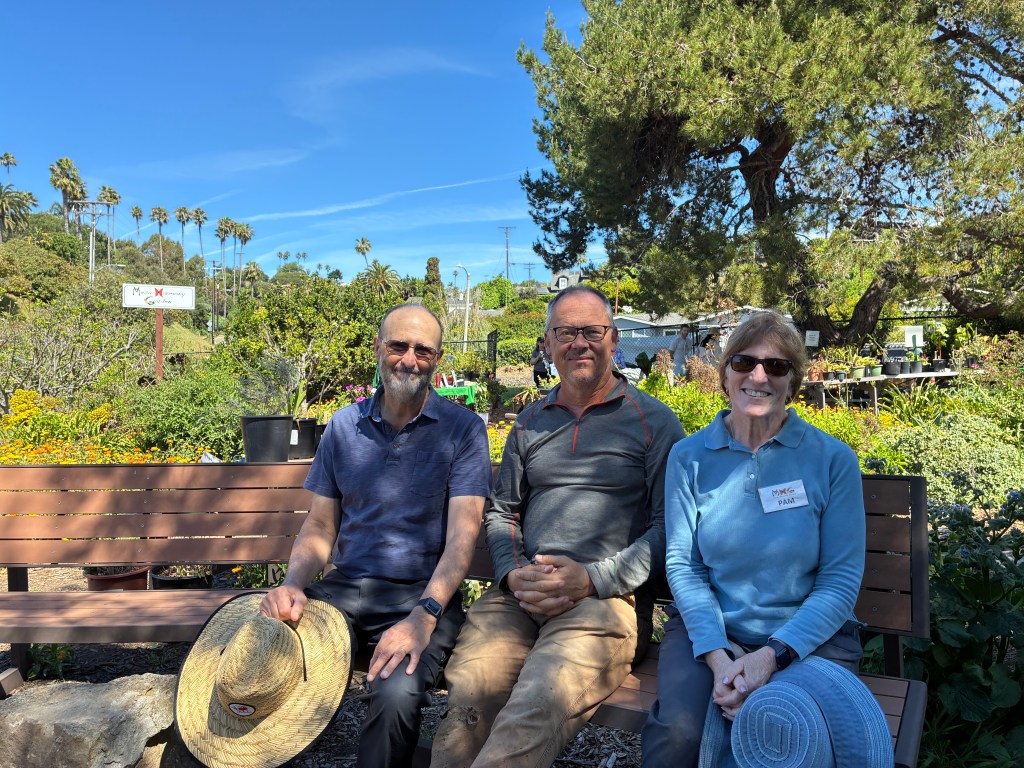
“It’s not just an orchard where you grow trees and kill everything else. It’s trying to think about the different roles that different plants can play,” said Hugh Kelly, vice president and former president of the garden. “There’s all sorts of ways plants can contribute to the overall health of the ecosystem.”
The food forest, now headed into its 16th year of operation, is massively productive. “Our average, over the last six or seven years, is about 1,200 pounds a year,” said Lombardo.
But Mesa Harmony Garden’s community of volunteers, who turn up Saturday after Saturday to plant, weed, graft, prune, and ultimately harvest, are not the recipients of that bounty. Every single pound of produce is donated to the Foodbank of Santa Barbara County.
It’s a relationship that dates back to the garden’s founding. The project began in 2010 when Santa Barbara City College environmental science professor Adam Green reached out to Father Ludo DeClippel of the Mesa’s Holy Cross Parish about a barren plot of land beneath the church’s parking lot, which had lain vacant for more than 40 years. Green wanted to use the space for a permaculture project; DeClippel enthusiastically agreed.
Larry Saltzman, who led the initial design process, ended up in contact with a representative from the Foodbank. “This guy says, ‘Oh, I’ve just got a big grant for fruit trees. You can have the fruit trees if we can have the fruit,’” recalled Kelly. With the Foodbank’s grant, the gardeners purchased 87 fruit trees and got to planting. From the first harvest to the latest, they’ve given all that fruit back.
“Permaculture is all about working with nature rather than against it,” said Kelly. Of course, that’s no short task. Transforming a deserted patch of dirt and dry grass into a flourishing, diverse ecosystem takes great physical labor, not to mention the planning and problem-solving required to design a food forest in accordance with the Mesa’s specific environmental advantages and disadvantages.
The volunteers’ first project was to dig a network of swales — shallow, contoured trenches designed to collect and direct water. Mesa Harmony Garden’s swales are a remarkably effective irrigation method. After the first late-autumn or winter rainstorm hits Santa Barbara, the gardeners turn off their manual watering system until just about June.
“All the rain that falls in the garden stays in the garden,” said Kelly.
“I think our water bill in January was something like $1.63,” said Lombardo.
The garden continues to evolve. Many plants mature, settling into position as fixtures of the food forest; others struggle, leading volunteers to troubleshoot. Garden President Russ Baldocchi pointed out a healthy avocado tree that was the result of grafting two weaker plants together.
“I’m kind of a scientist by training, so there’s a natural inclination to just study stuff, to see what works and what doesn’t work, how the plant responds,” said Baldocchi. “It brings out this empathy in you. You start thinking about other people’s or plants’ ways of thinking and communicating and responding to things. I just really got into that whole interplay between humans and plants.”
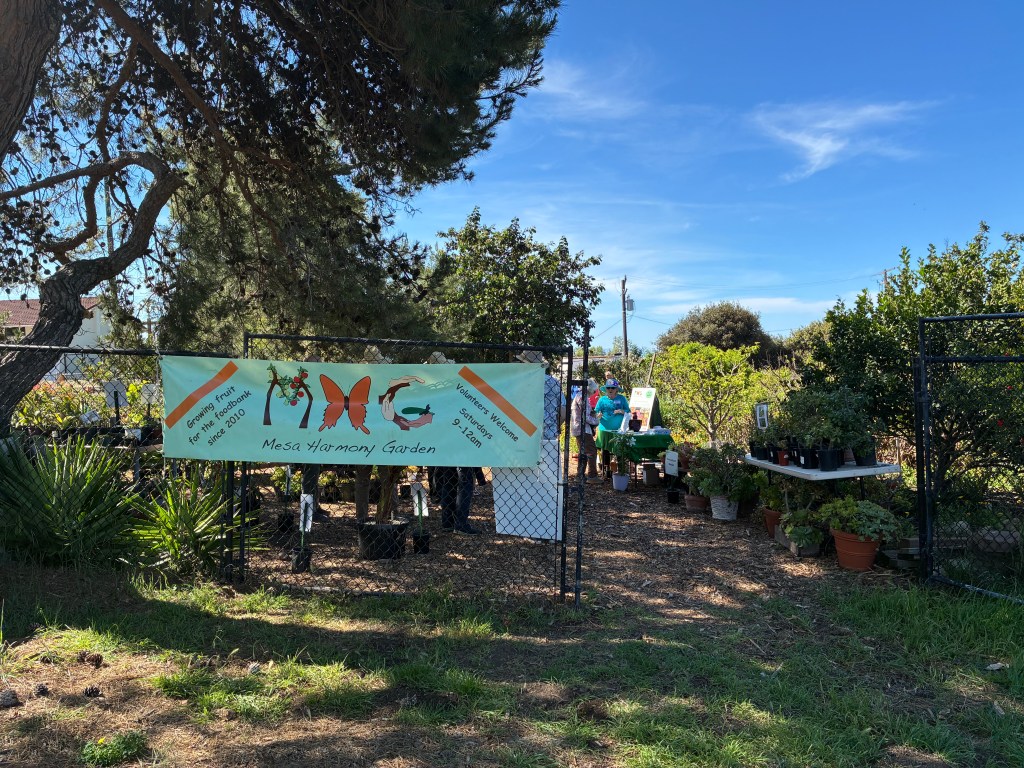
As the garden has grown, so has its community. Kelly estimates they’ve had several hundred volunteers over the past decade and half. In addition to their weekly work parties — Saturday mornings from nine to noon — Mesa Harmony Garden offers frequent trainings and teach-ins about a range of gardening topics, sometimes in collaboration with Master Gardeners of Santa Barbara County or the Santa Barbara Botanic Garden. Volunteers take the skills they learn at Mesa Harmony Garden back to their own home projects.
All are welcome to join — no gardening experience necessary. Interested persons can find more information on the garden’s website, mesaharmonygarden.org.
Related Posts







Premier Events

Fri, Jul 10
12:00 AM
Santa Barbara
The A250! American Revolution Experience Exhibit

Thu, Jul 16
5:30 PM
Santa Barbara
Art4Grief & Meaning: Expressive Painting Part 1
Sun, Jul 19
10:00 AM
Santa Barbara
Art4Grief & Meaning: Expressive Painting Part 1

Tue, Jun 30
6:00 PM
Santa Barbara
Chaucer’s Books Poetry Reading With Swamini B.

Wed, Jul 01
6:00 PM
Santa Barbara
Going Batty at the Nature Center

Wed, Jul 01
6:30 PM
Santa Barbara
Independence Day Benefit Concert & Pop-Up Exhibit

Thu, Jul 02
5:00 PM
Santa Barbara
First Thursday Jazz Jam

Thu, Jul 02
6:00 PM
Santa Barbara
Concerts in the Park at Chase Palm Park

Thu, Jul 02
6:00 PM
Santa Barbara
Love Island Watch Party & Speed Dating Night
Fri, Jul 03
4:00 PM
Santa Ynez
Brander July 3rd Kickoff! Music + Oysters

Fri, Jul 03
7:00 PM
Santa Barbara
Celebrate the 4th on the 3rd with Unity Singers

Fri, Jul 03
9:00 PM
Santa Barbara
Daft Punk Night

Sat, Jul 04
11:00 AM
Santa Barbara
4th of July Family Fun Fair and Picnic – S.B. Elks Lodge #613
Fri, Jul 10 12:00 AM
Santa Barbara
The A250! American Revolution Experience Exhibit
Thu, Jul 16 5:30 PM
Santa Barbara
Art4Grief & Meaning: Expressive Painting Part 1
Sun, Jul 19 10:00 AM
Santa Barbara
Art4Grief & Meaning: Expressive Painting Part 1
Tue, Jun 30 6:00 PM
Santa Barbara
Chaucer’s Books Poetry Reading With Swamini B.
Wed, Jul 01 6:00 PM
Santa Barbara
Going Batty at the Nature Center
Wed, Jul 01 6:30 PM
Santa Barbara
Independence Day Benefit Concert & Pop-Up Exhibit
Thu, Jul 02 5:00 PM
Santa Barbara
First Thursday Jazz Jam
Thu, Jul 02 6:00 PM
Santa Barbara
Concerts in the Park at Chase Palm Park
Thu, Jul 02 6:00 PM
Santa Barbara
Love Island Watch Party & Speed Dating Night
Fri, Jul 03 4:00 PM
Santa Ynez
Brander July 3rd Kickoff! Music + Oysters
Fri, Jul 03 7:00 PM
Santa Barbara
Celebrate the 4th on the 3rd with Unity Singers
Fri, Jul 03 9:00 PM
Santa Barbara
Daft Punk Night
Sat, Jul 04 11:00 AM
Santa Barbara


You must be logged in to post a comment.