

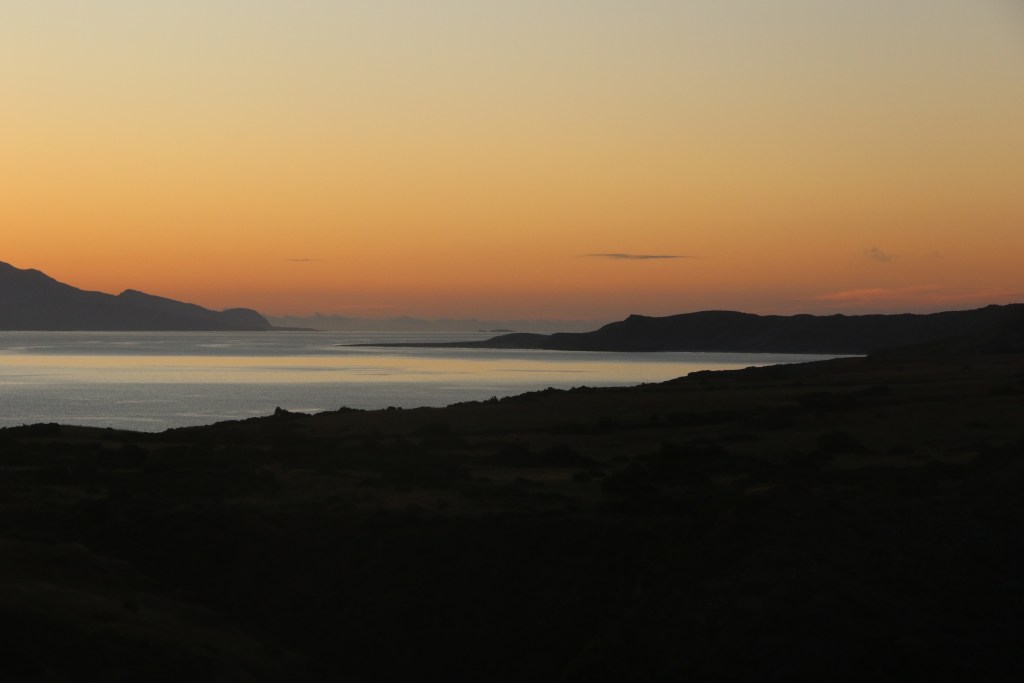
While gazing northwest from Fraser Point across the daunting, roughly eight-mile-wide Santa Cruz Passage toward Santa Rosa Island, I heard the distinct pop of a nearby whale spout.
It’s always been a little intimidating paddling across the passage. From my kayak, it feels like a gauntlet of sorts. At some point, fog, wind, current, and swell can all come into play, but for migrating Eastern North Pacific gray whales, it’s just another blip on their annual 10,000-12,000-mile round-trip migration.
I was keen on seeing gray whales feasting inside Bechers Bay. The massive natural anchorage has become a reliable pit stop for some northbound grays heading to their distant Arctic feeding grounds before turning around and travelling back to the warmwater lagoons of Baja California to give birth and mate.
Southerly Sanctuary
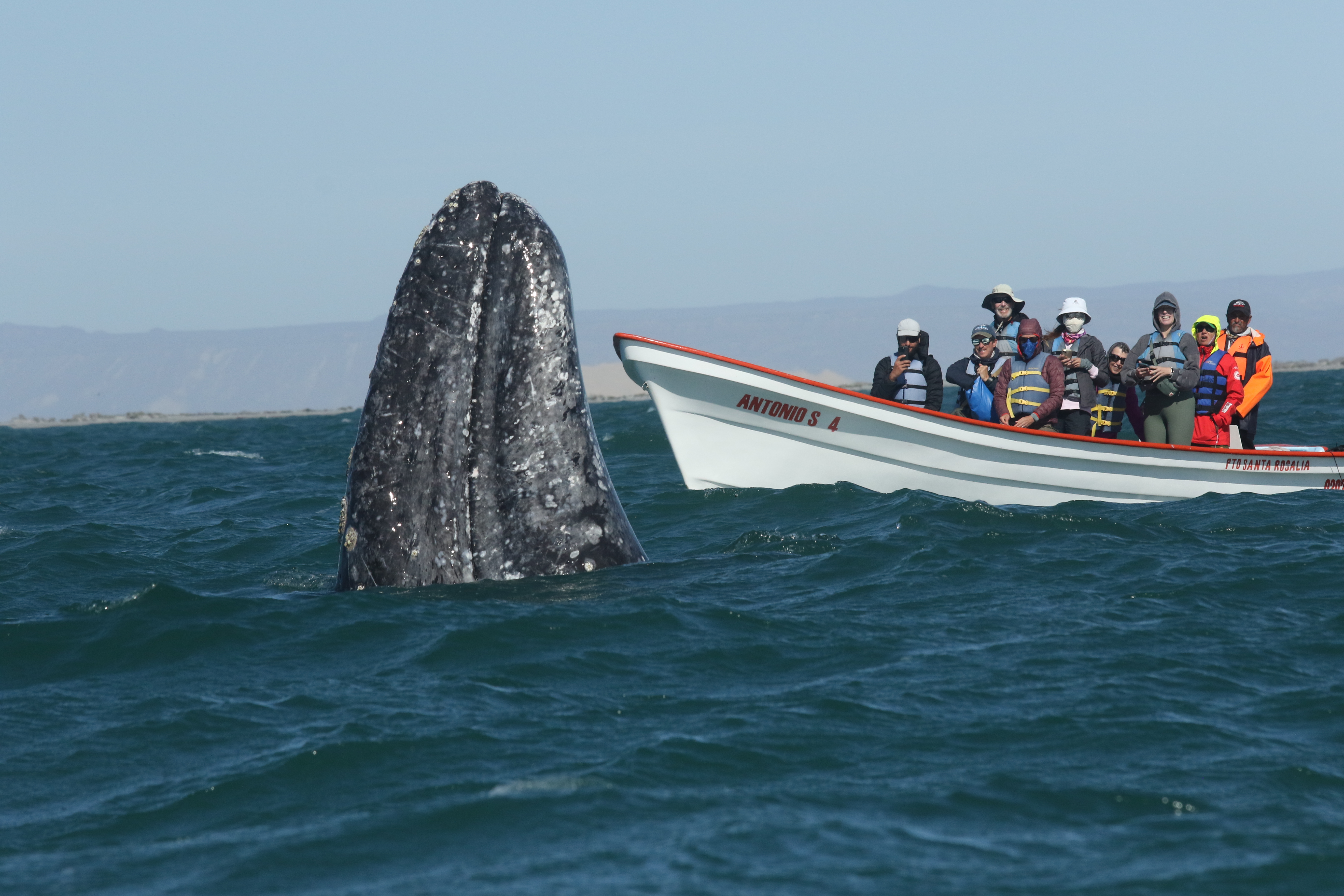
As a flotilla of pangas gently idled inside San Ignacio Lagoon, in Baja California, the passengers anticipated where the next whale might resurface. From our panga, Holly Lohuis, naturalist and co-director of the Santa Barbara Channel Whale Heritage, and I had counted about 15 grays spouting and frolicking around the boats. It was the first week of March 2026, and it had already been a decent year for spotting cow/calf pairs.
Suddenly, a mom with her rambunctious calf surfaced just a few feet off our stern. The calf bounced around in the water next to us, repeatedly breaching into choppy, uneven seas. It played around all the pangas as its mother kept a watchful eye while she rubbed up against our bow. They were an animated pair for all onlookers to enjoy, and it was easily the closest I’d ever been to a gray whale.
It was encouraging to see, considering the winter and spring of 2025 saw zero calves inside San Ignacio Lagoon. There were also lots of skinny whales. In 2026, the script flipped. The ebb and flow of food sources and survival weigh heavily on a species that peaked at about 27,000 individuals in 2015-2016. Since that high mark, their numbers have declined to less than half at around 13,000, the lowest total since the 1970s.
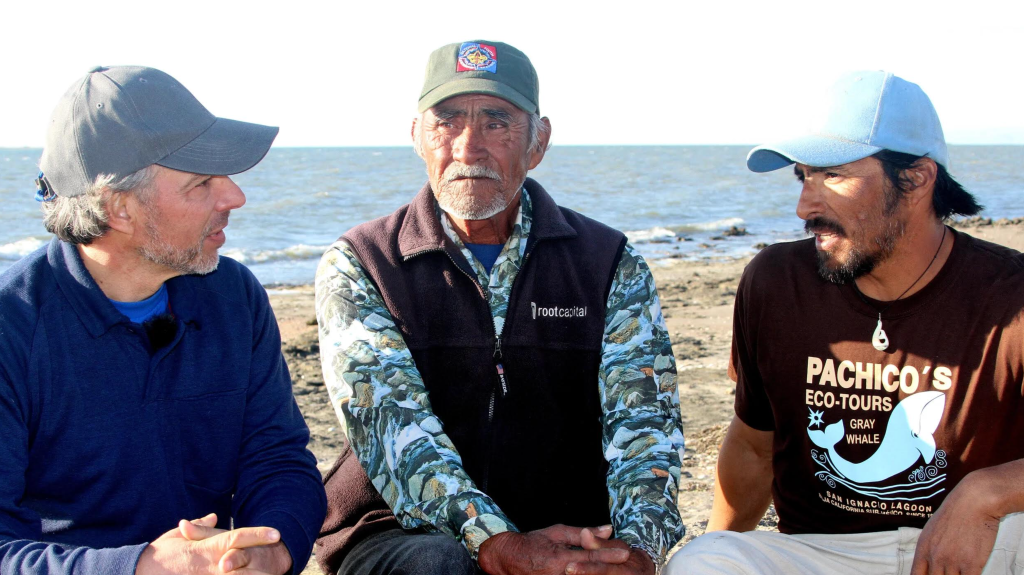
Holly and I had the pleasure of staying with Pachico Tours, the longtime family-run whale-watching outfit started by Pachico Mayoral, the first person at San Ignacio to encounter a “friendly” gray whale in 1972. Back then, gray whales were known as “devilfish,” but Pachico’s infamous encounter turned the tide of public perception.
Most of Mayoral’s six children participate in their eco-operation. One of the sons, Pancho Mayoral, doubles as a captain for Ventura-based Island Packers, where he has worked since 2011. He travels to San Ignacio each winter to help run the family business that is dear to him and his siblings. San Ignacio has been a Biosphere Preserve since 1988.
“After my dad had the famous first encounter, he provided boat service to anyone showing up on their own, and they set up their tents along the beach,” said Pancho. “I started boat driving with whales at the age of 15.”
As word got out, several camps were established within San Ignacio Lagoon, while others spread to nearby Magdelana Bay and Guerrero Negro. It wasn’t until 2002 that Pachico and his family built their own camp.
As time went on, documentaries and magazine articles described Pachico as a “whale whisperer,” “grandfather of whales,” and “whale tamer.” He passed away on in 2013 at the age of 72.
“I give him credit for being brave. When everyone was afraid of whales, he was able to overcome fear and recognize that their behavior wasn’t aggressive and he was willing to reach out and make that first contact,” continued Pancho. “We sure are proud of what our father did, what our father taught us, and what he represents in the community and Baja. We feel that responsibility, and an honor to carry on with his legacy.”
After a week of enjoying the whales, their numbers were dwindling by mid-March as that innate tug pulled them back to their Arctic feeding grounds.
I couldn’t help but wonder if some of these same whales would stopover at Bechers Bay on Santa Rosa Island?
Channel Islands Pit Stop
With spring on the immediate horizon, every time I was around any of the Island Packers crew, I asked, “Have you seen any gray whales at Bechers?” The answers varied, but sightings were frequent. Once again, groupings of gray whales were utilizing the sandy bottom at the bay to feed.
The scenic bay isn’t very deep, where gray whales scrape the bottom, consuming some of the 90 different species of their preferred prey. This behavior is known as benthic feeding. While lying on their sides, they churn up the seafloor, consuming crustaceans and filtering out sediment through their baleen.
“Pacific gray whales are best known as bottom-feeders — unique among baleen whales — yet they reveal a remarkable versatility, sometimes surface-feeding during their epic migration when every meal matters,” said Lohuis. “In recent years, more are lingering in Bechers Bay in late winter to early spring. It leaves us wondering: Are these the same individuals making this nourishing stop in the Channel Islands National Park?”
Related Posts




Premier Events

Mon, Oct 26
7:00 PM
Santa Barbara
Beauty and the Origins of Electrophysiology, Telecommunications & the Global Theater
Mon, Oct 26
5:00 PM
Montecito
Halloween at The Speakeasy at San Ysidro Ranch

Mon, Oct 26
6:00 PM
Santa Barbara
Chaucer’s Book Talk & Signing with Jennifer Chassman Browne “See Us, Know Us: Profiles of Disability”

Wed, Oct 28
5:00 PM
Santa Barbara
Fundraiser for Domestic Violence Solutions

Wed, Oct 28
7:00 PM
Santa Barbara
Reel Rock 20 Climbing Film Tour
Wed, Oct 28
7:00 PM
Goleta
IVRPD Presents : Halloween Pumpkin Patch

Thu, Oct 29
6:00 PM
Santa Barbara
Halloween Paint & Sip at Goodland Wine Shop
Fri, Oct 30
12:00 AM
Montecito
Día de los Muertos at The Speakeasy
Fri, Oct 30
11:30 AM
Santa Barbara
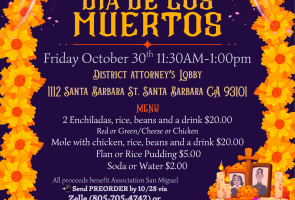
🌼💀 Join us for Día de los Muertos! 💀🌼
Fri, Oct 30
2:00 PM
Santa Barbara
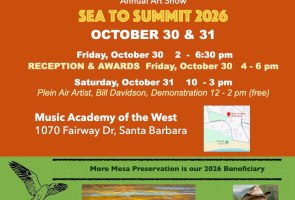
“Sea to Summit “Art Exhibit & Benefit Oct 30 & 31

Fri, Oct 30
3:00 PM
Santa Barbara
Family Movie Night at the Eastside Library: “Coco”
Mon, Oct 26 7:00 PM
Santa Barbara
Beauty and the Origins of Electrophysiology, Telecommunications & the Global Theater
Mon, Oct 26 5:00 PM
Montecito
Halloween at The Speakeasy at San Ysidro Ranch
Mon, Oct 26 6:00 PM
Santa Barbara
Chaucer’s Book Talk & Signing with Jennifer Chassman Browne “See Us, Know Us: Profiles of Disability”
Wed, Oct 28 5:00 PM
Santa Barbara
Fundraiser for Domestic Violence Solutions
Wed, Oct 28 7:00 PM
Santa Barbara
Reel Rock 20 Climbing Film Tour
Wed, Oct 28 7:00 PM
Goleta
IVRPD Presents : Halloween Pumpkin Patch
Thu, Oct 29 6:00 PM
Santa Barbara
Halloween Paint & Sip at Goodland Wine Shop
Fri, Oct 30 12:00 AM
Montecito
Día de los Muertos at The Speakeasy
Fri, Oct 30 11:30 AM
Santa Barbara
🌼💀 Join us for Día de los Muertos! 💀🌼
Fri, Oct 30 2:00 PM
Santa Barbara
“Sea to Summit “Art Exhibit & Benefit Oct 30 & 31
Fri, Oct 30 3:00 PM
Santa Barbara



You must be logged in to post a comment.