
Most people know the first five seconds.
The bright fingerpicking that leads into the upbeat doo-do-do-do. “Here comes the sun … it’s alright.” It makes you feel happy. Calm. I am listening to George Harrison’s Beatles smash hit as I write this — head bobbing, foot tapping, a small smile on my face.
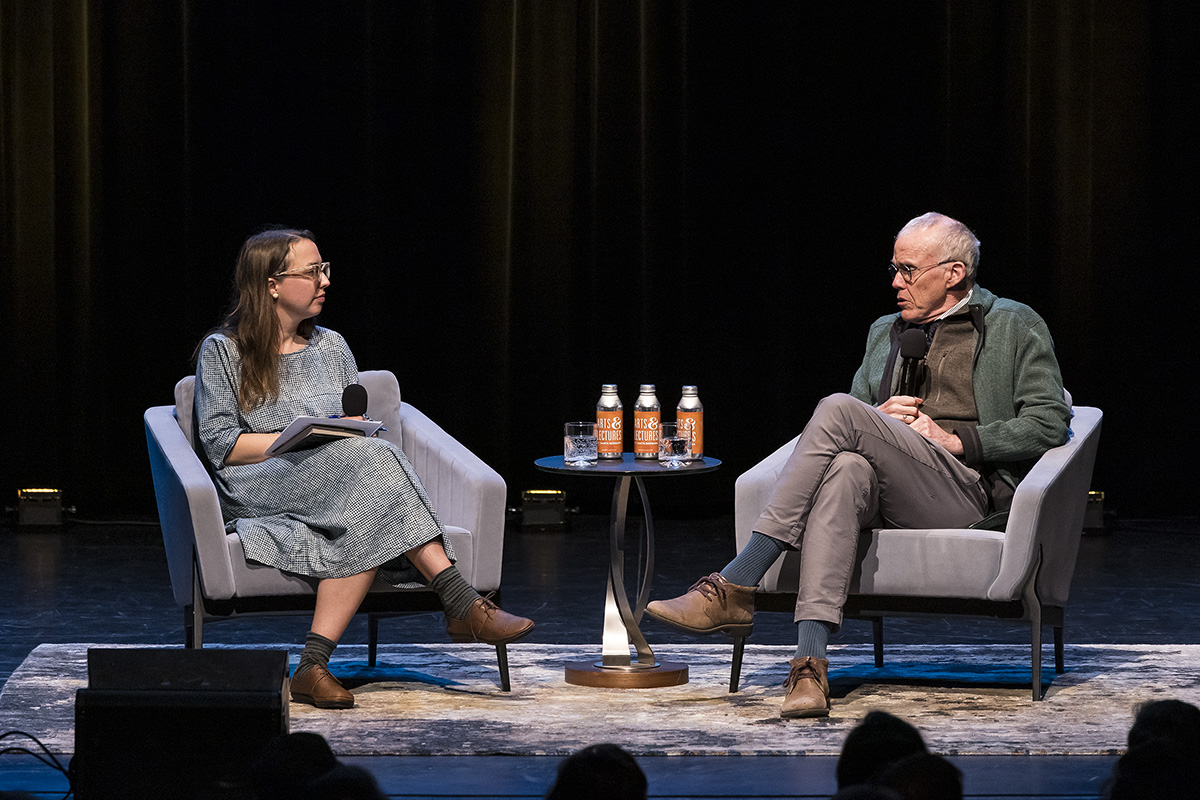
The title, borrowed for Bill McKibben’s upcoming book Here Comes the Sun and his Tuesday night talk at UC Santa Barbara’s Campbell Hall, carried with it a promise: hope, or at least the possibility of it. McKibben, one of the country’s best-known climate writers, did eventually arrive there. But not before beginning somewhere else entirely — with a morning flight across a nearly snowless West, a visible bathtub ring around Lake Mead, and a warning about just how little time remains.
While there is an irony in the emissions from the flight, McKibben instead focused on the mountains, where he said he had once “glissaded down snowfields in June.” There was now “not a touch of snow.”
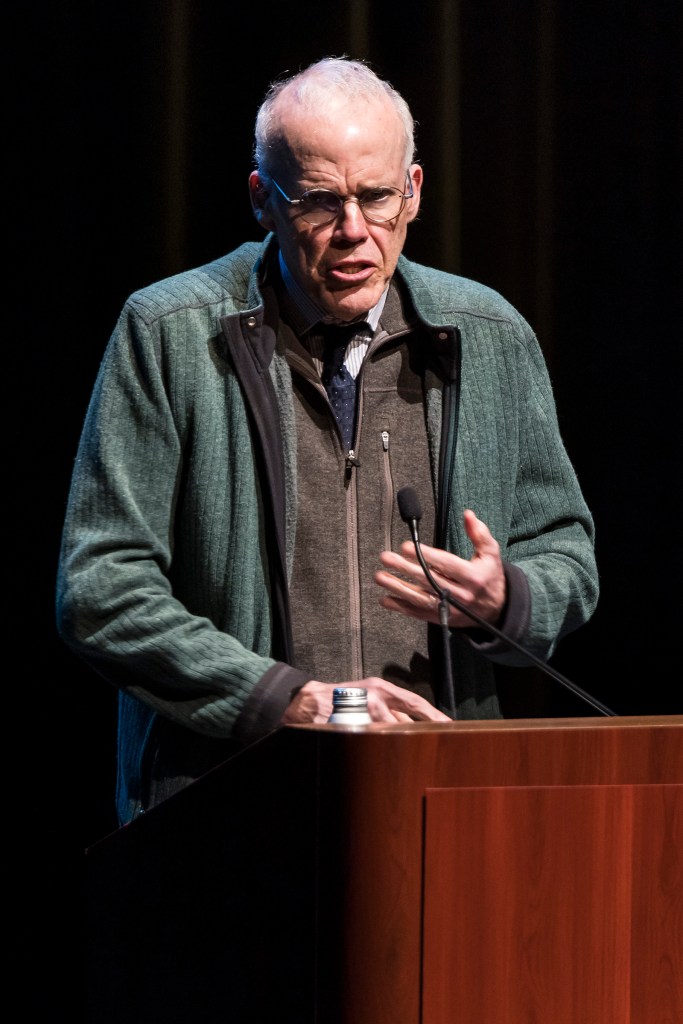
This winter, he said, was the hottest on record for much of the West. Then there’s the looming El Niño. Fire, flood, drought, and heat are no longer abstract forecasts but recurring facts.
He moved briskly from California to Vermont to Libya, where floods after a dam collapse killed thousands. Libya, he noted, has produced only a tiny share of the greenhouse gases now heating the planet, while the United States, with roughly 4 percent of the world’s population, has produced 25 percent.
He spoke of ocean currents faltering, of jet streams destabilizing, of three straight years of record heat. Then, after stacking enough evidence to quiet the room, he paused to acknowledge the obvious.
“I realize,” he deadpanned, “that this is depressing.”
It was also, in classic McKibben fashion, a setup.
“Here, I switch registers,” he said.
What followed was the argument at the center of his book: that while the climate crisis is accelerating, so is the rise of renewable energy — and fast enough, perhaps, to calm the nerves.
McKibben’s core point was not that solar and wind are promising. It was that they are already winning, and that much of the public has not caught up to the scale of the shift. For too long, he argued, they have been described as “alternative” energy sources, a label that trapped them in the margins. No longer.
Around 95 percent of new power generation added worldwide last year, he said, came from solar, wind, and water. The earth, he added, is producing roughly a third more power from the sun this spring than it was last spring. The economics, in his telling, are no longer speculative. About five years ago, he said, the world crossed “some invisible line” where it became cheaper to generate power from the sun and wind than by burning fossil fuels.
China has built roughly half the world’s clean energy in recent years, he said, adding solar at a speed that borders on absurd. Pakistan, hammered by heat and flood, has imported vast quantities of cheap Chinese solar panels as residents and farmers bypass an unreliable grid. Africa, he said, is beginning to follow a similar pattern. Even California, often trapped in its own bureaucracy, has made gains.
“Most days, California produces more than 100 percent of the electricity that it uses for some long stretch of the day,” McKibben said. Citing Stanford research, he said California is now using roughly 60 percent less natural gas to produce electricity than it did three years ago.
This was McKibben’s talent on full display: to toggle between doom and sarcastic one-liners. Donald Trump, he said, cannot by himself stop the energy transition — “It’s not like he’s Jesus Christ or something” — but he can slow it down. The crowd laughed. McKibben did not.
That slowdown, in his view, is the real danger: not whether renewable energy works but whether fossil-fuel wealth can buy enough delay to make the transition arrive too late.
“Forty years from now, we will run the planet on sun and wind,” he said. “But if it takes us anything like 40 years to get there, then we will have ruined the planet.”
That, more than anything, was the speech’s governing thesis. Time is short. The technology is here. The obstacle is power.
Fossil fuels, McKibben argued, do more than heat the atmosphere. They concentrate wealth and influence in the hands of whoever controls what lies underground. Oil fields, pipelines, refineries, shipping lanes — they do not merely produce energy. They produce geopolitical leverage and enable authoritarian regimes.
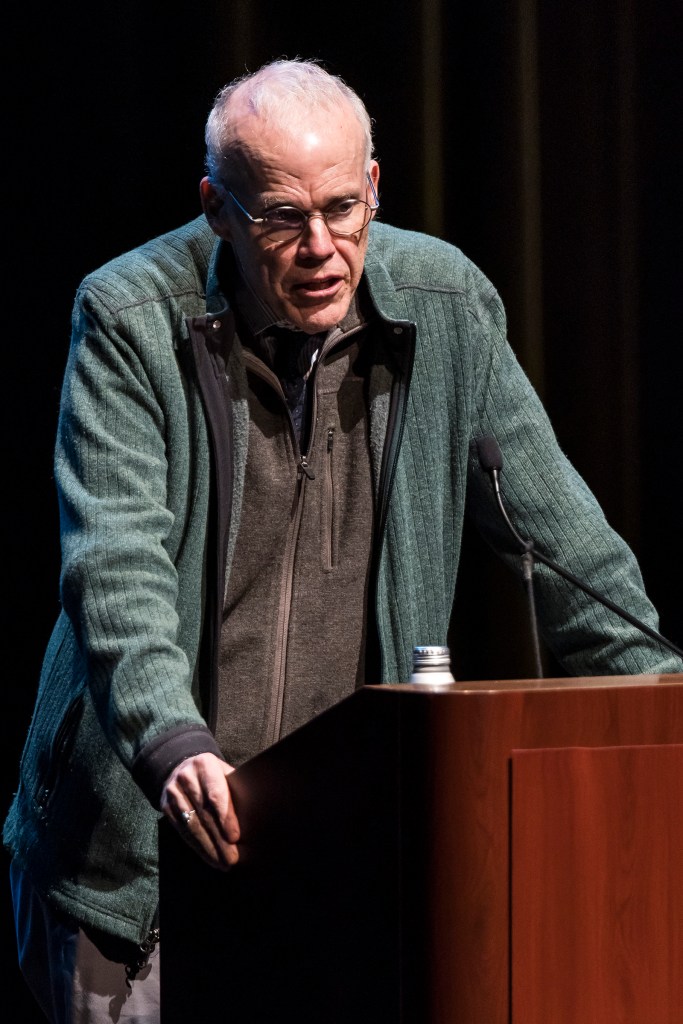
“Sunlight travels 93 million miles to reach the Earth,” he said, “but none of those miles go through the Strait of Hormuz.”
Sunlight is much harder to hoard — or to wage war over.
The irony, of course, is that the country now resisting parts of that transition most fiercely is one already rich with sun. McKibben took particular aim at the American tendency to make solar deployment cumbersome and expensive. In this country, he said, rooftop solar can cost three to five times more than it does in Australia or Europe, not because the panels are pricier but because the process is.
“It should not be that hard — similar to going and getting a new refrigerator,” he said.
California, in his view, has work to do here. Its utilities, he said dryly, “are not a model of good governance.” Australia, by contrast, has put solar on roughly 40 percent of its roofs. From noon to 3 p.m., he said, electricity is free. People have adjusted accordingly. They do laundry then. Charge their EVs then. They “figured it out.”
By the end of the talk, McKibben returned to his other role — not just as a writer, but as an organizer. The author and environmentalist is also the founder of Third Act, a group that mobilizes Americans older than 60 to take action on climate change and defend democracy. He urged older Americans especially to engage, arguing they have an underappreciated role to play. It was one of several moments in which he moved from analyst to organizer — which is, by now, his second job.
Later, in conversation with UCSB professor Leah Stokes, he explained his own evolution in blunter terms. “I thought we were engaged in an argument,” he said, referring to his young adult life as a writer. “Then I realized we had won the argument but were losing the fight.”
“The fight was not about science,” he added. “It was about money and power.”
Here Comes the Sun is not a song about the absence of winter. It is a song about surviving one — about enduring something bleak enough that the return of light feels like hope. That was McKibben’s message, too — only with more data and gallows humor.
“Energy from heaven,” he said near the end, “not from hell.”
Related Posts



Premier Events
Sat, Oct 10
9:00 AM
Santa Barbara
Treble Clef Chorus Fall Treasure Sale
Sun, Oct 11
5:00 PM
Santa Barbara
Trinity Choir: Choral Evensong
Wed, Oct 07
7:30 PM
Santa Barbara
Ensemble Theatre Company Presents: “Buyer & Cellar”

Wed, Oct 07
7:30 PM
Santa Barbara
The Theatre Group at SBCC Presents: “CLUE”
Thu, Oct 08
7:00 PM
Santa Barbara
“A Night of Blues” with Morganfield Burnett

Fri, Oct 09
7:00 PM
Santa Barbara
Paseo Nuevo Spooky Movie Nights

Sat, Oct 10
9:00 AM
Santa Barbara
SBNC 1st Annual Health & Wellness Fair

Sat, Oct 10
1:30 PM
Goleta
🌴 Another Day in Paradise at S.B’s Premier Ice Rink

Sun, Oct 11
7:00 AM
Ojai
Flamenco Guitarist Tony Ybarra

Sun, Oct 11
10:00 AM
Santa Barbara
18th Annual Domestic Violence Solutions Brunch
Sun, Oct 11
10:00 AM
Santa Barbara
Free Community Day at S.B. Botanic Garden
Sun, Oct 11
10:00 AM
Santa Barbara
Downtown Classic Car Show Santa Barbara
Sat, Oct 10 9:00 AM
Santa Barbara
Treble Clef Chorus Fall Treasure Sale
Sun, Oct 11 5:00 PM
Santa Barbara
Trinity Choir: Choral Evensong
Wed, Oct 07 7:30 PM
Santa Barbara
Ensemble Theatre Company Presents: “Buyer & Cellar”
Wed, Oct 07 7:30 PM
Santa Barbara
The Theatre Group at SBCC Presents: “CLUE”
Thu, Oct 08 7:00 PM
Santa Barbara
“A Night of Blues” with Morganfield Burnett
Fri, Oct 09 7:00 PM
Santa Barbara
Paseo Nuevo Spooky Movie Nights
Sat, Oct 10 9:00 AM
Santa Barbara
SBNC 1st Annual Health & Wellness Fair
Sat, Oct 10 1:30 PM
Goleta
🌴 Another Day in Paradise at S.B’s Premier Ice Rink
Sun, Oct 11 7:00 AM
Ojai
Flamenco Guitarist Tony Ybarra
Sun, Oct 11 10:00 AM
Santa Barbara
18th Annual Domestic Violence Solutions Brunch
Sun, Oct 11 10:00 AM
Santa Barbara
Free Community Day at S.B. Botanic Garden
Sun, Oct 11 10:00 AM
Santa Barbara


You must be logged in to post a comment.