

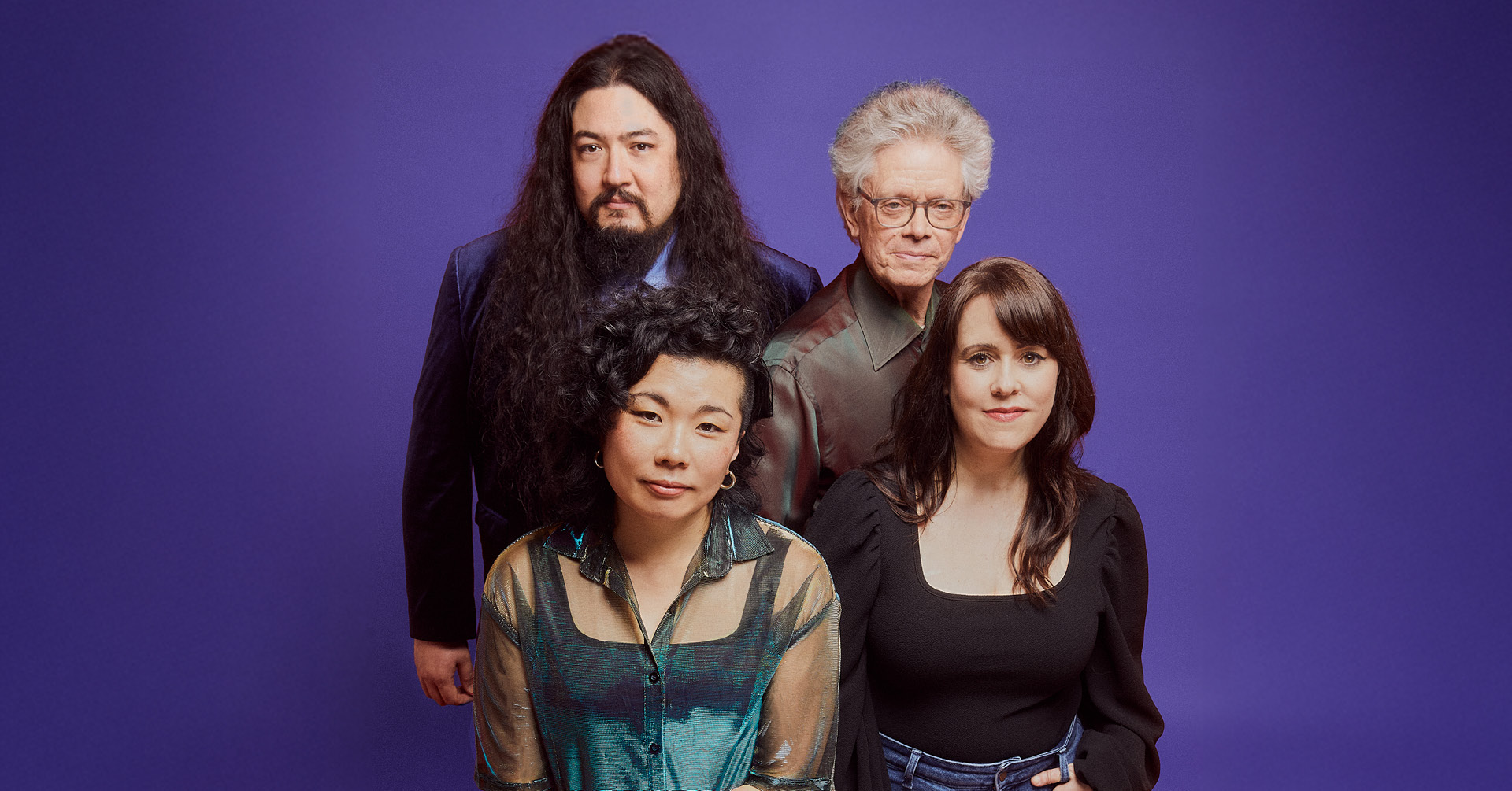
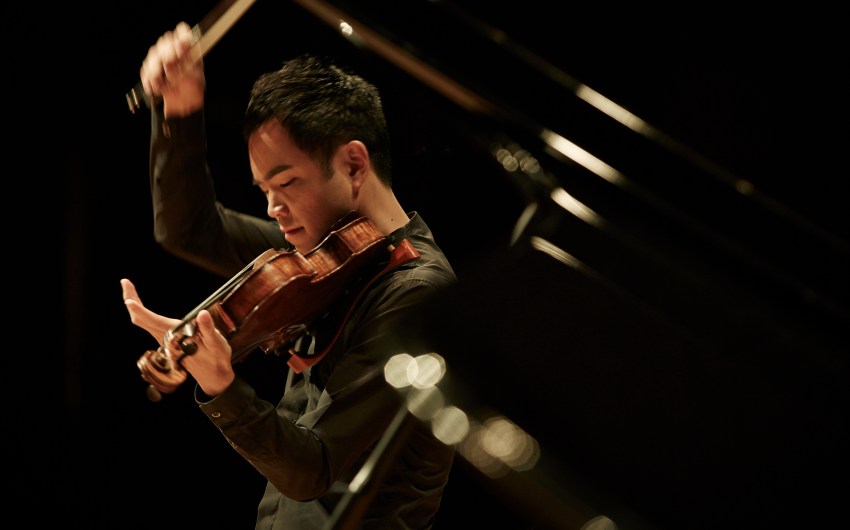
Some artists and ensembles seem to tap into some eternally springing youthful spirit, one of them being the Kronos Quartet (KQ). And it’s not because founder David Harrington is now, as of last year, playing with new recruits half (or more) his age (76): cellist Paul Wiancko, violinist Gabriela Díaz, and violist Ayane Kozasa.
Last year’s Campbell Hall appearance, one of many in Santa Barbara over the past half-century, saw the celebration of the group’s milestone 50th anniversary, as well as the retirement of longtime members John Sherba and Hank Dutt.
The next Kronos concert in town, May 2 at UCSB’s Campbell Hall, a crown jewel of the current Arts & Lectures season, will mark the West Coast premiere of a new and ambitious music-and-more work, Three Bones. And that is just one piece of a dense puzzle of current projects in the Kronos oven. Harrington won’t stop/can’t stop the Kronos train he set in motion as a twentysomething.
We recently connected with Harrington for an update on the progress of what is considered the contemporary string quartet of our age. Or the past few ages.
I was just wondering about your relationship with Santa Barbara. I first saw Kronos in its early stages at the Music Academy of the West, a residency or series kind of thing, and have watched the project evolve over the decades. Do you have any idea how many times you’ve played in Santa Barbara by now?
Kronos has performed in Santa Barbara since 1974. I’m not certain of the total number of performances, but we have performed in various places, including UCSB, the Biltmore Hotel, and the Music Academy of the West. Frank Zappa’s None of the Above was premiered in Santa Barbara in 1993, and KQ has performed many concerts with guests such as Chinese pi-pa player Wu Man and Iranian singer Mahsa Vahdat as well.
When last we saw Kronos at Campbell Hall, it was part of both the milestone 50th birthday and the swan song season for veteran members Hank Dutt and John Sherba. You have been sailing forth with the newly constituted quartet for a bit now. Does it feel like a new chapter for your project, one both fresh and a continuation of what has been established?
It has taken all the many hands on the deck of our Kronos ship since 1973 to bring us to where we are now. A sense of renewal is in the air. We can and will honor all the dedication and amazing work of the past as we forge future paths. I’m loving the feeling of growth from all the earlier experiences of KQ. Ayane, Gabriela, and Paul provide new perspectives for me and our audiences as they have each grown up with Kronos music in their lives and now have the opportunity to form and expand Kronos. So, Kronos is experiencing a growth spurt in the angst and violence of our time.
So happy to hear about the West Coast premiere of your new piece, Three Bones, an ambitious, multi-layered work, with guests Laura Ortman, Quentin Baxter, and Wu Man. Can you tell me about its origin and intent, and how this differs from other of the many innovative Kronos projects to date?
About three years ago, Carnegie Hall called with the question, “What would Kronos like to do for the 250th year of our country?” I answered instinctively, “We will do a triptych that explores three groups in our country who have had enormous challenges: Indigenous people, African Americans, and Chinese Americans. The idea will be to bring music combined with other elements and KQ’s history with each of these groups onto the concert stage and into an experience that can give our audience a sonic/dramatic window for exploration.”
In everything KQ does, we try to use what we have learned to propel us forward. The concerts of 2026 have so many possibilities that were not available in 1973. Our guests: Laura Ortman [White Mountain Apache], Quentin Baxter [African American/Gullah], and Wu Man [Chinese/ Chinese American] are primary sources of information. Also, we have benefited enormously from our relationship with the Library of Congress and the American Folklife Center. When I was the Kluge Chair in Modern Culture at the Library of Congress in 2024, Kronos and I gained access to a world of opportunities that I could only have dreamed of earlier. Three Bones is the resulting first installment of some directions that have opened up for Kronos and, in turn, musicians all over the U.S.
Wu Man has been integrated into Kronos’s music for many years. Can you tell me about the common and sympathetic ground between the quartet and her musical voice?
When I first heard Wu Man’s playing at the home of Zhou Long and Chen Yi in 1992, I realized immediately that she had a vivid, powerful force, something like that of Jascha Heifetz, Jimi Hendrix, Glenn Gould, Astor Piazzolla, and Asha Bhosle. Kronos had to perform with her.
We have had many fabulous experiences together: Tan Dun wrote Ghost Opera and Terry Riley wrote The Cusp of Magic for us. Wu Man’s artistry joined Kronos with that of Asha Bhosle and Zakir Hussain to record “You’ve Stolen My Heart.” I’m proud to say that the work we have done together has contributed to the pi-pa becoming an essential instrument on concert stages worldwide.
Today, I heard that Asha Bhosle, one of my favorite musicians and the legendary Bollywood soundtrack singer, died. I’m taken back to the memories of recording and touring with Asha, Wu Man, and Zakir, and the expansion of what a concert might be.
In your discography over the past few years, there seems to be a growing interest in historical matters and source material, including the ’20s, such as the recent Mahalia Jackson project Mỹ Lai, and the music of legendary street musician Moondog. Social commentary and content have always been part of the Kronos, but has that interest grown in recent years?
Glorious Mahalia came out on April 3. We wanted to celebrate the pivotal role of one of our greatest singers, Mahalia Jackson. As a singer, she was incomparable. As a friend to MLK Jr. and the Civil Rights movement of the 1960s, she showed that artistic excellence could be joined with activism at the highest and most personal level. Mahalia Jackson taught me and hopefully all musicians the necessity of listening to our friends and the world around us when she called out to MLK Jr., “Tell them about the dream, Martin,” during the “I Have a Dream” speech.
Yes, then there was Hard Rain and Hard Rain Drone, Mỹ Lai, Outer Space Ways Incorporated: Kronos Quartet and Friends Meet Sun Ra, and The Music of Moondog with Ghost Train Orchestra.
And now, with our appointment as Doomsday Clock Artists-in-Residence for The Bulletin of the Atomic Scientists, we are doing our best to keep a flicker of hope alive.
You seem insatiably curious about the music world, in terms of music from around the world and how other cultural worlds can be integrated into your concept of the quartet format. We will catch a particular Kronos concert, realizing that this is only a momentary snapshot amid a flurry of work in progress. Do you thrive on that kind of perpetual motion in your creative life?
I’m most alive when I’m working on about 20 things simultaneously, with each of them feeding each other. My hope is to continually take natural next steps.
Regarding current things on the Kronos plate, can you tell me about the Doomsday Clock Artist-in-Residency? What does that entail?
We are trying to take every opportunity to bring our music to the fore and give voice to buried, often marginalized voices. What the Doomsday Clock Artist-in-Residence means can be a lot of new opportunities — I can imagine a KQ concert near the Peace Bell at Hiroshima, Japan, or at the DMZ between North and South Korea, or at a refugee site in the U.S. There are so many things to do. We are continually exploring ways to energize [discussions on] climate change.
What other projects are you excited about presently in the Kronos orbit?
We have a concert at The Chapel in San Francisco on May 11, celebrating Allen Ginsberg’s 100th year. We performed and recorded his “Howl” with him in 1995, and KQ is bringing this Lee Hyla piece back as we speak. What a monumental poem, and Ginsberg was like the most awesome vocal saxophonist known to American poetry!
Just encountered a fabulous author — Alif Sharak.
I remember my first interview with you back in the ’80s, in a San Francisco coffee shop — this was for Musician magazine. At one point, after you spoke about playing Beethoven through wah-wah pedals, I asked you, at least half tongue-in-cheek, “Is there nothing sacred?” I loved and remembered your answer (something to the effect of): “Everything is sacred. That’s why you respect it by bringing your own ideas to it.” Is that still a Kronos mantra all these years later?
Live performance — its raw chanciness is thrilling! The possibility someone may have a life-altering moment in a hall filled with a group of music lovers is the best.
Kronos Quartet performs on Saturday, May 2, at 6 p.m. at UCSB’s Campbell Hall. See bit.ly/4mNpmA7 for tickets and additional information.
Related Posts

Premier Events

Sat, Oct 03
9:00 AM
Santa Barbara
Fall Plant Sale and Master Gardener Workshop
Sat, Oct 03
7:00 PM
Santa Barbara
Clean Comedy at Carrillo Recreation Center
Sat, Nov 14
7:00 PM
Santa Barbara
Clean Comedy at Carrillo Recreation Center
Sat, Dec 05
7:00 PM
Santa Barbara
Clean Comedy at Carrillo Recreation Center
Thu, Oct 01
11:00 AM
Santa Barbara
In Studio: Julie Anderson Mathias

Thu, Oct 01
7:30 PM
Santa Barbara
Robert Plant with Saving Grace and Suzi Dian

Fri, Oct 02
5:30 PM
Santa Barbara
Pet Blessing at Trinity Episcopal Church
Fri, Oct 02
8:00 PM
Santa Ynez
Comedian Ron White Performs at Chumash Casino Resort
Sat, Oct 03
9:00 AM
Goleta
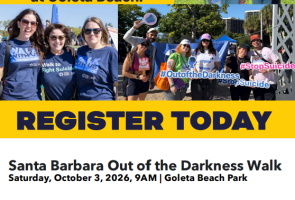
Out of the Darkness Suicide Awareness Walk
Sat, Oct 03
10:00 AM
Santa Ynez
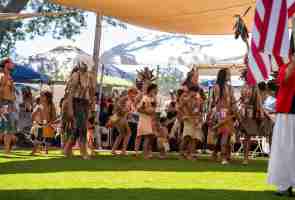
Chumash Intertribal Powwow Returns
Sat, Oct 03
10:00 AM
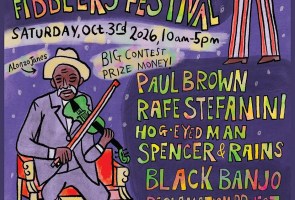
54th Santa Barbara Old -Time Fiddlers’ Festival

Sat, Oct 03
11:00 AM
Santa Barbara
OktoBEERfest at Dutch Garden Restaurant!
Sat, Oct 03
12:00 PM
Santa Barbara
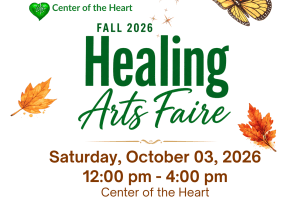
Reclaim Your Radiance Fall 2026 Healing Arts Faire
Sat, Oct 03
12:00 PM
Santa Barbara
CWC Docs: “SURFILMUSIC” (2026)
Sat, Oct 03 9:00 AM
Santa Barbara
Fall Plant Sale and Master Gardener Workshop
Sat, Oct 03 7:00 PM
Santa Barbara
Clean Comedy at Carrillo Recreation Center
Sat, Nov 14 7:00 PM
Santa Barbara
Clean Comedy at Carrillo Recreation Center
Sat, Dec 05 7:00 PM
Santa Barbara
Clean Comedy at Carrillo Recreation Center
Thu, Oct 01 11:00 AM
Santa Barbara
In Studio: Julie Anderson Mathias
Thu, Oct 01 7:30 PM
Santa Barbara
Robert Plant with Saving Grace and Suzi Dian
Fri, Oct 02 5:30 PM
Santa Barbara
Pet Blessing at Trinity Episcopal Church
Fri, Oct 02 8:00 PM
Santa Ynez
Comedian Ron White Performs at Chumash Casino Resort
Sat, Oct 03 9:00 AM
Goleta
Out of the Darkness Suicide Awareness Walk
Sat, Oct 03 10:00 AM
Santa Ynez
Chumash Intertribal Powwow Returns
Sat, Oct 03 10:00 AM
54th Santa Barbara Old -Time Fiddlers’ Festival
Sat, Oct 03 11:00 AM
Santa Barbara
OktoBEERfest at Dutch Garden Restaurant!
Sat, Oct 03 12:00 PM
Santa Barbara
Reclaim Your Radiance Fall 2026 Healing Arts Faire
Sat, Oct 03 12:00 PM
Santa Barbara


