

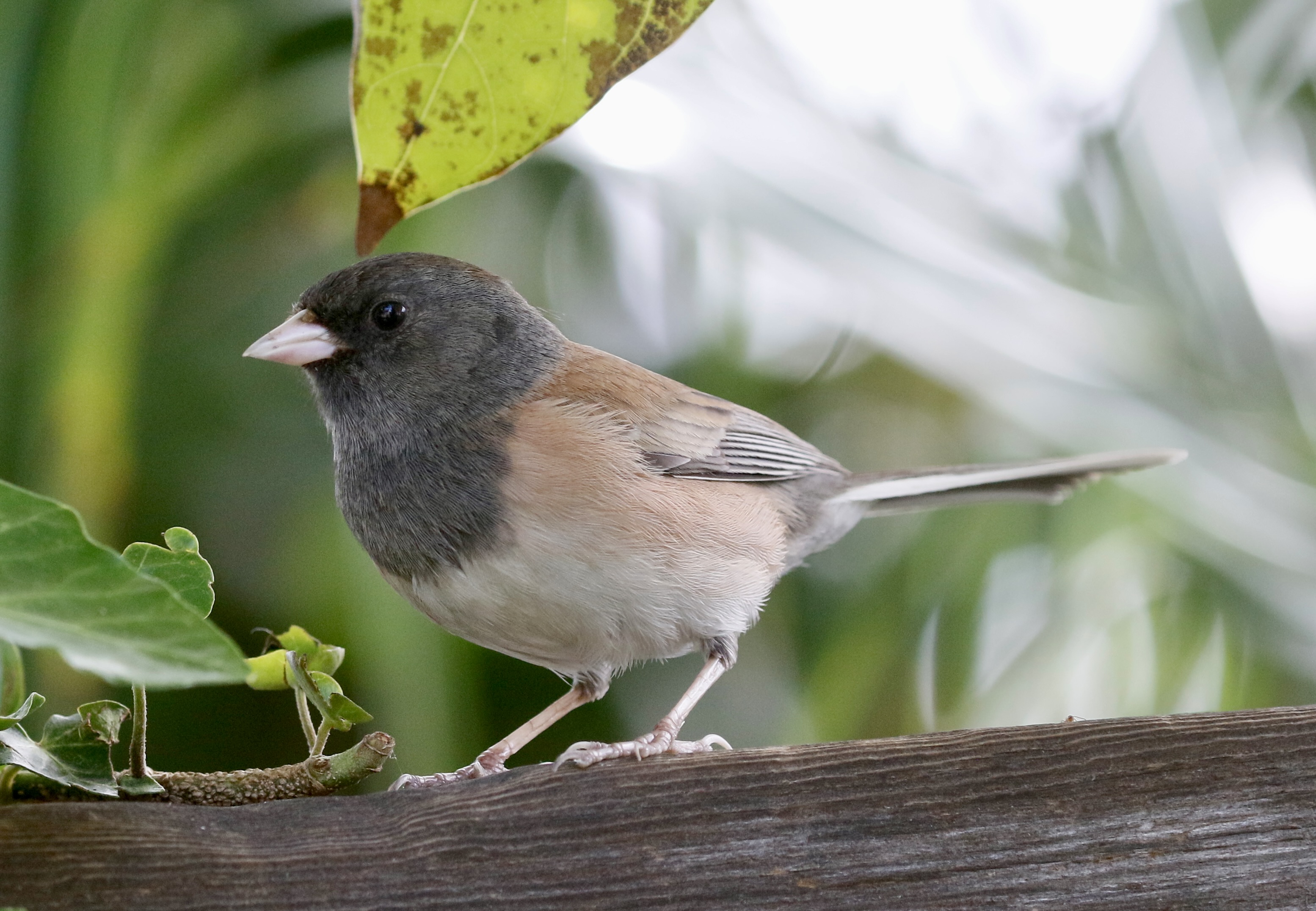
I confess I haven’t felt much like writing over the past months. Every morning, the news provides its own little hell, and going out birding isn’t the salve it once was, partly because the decline in birds is becoming more and more apparent. So what has encouraged me to put forefingers to keyboard? A pair of birds that decided to raise their young on our patio, that’s what.
My wife, Trisa, and I first noticed the female dark-eyed junco disappearing with some regularity into the same spot in the ivy along the fence right outside our kitchen window. A few days later, I peered into the ivy, and there was a perfect nest of grasses, lined with animal hair. It wasn’t long before the junco was settled on the nest, presumably on eggs, only leaving for 20 minutes or so at a time to feed. When she was home, we could just make her out from the kitchen window between the leaves of the ivy. Her dark hood blended with the shadows, but her stout pink beak gave her away. She was on the nest for several days, her mate giving his tuneless trill from the treetops nearby.
Then, one morning, she wasn’t there. I waited for several hours without seeing her anywhere around the nest, then I went for a quick look — and the nest was empty. Animals use the fence as a thoroughfare, and I surmised that one of these ― probably a rat ― must have made a meal of her eggs.
We didn’t have much time to feel sorry, because almost immediately, the female was nest building again, this time in a hanging spider plant on our patio. The plant is at eye level, so whenever we went out onto the patio, we could easily see her progress, and within a couple of days, another perfect nest was completed. But that was it. She didn’t come back, and I thought she’d realized that the location was a bit silly.
A few days went by, and we were hosting a child’s birthday party on the patio. I was up on a stepladder, fixing some lights, and looked down into the spider plant. I received a jolt when the junco hurtled off her nest and scolded me ― “tuck, tuck” ― from the Japanese maple. I looked in the nest and my heart gladdened ― four beautiful, perfect little eggs. What a miracle eggs are.
I wanted to move the party indoors, but Trisa would have none of it. She knew just how resilient juncos are. When she taught 1st grade at Foothill School, a pair of juncos built a nest on the ground in a planter right outside of her classroom and next to the playground. Kids walked and ran by within inches all the time, and that pair of juncos successfully fledged their young. If they could do it, the patio juncos could put up with a couple of hours of K-pop. And so it proved. The female sat tight even with the great hubbub going on around her.
I looked up how long it takes a junco’s eggs to hatch, and was surprised to find it was only 12 days. I kept track on the calendar and counted down the days. I’d check through the window a few times every hour to make sure she was still on the nest and would worry when she was gone for what seemed like too long. During this incubating period, I didn’t see the male at all. They are readily distinguishable with a little practice. The male’s hood is jet black, while the female’s is dark gray. I didn’t see him, but I heard him a lot. He sang his tuneless dry trill from high in the trees around the house, probably proclaiming his territory and warning off interlopers.
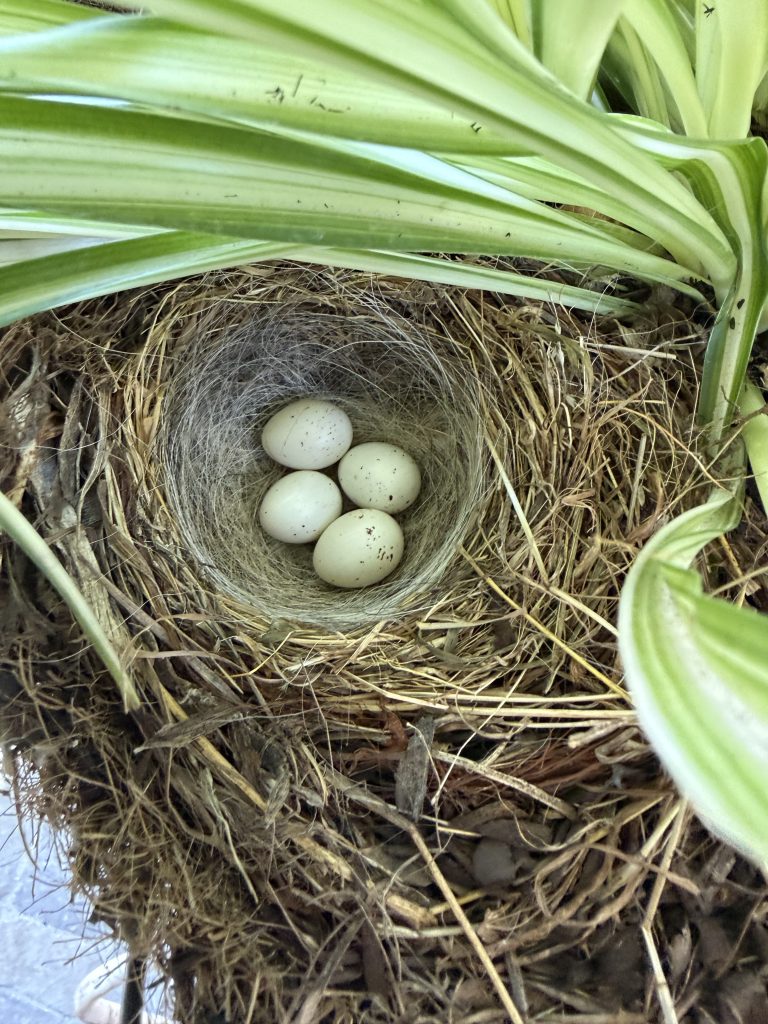
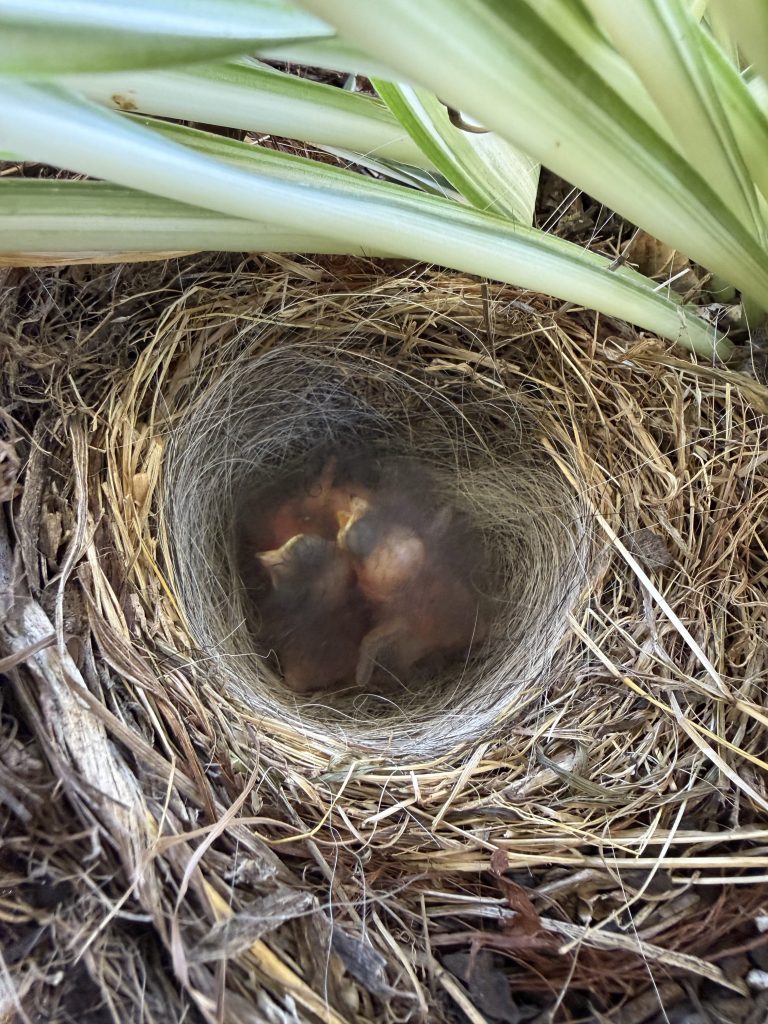
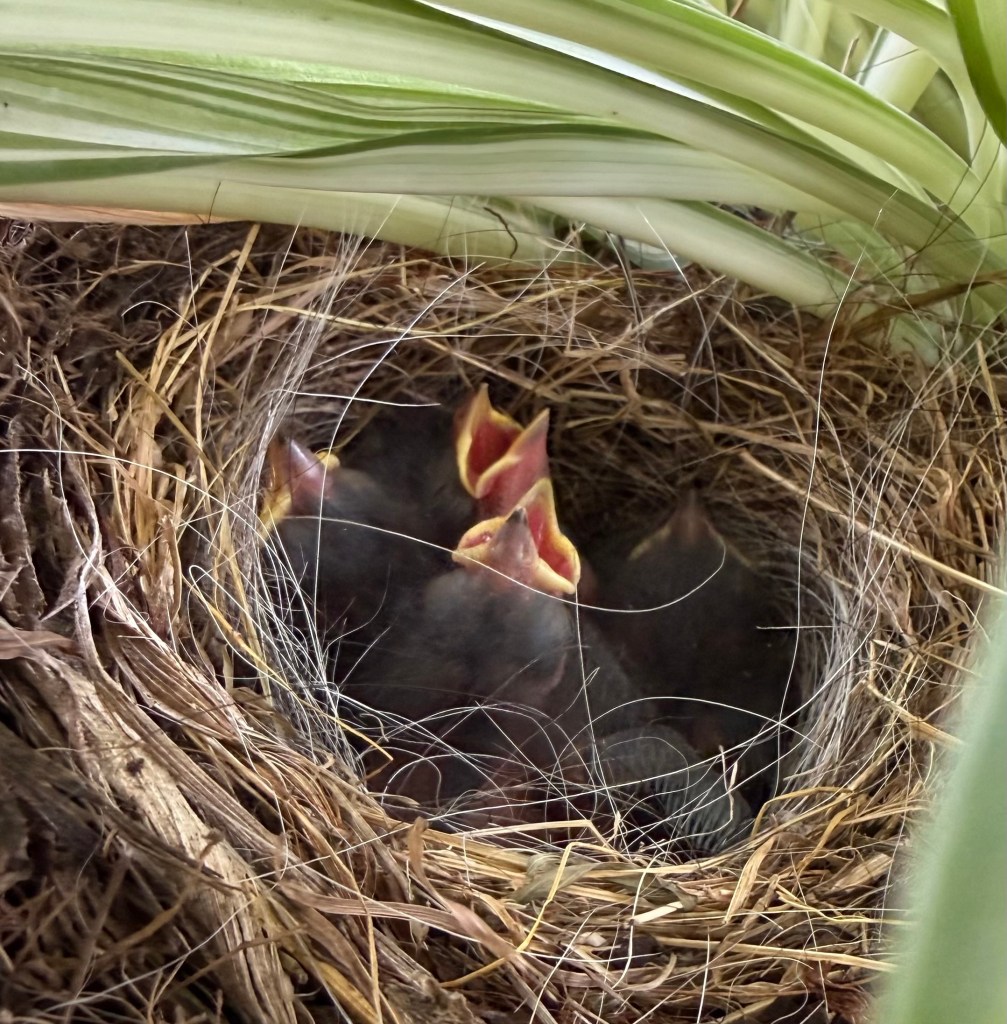
But I wondered if his song signaled more. Was he telling his girl that, not to worry, he was still around, hadn’t been eaten by a hawk or cat, and would help out once the eggs hatched? Did she listen and feel assured? Did she see him in her mind’s eye? Do birds have the capacity to imagine? I wondered, too, that when she left the nest to feed, did they meet up and greet one another? I marveled at her patience, the ability to sit still for hours at a time, the instinct to make more juncos overriding the fear she must often feel with humans walking within inches of her head. Was she a seasoned mother, or was this going to be her first brood? Either way, she knew exactly what to do.
I did some more research into juncos. I knew that they were only recent colonizers of urban areas. I’ve lived in my house on the Westside for 30 years, and didn’t see my first junco in the yard ’til 15 years ago. After that, they were still only occasional visitors. Then about five years ago, there seemed to be a big surge of the birds into built-up areas, very similar to the way that Cooper’s hawks have recently found urban neighborhoods to their liking.
Paul Lehman’s Birds of Santa Barbara County held information that surprised me. Until the 1930s, dark-eyed juncos were restricted as nesters to the higher mountains, such as Big Pine Mountain in the northeast of our county. Since then, they have marched or fluttered downslope, with the first nesting confirmed in Mission Canyon in 1936. By 1965, they were nesting in most of the foothill canyons. In the 1960s, they were breeding on the coastal plain, and the 1970s saw birds nesting in well-vegetated residential areas such as in Hope Ranch. And now they have moved into towns and cities, and most welcome they are.
Sure enough, on day 12, I peeked in the nest after the female had flown off to feed, and there was a little mound of gray fuzzy flesh. No eggshells were around; she must have carried them away.
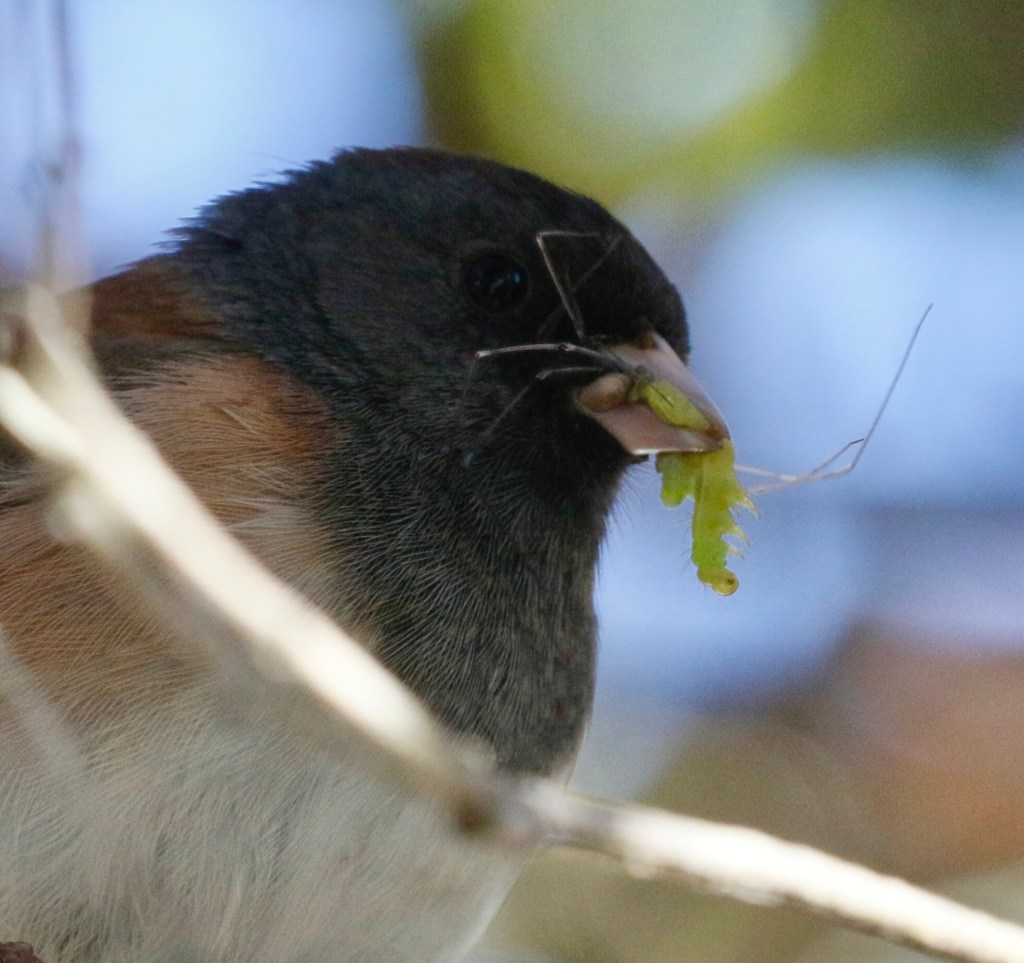
A new phase of nest watching had begun. The Cornell page on dark-eyed juncos said that both parents feed the youngsters, but a day went by and I saw no sign of him. I thought uncharitable thoughts. She came in regularly, though, with a beakful of bugs. She’d wait in the maple, making sure the coast was clear, and then slip into the nest and fly out within seconds.
Juncos are seed eaters, so why was she bringing in bugs? Insects are nutrient rich, and baby birds require enormous amounts of protein and fat to grow quickly. Seeds would be difficult to digest and would not provide the necessary nutrients for rapid growth. Caterpillars are particularly beneficial, being easily swallowed and digested. I watched her bring in several caterpillars. She’d often leave the nest carrying a fecal sac, making sure the nest stayed clean.
More than 96 percent of terrestrial birds feed their young on insects. One study of chickadees found that a successful brood required more than 6,000 caterpillars. That’s a lot of food to gather, and birds need all the help they can get. Studies have shown that the steady decline in most bird populations is closely tied to the plummeting of insect numbers. Is there anything we can do? Yes! Grow native plants. Our native insects developed alongside our native plants. They depend on one another: The plants need pollinating, and the insects need plant food in their larval stages. More native plants = more native insects = more food for birds. More birds = more joy for humans.
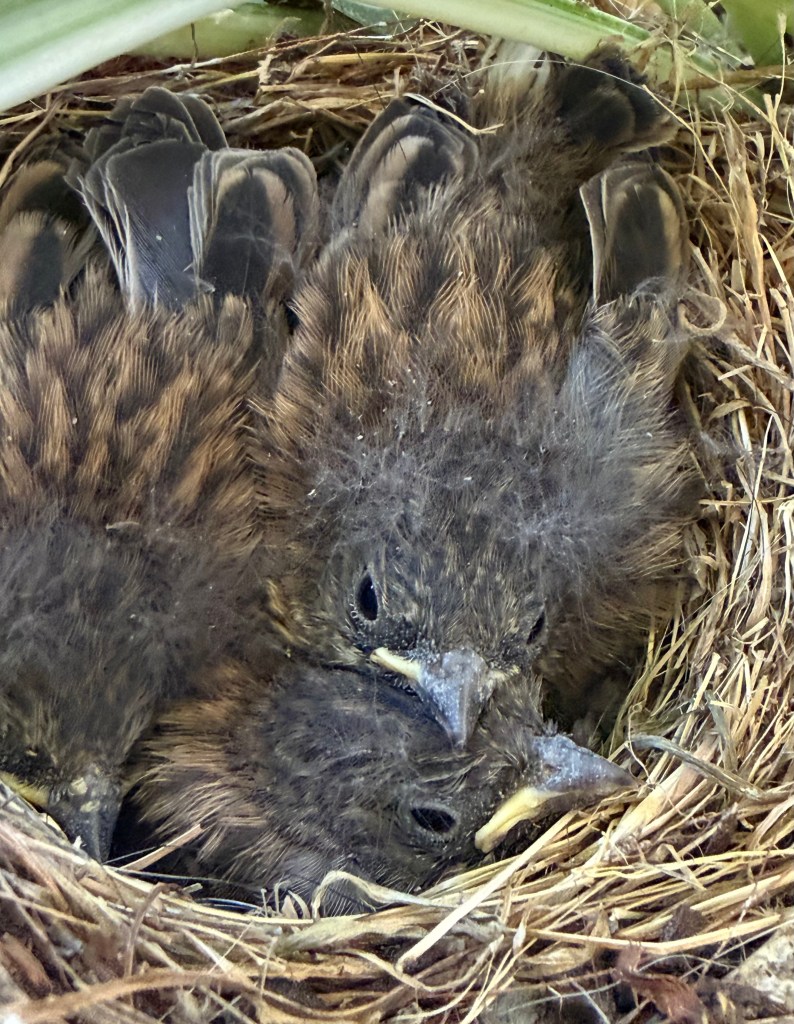
Finally, the male showed up and began to do his bit. Had she gone out and badgered him, or had he noticed her collecting the insect food that she would not normally eat? The important thing was that he was pulling his weight; both parents would need to be on duty if the brood was to fledge successfully.
As the days went by, food deliveries became more and more frequent, sometimes as often as five minutes apart. Occasionally, the parents would arrive simultaneously, and he would courteously wait while she fed the chicks. And then, one morning, it seemed as though calamity struck. As he was leaving the nest after a delivery, I saw the male fly straight into the glass of the French doors with a soft thunk. He flew off, but I knew that window strikes are serious, and even if the bird appeared okay at first, injuries are often severe and can kill the victim.
I watched for him for the rest of the day, and he didn’t appear. His mate kept up her end, bringing beakful after beakful of bugs, and I feared for the worst. But then, in the evening, he was back on duty as though nothing had happened.
Within a week of hatching, the nestlings began to grow feathers on their backs and wings, and soon there was the weak flapping of wings. Throughout their time in the nest, the young made no discernible sounds. This surprised me, as I often hear baby birds calling to be fed when walking in woodland. Juncos are stealthy creatures, and need to be, now that they have found urban living to their liking. With the number of cats in neighborhoods, and the birds’ habit of nesting on or close to the ground, baby juncos wouldn’t last long if they cried out to be fed.
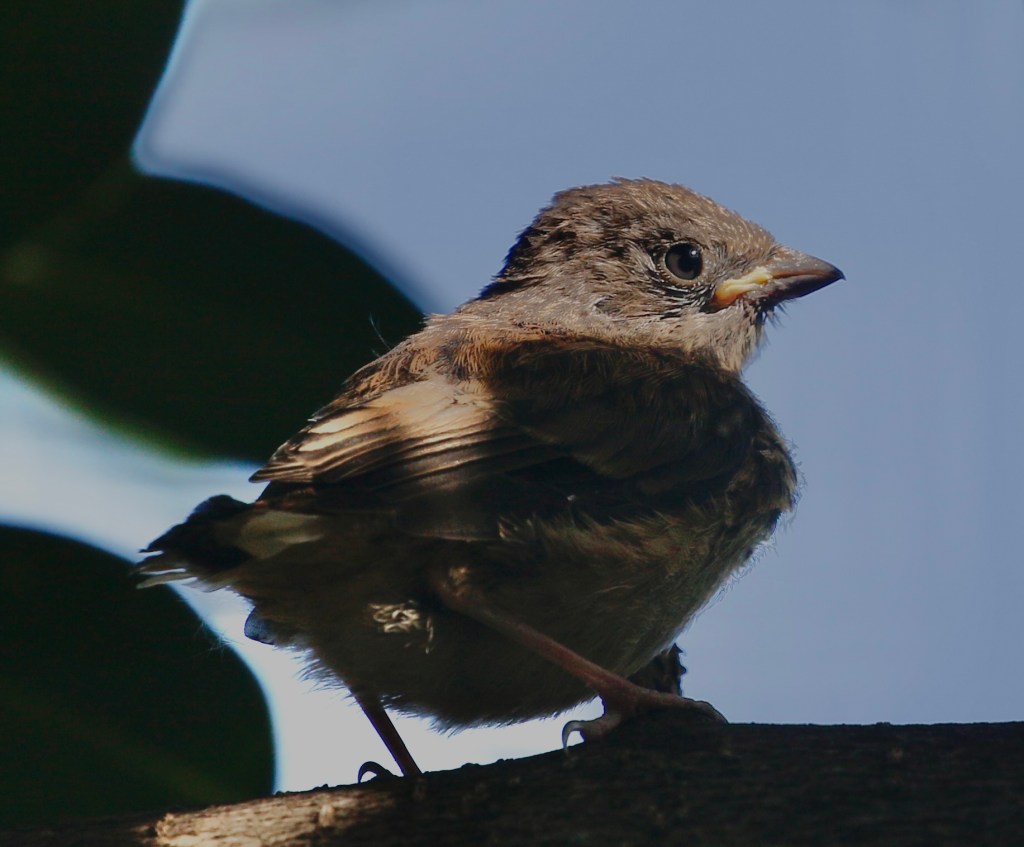
I missed the fledging of the juncos, which occurred on the 11th day after hatching, but fortunately Trisa was out on the patio at the time. Out of the corner of her eye, she saw two shapes hurtle out of the nest and settle on the pathway. One of the adult juncos flew down and led them, in a line, hopping down the garden path, flicking their white outer tail feathers like little flags, then showed them where to flutter up into the ivy. When I got home, two juncos remained, and then the following morning, they too had flown.
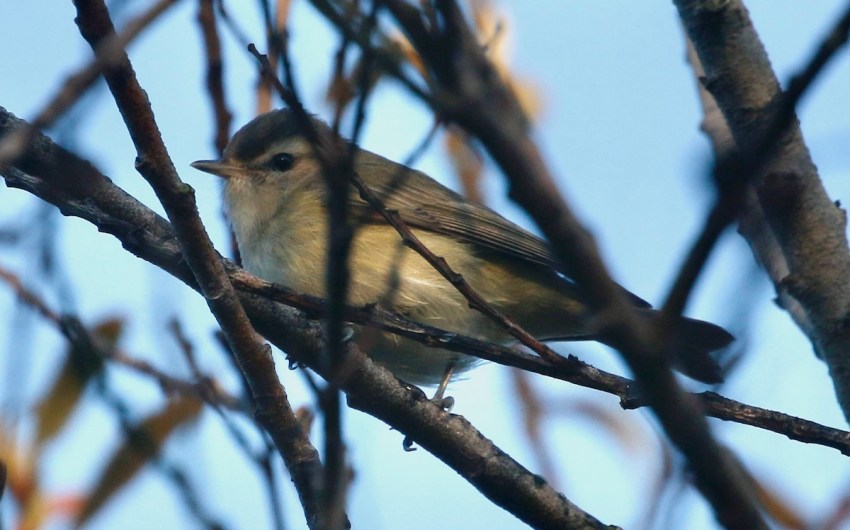
I wanted to see the youngsters again for perhaps one last time, so I walked down our narrow strip of back yard. There was movement in the lemon tree, and it was a young bird as told by its fleshy gape, but it was a Bewick’s wren, not a junco — where had they been nesting? Then I heard the “tuck, tuck” adult junco alarm call, and there was a young junco midway up a tree, watched over by his father. After getting a photo, I went back inside and left them to it.
Hugh Ranson is a member of Santa Barbara Audubon Society, a nonprofit organization that protects area birdlife and habitat and connects people with birds through education, conservation, and science. For more information, see SantaBarbaraAudubon.org.
Related Posts




Premier Events

Sat, Oct 10
9:00 AM
Santa Barbara
Treble Clef Chorus Fall Treasure Sale

Sun, Oct 11
5:00 PM
Santa Barbara
Trinity Choir: Choral Evensong

Wed, Oct 07
7:30 PM
Santa Barbara
Ensemble Theatre Company Presents: “Buyer & Cellar”

Wed, Oct 07
7:30 PM
Santa Barbara
The Theatre Group at SBCC Presents: “CLUE”

Thu, Oct 08
7:00 PM
Santa Barbara
“A Night of Blues” with Morganfield Burnett

Fri, Oct 09
7:00 PM
Santa Barbara
Paseo Nuevo Spooky Movie Nights

Sat, Oct 10
9:00 AM
Santa Barbara
SBNC 1st Annual Health & Wellness Fair

Sat, Oct 10
1:30 PM
Goleta
🌴 Another Day in Paradise at S.B’s Premier Ice Rink

Sun, Oct 11
7:00 AM
Ojai
Flamenco Guitarist Tony Ybarra

Sun, Oct 11
10:00 AM
Santa Barbara
18th Annual Domestic Violence Solutions Brunch
Sun, Oct 11
10:00 AM
Santa Barbara
Free Community Day at S.B. Botanic Garden

Sun, Oct 11
10:00 AM
Santa Barbara
Downtown Classic Car Show Santa Barbara
Sat, Oct 10 9:00 AM
Santa Barbara
Treble Clef Chorus Fall Treasure Sale
Sun, Oct 11 5:00 PM
Santa Barbara
Trinity Choir: Choral Evensong
Wed, Oct 07 7:30 PM
Santa Barbara
Ensemble Theatre Company Presents: “Buyer & Cellar”
Wed, Oct 07 7:30 PM
Santa Barbara
The Theatre Group at SBCC Presents: “CLUE”
Thu, Oct 08 7:00 PM
Santa Barbara
“A Night of Blues” with Morganfield Burnett
Fri, Oct 09 7:00 PM
Santa Barbara
Paseo Nuevo Spooky Movie Nights
Sat, Oct 10 9:00 AM
Santa Barbara
SBNC 1st Annual Health & Wellness Fair
Sat, Oct 10 1:30 PM
Goleta
🌴 Another Day in Paradise at S.B’s Premier Ice Rink
Sun, Oct 11 7:00 AM
Ojai
Flamenco Guitarist Tony Ybarra
Sun, Oct 11 10:00 AM
Santa Barbara
18th Annual Domestic Violence Solutions Brunch
Sun, Oct 11 10:00 AM
Santa Barbara
Free Community Day at S.B. Botanic Garden
Sun, Oct 11 10:00 AM
Santa Barbara


You must be logged in to post a comment.