
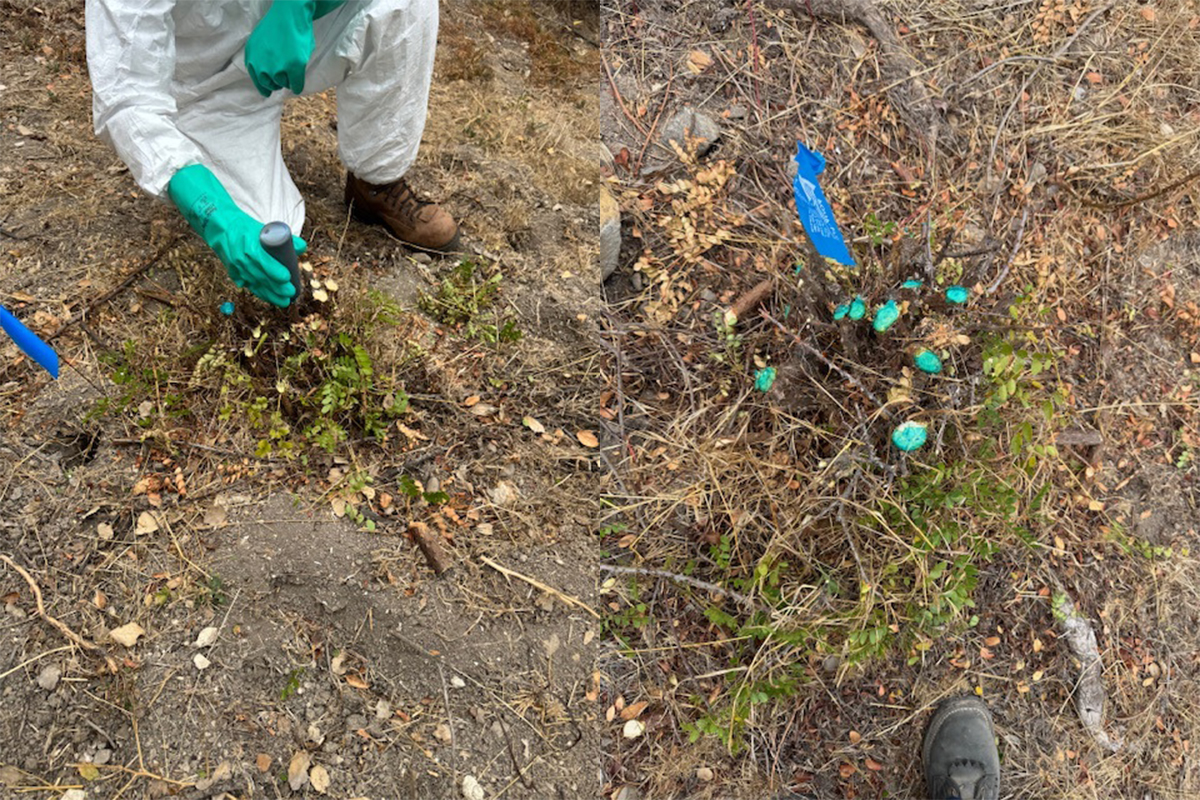
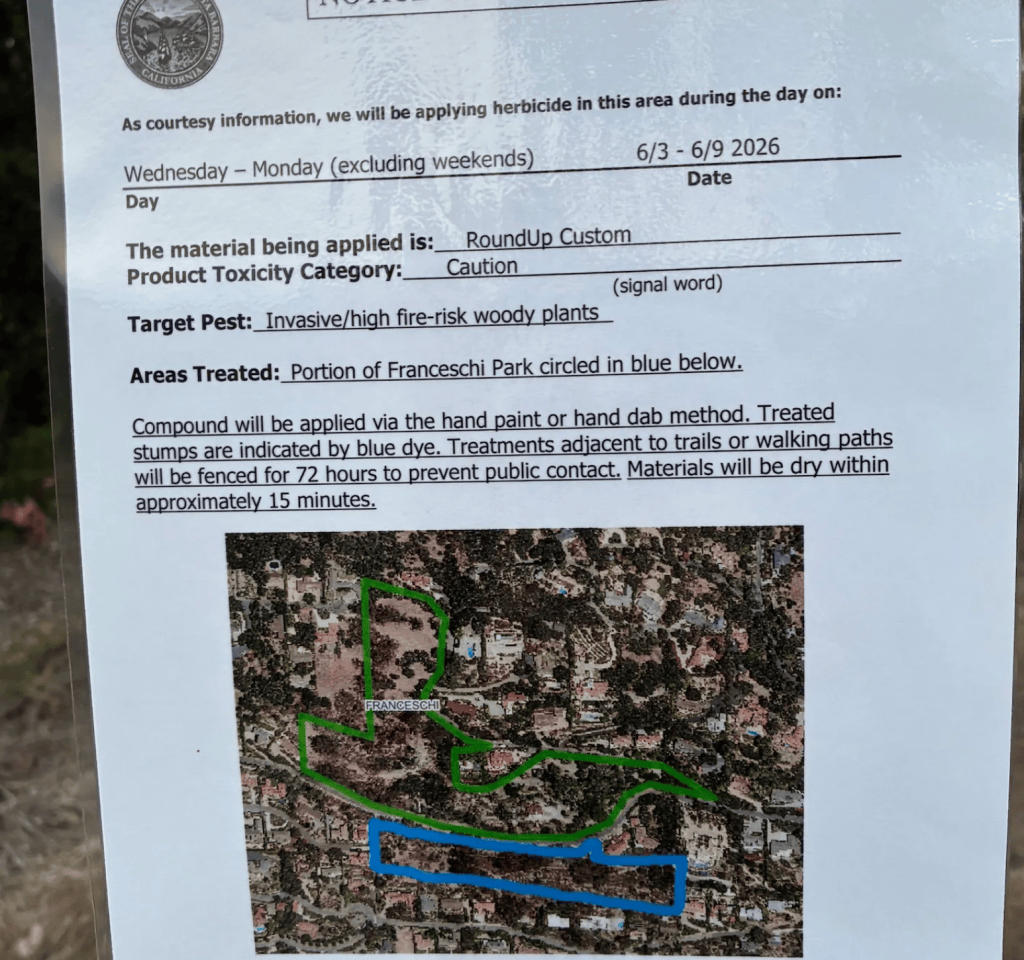
Santa Barbara residents received notice last week that Roundup, a toxic herbicide, was being applied at Franceschi Park on the Riviera from June 3 to June 9. They also saw it being applied along Tunnel Trail near Mission Canyon. It sparked concern from residents, considering Roundup’s potential risks.
Roundup contains glyphosate, a chemical that the International Agency for Research on Cancer has identified as a probable carcinogen. Tens of thousands of claims have been filed against Roundup manufacturer Bayer, alleging that the weedkiller causes non-Hodgkin lymphoma, a blood cancer.
“Roundup … is not only toxic to humans, but it is also toxic to the abundant wildlife that currently thrives in the park,” wrote one resident in a letter to the Independent. He noted that the National Library of Medicine documents that exposure to glyphosate can produce alterations in the structure of the nervous systems of humans and animals. “The City of Santa Barbara should not be using such a dangerous, toxic substance in a public park.”
But the city insists it is using the herbicide safely and as a last resort.
Jazmin LeBlanc, the city’s Integrated Pest Management (IPM) coordinator, explained that they use biological, cultural, and physical methods first, before resorting to chemicals, to minimize risks. Since 2004, when the Santa Barbara City Council first adopted its IPM strategy, the city has only become more restrictive in its use of chemicals, she said. The goal, she said, is to be preventative rather than reactive.
The city categorizes different methods into green (safe), yellow (some risks), and red (deadly) zones. Roundup was recently recategorized as red by the state.
Every single public park is coded green, except by exemption — which needs to be approved by an independent committee consisting of environmental consultants and scientists, such as the head of horticulture at the Santa Barbara Botanic Garden, before application.
There are also emergency exemptions, such as when the city was faced with a potential fruit-fly invasion a few months ago, which presented the risk of agricultural catastrophe and a huge loss of revenue.
For Franceschi, the use of Roundup is a one-time programmatic exemption, Leblanc explained, to target woody, invasive species that are highly flammable — namely acacia and eucalyptus — and instead encourage growth of native species. All uses in this case are in high-fire-hazard areas. She said that the California Invasive Plant Council recommends glyphosate for targeting most woody, invasive species for fire prevention.
Other tactics, such as mechanized and hand removal, are tried first but sometimes fail. Certain plants can be hardy, springing back up even after mechanical removal; or, like in the case of Franceschi, the plants grow on slopes, where pulling the stumps out may cause harmful erosion, but if you cut the trees down, they just regrow.
The city does not spray the chemical, instead painting the material onto the stumps, for precise application and to use as little as possible. Roundup chemically breaks down very fast, avoiding secondary effects on, say, birds that might land in the area 20 minutes later. The city also must put up mandatory signage — which residents noticed at Franceschi — and fence off the area for 72 hours, giving ample time for the herbicide to break down.
Other parks where the city uses the herbicide are identified in its Wildfire Resiliency Project within high-fire-hazard areas — including Stevens, Lauren Canyon, Skofield, Parma, Orpet, Loma Media, Hale, Hidden Valley, Hilda Ray Escondido, Honda Valley, and La Mesa. In Stevens Park, for example, eucalyptus and acacias grow on steep hillsides that lead up to homes and are outcompeting native oaks and sycamores, which are more fire resilient, according to the city.
Yellow-coded areas also include the Mission Rose Garden, lawn bowling areas, and street medians. Golf courses’ putting areas are where the most red-coded materials are applied, due to the difficulty of maintaining such a monoculture. Roundup is also used at the Santa Barbara Airport to keep weeds off the runways.
Leblanc said the city is aware of the dangers of using toxic herbicides in public parks. However, city officials must also weigh the dangers of habitat and wildfire risks. In some urban parks, she noted, visitors will see weeds because the city has determined that using an herbicide is not worth the risk. For example, Douglas Family Preserve is often packed with people and off-leash dogs, and other methods have shown to be sufficient on its flat topography, she said.
Tunnel Trail Usage
Roundup usage at Tunnel Trail is slightly more complicated.
While Tunnel Trail is technically outside city limits, the property is owned by the city.
Southern California Edison has been reported applying Roundup along the trail as part of required habitat restoration for work they did that caused erosion around Mission Canyon Stream from 2019. It took years just to draft the mitigation plan, due to all of the moving parts, such as replanting vegetation. It is being overseen by the county.
The trail is lined with new saplings in cages to protect from gophers and surrounded by irrigation systems, which are immediately visible to hikers. However, in other areas, the plan outlines the use of herbicides, including those like Roundup, which contain glyphosate.
Public complaints to the city described workers seemingly spraying herbicides onto areas of the trail with people around, which prompted the city to intervene. But an SCE spokesperson insisted that the company recognizes the community’s concerns and is “working closely with local officials, and when herbicides are used it is in targeted applications by trained professionals and consistent with approved plans and permits.”
He said they used mechanical and manual methods but relied on glyphosate where those methods were ineffective, particularly on “slopes and burns where it could destabilize the terrain.”
He said the company used blue dyes, similar to the city, so the public can see where application happens and uses trail signage to advise people to steer clear of application sites.
While construction work for the Mission Canyon Stream Restoration Project was completed last year, the utility company’s ongoing work includes the installation of plants, irrigation systems and hydroseeding, and monitoring and maintenance of revegetation.
Related Posts

Premier Events

Wed, Oct 14
5:30 PM
Santa Barbara
Free Home Hardening & Firescaping Workshop

Fri, Oct 16
7:00 PM
Santa Barbara
Divine Within: A Sufi Exploration of Love & Unity
Sat, Oct 17
9:30 AM
Santa Barbara
Divine Within: A Sufi Exploration of Love & Unity
Sun, Oct 18
9:30 AM
Santa Barbara
Divine Within: A Sufi Exploration of Love & Unity
Fri, Nov 13
7:00 PM
Santa Barbara
Divine Within: A Sufi Exploration of Love & Unity
Sat, Nov 14
9:30 AM
Santa Barbara
Divine Within: A Sufi Exploration of Love & Unity
Sun, Nov 15
9:30 AM
Santa Barbara
Divine Within: A Sufi Exploration of Love & Unity
Fri, Dec 11
7:00 PM
Santa Barbara
Divine Within: A Sufi Exploration of Love & Unity
Sat, Dec 12
9:30 AM
Santa Barbara
Divine Within: A Sufi Exploration of Love & Unity
Sun, Dec 13
9:30 AM
Santa Barbara
Divine Within: A Sufi Exploration of Love & Unity
Wed, Oct 14 5:30 PM
Santa Barbara
Free Home Hardening & Firescaping Workshop
Fri, Oct 16 7:00 PM
Santa Barbara
Divine Within: A Sufi Exploration of Love & Unity
Sat, Oct 17 9:30 AM
Santa Barbara
Divine Within: A Sufi Exploration of Love & Unity
Sun, Oct 18 9:30 AM
Santa Barbara
Divine Within: A Sufi Exploration of Love & Unity
Fri, Nov 13 7:00 PM
Santa Barbara
Divine Within: A Sufi Exploration of Love & Unity
Sat, Nov 14 9:30 AM
Santa Barbara
Divine Within: A Sufi Exploration of Love & Unity
Sun, Nov 15 9:30 AM
Santa Barbara
Divine Within: A Sufi Exploration of Love & Unity
Fri, Dec 11 7:00 PM
Santa Barbara
Divine Within: A Sufi Exploration of Love & Unity
Sat, Dec 12 9:30 AM
Santa Barbara
Divine Within: A Sufi Exploration of Love & Unity
Sun, Dec 13 9:30 AM
Santa Barbara


You must be logged in to post a comment.