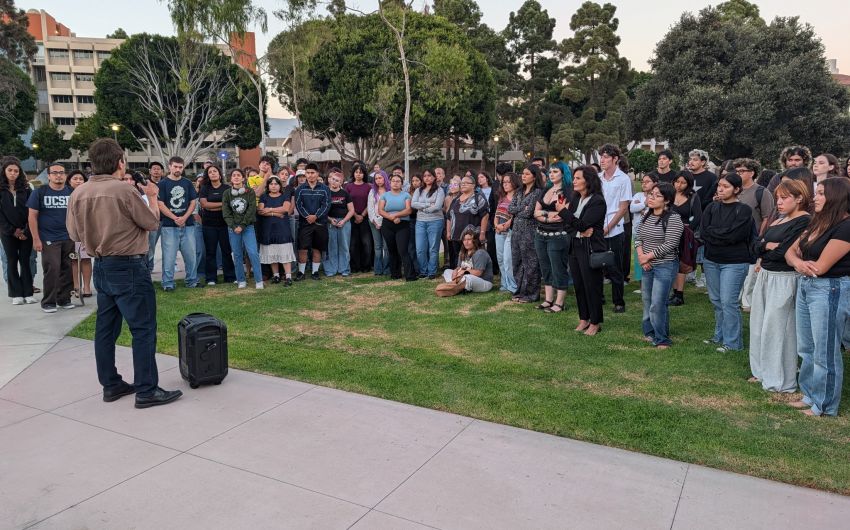
During a school assembly at Washington Elementary on Monday morning, the actual winners of the student government election were announced. This followed the election-cheating scandal that erupted in September after a whistleblower revealed that Principal Arielle Curry had named her child, a runner-up in the contest for class president, as the winner instead of the 6th-grade student who received the most votes.
A text from the Santa Barbara Unified School District sent to school families on Monday stated that “the original election results have been reinstated” and that the student council’s cabinet had been “extended.” The extended cabinet was announced in September, along with the first election results, and included runners-up.
District administrators placed Curry on administrative leave on September 28 after the election-rigging became public. The two-week leave was not a disciplinary action, said the school district’s head of Human Resources, John Becchio. Any disciplinary action that might have occurred would be a personnel matter that could not be disclosed.
In falsifying the election results, Curry had changed the outcome of two positions, one of which was 6th-grade president. The second position was not named. She sent a letter to the campus community on October 8, in which she admitted to “overriding” the results and apologized. She promised to improve the process and returned to her job the next day.
By all accounts, some parents and students are upset by the principal’s actions, questioning what this incident teaches. Others are concerned about the potential for backlash against the school, given the national and international headlines the scandal has generated in this intensely political election year. As one parent said, “It’s disappointing.”
Elections are an important part of life in all schools, Becchio asserted. The experience allows students to be in leadership positions, to plan things, and ultimately to work with school staff. “An election might be a minor thing at the elementary level, but it’s an important part of having ownership of your organization,” Becchio said. “A lot more is at stake as you get older, but it’s still valuable at the elementary level.”