
The Santa Barbara Unified School District is rethinking its response to racist acts, following public outcry over white students at San Marcos High School portraying “blackface” in a social media post last month.
In the post, a group of four white students at San Marcos recreated an AI meme featuring Black children. They artificially darkened their skin to match the children’s skin tone and captioned the post with ninja emojis, which is widely used on social media as a stand-in for the N-word.
The post quickly spread around campus and was not publicly addressed by school administrators until two weeks later.
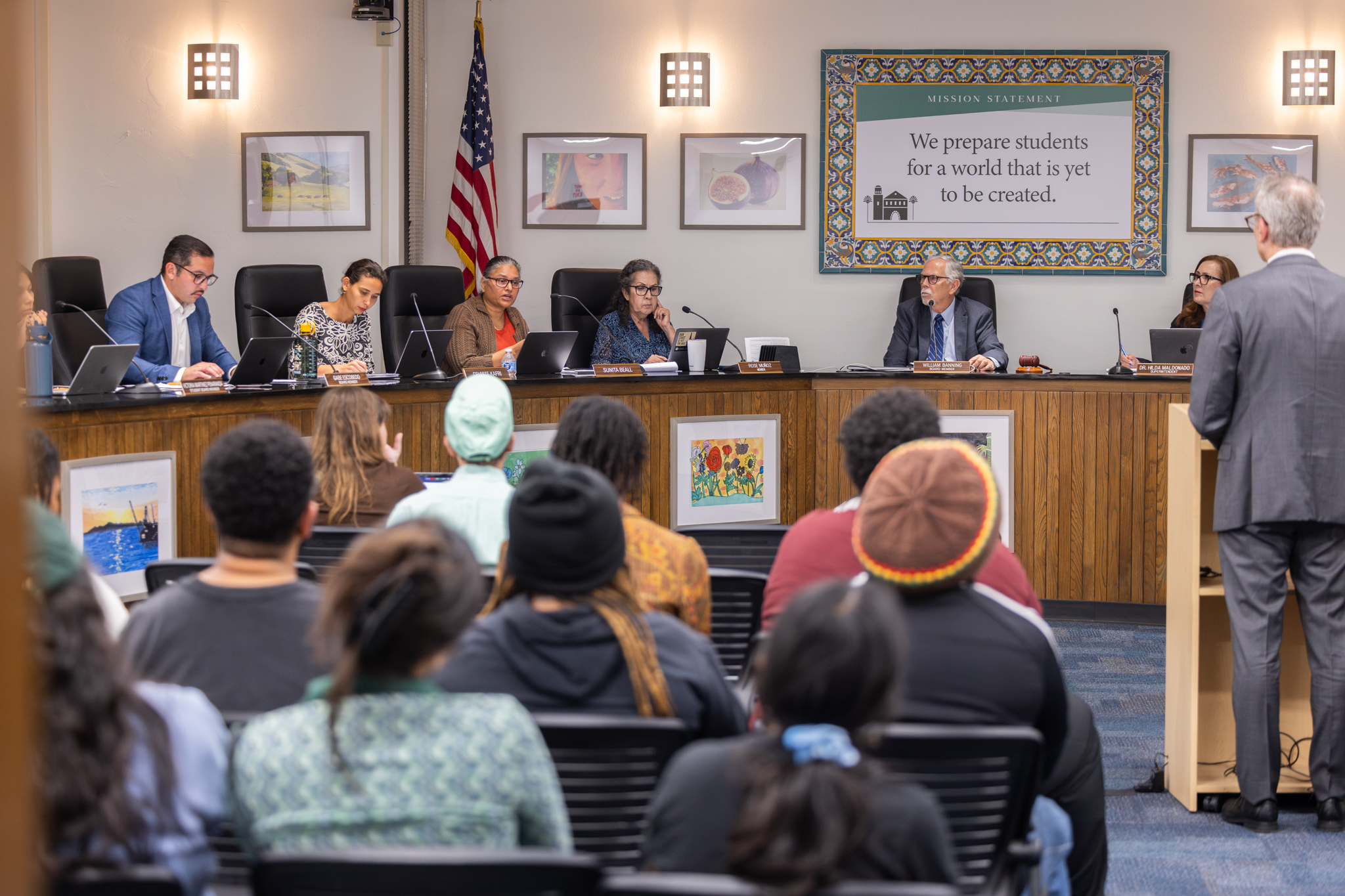
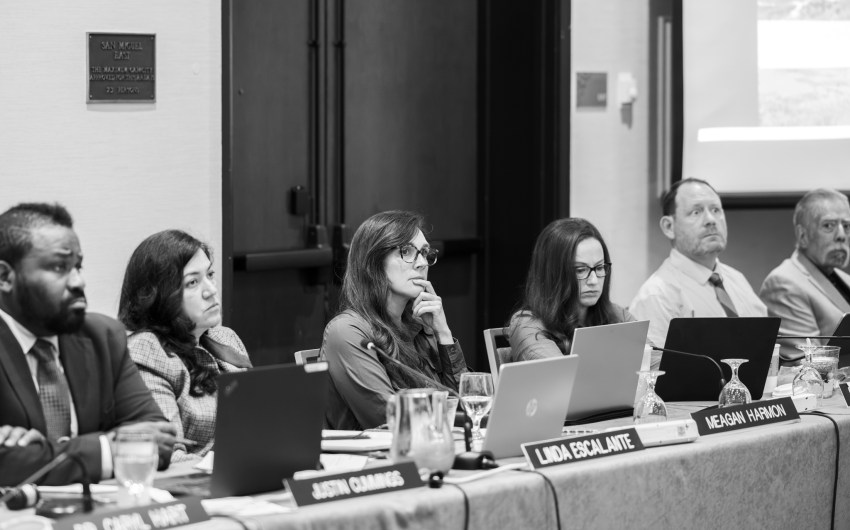
Steve Venz, the district’s chief operating officer, laid out the district’s ongoing and planned actions at the school board meeting on Tuesday. At past meetings, community members have criticized inconsistent responses to racial incidents between schools, a lack of meaningful consequences for offenders, and inadequate communication when racial incidents occur.
In response, the district developed a new racial incident response protocol that every school will follow and updated and clarified its discipline guidelines, or “discipline matrix.”
Venz said the materials were developed and reviewed in coordination with the district’s partners and its Committee Advancing Black Achievement, Wellness, and Excellence (CABAWE).
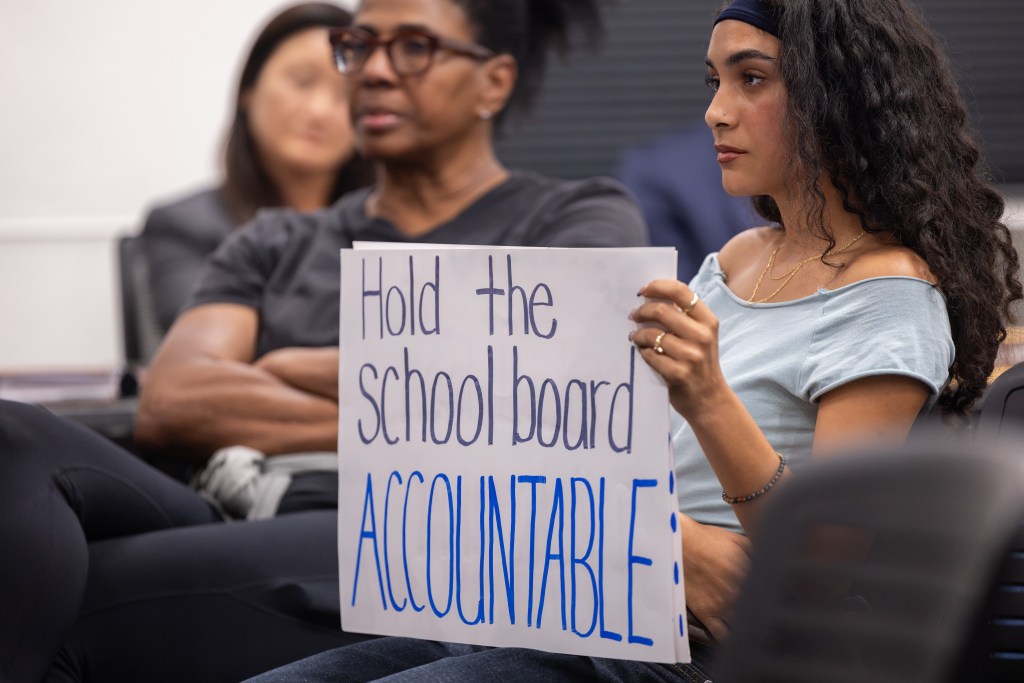
The new response protocol establishes a timeline for responding to racial incidents, involving a “team” of people rather than just one person. It spans initial response and investigation to “repair” work, including continuous support for harmed students and preventing continued racist behavior from offenders.
Venz said it will involve “multiple resources” connected to the district’s partners, such as Healing Justice Santa Barbara, and families. The timeline follows milestones to keep the response on track, from the initial 24 hours to the weeks and months following it.
It also involves a new system, Safe2Speak Up, implemented in August, that sends reports straight to the school’s administration to prevent delays incurred by the previous system, in which reports would first go through the district.
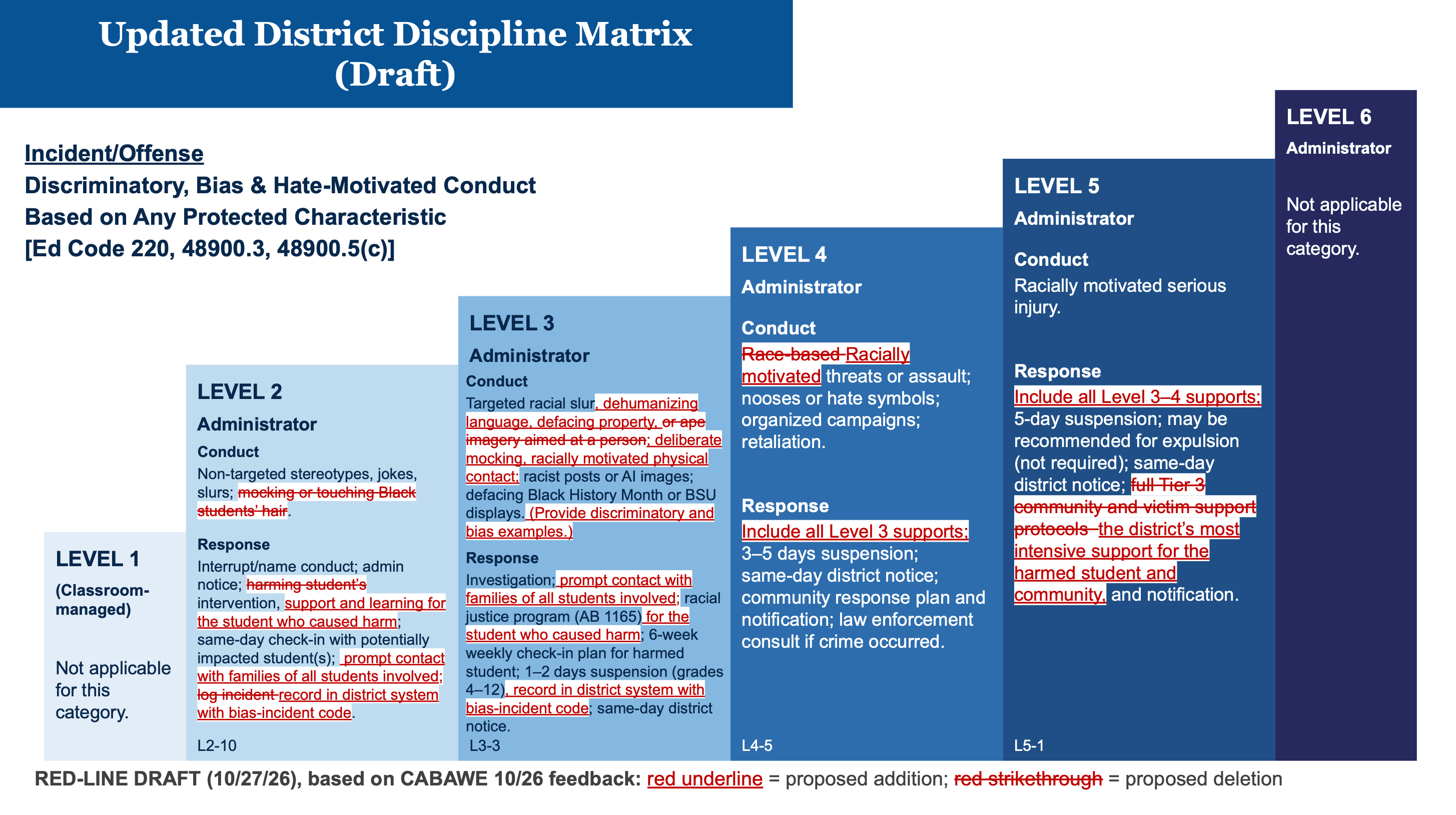
The discipline matrix, created around 2019, outlines a tiered response to racist acts depending on severity. The draft presented on Tuesday incorporated revisions from CABAWE.
It was created to support staff on how to address acts that are discriminatory, biased, or hate-motivated, Venz explained, and communicates specifically to parents what the consequences are, “so there’s no guessing.”
For example, a “level three” offense — such as a targeted racial slur or a racist social media post — would prompt an investigation, immediate contact with involved families, and a mandatory racial justice program and suspension for offenders.
Additionally, he said, the district is strengthening its professional learning for staff to “prevent, interrupt, and repair” racial harm.
“We know that we live in a society where there is always anti-Black actions or bias,” Venz said, “but the point is to educate our staff, educate our students to bring in a more inclusive environment, so it reduces that.”
The district must also notify teachers when harmful incidents occur in their classrooms. The “blackface” photo was reportedly taken in Black studies teacher Abel Gonzalez’s classroom when he was not there, he told the board at its October 13 meeting. Gonzalez did not learn about it until district administrators came to talk to his students, he said.
“What did we learn from what happened at San Marcos?” Venz continued as he went over the new protocols.
The draft protocols and disciplinary actions were sent to Dos Pueblos High School to pilot and will now be implemented districtwide.
Several community activists, parents, and students at Tuesday’s meeting thanked district staff for their efforts but demanded the board do more to create a safe environment for Black students. They noted a lack of financial commitment from the district for the work, as well as a lack of dedicated leadership to monitor implementation.
Dr. Michelle Petty, the parent of an 11-year-old student and a member of CABAWE, said she has not felt confident about sending her child to secondary school in the district. The incidents she hears about are concerning, and “there’s a lot,” she said.
“I do not trust the district with the innocence of my child,” Petty said.
Many speakers said that nothing much has changed, despite promises from the district to address anti-Black incidents dating back to 2020.
“What were you all doing when we began with this in 2020?” asked Leticia Forney Resch, the executive director of Healing Justice. “Nothing has changed since then. Here we are, trying to move the needle, and we still don’t have a financial plan. We cannot address these issues without institutional funding.”
Resch was joined by other Healing Justice staff to ask for funding to provide “office hours” for students at all three high schools to access support during the day. Healing Justice staff visit the high schools often and host events for students and families.
Healing Justice’s budget this year was cut by $5,000, said employee Jazmyn Jackson, leaving only $42 for their recent Black family cookout event, which several school board members attended. She said their contributions are “undervalued until times of crisis.”
“Our time this year has increased as we’ve had to advocate for Black students, including those at San Marcos, and then beg the district after the fact to pay us to correct the harm that you guys caused,” Jackson said. “There is a better way to show that you actually care.”
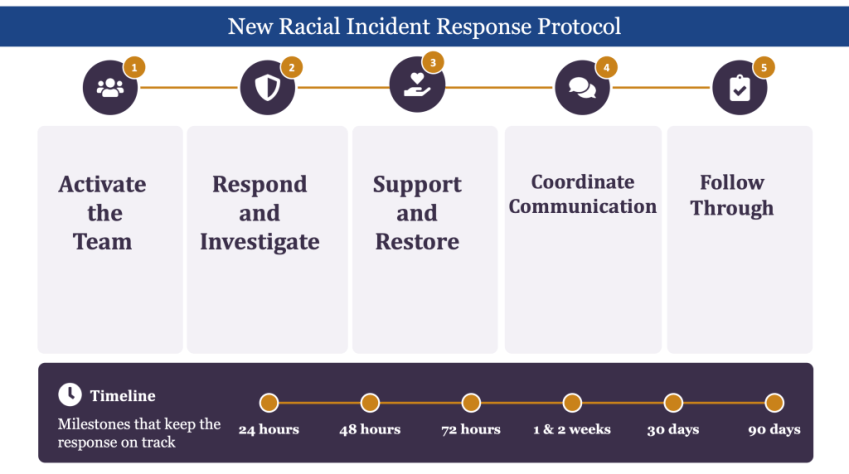
Others asked for expanded ethnic studies curricula districtwide and better investments in the recruitment and retention of Black staff. Santa Barbara High School ethnic studies teacher Miranda Jue said that two-thirds of the schools’ Black Student Unions are advised by non-Black staff.
“The district should feel embarrassed,” she said. “Black and non-Black students alike deserve Black mentors they can look up to.”
According to Venz, certificated staff of color rose from 35 percent of the workforce in 2023 to 38 percent in 2026.
Goleta Valley Junior High ethnic studies teacher Jessie Herdrich said it is time to take anti-racist and culturally responsive curriculum more seriously, and “become leaders in anti-racist education … rather than making headlines with our failures to address racism.”
Teralyn Renea Evans-Gutiérrez told the board to “stop lollygallying.”
“This city in general relies a lot on institutional amnesia — you wait until the cohort leaves so that the momentum stops and then the next cohort comes in and has to start from zero,” she said. “And that’s really inappropriate.”
Nahsia Darcus, president of the Black Student Union at San Marcos, reiterated students’ demands: a zero tolerance policy for use of the N-word and consequences for staff who fail to properly report acts of violence or anti-Black racism, for example.
“These demands are more than a cry for help,” Darcus said. “They are a result of years of neglect in this very racist system that you proudly represent.”
Board members acknowledged that the needle has barely moved since they joined the board, and all seemed interested in changing that. Trustee Gabe Escobedo, who joined in 2023 and will be leaving at the end of the year, expressed his frustration that the work so far has attempted to be “proactive” but has not been “effective.” He punctuated his comments by tapping his hand on the dais: “We find ourselves here time and time again, and we have ducked the true aim, which is systems change.”
He pitched the inclusion of an agenda item at the next board meeting, scheduled for November 17, to consider investing in additional staff support at the elementary and secondary levels and creating a leadership position to oversee the district’s equity and anti-discrimination initiatives. The board approved it unanimously.
“This can’t just be one of many duties that someone has,” Escobedo said. “This can’t be an afterthought, and I feel like in so many ways, this is an afterthought.”
Related Posts



Premier Events

Thu, Oct 29
12:00 PM
Santa Barbara
Spook Fest at Loubud Wines Halloween Experience
Thu, Oct 29
5:30 PM
Santa Barbara
Silent Movies + Live Organ, Trunk or Treat & More

Thu, Oct 29
6:00 PM
Santa Barbara
Halloween Paint & Sip at Goodland Wine Shop

Fri, Oct 30
12:00 AM
Montecito
Día de los Muertos at The Speakeasy
Fri, Oct 30
11:30 AM
Santa Barbara
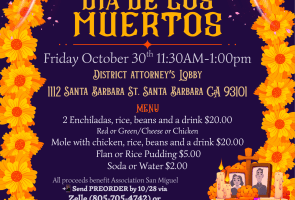
🌼💀 Join us for Día de los Muertos! 💀🌼

Fri, Oct 30
2:00 PM
Santa Barbara
“Sea to Summit “Art Exhibit & Benefit

Fri, Oct 30
3:00 PM
Santa Barbara
Family Movie Night at the Eastside Library: “Coco”

Fri, Oct 30
3:00 PM
Goleta
The Towbes Group presents: MONSTER MASH!

Fri, Oct 30
3:00 PM
Goleta
Halloween Paint Night at SAMsARA
Fri, Oct 30
6:00 PM
Goleta
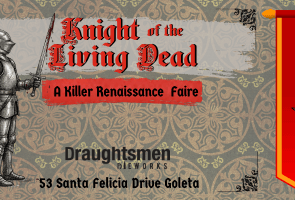
Halloween @Draughtsmen: A KILLER RENAISSANCE FAIRE
Thu, Oct 29 12:00 PM
Santa Barbara
Spook Fest at Loubud Wines Halloween Experience
Thu, Oct 29 5:30 PM
Santa Barbara
Silent Movies + Live Organ, Trunk or Treat & More
Thu, Oct 29 6:00 PM
Santa Barbara
Halloween Paint & Sip at Goodland Wine Shop
Fri, Oct 30 12:00 AM
Montecito
Día de los Muertos at The Speakeasy
Fri, Oct 30 11:30 AM
Santa Barbara
🌼💀 Join us for Día de los Muertos! 💀🌼
Fri, Oct 30 2:00 PM
Santa Barbara
“Sea to Summit “Art Exhibit & Benefit
Fri, Oct 30 3:00 PM
Santa Barbara
Family Movie Night at the Eastside Library: “Coco”
Fri, Oct 30 3:00 PM
Goleta
The Towbes Group presents: MONSTER MASH!
Fri, Oct 30 3:00 PM
Goleta
Halloween Paint Night at SAMsARA
Fri, Oct 30 6:00 PM
Goleta


You must be logged in to post a comment.