

Getting a reliable fix or overview of the region’s artist landscape is slippery business, by the highly subjective and solitary nature of the creative field. To which source do we go to find out? Claude and his AI kin won’t have a trustworthy clue.
One selective sampling is supplied each year around this time, courtesy of the Westmont Ridley-Tree Museum of Art’s annual Tri-Counties Juried Exhibition, the latest edition of which both confirms and expands our understanding of artists sharing the area’s populace.
Going by the handle Altered Realities, the current model has a new juror — Los Angeles–based curator, author, and film producer Andi Campognone — behind the winnowing of 468 entries by 222 artists down to a manageable exhibition size of 56 works, by 50 artists. Relying on the objective observations of a different juror each year, and from outside the tri-counties, gives this call-for-artists tradition a special cachet, and often gives exposure to artists not normally in the established forums of gallery wall space.
As we’ve come to expect, the new show ranges freely across mediums, from two- to three-dimensional work, and a few outliers. More than usual, three-dimensional art is given showcase space — favoring work from off the radar, in various ways, and with conceptual agendas attached.
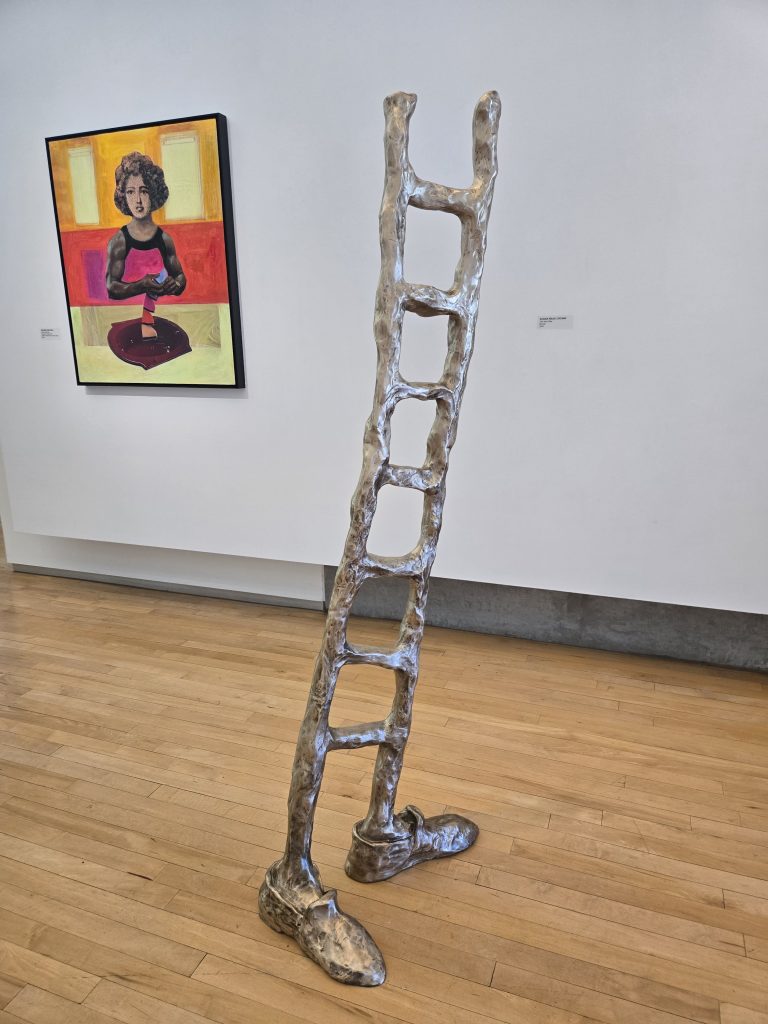
That thread begins in the entryway gallery, with Susan Read Cronin’s “The Next Step,” a tipsy (in fact and in conception) ladder, conjuring echoes of Oldenburg, Giacometti, and a surrealist wink. Across the way, Pecos Pryor continues the mixed messaging, in this case of materials, with his “Porcelain Lemons.”
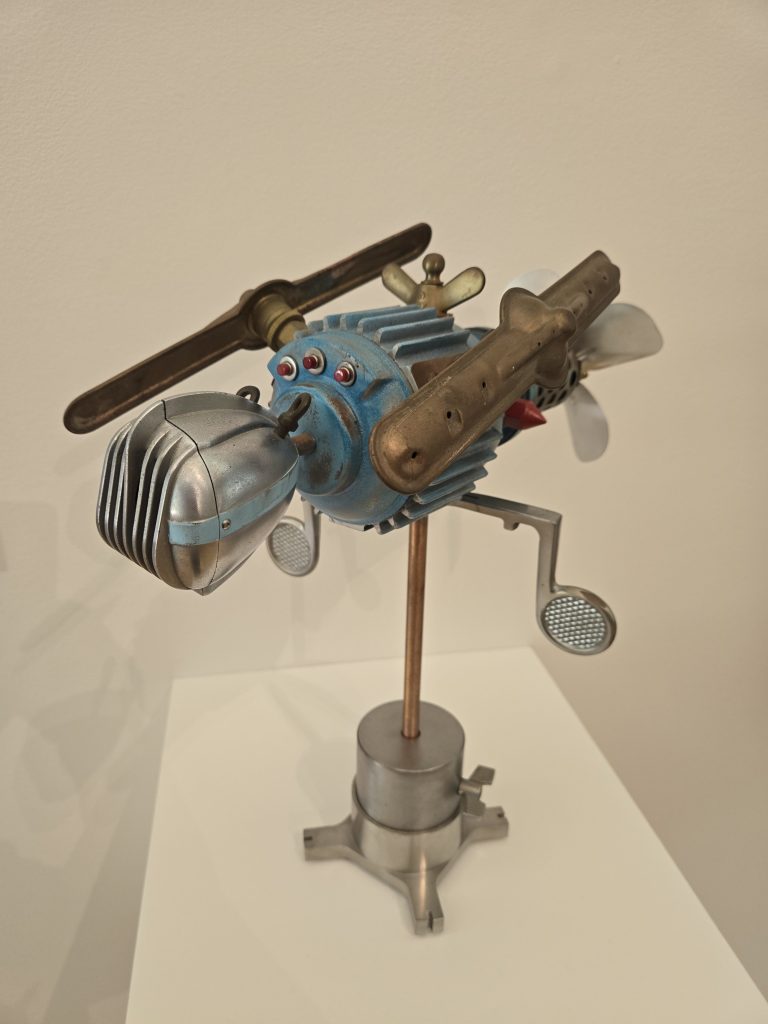
Tal Avitzur’s “Huey” is a cobbled-together “airplane model” made of unexpected parts and non-sequitur art supplies, and Frances Reighley’s assemblage “Woodshop Nest” is an onomatopoeic mix of woodshop tools plus a bird: Tools for the job become part of the job.
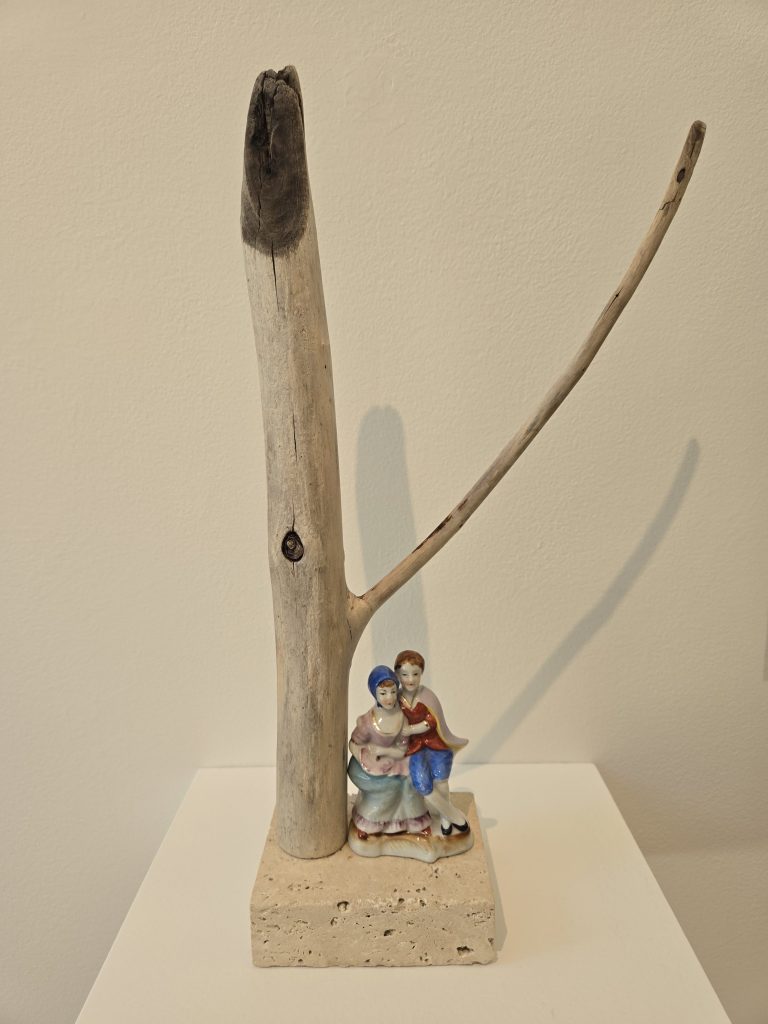

The “title artwork” in the house illustrates the general relevance of the phrase and idea of altered realities. Lisa Howard’s “Altered Reality/Fleeting (Improbable)” is a deceptively simple assemblage proposing an innocent scene in which a fancifully adorned retro couple, in ceramic figurine form, and a spare tree standing in as a nature context evoke nostalgia deconstructed.
More broadly, Campognone seems to base thematic biases toward art that channels and alters realities as we know them, in and out of the art world mind frame. Social and/or political realities are mostly avoided, or touched on indirectly, as in James Van Arsdale’s psychedelic and grassroots-y American flag redux.
More broadly, Campognone seems to base thematic biases toward art that channels and alters realities as we know them, in and out of the art world mind frame. Social and/or political realities are mostly avoided, or touched on indirectly, as in James Van Arsdale’s psychedelic and grassroots-y American flag redux.
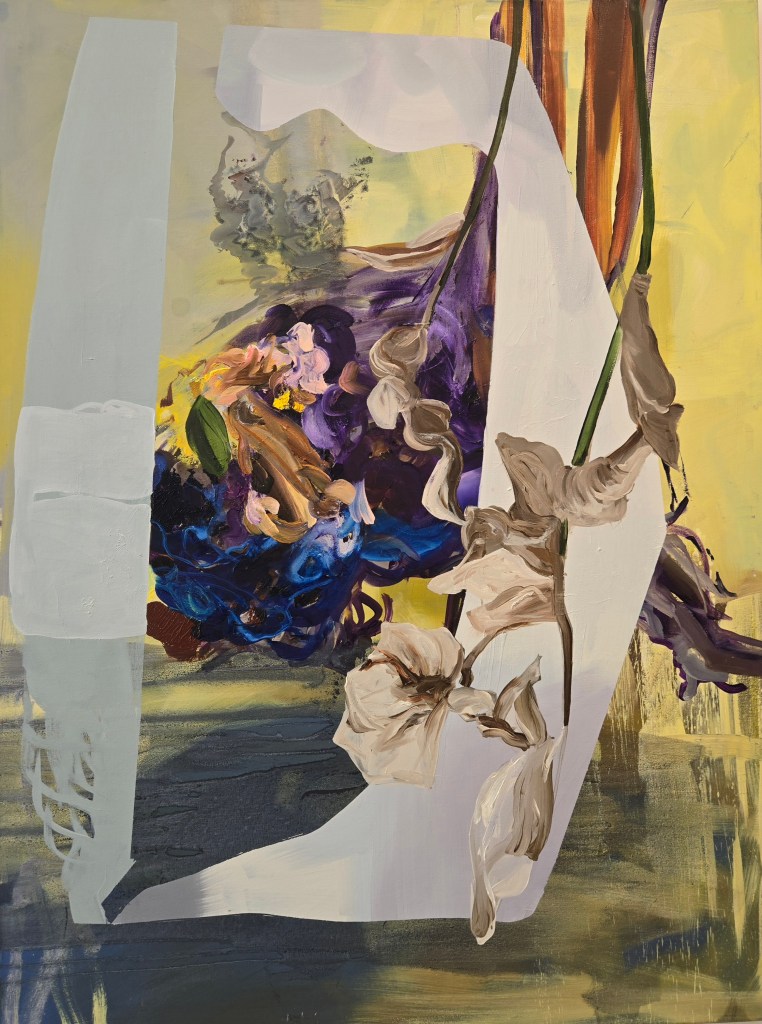
Art attitudes are nicely roughed up and crossbred in some cases, as with a few paintings in which abstraction and nature/floral values interweave. The “Best of Show” blue sticker adorns Nurit Ruckenstein’s “Day in the Life of a Dream #1,” in which brusque, vivid-colored brushstrokes energize the vertical canvas, while more realistic floral details appear in fading gray, as if fueled by dream logic.
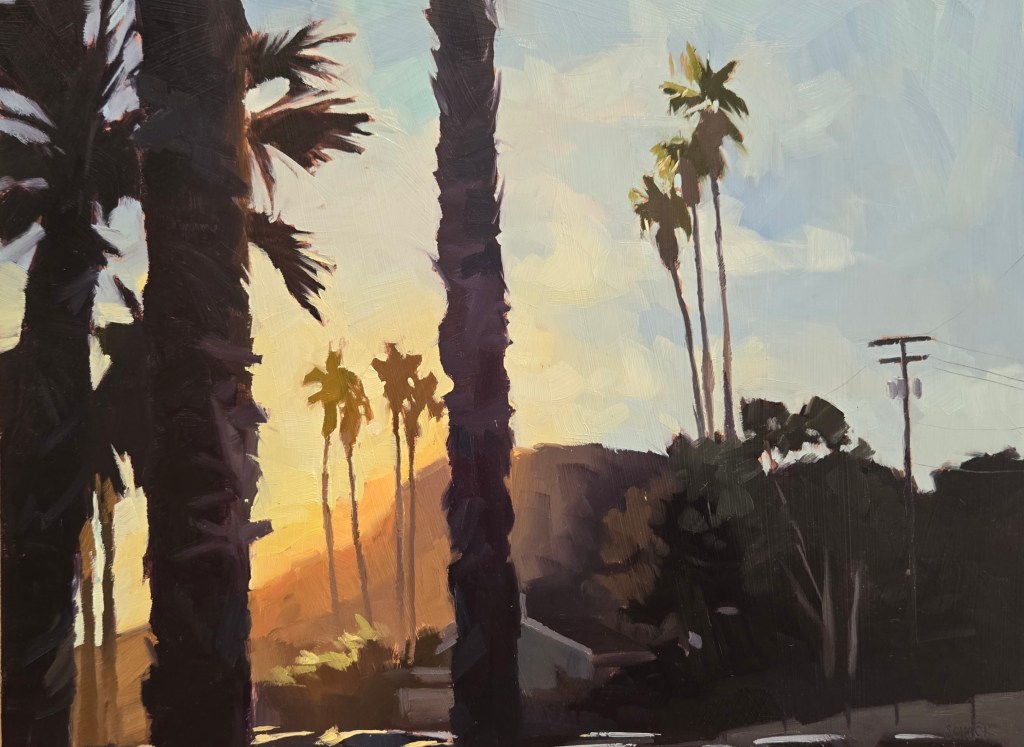
Skeins of floral fragments heave into a chaotic, yet somehow graceful, bouquet pile in Carol Paquet’s “Tangled” and similar abstract-floral hints — now underwater — show up in David Gallup’s “Pentimento – the Octopus’s Lair.” Sharon Schock’s “Haloed Giants” offers a refreshing variation on the landscape art theme, in which the subjects in the “spotlight,” familiar palm trees near Leadbetter Beach, are in fact in shadow, silhouetted.
Nature and reality are cannily cropped at times, as in Marjorie Shipp’s “Surf and Sky,” an almost gray square space with hints of the subjects in the title. Finding transient beauty in the everyday is the operating principle, as well, in Cynthia Stahl’s “Pink Fire Retardant, Gray Smoke,” with a pink-plumed form like a feather boa, flecking the indifferent sky. One of the photographs in the show, Laura Mullen’s “Bench,” finds its artful essence in the vision of a commonplace park bench wrapped in a translucent green tarp, symmetrically placed in the composition.
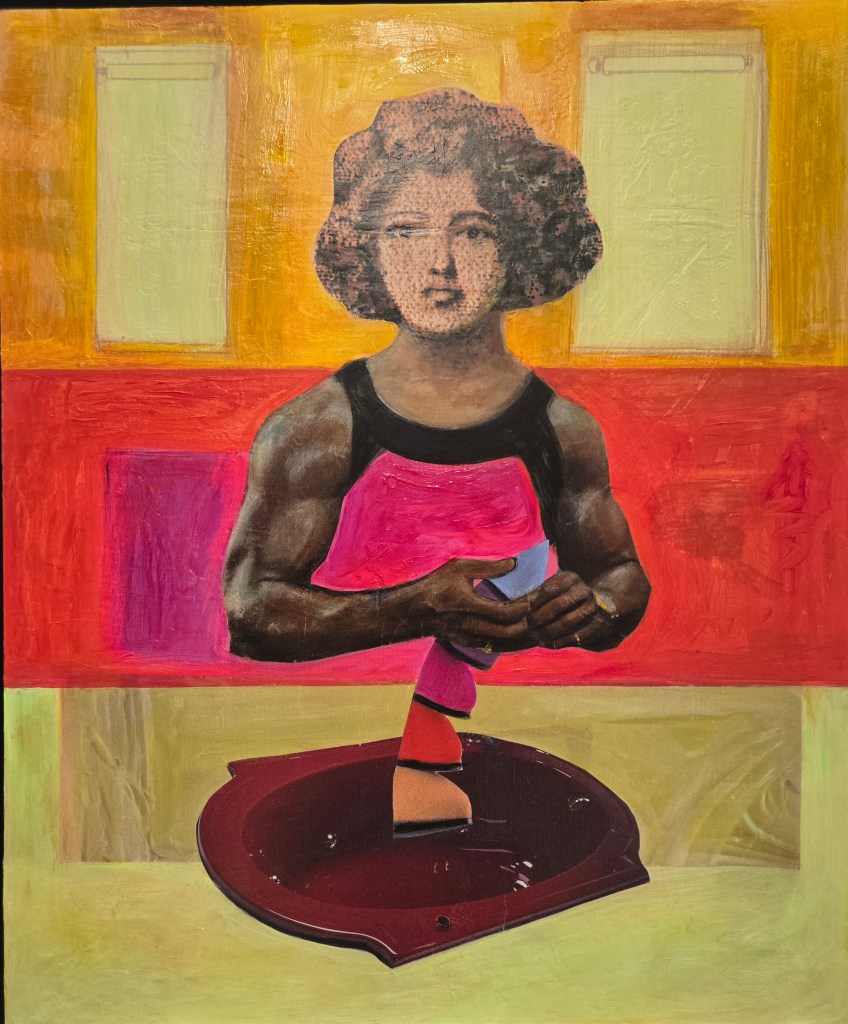
Off to the side of stock media, the intriguing entries include one of Jeanne Dentzel’s unique painted collage works, in a witty mash-up style. “Public Bathroom” basks in a friendly brand of surrealist approach, with its woman’s head fused with a muscular male torso, and rainbow-colored toilet paper reacting with the abstract patchwork “wallpaper” in the dream scenario.
Jeff Harris also eludes easy categorization, in the best way, with his humble but alluring “Little urban achievers,” said achievers being delicately watercolored poppy blossoms painted on the quotidian surface of cardboard. It gets my vote as “Wallflower Charmer of Show.”
And there we have it, another slice of artistic life in our tri-counties, as presented by an outsider in the know. According to her own sensibilities. We’ll never know what art was passed over and how our own senses would have responded — or not. Therein lies the innate limitation and fragile beauty of art appreciation.
Altered Realities Tri-County Juried Exhibition is on view at Westmont Ridley-Tree Museum (955 La Paz Rd.) through June 20. See westmont.edu/museum/juriedshow2022.
Related Posts
Premier Events
Wed, Oct 14
5:30 PM
Santa Barbara
Jodi House “Paint the Town Blue” Benefit for Brain Injury Awareness
Wed, Sep 30
12:00 PM
Santa Barbara
Origins of Fashion in France: Zoom Lunch & Learn
Wed, Sep 30
5:30 PM
Santa Barbara
S.B. Independent: Santa Barbara City Mayoral Forum
Thu, Oct 01
11:00 AM
Santa Barbara
In Studio: Julie Anderson Mathias

Thu, Oct 01
7:30 PM
Santa Barbara
Robert Plant with Saving Grace and Suzi Dian

Fri, Oct 02
5:30 PM
Santa Barbara
Pet Blessing at Trinity Episcopal Church
Fri, Oct 02
8:00 PM
Santa Ynez
Comedian Ron White Performs at Chumash Casino Resort
Sat, Oct 03
9:00 AM
Goleta
Out of the Darkness Suicide Awareness Walk
Sat, Oct 03
10:00 AM
Santa Ynez
Chumash Intertribal Powwow Returns
Sat, Oct 03
10:00 AM
54th Santa Barbara Old -Time Fiddlers’ Festival

Sat, Oct 03
11:00 AM
Santa Barbara
OktoBEERfest at Dutch Garden Restaurant!
Wed, Oct 14 5:30 PM
Santa Barbara
Jodi House “Paint the Town Blue” Benefit for Brain Injury Awareness
Wed, Sep 30 12:00 PM
Santa Barbara
Origins of Fashion in France: Zoom Lunch & Learn
Wed, Sep 30 5:30 PM
Santa Barbara
S.B. Independent: Santa Barbara City Mayoral Forum
Thu, Oct 01 11:00 AM
Santa Barbara
In Studio: Julie Anderson Mathias
Thu, Oct 01 7:30 PM
Santa Barbara
Robert Plant with Saving Grace and Suzi Dian
Fri, Oct 02 5:30 PM
Santa Barbara
Pet Blessing at Trinity Episcopal Church
Fri, Oct 02 8:00 PM
Santa Ynez
Comedian Ron White Performs at Chumash Casino Resort
Sat, Oct 03 9:00 AM
Goleta
Out of the Darkness Suicide Awareness Walk
Sat, Oct 03 10:00 AM
Santa Ynez
Chumash Intertribal Powwow Returns
Sat, Oct 03 10:00 AM
54th Santa Barbara Old -Time Fiddlers’ Festival
Sat, Oct 03 11:00 AM
Santa Barbara



You must be logged in to post a comment.