[The One-hearted] are the warriors of hope, navigating
oceans and crossing continents.
Their message is simple: Now
is the time for peace. It always has been.
-from “The Doves Flew High,” by David Krieger
December’s darkness leads us inward. We light candles and turn our thoughts to peace, taking a small break from all the chaos. Almost everyone becomes a poet, reaching out to others with words. “Poetry is an act of peace,” wrote Pablo Neruda, a statement David Krieger quotes in his preface to The Poetry of Peace (Capra Press, 2003), a collection of the winning poems from the first seven years of the Barbara Mandigo Kelly Peace Poetry Awards, sponsored by the Nuclear Age Peace Foundation of Santa Barbara. Krieger, president of the foundation, continues, “Peace and poetry meet and interact in mysterious and surprising ways : and inspire us to action.” I like to think that a poet’s words turn some minds around, give comfort and company to those who grieve, and give voice to the unheard.
So many poems have been written throughout history for peace and against the atrocities of war, you’d think by now we would have listened. Award-winning Fresno poet Brian Turner, an Iraq War veteran, writes, “it should break your heart to kill / It should never be so easy as this” in his book, Here, Bullet (Alice James Books, 2005). Santa Barbara poets Bob Potter, J. Cruickshank Muir, and David Krieger’s thoughts follow in the same vein, evident at the November Veteran’s Day Poetry Zone reading held at the Karpeles Manuscript Library.
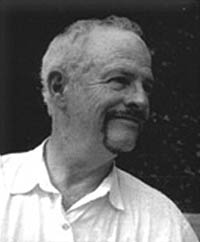
Potter joined the Army Reserves in 1957 during the Cold War “peacetime army.” “But all the same,” he writes in his collection, Poems in Transit 1957-2004 (Solstice Press, 2004), “being trained to kill people proved to be quite an enlightening experience.” A retired professor of dramatic art and playwriting at UCSB, Potter is the vice president of the Santa Barbara chapter of Veterans for Peace and one of the founders of Arlington West, a project that has erected crosses on the beach beside Stearns Wharf every Sunday since November 2003. When American casualties in the Iraq War reached 3,000, he wrote a poem, “Three Thousand Deaths,” which, in part, reads:
If there were three thousand deaths here
Instead of these chaste memorial place markers,
Three thousand rotted blood-soaked dismembered corpses
Of former American boys and girls from the small towns and barrios :
Strewn chaotically, catastrophically across an invasion beach
Of reality, crashed in our midst in a terrible tsunami
Flooding the beaches and the streets, dashed
Across our suburban lawns :
Something would have to be done about it.
But as it is, the crosses and the grizzled veterans
Who tend them like a flowered garden of regret
Are the matter of a brief moment
For onlookers with other destinations,
And the ignorant carnage grinds on,
Eleven time zones away, receding
Into the forgetful future of a careless empire.
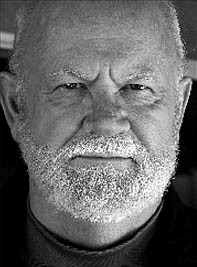
J. Cruickshank Muir is a decorated, disabled Marine Corps combat veteran of the Vietnam War. Poet, essayist, and educator, he has been active in veterans’ concerns for more than 30 years. He read from his recently published book, Tigers and Songbirds (The Muir Studio, 2007), which includes his years in Vietnam. He describes the “nightmare” of a vet returning to a society that “has no rituals for reintegrating its weary, wounded warriors.” His poems sting with truth and humor, and the ordeal of finding yourself, if you survive. In the poem “Small Minds,” Muir sums up in a few profound words one of the saddest effects of war for veterans:
Back from the precipice
I am afraid of eyes filled with
fear
the fear that kills
the very yearning
to look up and dream
As the year draws to an end, let’s remember that-to dream-and as Pablo Neruda encourages in “Keeping Quiet,” “let’s stop for a second, and not move our arms so much.”
4•1•1
For more information on the Nuclear Age Peace Foundation’s annual peace poetry contest, check out wagingpeace.org. For more information on J. Cruickshank Muir, visit muirstudio.com. For more on Bob Potter, check out bobpotter.org. For more on David Krieger, visit artamo.com.