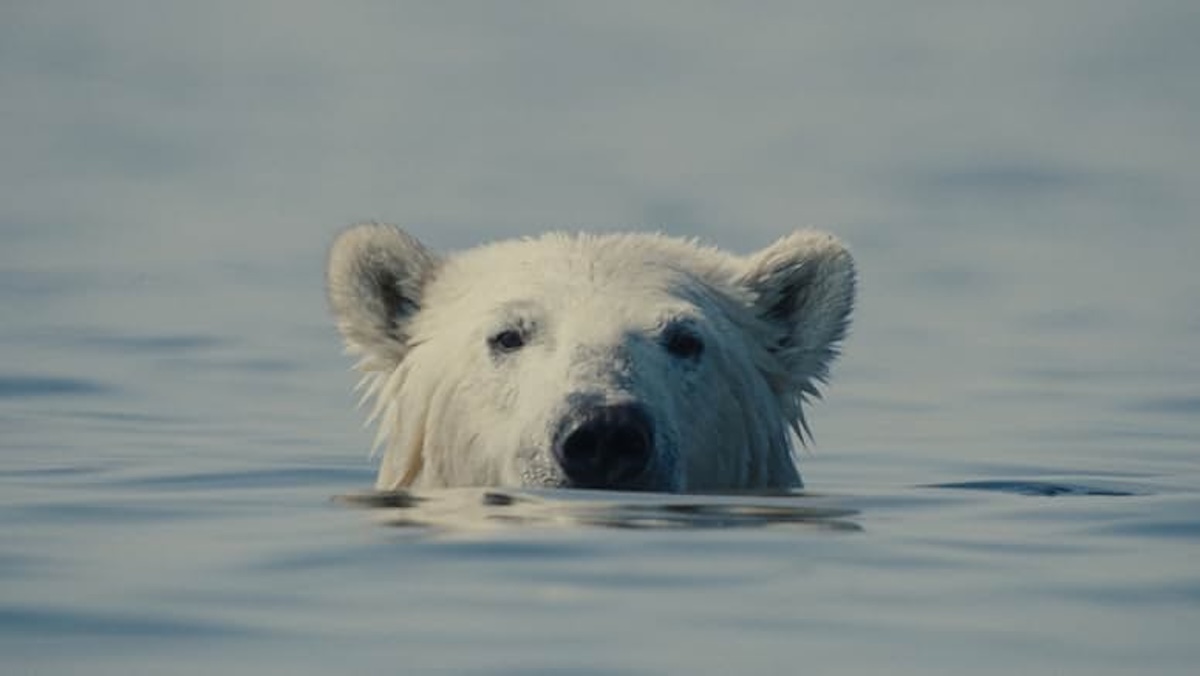
It may be fitting, ironically, that one of the keynote films of this weekend’s Wild and Free Film Festival is the superb documentary Nuisance Bear, which is about animals that are anything but wild and free. More specifically, the film chronicles the struggles and barriers of its animal subject, polar bears, braving the fragile border between civilization and their natural habitat.
On at least some levels, the film is a story of a habitat of inhumanity, with the elephant-in-the-room subject of climate change being only part of the larger story.
Much of the action and interspecies friction occurs in the town of Churchill, Manitoba, whose unofficial motto, “polar bear capital of the world,” draws busloads of tourists. They come bearing zoom-lens-equipped cameras and a hunger for sightings of these mythic white animals, as we see in the film’s opening sequence. But as a stage setting for the film’s deeper sympathies, the literal opening is a close-up of a peacefully nuzzling polar bear family, unaware of the human gawkers at a distance.
Directors Gabriela Osio Vanden and Jack Weisman, a married couple, expanded an earlier short doc from 2016 to create what has been greeted with deserved kudos, including the Grand Jury Prize for Documentary (U.S. Documentary Competition) at this year’s Sundance Film Festival and the 2026 Werner Herzog Film Award for its “groundbreaking approach.” (Herzog should approve, as one whose filmic curiosity has often taken him to ends of the earth, and who dealt directly with bear life in Grizzly Man).
The film maintains a sympathetic, even empathetic focus on the bear’s life, sometimes adopting a bear’s-eye perspective. In one sequence, we follow the trail of a bear who is identified rummaging around a warehouse, following the scent of food, and is shot with a tranquilizer dart. After falling unconscious in the underbrush, we see presumed dream images of his underwater life, and follow as the bear is relocated — suspended in a net carrier by helicopter — back to a wilderness area.
In a montage sequence, we catch slices of a modern bear’s life — dreamy underwater shots of him swimming, at rest on land, grabbing at a hunk of fresh-killed meat, being caught in a trap. The filmmakers have unusually intimate footage of bears in many of their different states and wanderings, while also documenting the human element of the story, from the Inuit native life to tour busloads of bear-watchers, kids being trained by someone from the “Polar Bear Alert Team,” and a critical sidebar subplot — the subjugation and radical lifestyle upheaval of indigenous people with the arrival of whites.
An important storyteller in the film, and a historian with a deep lived-in connection to the place, the Inuit elder Mike Tunalaaq Gibbons (who died in 2025, before seeing himself in the film) gives important context to the situation on the ground, and over a generation.
“Stories are like mazes,” he says. “They take us where we least expect.” (Could that be a motto for this film?)
“For generations, we lived in a world where we kept our distance from each other. That world no longer exists,” he says, referring to the fragile “wildland–urban interface (WUI)” condition in which bears overcome their fear and follow their noses to the realm of human food and culture in Churchill and Arviat, Nunavut. Bears out of the wild are deemed “nuisance bears,” tagged for relocation and, for some natives, liquidation at the end of a rifle.
The elder adds that “it’s also a boundary in time. The land used to be so quiet. We could hear the machines clanking over the horizon. The bear is a visitor from the past, navigating the maze of the present.”
“I grew up on the land. There were only Inuit here. Outsiders came in, and we had to change our way of life. We were told life would be easier if we stayed in one place and followed their rules. Back then, the bears stayed in their place. But not anymore.” Added poignancy arrives later in the film, when we learn that a confused and displaced bear killed his own son, an act he now forgives, but relates to the systemic problem of white incursions in the area.
Climate change alarm — a subject often reflexively tied to the fate and state of polar bears — remains an unstated issue in this well-made, visually captivating documentary. Instead, it focuses on the precarious link between humanity and wildlife of a very specific, majestic and, when threatened, potentially ferocious kind.
Nuisance Bear screens on Saturday, November 7 at 5 p.m. at Camino Real Cinemas as part of the Wild and Free Film Festival. See wildandfreefilm.org/tickets-1 for details.
For more information on the Wild and Free Film Festival, see wildandfreefilm.org.