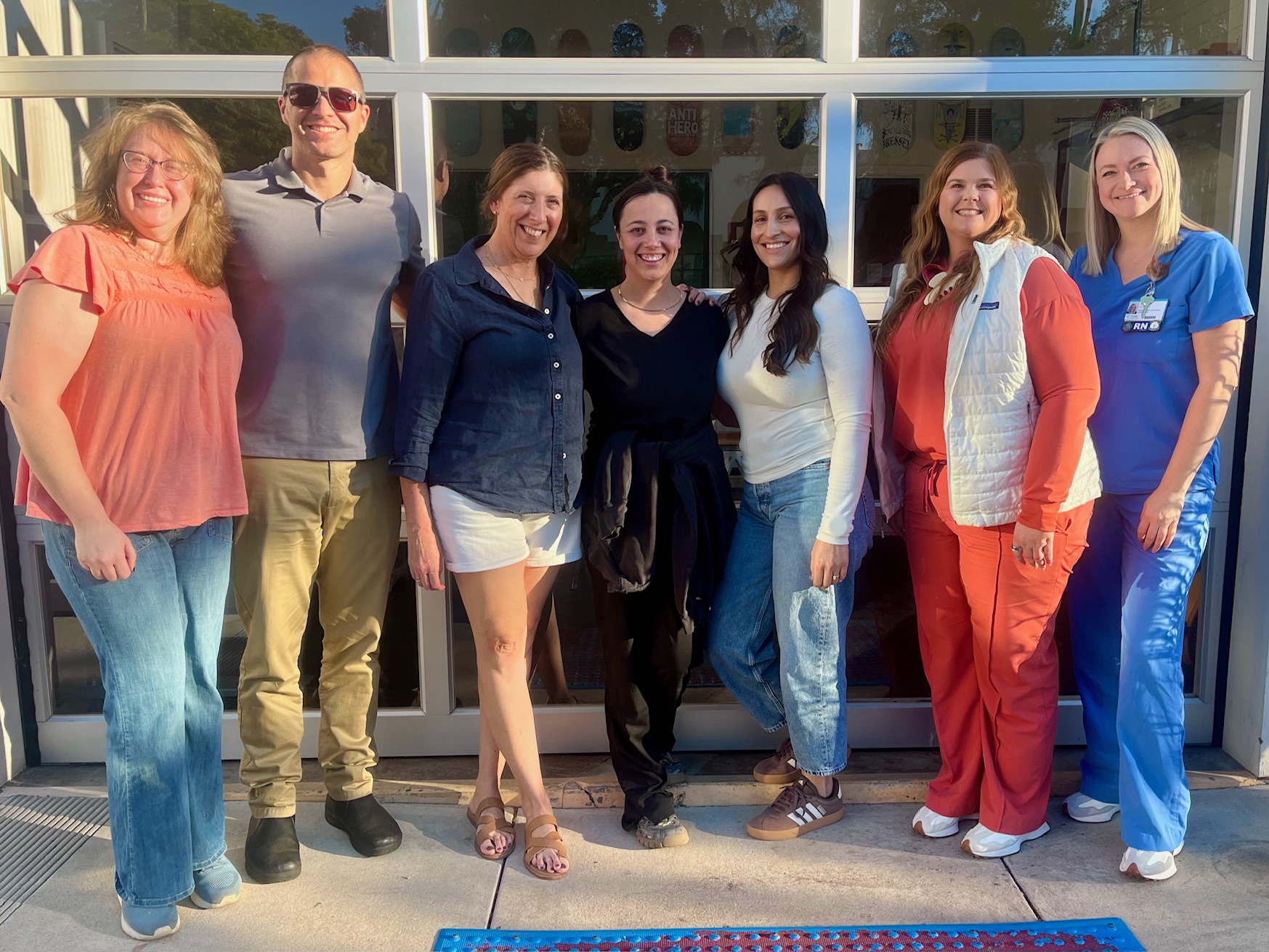
Seven Cottage Hospital nurses sit around a table, a couple of them fresh off their shifts and still in their scrubs. They work in different departments, span several generations, and have been in their jobs between eight and 30 years. They sip coffee and chat like old friends, but when the conversation turns to an upcoming union vote, the banter quickly gives way to why they’re voting no.
For the past year, a separate contingent of Cottage nurses has been leading the charge to join SEIU 121RN, a union that represents healthcare workers throughout Southern California. Voting is scheduled for December 8 and 9, and if a majority say yes, the bargaining unit would cover roughly 1,300 registered nurses at Cottage’s Santa Barbara, Goleta, and Rehabilitation hospitals.
Those organizing the drive are calling for better staffing, more transparency around pay and raises, and a stronger voice in decisions about patient care. They’ve painted Cottage administration as distant and impersonal, preoccupied with the bottom line and not in tune with the needs of frontline workers.
But the group of seven, along with others who oppose SEIU entering the fold, describe a very different working environment and hospital, one that cares deeply about its employees and their well-being. They say managers are not only accessible but compassionate. Benefits have helped them buy homes and go back to school. And they worry a new union contract could compromise the close relationships and flexibility they’ve come to rely on.
“I’m not exaggerating when we say we love where we work,” said Kerry MacIntosh, a charge nurse in the emergency department with three decades of experience. She was also just selected by her peers as Cottage’s 2026 Nurse of the Year. “They care about us, from top to bottom. And they pour a lot into us so we can give the best care to our patients.”
Sarah Gray, a surgical ICU nurse with the hospital for 17 years, noted how some of the nurses leading the union drive have spent less time at Cottage, or worked at fewer hospitals, than those sitting around the table. They may lack the perspective, she said, to appreciate how well Cottage treats its staff and what makes it such a desirable place to work. “I think the tenure here speaks to that,” she said.
Alexis Alcantar grew up in a family of nurses in Santa Barbara and went to Santa Barbara City College before taking her first nursing job in Ventura County. How did it compare with Cottage? “It’s really night and day. Night and day,” she said, adding that there’s a reason so many traveling nurses come to Santa Barbara and want to stay.
Cottage helped Alcantar buy a home in Ventura, and she still chooses to make the commute. The hospital’s tuition reimbursement and scholarships covered most of the cost of her bachelor’s and master’s degrees, and her employee recognition points helped with one more purchase: “I bought a brand-new vacuum for my brand-new house,” she said.
Rachel Meyers started at Cottage as a telephone operator and her husband as a patient care tech. They went to nursing school on loans from Cottage and repaid them by working at the hospital. “We were supported the whole time,” said Meyers, now an ICU nurse. She’s used Cottage’s pet insurance several times and said a newer benefit helps colleagues who travel to Guatemala each year to perform surgeries for patients with limited access to care.
Those benefits help explain why Alcantar wants to stick with Cottage. What she’s heard from nurses at Los Robles Regional Medical Center in Thousand Oaks makes her wary of joining SEIU 121RN. Colleagues who work at both hospitals told her Los Robles nurses were considering a strike during contract talks. She worries Cottage nurses could face the same choice and lose wages if they walk out. “When I’m hearing that from someone who I trust, who is like, ‘Do not let this happen to you,’ that scares me,” Alcantar said.
With respect to union organizers’ complaints over wages, the nurses acknowledged that everyone would like to get paid more. But they said their compensation is already competitive with other hospitals in the region. Their annual raises have averaged about 6 percent a year over the past five years, they said, and they can earn even bigger pay bumps by leading a project or serving on a committee. Bonuses are also available for professional certifications.
Union supporters have pointed to the gap between nurses’ wages and what Cottage pays its CEO. MacIntosh sees that as an apples-to-oranges comparison. “They’re totally different careers,” she said, pointing to what other hospital systems pay their executives. Sutter Health’s CEO, for example, took home $11 million in 2024. MacIntosh said the gap reflects a much broader issue with how executives are paid. “That’s a fundamental problem in America,” she said, “not just Santa Barbara.”
As the vote approaches, the nurses said the campaign has become a distraction at work and strained relationships among colleagues. Still, they acknowledge there is room for improvement at Cottage. The hospital could pay more for nights and weekends, they said, and units could use more backup when they run short.
Chelsea Ruggiero wants nurses across Cottage to feel heard, whichever way they vote. She takes her colleagues’ concerns about staffing seriously. “I want them to feel heard and be able to help change the things that need changing,” she said.
To that end, Ruggiero is proposing that Cottage create a Frontline Nurse Advisory Council, where nurses from each unit would choose a representative to meet quarterly with the CEO and chief nursing officer to discuss issues and hammer out solutions. If leaders turn down a request, she wants a reason in writing. If they agree to a change, she wants a timeline and a chance to follow up.
Ruggiero sees the council as a way for nurses to keep working together after the vote, just as they do when a shift gets busy and someone needs a hand. “I think we have more power than they think we have,” she said. And no matter what, she said, the job still comes down to “taking care of your patients and your community and supporting each other.”
Related Posts








Premier Events

Fri, Nov 27
9:00 AM
Solvang
Solvang Julefest 2026

Tue, Dec 01
All day
Montecito
Culinary Christmas at Rosewood Miramar Beach

Wed, Dec 02
3:00 PM
Solvang
Solvang Julefest Nighttime “Makers Markets”

Wed, Dec 02
6:00 PM
Santa Barbara
Holiday Bingo to Benefit the Friendship Center

Wed, Dec 02
7:00 PM
Ventura
Rubicon Theatre Company Presents “Dickens’ A Christmas Carol: A Ghost Story”

Wed, Dec 02
7:30 PM
Santa Barbara
Ensemble Theatre Company Presents “RENT”

Thu, Dec 03
3:00 PM
Santa Barbara
MORE Theater/SB presents “Madame Ebeneza’s Holiday Inn”

Fri, Dec 04
10:00 AM
Santa Barbara
8th Annual Elks Lodge Holiday Bazaar & Bake Sale

Fri, Dec 04
7:00 PM
Carpinteria
The Alcazar Theatre: “A Christmas Carol”

Sat, Dec 05
6:00 PM
Goleta
Annual Old Town Goleta Holiday Parade
Fri, Nov 27 9:00 AM
Solvang
Solvang Julefest 2026
Tue, Dec 01 All day
Montecito
Culinary Christmas at Rosewood Miramar Beach
Wed, Dec 02 3:00 PM
Solvang
Solvang Julefest Nighttime “Makers Markets”
Wed, Dec 02 6:00 PM
Santa Barbara
Holiday Bingo to Benefit the Friendship Center
Wed, Dec 02 7:00 PM
Ventura
Rubicon Theatre Company Presents “Dickens’ A Christmas Carol: A Ghost Story”
Wed, Dec 02 7:30 PM
Santa Barbara
Ensemble Theatre Company Presents “RENT”
Thu, Dec 03 3:00 PM
Santa Barbara
MORE Theater/SB presents “Madame Ebeneza’s Holiday Inn”
Fri, Dec 04 10:00 AM
Santa Barbara
8th Annual Elks Lodge Holiday Bazaar & Bake Sale
Fri, Dec 04 7:00 PM
Carpinteria
The Alcazar Theatre: “A Christmas Carol”
Sat, Dec 05 6:00 PM
Goleta