

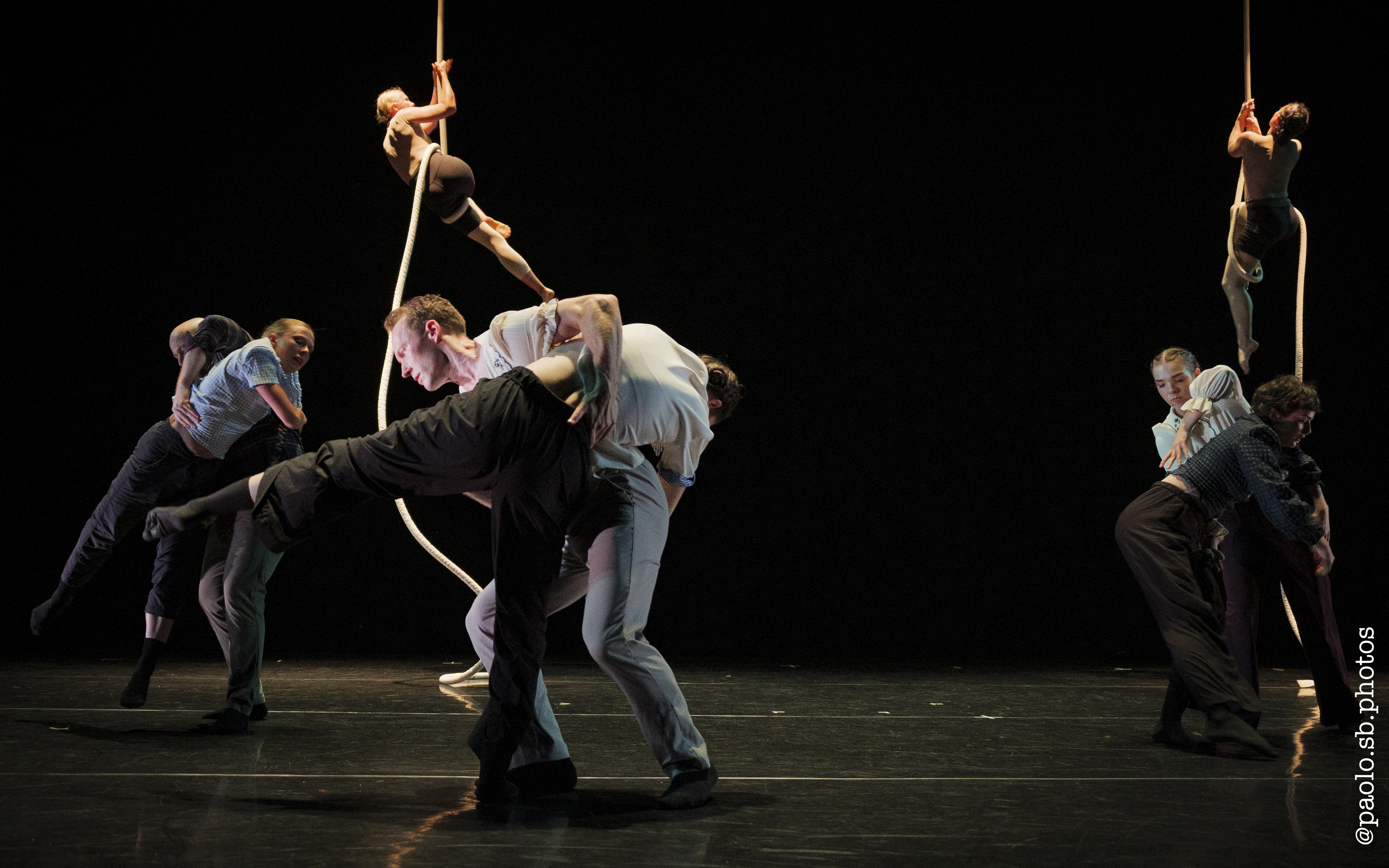
In The Stranger, choreographer Meredith Ventura explores what it means to be an outcast, to be alone in a crowd, to dance invisibly within a social space. In Beethoven’s Tango, choreographer Fernanda Ghi explores the inner world of the creative genius. Poignantly dramatic, each piece — performed September 11 at the Lobero Theatre — explored difficult aspects of what it means to be human; each was performed with exquisite music and impeccable musicality. Both pieces were fascinating, at times disturbing, at times darkly humorous, but ultimately hopeful.
The Stranger

The dancers of Selah and Novus have achieved a new level of excellence with The Stranger, executing Ventura’s difficult choreography with the precision demanded by the Bach music.
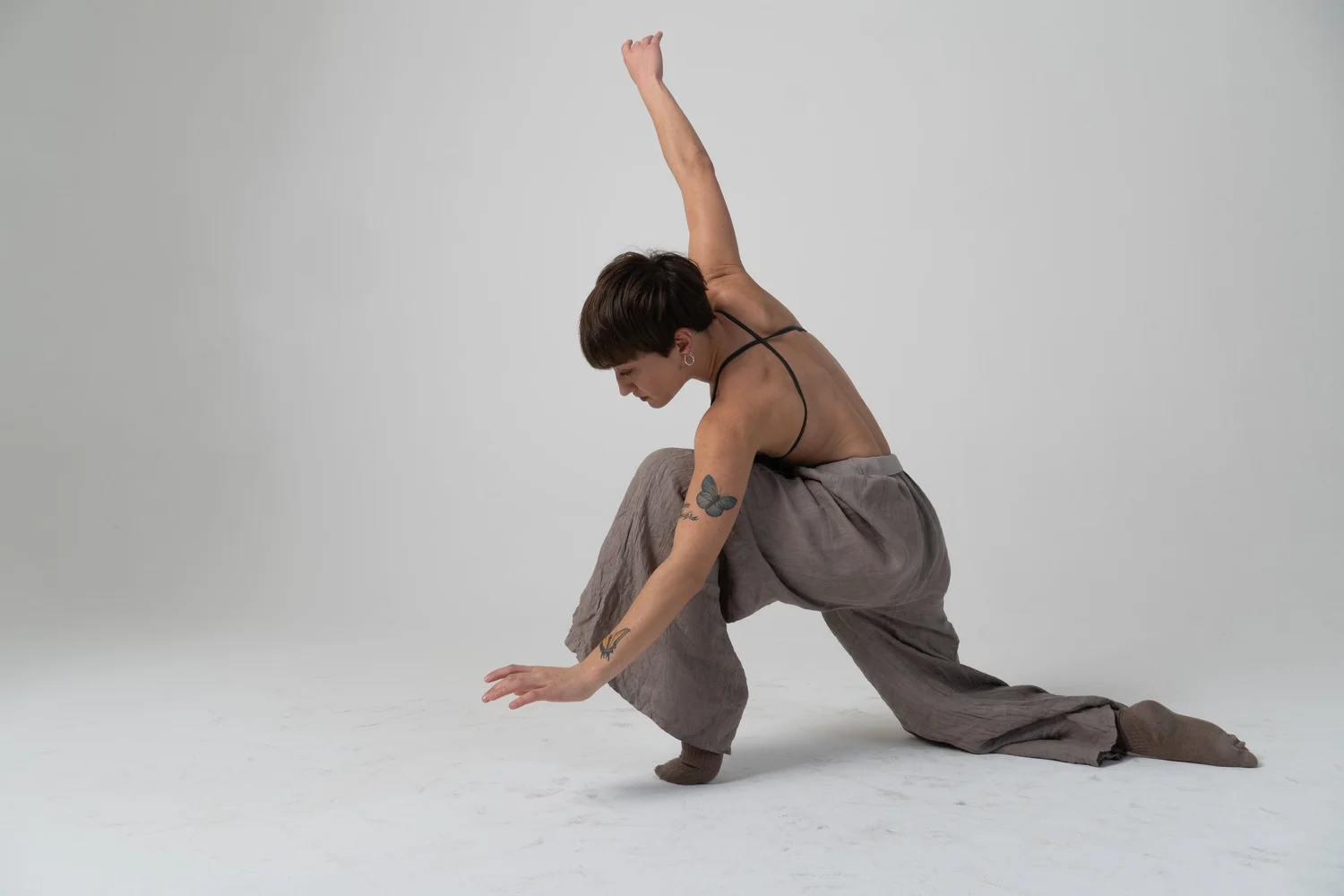
Lifts are one of Ventura’s “Seriously WOW” features. Gender-neutral lifts, in rolling-ocean-waves motion, make the liftees appear weightless. Watching the dancers is endlessly fascinating. Swirling, turning, extending, falling, rising — each movement starts with a distinct impulse from their centers, stirring up vortices of energy in the airspace, creating the illusion of weightlessness.
Ventura is a master of illusion. Her iconic dance lexicon is shaping the landscape of 21st-century dance-theater.
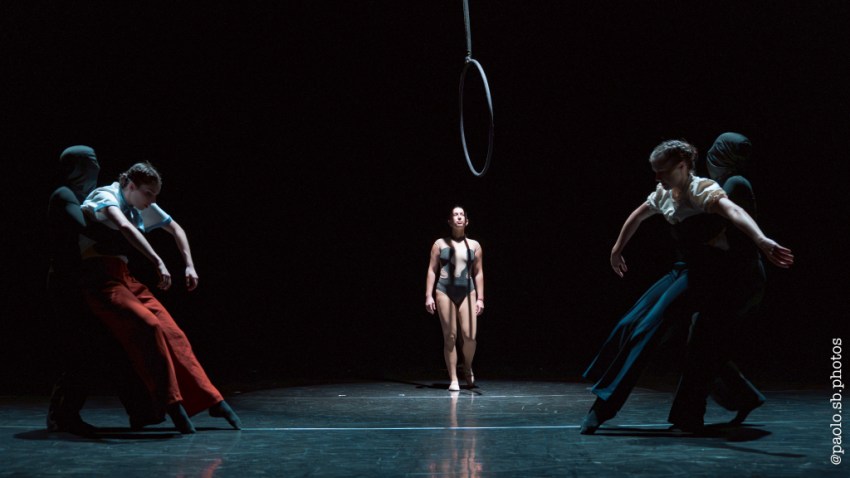
The Stranger opened with soloist Mary Aleiner spinning shapes in the air on a lyra while others danced below her, in Ventura’s signature fugue-and-canon style, to fast-paced music of Bach remastered. All at once the dancers were gone, leaving Aleiner alone in the air, draped over the lyra. The music changed to Arvo Pärt’s haunting “Fratres,” as a lone figure covered in black (Vietor Davis) gently took her down. The two danced a gravity-defying pas de deux with Davis as her Kuroko (shadow) partner, while the Stranger (Noah Olorin), who suddenly appeared out of the darkness, watched from the side. Various Kuroko appeared throughout the first movement, silent partners lifting other dancers, sliding them offstage like props, sometimes dancing among them like shadows.
Ventura’s use of extreme lighting — so–black darkness, pierced by pools and shafts of sun-bright light — created the illusion of dancers appearing out of nowhere and silently disappearing.
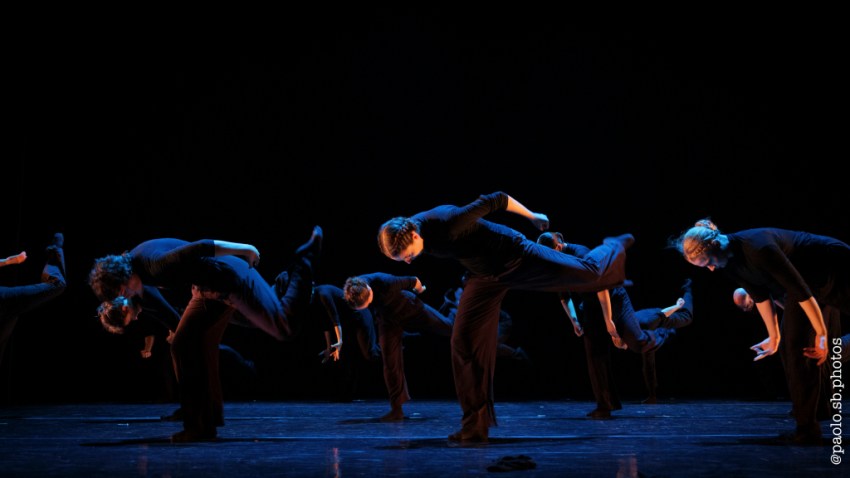
Periodically the Stranger appeared, sometimes walking unnoticed among a landscape of dancing couples, sometimes appearing in an array of dancers who left the stage once they noticed him.
In one of my favorite scenes, the Stranger appears in a pool of light on stage left, as a long line of graceful naked arms and hands (attached to dancers in black) discuss his fate, a reference to the court scene in Camus’s novel. Suddenly, one masked dancer (Madeline Stiner) steps forward (a prosecutor?) as another falls to the floor. After her argument, she grabs her black mask and throws it at the Stranger, while four naked arms drag the fallen one back to the line. The hands deliberate further, with a sense of urgency, while the Stranger looks down, motionless. Suddenly, a slender finger (belonging to Elianne Holt) extends skyward, appearing to gesture “Wait!” Perhaps she is an advocate, pleading for mercy for the Stranger. After more naked-hand deliberations, they all throw down their masks, and suddenly the stage is filled with rows of black-clothed jurors dancing in fugue-and-canon style until they freeze.
Another stranger emerges from the group (Darya Hessami), her slender body convulsing with insane staccato movements, as if to convey, “I can’t take this anymore!” Her action initiates chaos in the group, who no longer dance in orderly fugue-and-canon style, but as individuals writhing in agony. Suddenly, they all stop. Half of them run off, while others appear frozen in place, trying, unsuccessfully, to move. The freed ones run through the empty spaces, like dark-matter particles whizzing through, mostly not interacting. Eventually, everyone runs, or is dragged or carried, off stage.
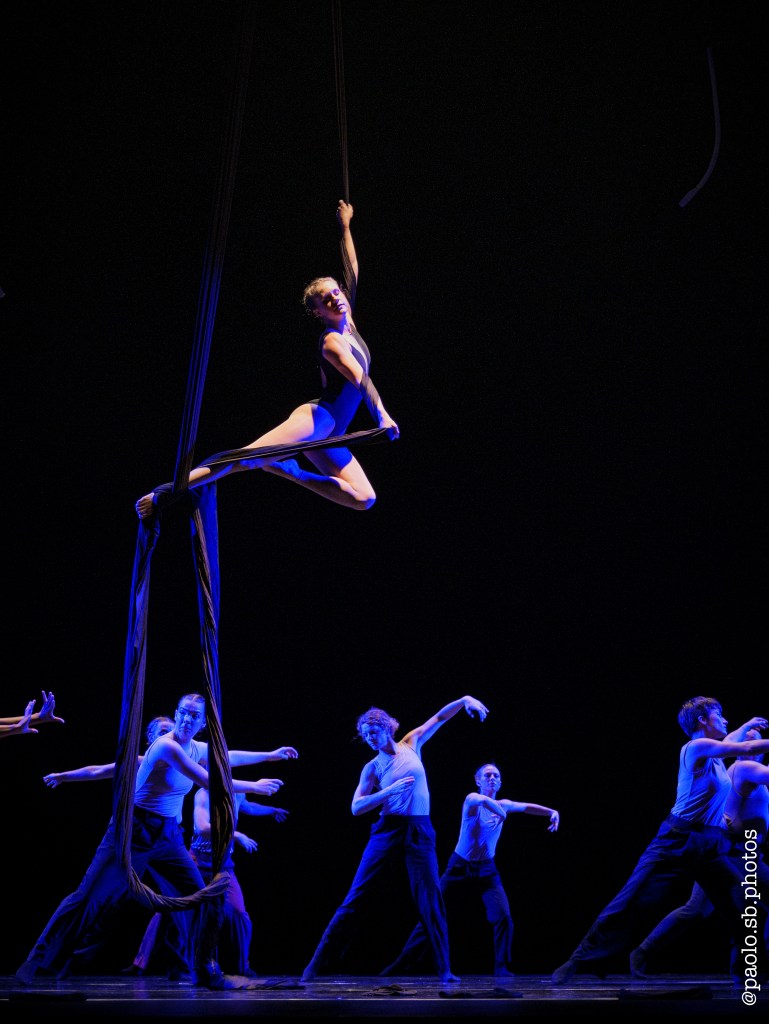
Toward the end of the piece, two black silks appear in a pool of light, having descended, unseen, in midnight-blackness, while the amazing Rachyl Pines appeared, wound and unwound herself, rolled up and stretched into splits high in the air, while those on the ground danced in various formations. The Stranger danced among them until the music stopped, the people slowly left the stage, and the Stranger was, again, alone in his corner. Pines, the elegant air-dancer, came silently down, looked at the Stranger (perhaps with a hint of pity), then disappeared into the blackness, leaving the Stranger alone.
Beethoven’s Tango
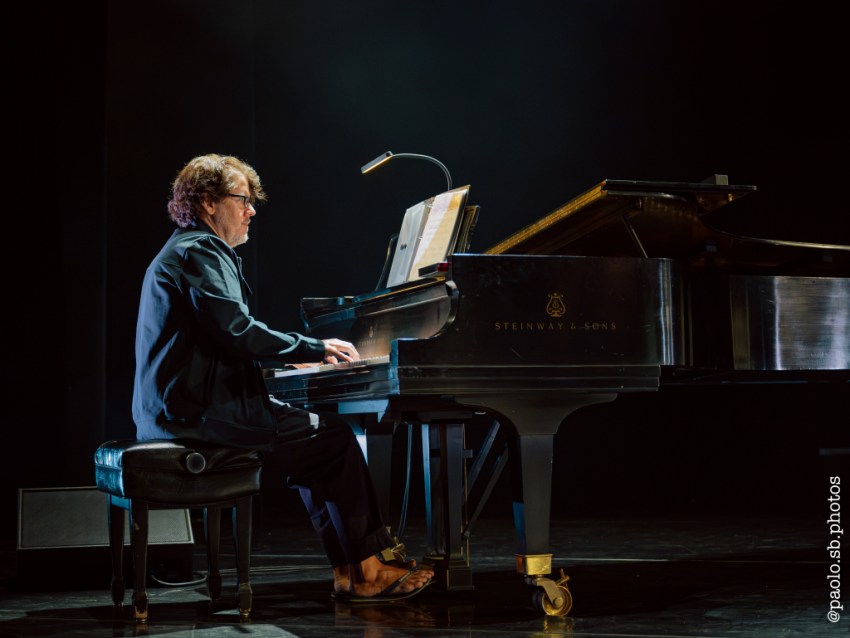
Internationally acclaimed Argentine Tango champions Fernanda Ghi and Silvio Grand collaborated with Latin Grammy–nominated Alfredo Minetti (piano) and Richard Scofano (bandoneón) to create Beethoven’s Tango, blending tango and milonga with classical and contemporary dance and music to tell the story of the three forces that guide artistic creation — the Muse, the Angel, and the Duende, first proposed by Federico García Lorca in 1933.
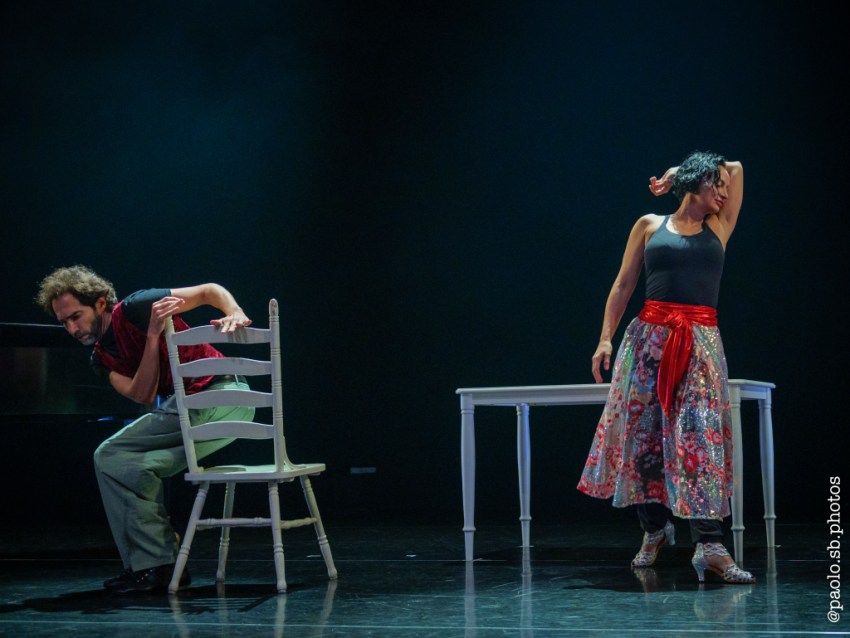
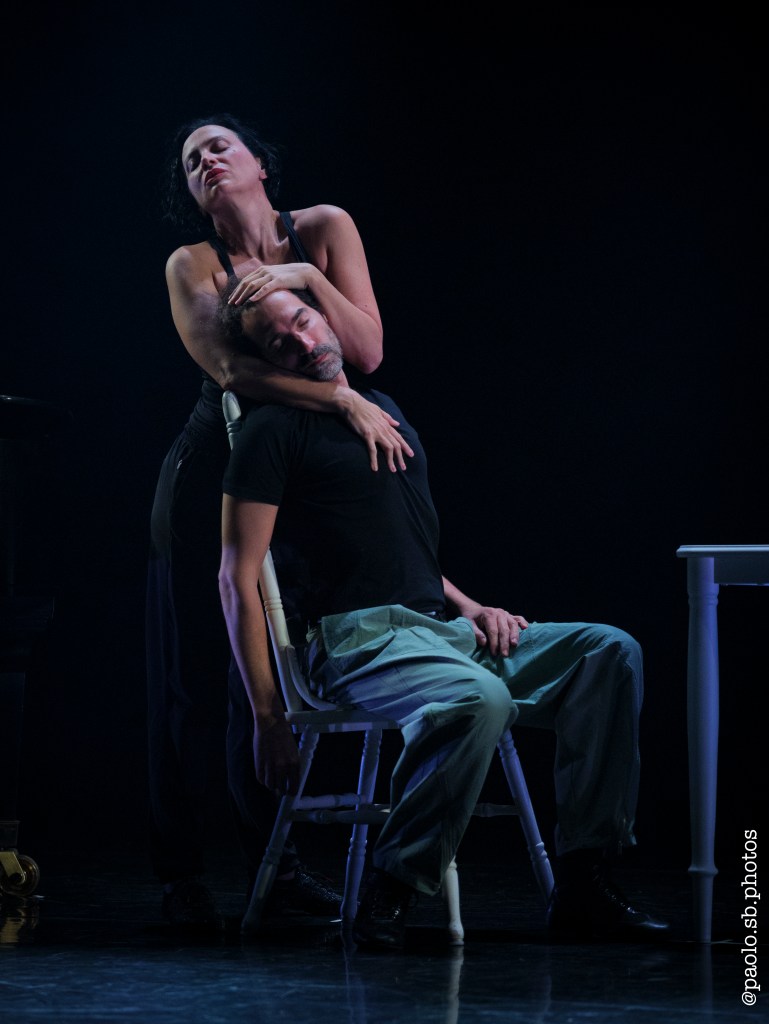
Ghi explained, “The Muse inspires. She brings ideas from outside and whispers them to the artist. The Angel illuminates, bringing beauty, grace, and perfection, as if everything happened effortlessly.” But the Duende “rises from the soles of the feet, enters the body, and appears when there is a real struggle — when something is truly at stake.”
Minetti described their creative process: “We wanted to create something together with tango and classical music, but with a narrative that would justify it.” Both were drawn to Garcia Lorca’s idea of the duende, a fundamental concept in flamenco and tango. For the main character they wanted an artist who was “in constant internal fight with their creative impulses.” Beethoven’s troubled soul seemed like the perfect fit.
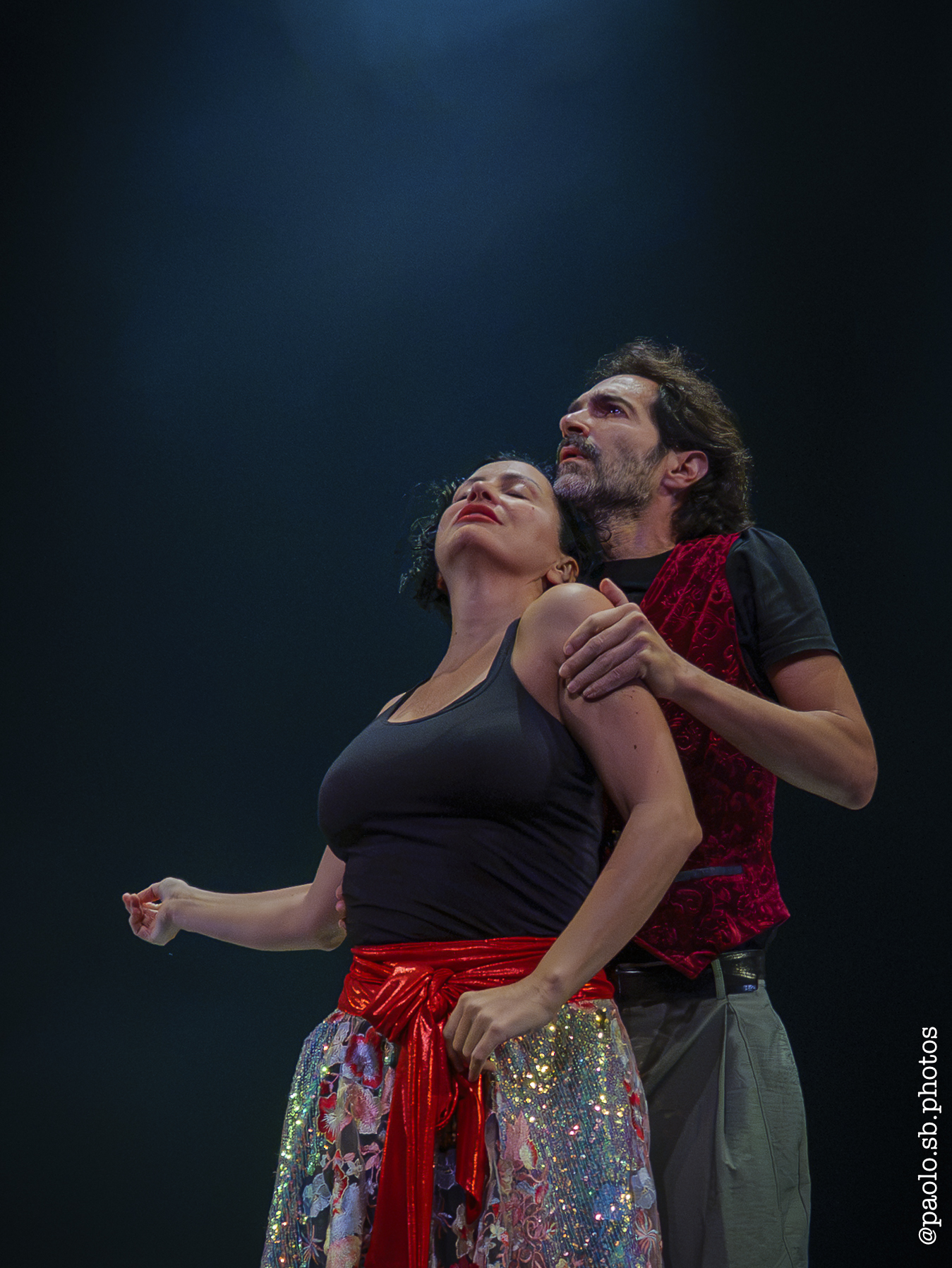
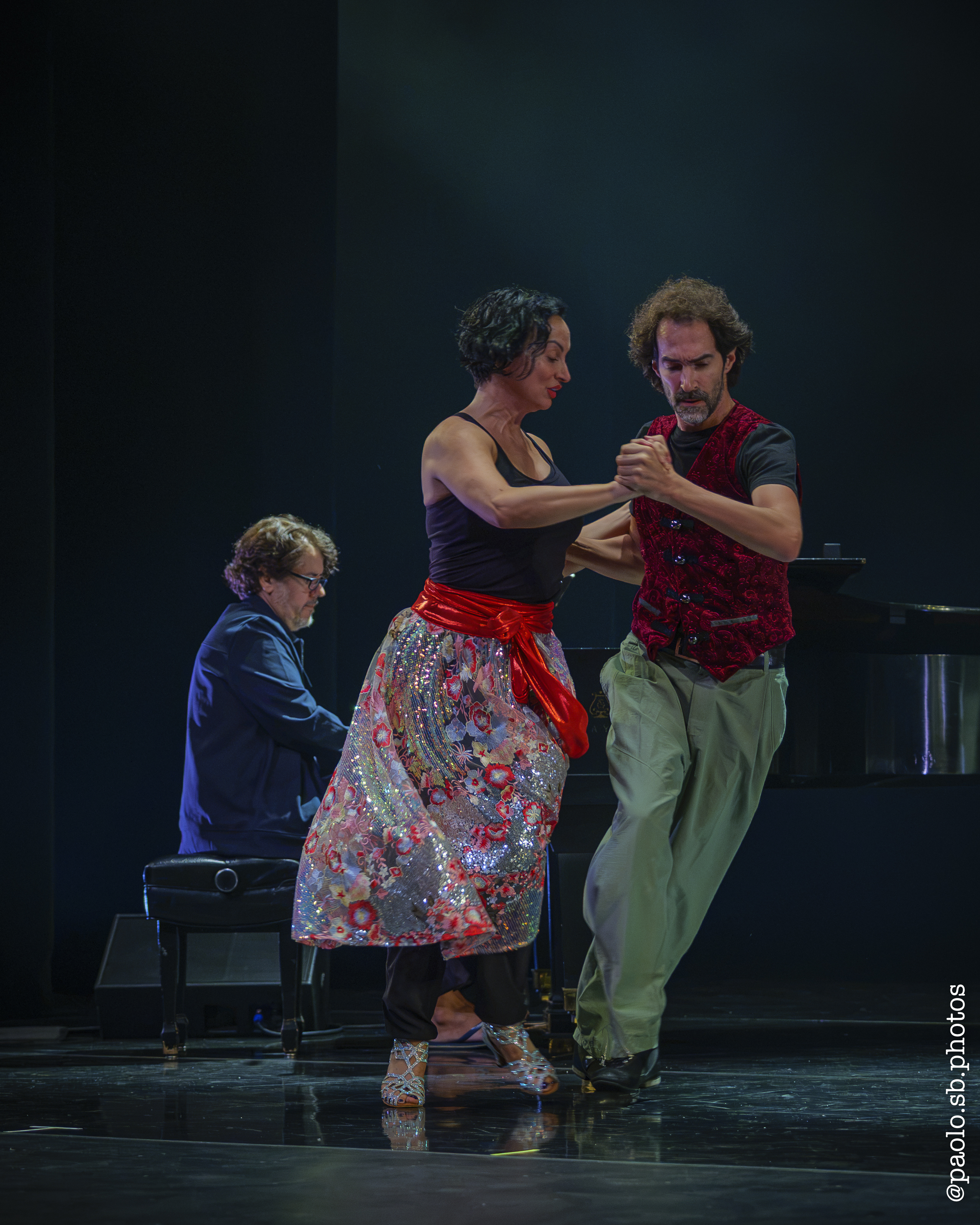
Beethoven (Silvio Grand) and the Muse (Fernanda Ghi). | Photo: Paolo Garinaldi
As they developed the story, Minetti would send Ghi music; she would call him with her choreographic ideas, and they would get together in her studio to develop the project. Minetti wove iconic sections of Beethoven into the score, famous “quotes” from his symphonies and concerti, with tango and milonga, creating a fascinating musical landscape.
Grand portrayed the tormented, yet hopelessly romantic Beethoven. He alternately embraced and confronted the feminine archetypes who came to inspire, protect, and challenge him. At times, he rolled under a table in apparent agony, later collapsing into the arms of one of his muses. Ghi portrayed the various feminine archetypes that came to visit Beethoven, masterfully morphing between playful and coquettish, dreamy and sensual, supporting and nurturing, and darkly frightening. The mutual strength, trust, and dramatic portrayal by this powerful duo attest to their long creative and performing relationship.
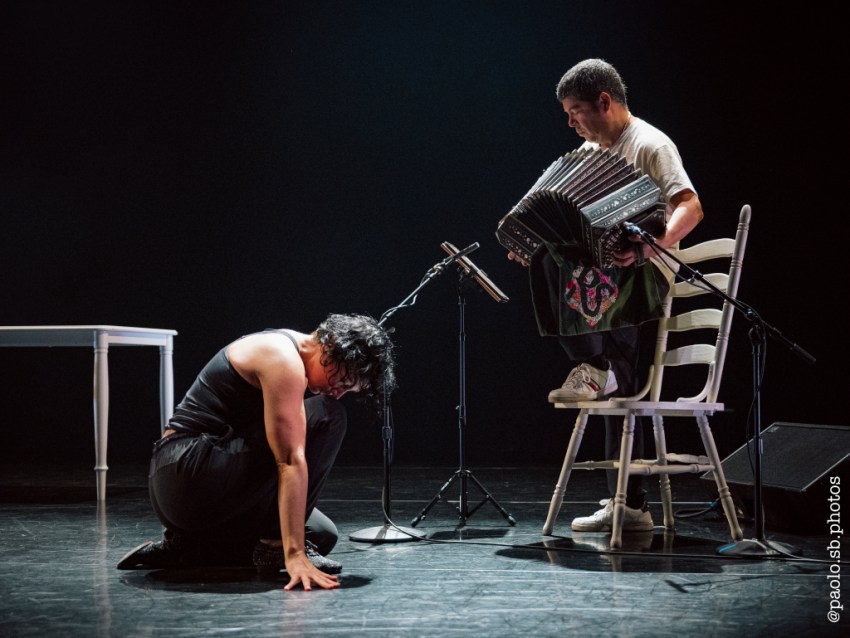
Minetti and Scofano framed the stage, each bathed in a pillar of light, motivating the action like dei ex machina, never getting involved, as if in another dimension.
In between the drama, Ghi and Grand danced tangos and waltzes, finally dancing a lively milonga together, ending the show on a hopeful note.
Related Posts



Premier Events

Sat, Oct 03
9:00 AM
Santa Barbara
Fall Plant Sale and Master Gardener Workshop

Sat, Oct 03
7:00 PM
Santa Barbara
Clean Comedy at Carrillo Recreation Center
Sat, Nov 14
7:00 PM
Santa Barbara
Clean Comedy at Carrillo Recreation Center
Sat, Dec 05
7:00 PM
Santa Barbara
Clean Comedy at Carrillo Recreation Center
Thu, Oct 01
11:00 AM
Santa Barbara
In Studio: Julie Anderson Mathias

Thu, Oct 01
7:30 PM
Santa Barbara
Robert Plant with Saving Grace and Suzi Dian

Fri, Oct 02
5:30 PM
Santa Barbara
Pet Blessing at Trinity Episcopal Church

Fri, Oct 02
8:00 PM
Santa Ynez
Comedian Ron White Performs at Chumash Casino Resort

Sat, Oct 03
9:00 AM
Goleta
Out of the Darkness Suicide Awareness Walk
Sat, Oct 03
10:00 AM
Santa Ynez
Chumash Intertribal Powwow Returns
Sat, Oct 03
10:00 AM
54th Santa Barbara Old -Time Fiddlers’ Festival

Sat, Oct 03
11:00 AM
Santa Barbara
OktoBEERfest at Dutch Garden Restaurant!

Sat, Oct 03
12:00 PM
Santa Barbara
Reclaim Your Radiance Fall 2026 Healing Arts Faire

Sat, Oct 03
12:00 PM
Santa Barbara
CWC Docs: “SURFILMUSIC” (2026)
Sat, Oct 03 9:00 AM
Santa Barbara
Fall Plant Sale and Master Gardener Workshop
Sat, Oct 03 7:00 PM
Santa Barbara
Clean Comedy at Carrillo Recreation Center
Sat, Nov 14 7:00 PM
Santa Barbara
Clean Comedy at Carrillo Recreation Center
Sat, Dec 05 7:00 PM
Santa Barbara
Clean Comedy at Carrillo Recreation Center
Thu, Oct 01 11:00 AM
Santa Barbara
In Studio: Julie Anderson Mathias
Thu, Oct 01 7:30 PM
Santa Barbara
Robert Plant with Saving Grace and Suzi Dian
Fri, Oct 02 5:30 PM
Santa Barbara
Pet Blessing at Trinity Episcopal Church
Fri, Oct 02 8:00 PM
Santa Ynez
Comedian Ron White Performs at Chumash Casino Resort
Sat, Oct 03 9:00 AM
Goleta
Out of the Darkness Suicide Awareness Walk
Sat, Oct 03 10:00 AM
Santa Ynez
Chumash Intertribal Powwow Returns
Sat, Oct 03 10:00 AM
54th Santa Barbara Old -Time Fiddlers’ Festival
Sat, Oct 03 11:00 AM
Santa Barbara
OktoBEERfest at Dutch Garden Restaurant!
Sat, Oct 03 12:00 PM
Santa Barbara
Reclaim Your Radiance Fall 2026 Healing Arts Faire
Sat, Oct 03 12:00 PM
Santa Barbara


You must be logged in to post a comment.