The Medical Marijuana Movement Grows in Santa Barbara
Emerald Dreams and Smoky Realities


In a small two-bedroom home, nestled anonymously on the upper Westside of Santa Barbara, the lights are humming right now. Vaguely Victorian in style with a white picket fence and a well-manicured front lawn, the home does little to betray the blooming emerald harvest growing inside its walls. A woman walking her dog passes by the driveway, urging her four-legged friend to “do your business,” never giving a second thought to the perpetually drawn window shades of the back room, the constantly spinning electricity meter humming in the side yard, or the sweet odor of fresh ganja blowing in the breeze.

On the inside, behind a series of remarkably unlocked doors, several dozen marijuana plants grow under the warm white glow of two high-wattage light bulbs. The room is tropical and welcoming, a meticulously built and cared for growing space complete with CO generators, fans, high-tech venting, massive air filters, digital ballasts, and an atmospheric control panel that not only governs the humidity but also powers an iPod to play smooth jazz when the lights are off. In a matter of days, this secret garden will yield at least four pounds of high-grade medicinal cannabis known as “purple kush”-every gram of it, at least in the eyes of our town’s law enforcement, completely legal while simultaneously being, in the esteem of the federal government, unfailingly illegal.
Even with its state legality proven by a wall full of photocopied doctors’ recommendations and a notebook filled with legal documents naming the tenant of the house as the “primary caregiver” for several medical marijuana patients, standing in the grow room feels undeniably like an illegal act. After all, we live in a country that’s been culturally conditioned to view cannabis as criminal since the drug was banned in 1937. Sensing my discomfort, my host patted me on the back. “I know it takes some getting used to, but try and relax, man. It’s medicine,” he smiles, “no different than going to a Tylenol factory.”
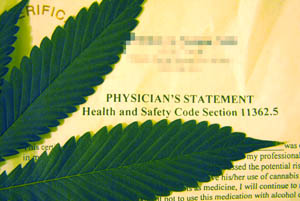
Unlike Tylenol, of course, you can’t just pick up your daily marijuana dose at Rite Aid or Vons-though, as of late, it has become just about that easy for people with a doctor’s recommendation. To that end, after this herb has been dried and properly manicured, it will be delivered to one of at least 10 medical marijuana dispensaries within Santa Barbara city limits where it will fetch up to $20 a gram from patients looking for the purple kush’s trademark high, now famous for its pain-killing powers. And, just like Tylenol or any prescription medicine, chances are the kush will come in a traditional pill bottle complete with warning labels and instructions.
Welcome to the 2007 version of reefer madness, where in Santa Barbara, there are more marijuana markets than Starbucks and thousands of citizens, with their doctor’s approval, are legally lighting up every day. But with business booming in this multimillion-dollar cottage industry, law enforcement agencies are left scratching their heads at how to navigate the unprecedentedly ambiguous legal haze blurring the lines of what’s cool and what’s criminal. What’s most cool, though, is that regulations appear to be on the way, and, surprisingly, they’re not coming from the government: Santa Barbara’s marijuana industry is starting to self-regulate, and for everyone-from growers and sellers, to patients and police-that should be good news.
A Hazy History
It’s been 11 years since California voters bucked a six-decades-old federal prohibition on marijuana and approved Proposition 215, effectively making it legal for adults who have a doctor’s permission to grow and use cannabis for medical purposes. Though critics feared such a vote would open the floodgates for criminal chaos, the result has been quite the contrary. At first, only a few outposts quietly opened their doors to dispense the forbidden herb to AIDS patients, cancer victims, and assorted others. Like a group unsure if the lake had frozen enough to walk across, these strong-willed activists treaded lightly, spoke in whispers, and prepared for the worst.
Things took a turn in 2004 with the passage of California Senate Bill 420, which gave slightly more specific protections for patients, distributors, and doctors who recommend cannabis. That nod from the state legislature allowed cannabis clubs and marijuana-smoking (and -eating) patients to step out of the shadows and onto the ice. From Eureka to San Diego, literally hundreds of clubs opened and tens of thousands of Californians got their doctor’s permission to toke. Nearly one dozen other states ratified similar laws, including Oregon, Colorado, Arizona, Maine, Montana, and, just last month, New Mexico.
Here on the South Coast, only two dispensaries walked on the thin ice of the pre-2004 era. In nondescript storefronts, operating almost anonymously behind locked doors and thick security glass, the Compassion Center and Santa Barbara Patients’ Group survived robberies, public scorn, skeptical landlords, and the ever-present threat of a federal raid. The guarded hush-hush behavior continued without incident for years until about two years ago, when Santa Barbara’s medical marijuana dispensaries grew exponentially almost overnight. That proliferation was further supported last November, when an overwhelming majority of Santa Barbara voters passed Measure P, making adult use of marijuana-both medical and non-medical-the lowest law enforcement priority. Today, there are 10 fully functioning dispensaries within city limits, plus a couple more in the planning stages (including the first one ever in Goleta due next month). For a relatively small town, the amount impresses everyone in the trade.
While certainly aware of them, spokespeople from every local law enforcement agency admitted to some sticker shock when informed of the recent rise in clubs. Most were not aware the number had grown past the initial two, let alone increased five-fold in less than 20 months. As S.B. County District Attorney Christie Stanley remarked upon hearing the news, “You’re kidding me? Wow, that’s something I didn’t know.”
In fact, not knowing is exactly the problem for everyone involved, due to the murky nature of medical marijuana’s legality. Because Senate Bill 420 is in direct opposition to federal law, Sacramento was reluctant to fill it with the teeth of regulations and bite of enforcement they would normally assign to such landmark legislation. As a result, the system is devoid of checks and balances and even lacks a unilateral understanding of what the law means. For example, in Santa Barbara, the only hurdle a would-be dispensary needs to clear in order to open is the simple act of securing a business license from the city. There are absolutely no other obstacles in the way, which, for a federally illegal drug, tends to raise some eyebrows.
“It’s such a grey area,” Santa Barbara police spokesperson Paul McCaffrey said recently. “Basically [with the right paperwork], you can get a bunch of marijuana-or start growing it-and then sell it as medical marijuana. As appalling as it seems, you are essentially untouchable to us. : It’s not just a reality, but also state law.”
The Santa Barbara County Sheriff’s Department takes a slightly more aggressive stance and, as a result, only one dispensary currently exists in its contracted communities-though at least two other clubs are looking to open soon in the North County. Spokesperson Erik Raney explained last month, “It is very frustrating from the law enforcement side because we are forced to decipher the law and the law itself is not very clear at all.” Though deputies regularly let people go who can prove they are “legal” cannabis consumers, Raney guaranteed “debatable” infractions were always investigated and usually led to an initial arrest, though not always actual charges. District Attorney Stanley could recall only two instances of such prosecution in the past 11 years: one was a Buellton club that was shut in 2006 (but has since reopened) and the other was a woman who was growing “too much” medical marijuana (though she was allowed to keep the 70-plus plants for which she had proper paperwork).
Clearing the Smoke
Confused? You’re not alone. “From a legal standpoint, it is an absolutely fascinating problem,” said esteemed Santa Barbara attorney Joe Allen. “The unregulated nature of all this leaves everybody-the police, club owners, patients, and caregivers-very uncertain about what they are allowed to be doing.” In recent years, Allen, who’s held just about every legal title in his career except judge, has become a de facto expert on medical marijuana. Not only is he kept on retainer for several clubs, but he’s also the legal advisor for the city’s Measure P Committee and has successfully defended Goleta physician and outspoken medical cannabis advocate Dr. David Bearman, who was attacked by the Medical Board of California (MBC) for prescribing marijuana.
“The boundaries of protection are so fuzzy that it is very, very hard to even know when you are crossing those boundaries,” explained Allen. “Can a thousand patients band together and start a cannabis plantation in Santa Ynez? Probably, but who knows? Unfortunately, because no real regulations exist, the only vehicle by which we work this out is: People get arrested and have to go to court.” So would regulations or a dispensary review board help? “Absolutely,” said Allen. “City or county standards would go a long way in clearing up many of these issues.”
What is legal? According to Senate Bill 420, Californians with a doctor’s approval can carry as much as a half-pound (eight ounces) of marijuana and grow as many as six mature plants. That’s pretty clear-cut, but the situation hazes over with the role of “caregivers,” those assigned by patients to grow and provide their medicine. When patients join a cannabis club, they sign paperwork that establishes the club as their caregiver, allowing the dispensary to grow and possess marijuana in their name. So a club with 1,000 members could have as many as 500 pounds and grow 6,000 plants. But since there’s no oversight whatsoever, the formula is ripe for exploitation and constantly flirts with criminal status.
Though assuring she would “never get in the way of compassionate use,” the situation is disconcerting for District Attorney Stanley. “Crimes are being committed around it and people are just shrugging their shoulders,” she said. “It certainly isn’t the way we usually do business.” She also added that, to her knowledge, nothing was being done by the government to clear the regulatory haze.
The irony in all this is that three months ago, somebody did start to do something-and it wasn’t the DA, the cops, the county supervisors, or the City Council. It was the club owners themselves. And they’ve got good reason to regulate, for as one anonymous dispensary owner complained, “Right now, in this town, people are looking to exploit the law and take advantage of it. There’s no doubt about it, and no doubt they will ruin it for the thousands of us who are doing things the right way.”
Acting at the behest of medical marijuana lobbying group Americans for Safe Access (ASA), representatives from all but one of the S.B. clubs began meeting on a monthly basis in order to, as ASA organizer Chris Fusco put it, “get to know one another and to try to establish a standard of care for Santa Barbara.” With moratoriums on dispensaries already in place in Carpinteria and Solvang, Fusco said it is “really just a matter of time” until Santa Barbara does the same. But while the Carp and Solvang moratoriums are what Fusco calls “wolves in sheep’s clothing” since those towns have never had dispensaries, he thinks an S.B. moratorium would be temporary and allow the city to establish standards for clubs.
Heading off such a move at the pass, ASA is helping dispensaries to establish uniform ways of labeling medicine, verifying doctor’s notes, and registering patients. “These may seem like really basic things,” said Fusco, “but the reality is no one else is going through and making sure every club is doing them.” The hope is this early intervention will make fringe clubs clean up their acts while simultaneously streamlining the regulatory process when the city and county decide to tackle it.
Fusco enthusiastically explained, “The end result in this, for everybody, is regulations and a higher standard of care.” The club owners seem to be onboard, as one explained last month, “To be one of the people who helped set the regulations and the precedent for Santa Barbara? That would be a great honor.”
In the meantime, it’s business as usual seven days a week for the existing clubs, which have sprouted up everywhere, from Milpas and Haley streets to upper State Street. They run the full spectrum of incarnations: Some feel about one-degree removed from a De la Guerra Plaza drug deal while others provide laminated menus, 30-plus varieties of marijuana, dozens of hashes and hash oils, assorted THC-laced candies, cookies, and ice cream, and knowledgeable staffs who are able to recommend specific strains of cannabis for particular ailments. Some have security, others don’t; some let you smoke on the property, others don’t; and some are run as co-ops, while others seem to be enjoying the economic fruits of a successful business. While there’s absolutely no way to count the county’s medical marijuana patients, most clubs surveyed claim memberships well over 2,000, with some boasting more than 5,000 patients.
Despite these tallies, the county health department’s voluntary medical marijuana identification card program-in place solely to protect patients from the police-only has 348 patients and 49 caregivers enrolled. Attorney Joe Allen chalked up this discrepancy to patients’ overriding fear they’ll be placed on some list and left exposed to future federal prosecution. But Allen, perhaps our county’s foremost legal expert on the matter, wholeheartedly recommends the county card because, as he explained, “It’s all about being upfront and following what law there is. The card will only help.”
Being Up Front
The doors are usually wide open at Hortipharm Caregivers, allowing passersby on the 3500 block of State Street a glimpse of its smart, remodeled interior complete with hardwood floors, a flat-screen TV, and a glass-backed waterfall. The dispensary-Santa Barbara’s third club when it opened on Calle Laureles in 2005-just celebrated the first anniversary of its State Street location. Nestled among restaurants, a coffee shop, and a massage parlor, the building is both anonymous and inviting.
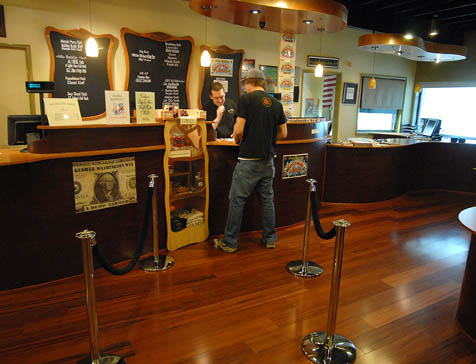
It’s early afternoon, and three patients are in the waiting room while another four are in the “green room,” inspecting various strains of cannabis. In a back office, flanked by a massive Executive Safe, the club’s owner Josh Braun leaned back in his chair. “Most days when I come to work it feels like heaven,” he explained, squinting through the smoke of a recently exhaled bong hit. “But other days are absolute hell.”
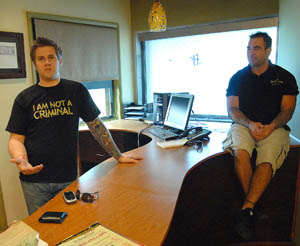
At 30 years old, clean-cut with full sleeve of detailed tattoos on his left arm, and married with a kid and another on the way, Braun is the epitome of the emerging 21st-century Southern California businessman: gregarious, well-spoken, intelligent, and just the right amount of cocky. He’s proud of the business he’s built and he should be-in 2006, Hortipharm grossed more than $3 million, provided medicine to nearly 4,000 patients, and employed 14 people, all paid decent wages plus full benefits and vacation packages. “I have two priorities in life,” explained Braun. “To provide food and shelter for my family and to provide care and medicine for my patients.” Given his background, you can’t help but believe him. The Santa Barbara native was raised in a devoutly Christian home, majored at UCSB in accounting and economics, and served in the Marine Corps.
But not all was peachy. Dually diagnosed with Attention Deficit Disorder (ADD) and anxiety, Braun spent years of his life on prescriptions of Adderall, Xanax, and Dexatrin. Admitting he was no saint in his youth, Braun believes his life seemed destined for something far darker than it is today were it not for the medicinal powers of cannabis. He explained, “My life is only here today because of marijuana.”
Friends of his haven’t been so lucky. Montecito native Paul Hindaling, who also suffered from ADD and anxiety, rode prescription pills to a tragic death via overdose in 2005. That death, coupled with the passing of Braun’s father-in-law from prescription narcotics, cemented his faith in medical marijuana. After a trip to Amsterdam-the home of modern marijuana innovation-Braun saw the light and began learning about the myriad medicinal uses of cannabis throughout the millennia. He spoke at length about marijuana’s healing role in just about every civilization since the dawn of humankind and how charred cannabis seeds can be found in many of the world’s oldest archeological sites. From there, he switched gears to talk about technological innovations in cloning and how today’s medicine is the most potent and powerful yet. “I may not have much formal training in healthcare,” Braum claimed, “but I know more about marijuana than just about anybody walking this world.”
But none of his well-supported beliefs change the fact that, as he admitted, “The feds could kick in my door at any time.” If they did, Braun potentially could go to jail for the rest of his life. He grimaced when I asked him about the federal raids of cannabis clubs in West Hollywood earlier this year and the raid of a club in Morro Bay just two days before our interview. But he takes solace in the fact that no one involved with the 11 clubs in West Hollywood have been charged with a crime yet and that most of the clubs have since re-opened. As for the Morro Bay bust, Braun simply shook his head and said, “It makes me nauseous to think about it.” (After learning the Morro Bay raid came after a security guard allegedly sold a half-pound to an undercover officer outside of the dispensary, Braun responded, “If it’s true, then it’s illegal. If someone worked for me and did that then-no questions asked-they’d be fired.”)
If you look at a map of California, it doesn’t take a genius to notice that Santa Barbara is smack dab between West Hollywood and Morro Bay, which begs the question: When might the feds come to our town? Word on the street is they already did a couple years ago, but were kindly told “thanks, but no thanks” by local authorities. Though they are under no legal onus to do so, the feds don’t like doing busts where local law enforcement isn’t supportive. Nonetheless, this stressful question made Braun begrudgingly admit, “I wish I could do this forever but I don’t really see it happening that way.”
As for the Santa Barbara authorities, Braun happily reported the sheriff, city police, narcotics detectives, and even Mayor Marty Blum have all been in his store. The visits don’t bother him-in fact, he practically encourages them. “I’m not scared because I’m not doing anything illegal,” he said. “I follow rules that don’t even exist yet.” He pays taxes, keeps extensive records, and fleshes out his books as any econ grad would. Furthermore, his team of lawyers-which includes Joe Allen-will even defend patients of Hortipharm should they run into trouble with the law, so long as they aren’t exploiting their doctor’s notes.
To Braun, the big issue facing everyone involved is regulation. Like the legal toddler it is, the movement needs direction and guidance. “We need to make the right choices,” he explained. “And it would be really great if the city would regulate and help us with those choices.”
A Matter of Medicine
Perhaps the most convoluted layer of ambiguity is the role doctors play in the medical marijuana equation. After all, without a written recommendation, none of this would be possible. And given the proliferation of clubs statewide, it’s obvious more physicians are approving medical marijuana consumption for a broader spectrum of reasons.
That’s “disturbing” to both District Attorney Stanley and Santa Barbara Sheriff’s Department spokesperson Raney. To them, Prop 215 was a last-ditch medical avenue designed for the most severely ill, such as cancer and AIDS patients. So when detectives report “perfectly healthy” young people frequenting dispensaries, they can’t help but be wary. “It certainly calls into question the doctors who are prescribing,” said Raney. “Clearly there are some arbitrary decisions being made and people who aren’t terminally ill are getting prescriptions.”
Of course, one needn’t be terminally ill-or even visibly distressed-to legally smoke marijuana. Prop 215 gives physicians carte blanche to approve ganja consumption for “any illness for which cannabis provides relief.” While the Food and Drug Administration still claims marijuana has no proven medicinal values-a stance often cited by law enforcement-extensive clinical trials in Europe and Canada (and, increasingly, California) have shown strong evidence of cannabis’s ability to help people suffering from, among other things, lupus, insomnia, multiple sclerosis, Alzheimer’s, ADD, anxiety, migraines, chronic pain, depression, hypertension, arthritis, and anxiety. And since the MBC set official standards in 2004 on medical marijuana recommendation writing that are “the same as any reasonable and prudent physician would follow when recommending or approving any other medication,” doctors really are free-no matter what law enforcement thinks-to recommend marijuana exactly as they would prescribe painkillers or antibiotics. That leaves the medical marijuana movement squarely in the hands of the physicians. Braun of Hortipharm explained, “No matter what, the success of any legally operating dispensary is really at the discretion of the doctors.”
Perhaps one of California’s most outspoken advocates is Goleta physician Dr. Bearman. Bearman, who wrote his first medical marijuana recommendation in April 2000 but refuses to reveal just how many he has written, is one of just four South Coast doctors who actively write recommendations. “At least 50 other doctors in town specifically tell their patients to come to me if they feel [medical marijuana] is appropriate simply because [those doctors] aren’t comfortable doing it themselves,” Bearman explained. He scoffs at the idea of law enforcement questioning who deserves a cannabis recommendation. “How can they tell somebody doesn’t have a significant medical problem just by looking at them?”
It’s a rhetorical question that particularly burns Bearman: In 2003, the MBC came after Bearman for the alleged “indiscriminate” recommendation of medical marijuana to a patient. That attack was triggered by a Lake Piru park ranger, who arrested a young man with a Bearman recommendation. The ranger, feeling the recommendation was unethical, formally complained to the MBC. Both the patient and Bearman refused to cooperate, citing doctor-patient confidentiality, so the matter hit the courts. Three years later, the charges against Bearman were sternly dismissed by a Los Angeles Superior Court that said the MBC “failed to show good cause,” a decision that medical marijuana supporters saw as a warning against similar witch hunts in the future. To date, the MBC has, with varied results, gone after 20 cannabis-approving physicians since the 1996 inception of Prop 215.

His vindication aside, Bearman acknowledged ethical debates will continue to rage as long as regulations remain absent. There are plenty of situations-though not necessarily illegal-that make Bearman shake his head, such as the doctors who come to town, team up with a dispensary, and conduct one-day recommendation blitzes where dozens of patients get certified in a hotel room for about $150 a pop. Then there are places in Los Angeles and San Francisco where doctors cater specifically to marijuana-minded clientele. These places are often advertised in newspapers, function as walk-in clinics, and tend to be packed to the gills.
Bearman, whose practice is traditionally conservative by comparison, calls these practices “detrimental” to the cause, though he also agrees with his attorney Joe Allen, who said, “You can’t legislate morality.” Nonetheless, Bearman knows that until the MBC establishes different language about the standards of practice for medical marijuana, such obviously rogue operations will continue to thrive, living happily in the grey haze of ambiguity. “Everyone knows it; we need regulations,” said Bearman, adding with a smile, “I would love to see the day when cannabis is available at Rite Aid.”
Cashed Out
Billy Adams (not his real name) has been selling marijuana in Santa Barbara for more than a decade. But due to the proliferation of dispensaries, Adams is effectively out of business these days. Approaching 30 and with children, Adams has mixed feelings about medical marijuana even though he himself, for the past two years, has been growing exclusively for Santa Barbara clubs and all but phased out his black market dealings. As he sees it, “The whole legal thing is sort of bullshit. I mean, the feds can still put you in jail forever. Plus, the people I deal with are the same faces I was dealing with 12 years ago but now, because of Senate Bill 420, they are supposedly legit. I can totally see why cops are bummed.” Despite that, Adams says that “without a doubt” it’s harder for people to get their hands on marijuana these days because dealers like him have turned to the clubs. “It’s just not out there as much as it used to be,” he said. “Actually, it’s still around-it’s just going to the clubs instead of the streets.”
While law enforcement doesn’t share Adams’s opinions-S.B. Sheriff’s Department spokesperson Raney called marijuana “still just about the number-one illegal substance that people possess”-it does reveal that the success of medical marijuana isn’t just a victory for the patients who need it. There are millions of dollars swirling around the cannabis plant.
In a study released last December by conservative public policy analyst Jon Gettman, the annual domestic marijuana harvest was estimated to be about $35.8 billion, making it hands-down the number-one cash crop in America. With around $13.8 billion of that believed to be grown on California soil, it’s an industry that’s rooted and fully blooming in the Golden State. However, most of this money goes untaxed and untracked at both the state and federal levels. While the feds just recently, despite their anti-medical marijuana position, created a tax bracket for the industry, it is safe to say the opportunity for income must be something the big-wig bean counters are looking into.
With this in mind, a longtime grower from Mendocino, who’s been supplying marijuana to Santa Barbara and many other areas south of Point Conception since the 1960s, made an observation recently that perhaps sums up everything currently happening with medical marijuana: “Make no mistake: This is a golden age we are living in. One way or the other, the door will be slammed shut on this within five years. I guarantee it. I don’t know if it will be federal regulation and taxing, total legalization, or a change back to how things used to be, but it’s going to change. It has to.”